
Pay-Per Click Affiliate Programs: What to Join in 2026
Discover the best pay-per click affiliate programs for 2026. Learn how to earn high CPC payouts or use paid PPC ads to drive massive affiliate commissions.
When most people start monetizing their websites, they assume the only way to make money is to sell a product. But what if you could get paid simply for sending a visitor to another website, regardless of whether they pull out their credit card?
That is the core appeal of pay-per-click (PPC) affiliate programs.
However, in the affiliate marketing industry, "PPC" is a term that suffers from a severe identity crisis. If you ask two veteran marketers about PPC affiliate marketing, you will likely get two completely different answers.
One will tell you about publisher networks that pay you a few cents or dollars for every click your website generates. The other will talk about spending thousands of dollars on Google Ads to drive traffic to high-converting CPA (Cost Per Action) offers.
In 2026, both models are thriving, but they require entirely different strategies. This comprehensive guide will break down both sides of the coin. We will explore the best affiliate networks that actually pay you per click, as well as the top platforms that allow you to use paid click traffic to generate massive commissions.
Whether you have a high-traffic blog or you are a media buyer looking for new arbitrage opportunities, here is everything you need to know about pay-per-click affiliate models this year.
The Dual Meaning of "PPC" in Affiliate Marketing
Before we dive into the specific programs, we need to draw a hard line between the two ways this term is used in the industry. Understanding this distinction is critical, as mixing them up leads to wasted time and rejected network applications.
1. Cost-Per-Click (CPC) Publisher Programs
In this model, you are the publisher. You own a website, blog, or niche site, and you place special affiliate links or display widgets on your pages. When your visitor clicks that link, the network pays you a set amount.
This is technically a Cost-Per-Click (CPC) model, though it is widely searched as a "PPC affiliate program." As Post Affiliate Pro notes in their glossary, PPC is an arrangement where affiliates earn money for every click generated, making it a low-friction way to monetize early-stage traffic. You do not need the user to buy anything, fill out a form, or subscribe. The click itself is the conversion.
2. PPC Affiliate Arbitrage (Media Buying)
In this model, you are the advertiser. You do not rely on organic SEO traffic. Instead, you buy ads on Google, Bing, Facebook, or native networks (paying per click) and funnel that traffic toward a high-paying affiliate offer (usually a CPA or CPS—Cost Per Sale—offer).
Your goal is simple math: if you spend $0.50 per click on an ad, and it takes 100 clicks to generate one $100 affiliate commission, you spent $50 to make $100. This is the art of affiliate media buying.
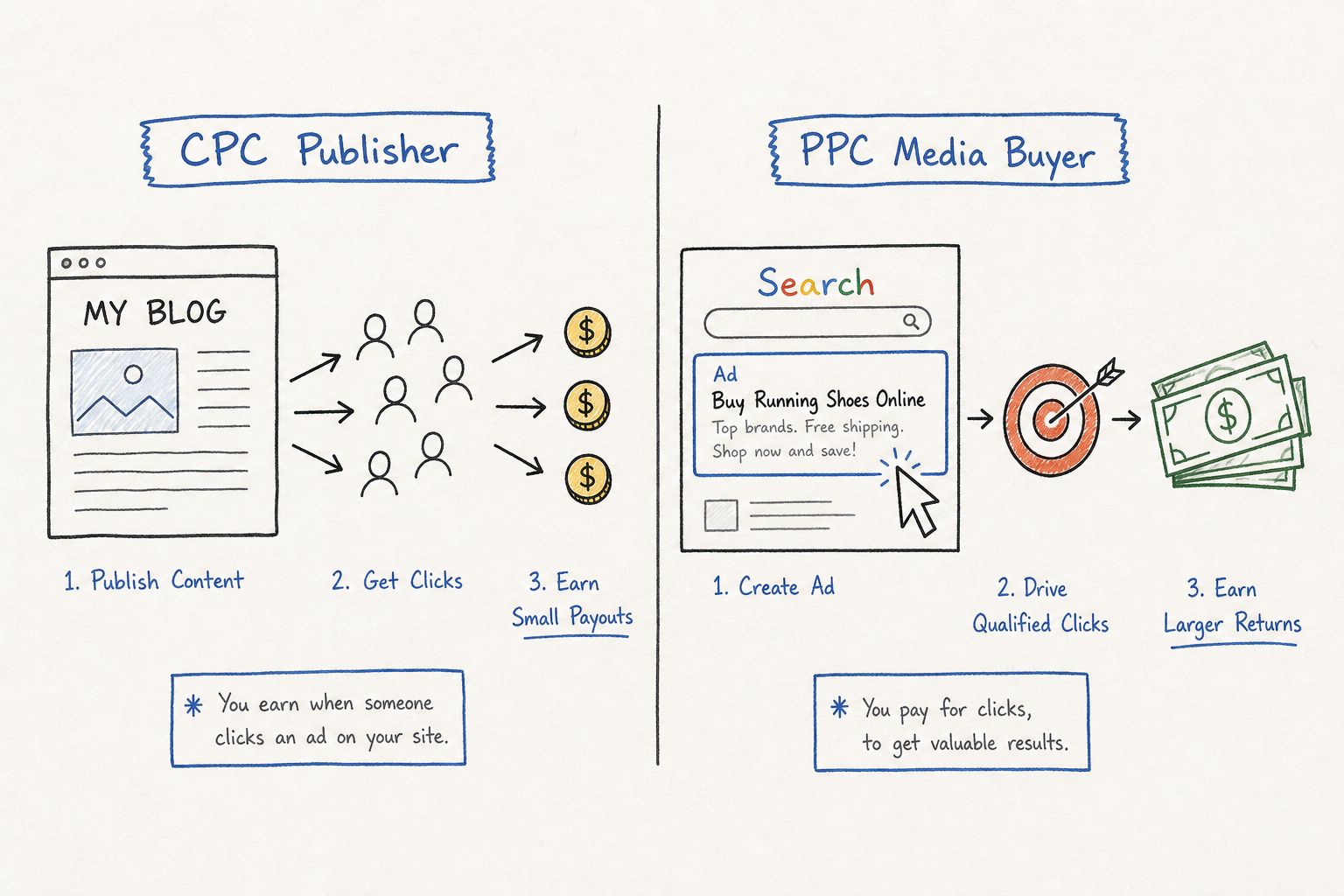 For the first half of this guide, we will focus on the networks that pay you per click. In the second half, we will cover the networks best suited for PPC ad buyers.
Why Pure Pay-Per-Click Programs Are Evolving in 2026
A decade ago, you could slap a few generic contextual ads on a thin blog and make a decent living from the clicks. Today, search engines and ad networks are much smarter. Advertisers are no longer willing to pay for low-intent, accidental, or bot-driven clicks.
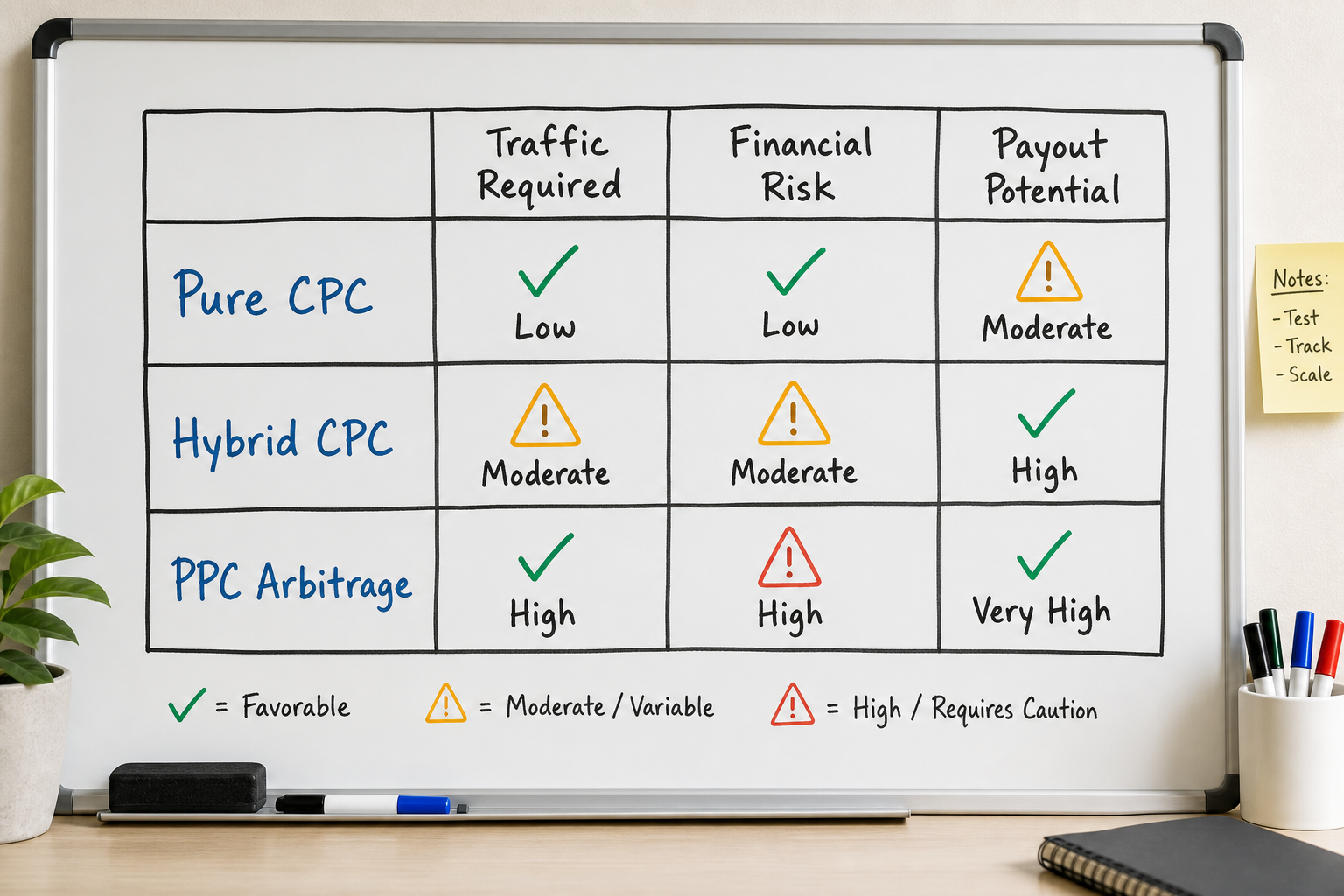
Because of this, pure "pay me for any click" affiliate links are rare outside of traditional display ad networks. Instead, the industry has shifted toward high-intent B2B platforms and smart hybrid models.
The B2B Advantage
Why would a company pay you $15 just for someone clicking a link? Because in the B2B SaaS (Software as a Service) world, a single lead can be worth thousands of dollars in lifetime value. Software directories and comparison engines are currently the most lucrative sources of CPC affiliate income. If you write about software, 11 Best Niches for Affiliate Marketing (SaaS & Digital) breaks down exactly why this sector is booming.
The Hybrid Shift
Many traditional networks now use an EPC (Earnings Per Click) metric rather than a strict CPC payout. While they technically pay you on a CPA (Cost Per Action) basis, their tracking is so dialed in that they can guarantee you a specific dollar amount per 100 clicks based on historical data.
Let's look at the actual networks you can join today.
Top Pay-Per-Click (CPC) Affiliate Programs for Publishers
If your goal is to monetize your website traffic without relying strictly on your audience pulling out their credit cards, these are the top platforms to consider in 2026.
1. Media.net (The Yahoo/Bing Contextual Network)
Media.net remains one of the largest contextual ad networks in the world, serving as the primary competitor to Google AdSense.
- How it works: You place their code on your site, and they serve highly relevant, keyword-driven ad blocks. When users click these contextual text links, you get paid.
- Best for: Content-heavy blogs, news sites, and informational niche sites.
- Pros: Excellent for text-heavy pages. Their contextual targeting often outperforms standard display ads in terms of Click-Through Rate (CTR).
- Cons: Traffic must be high quality, predominantly from Tier 1 countries (US, UK, CA, AU).
2. Capterra / Gartner Peer Insights Affiliate Program
If you run a B2B blog, a tech review site, or a business consulting hub, this is arguably the most lucrative CPC program available.
- How it works: Capterra is a software review directory. Their affiliate program pays you every time you send a legitimate, verified user to their site who leaves a published software review.
- Best for: B2B bloggers, SaaS reviewers, and tech influencers.
- Pros: Exceptional payouts. In some cases, B2B clicks or verified actions can yield equivalent EPCs of $10 to $20+ depending on the software category.
- Cons: Extremely strict verification. They will not pay for low-quality or fraudulent traffic.
3. Skimlinks (The Hybrid Powerhouse)
Skimlinks is a brilliant tool for publishers who don't want to manage hundreds of individual affiliate dashboards. While technically a CPA network, the sheer volume of merchants turns it into a highly predictable EPC machine.
- How it works: You install a script on your website. It automatically turns regular outbound links to brands (like Nike, Sephora, or Best Buy) into tracked affiliate links.
- Best for: Lifestyle bloggers, fashion sites, and product review hubs.
- Pros: Instant access to over 60,000 merchants. You don't have to apply to each one individually.
- Cons: Skimlinks takes a roughly 25% cut of your commissions in exchange for the convenience.
4. Outbrain & Taboola (Native Ad Networks)
If you have a site with massive traffic volume (usually over 100,000 pageviews a month), native ad networks are a fantastic way to earn per click.
- How it works: These networks provide the "Sponsored Content" or "Around the Web" grids you see at the bottom of major news articles. You earn money when visitors click on these native placements.
- Best for: Viral content sites, news aggregators, and entertainment blogs.
- Pros: High CTR because the ads blend in natively with your content suggestions.
- Cons: High entry barriers. These networks require significant monthly traffic to be approved.
5. Sovrn (Formerly VigLink)
Similar to Skimlinks, Sovrn Commerce automatically monetizes your outbound links.
- How it works: Sovrn routes your clicks through the highest-paying merchant available for that specific product.
- Best for: Forums, user-generated content sites, and broad niche blogs.
- Pros: They offer a feature where they will actually pay you on a CPC basis for certain merchants, even if the underlying merchant is CPA. Sovrn takes on the conversion risk.
- Cons: Payouts per click can be quite low (fractions of a cent) for non-commercial content.
The Best CPA Networks for PPC Advertisers (Media Buyers)
Now, let's flip the script. What if you do not have a website with 100,000 monthly visitors? What if you want to buy ads on Google, Bing, or Facebook and send that traffic to an affiliate offer?
This is where high-paying affiliate networks come into play. You need networks that offer substantial payouts (to cover your ad spend) and strictly permit PPC promotional methods. According to discussions on Reddit's affiliate marketing communities, the key to success here is finding offers with high EPCs that allow brand bidding or generic keyword bidding.
Here are the top networks for PPC media buyers.
1. ClickBank
When it comes to buying ads for affiliate offers, ClickBank is the undisputed heavyweight.
- Why it's great for PPC: ClickBank specializes in high-converting digital products and physical supplements. Many of these offers have payouts exceeding $100 per sale, giving you plenty of margin to buy clicks.
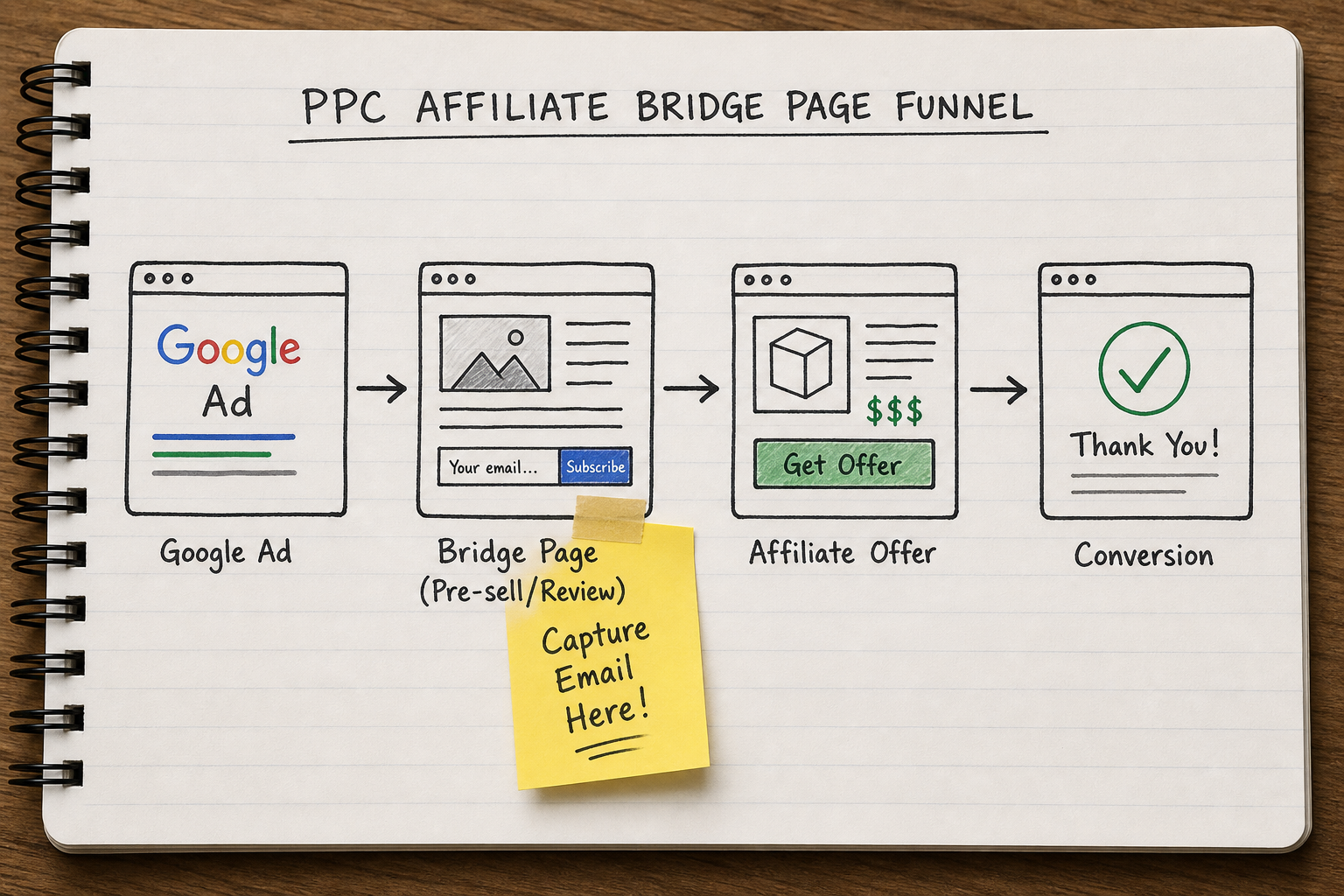
- The Strategy: Affiliates often run search ads to a "bridge page" (a simple landing page or advertorial) before sending the user to the ClickBank offer.
- Tip: Look for vendors that provide dedicated PPC resources, such as proven keywords, negative keyword lists, and demographic data. If you are aiming for big numbers, check out 11 High Paying Affiliate Programs for $500+ Commissions for strategies on finding premium offers.
2. MaxBounty
MaxBounty is a premier CPA network known for lead generation offers.
- Why it's great for PPC: Instead of needing a user to buy a $150 supplement, you can get paid $5 to $20 just for getting a user to submit their email or request a quote for insurance, solar panels, or home services.
- The Strategy: Bidding on local service keywords on Bing Ads or Google Ads and directing them to MaxBounty lead forms.
3. AffiliList (The SaaS Directory Approach)
Finding transparent data on what programs allow PPC bidding can be exhausting. Many networks bury their PPC policies deep in their Terms of Service.
- Why it's a game-changer: AffiliList is a comprehensive directory of over 10,000 affiliate programs, with a massive focus on high-paying SaaS and digital tools.
- The Strategy: Instead of signing up for dozens of networks just to read the rules, you can use AffiliList's advanced filtering to instantly find SaaS programs that permit PPC bidding, see their commission structures openly, and compare EPCs without the clutter.
4. PartnerStack
If you want to run PPC ads for B2B software, PartnerStack is the network you need.
- Why it's great for PPC: They host affiliate programs for massive SaaS companies like Monday.com, Notion, and Webflow. Software pays recurring commissions, meaning you pay for the click once, but earn monthly revenue for years.
- The Strategy: Bidding on "[Competitor] alternatives" or "Best [Software Category] tools" and sending traffic to an in-depth comparison review you wrote.
The Anatomy of a Profitable PPC Affiliate Campaign
If you are choosing the media buying route, you cannot simply slap an affiliate link into a Google Ad. Not only will Google likely suspend your account for "circumventing systems," but cold traffic rarely converts on a direct-linked sales page.
You need a strategic funnel.
1. The Bridge Page (The Missing Link)
A bridge page sits between your paid ad and the merchant's offer. Its job is to warm up the prospect, provide value, and frame the affiliate product as the ultimate solution.
If you are bidding on the keyword "best email marketing software," your ad should lead to a clean, fast-loading page on your domain titled "Top 5 Email Marketing Tools for 2026." You review the tools, provide your insights, and then use your affiliate links. This satisfies Google's requirement for original content and dramatically increases your conversion rate.
2. Mastering the "Promo" Keyword Strategy
One of the most effective, yet competitive, PPC strategies is bidding on promotional terms.
When brands run a spring promotional campaign or go live with a new product launch, search volume for "[Brand Name] promo code" or "[Brand Name] discount" skyrockets.
If the affiliate program's terms allow it, you can bid on these terms. Shoppers searching for these keywords have their credit cards out; they just want to spend a little less. By providing a valid coupon code alongside your affiliate link, you can intercept high-intent buyers right before checkout.
Caution: Always read the program's PPC terms. Many brands strictly prohibit bidding on their trademarked names or the word "promo" coupled with their brand. Violating this will result in immediate bans and forfeited commissions.
3. Dealing with Price Slashes and Bid Limits
In 2026, the cost of advertising on major platforms is higher than ever. When advertisers slash prices during major retail holidays (like Black Friday), the ad auction becomes hyper-competitive.
To survive, you need to understand your limits. If an affiliate program pays you a flat $50 CPA, you have strict bidding limits. If you pay $2 per click, you must convert at least 1 in 25 visitors just to break even.
This is why tracking is non-negotiable. As highlighted by Voluum's guide to top traffic sources, using advanced tracking software allows you to see exactly which keywords, devices, and times of day are generating sales, allowing you to cut the losers and scale the winners.
Essential Metrics for PPC Affiliate Marketers
Whether you are earning per click or paying per click, your success comes down to mastering a few key metrics. If you ignore these, you are flying blind.
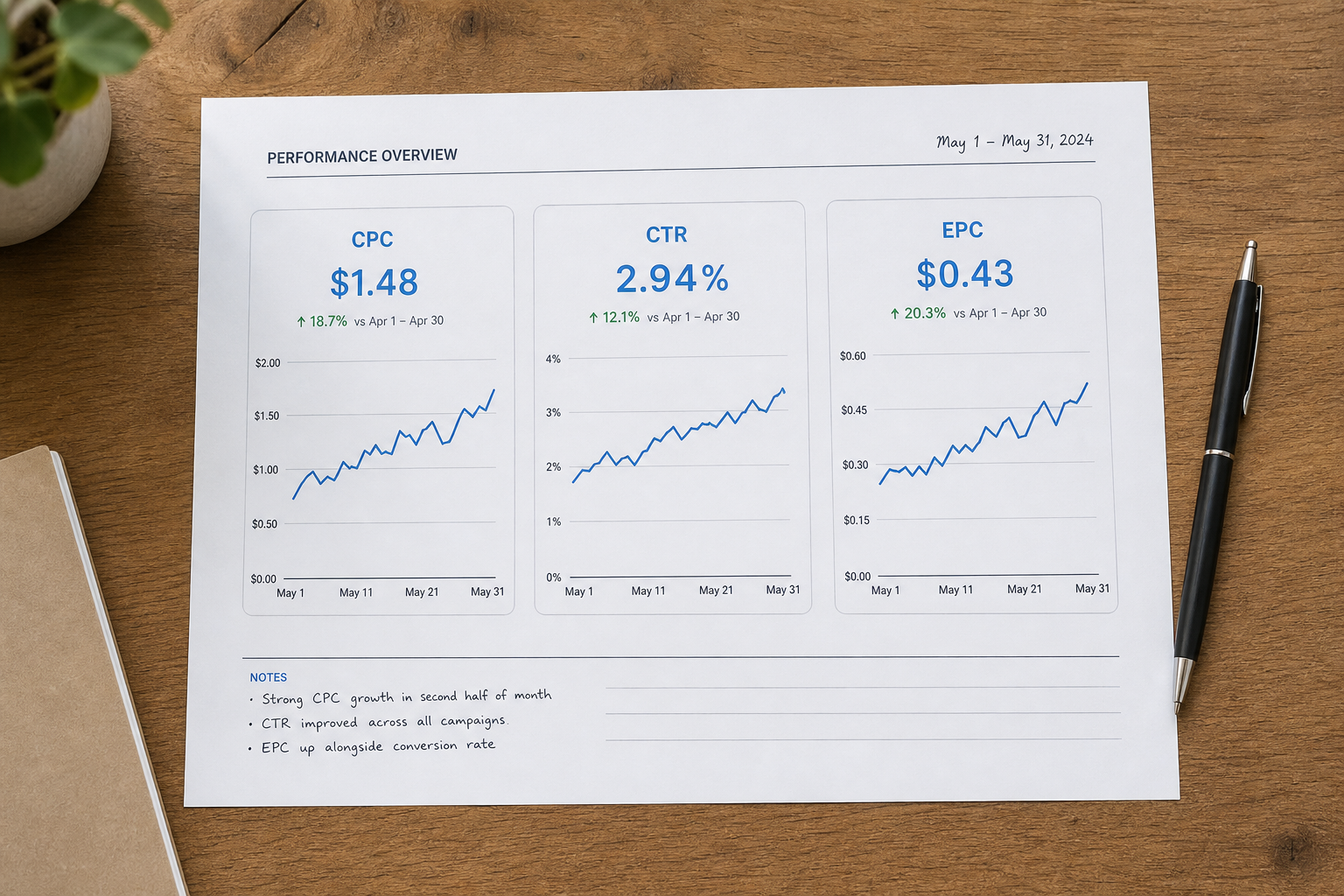
| Metric | What it Stands For | Why It Matters | How to Improve It |
|---|---|---|---|
| CPC | Cost Per Click | The amount you pay an ad network (or a network pays you) for a single click. | Improve ad relevance and Quality Score to lower your costs. |
| CTR | Click-Through Rate | The percentage of people who see your ad/link and actually click it. | Write stronger copy, use clear calls-to-action, and optimize placement. |
| EPC | Earnings Per Click | The average amount of money you earn for every 100 clicks sent to an affiliate offer. | Promote higher-converting offers, or target keywords with higher buyer intent. |
| ROI | Return on Investment | Your net profit divided by your total costs. | Cut underperforming keywords and negotiate higher payouts with affiliate managers. |
Pro Tip for Publishers: Always compare a network's EPC to standard CPC. Sometimes an affiliate program that pays $50 per sale (CPA) will result in a $1.50 EPC, which is vastly superior to a network offering a flat $0.30 CPC.
The Biggest Mistakes in PPC Affiliate Marketing
Success in this space requires discipline. Here are the failure modes that wipe out both publishers and media buyers.
1. Engaging in Click Fraud (Publishers)
If you are in a program that pays you per click, the temptation to click your own links, ask friends to click them, or buy cheap bot traffic is high. Do not do it.
Ad networks in 2026 use sophisticated machine learning to detect invalid traffic. If a user clicks your link, lands on the advertiser's site, and immediately bounces (or moves their mouse like a script), the network flags it. You will see massive "invalid click deductions" at the end of the month, or worse, your account will be permanently banned.
2. Direct Linking Without a Strategy (Advertisers)
As mentioned earlier, taking a ClickBank hoplink and pasting it directly into a Google Ad is a recipe for disaster. Not only do ad networks hate direct redirects, but you lose out on the opportunity to build your own email list.
Always capture the user's email on your bridge page before sending them to the offer. This way, while building your list, you can remarket to them for free via email if they don't buy the affiliate product on the first click. For a deeper dive into building an asset you own, read How to Start a Profitable Affiliate Marketing Blog.
3. Ignoring Mobile vs. Desktop Parity
Mobile traffic and desktop traffic behave entirely differently. A B2B SaaS review article might have a 5% conversion rate on desktop (where users are ready to start a free trial) and a 0.5% conversion rate on mobile (where users are just browsing on their commute). If you blend your PPC campaigns across all devices without adjusting your bids, mobile traffic will eat your budget alive.
Frequently Asked Questions (FAQ)
How much can you realistically make per click as a publisher?
It depends entirely on your niche. Entertainment and meme sites might earn $0.01 to $0.05 per click. Personal finance, legal, and B2B software niches can easily see clicks valued between $2.00 and $15.00. High-intent traffic is where the money is.
Is Google AdSense considered an affiliate program?
Technically, no. AdSense is an ad monetization network, not an affiliate program. However, because it pays out on a pure Cost-Per-Click basis, many beginners lump it into the PPC affiliate conversation. Affiliate programs typically require a user action (a lead or a sale) on the backend, even if intermediate networks calculate your earnings as EPC.
Can I do PPC affiliate marketing without a website?
If you are acting as an advertiser (buying ads), you technically can direct-link on some native ad platforms or smaller search engines. However, in 2026, almost all major ad networks (Google, Meta, TikTok) require you to send traffic to a compliant, verified domain that you control. A basic bridge page or advertorial is effectively mandatory. You can learn the fundamentals in Affiliate Marketing Side Hustle: 5 Steps to $1k/Mo (2026).
Are all PPC affiliate programs safe and legitimate?
No. The industry has its share of shady networks that will scrub your leads or refuse payouts. Always stick to established, transparent directories. If an offer sounds too good to be true, run it through the checks outlined in Is Affiliate Marketing Legit? (How to Spot Real Offers).
Moving Forward: Your 2026 Action Plan
The landscape of pay-per-click affiliate programs has matured. Whether you want to monetize your existing traffic via high-paying CPC links, or you are ready to invest in ad spend to drive massive volume to CPA offers, the key is aligning your traffic intent with the right network.
Stop wasting time signing up for closed-door networks just to find out their terms don't match your strategy. If you are looking for high-converting programs—especially in the lucrative SaaS and digital tools space—leverage tools that prioritize transparency.
By utilizing platforms like AffiliList, you can bypass the clutter, access open data on commission percentages, and quickly pinpoint the exact programs that fit your audience. Choose your model, optimize your funnels, track your data obsessively, and watch your earnings scale in 2026.