
Per Click Affiliate Programs: Earn Without Making Sales
Discover the top 15 pay per click affiliate programs for 2026. Learn how to earn consistent commissions without making sales using CPC and CPL hybrid models.
The traditional affiliate marketing playbook is drilled into every beginner's head from day one: drive traffic, cross your fingers that the user buys something, and wait for your commission. If the user abandons their cart, their credit card is declined, or they decide to wait until a spring promo goes live to slash the price—you get nothing.
But what if you didn't have to rely on a transaction to get paid?
Enter pay per click (PPC) affiliate programs (also known as Cost Per Click or CPC programs). In this model, merchants pay you simply for delivering a qualified visitor to their landing page. You earn while driving traffic, removing the friction of the checkout process entirely.
Finding these programs, however, is notoriously difficult. Because of the high risk of click fraud, most major affiliate networks bury their CPC and CPL (Cost Per Lead) offers. In this guide, we will break down the top pay-per-click affiliate programs for 2026, explain the economics of how they work, and show you how to leverage platforms like AffiliList to find high-converting SaaS and digital tool offers that pay you just for the click.
What Are Pay Per Click (PPC) Affiliate Programs?
Before diving into the lists and strategies, we need to clarify a massive point of confusion in the industry. If you search for "PPC affiliate programs," you will typically encounter two completely different conversations:
- Media Buying (Paying for Clicks): Affiliates buying ads on Google, Bing, or Meta to drive traffic to CPA (Cost Per Action) offers. The affiliate pays per click and earns per sale.
- Publisher Monetization (Earning per Click): Affiliates placing links on their blogs, newsletters, or social media, where the merchant pays the affiliate for every click generated.
For the scope of this guide—and delivering on the promise of "earning without making sales"—we are focusing purely on the second definition: Publisher-side CPC and CPL.
According to PostAffiliatePro, Pay Per Click (PPC) in an affiliate context is a performance-based advertising model where the affiliate is paid a flat rate every time a user clicks on their unique affiliate link, regardless of what the user does afterward.
The Shift from CPC to CPL
Pure "pay per click" affiliate links were abundant in the early 2010s, but they are increasingly rare today. Why? Bots. Merchants got tired of paying for worthless automated traffic. Today, true PPC has largely evolved into two distinct formats:
- Hybrid CPC Networks: Platforms like Skimlinks that auto-monetize your content, blending CPC and CPA payouts into a unified "Earnings Per Click" (EPC) metric.
- Cost Per Lead (CPL): Programs that pay you when a user clicks your link and performs a frictionless action—like submitting an email address or creating a free account.
While CPL requires an action, it requires zero financial commitment from the user, making it functionally similar to PPC for affiliates who drive highly targeted traffic.
How PPC Programs Differ from Traditional Affiliate Models
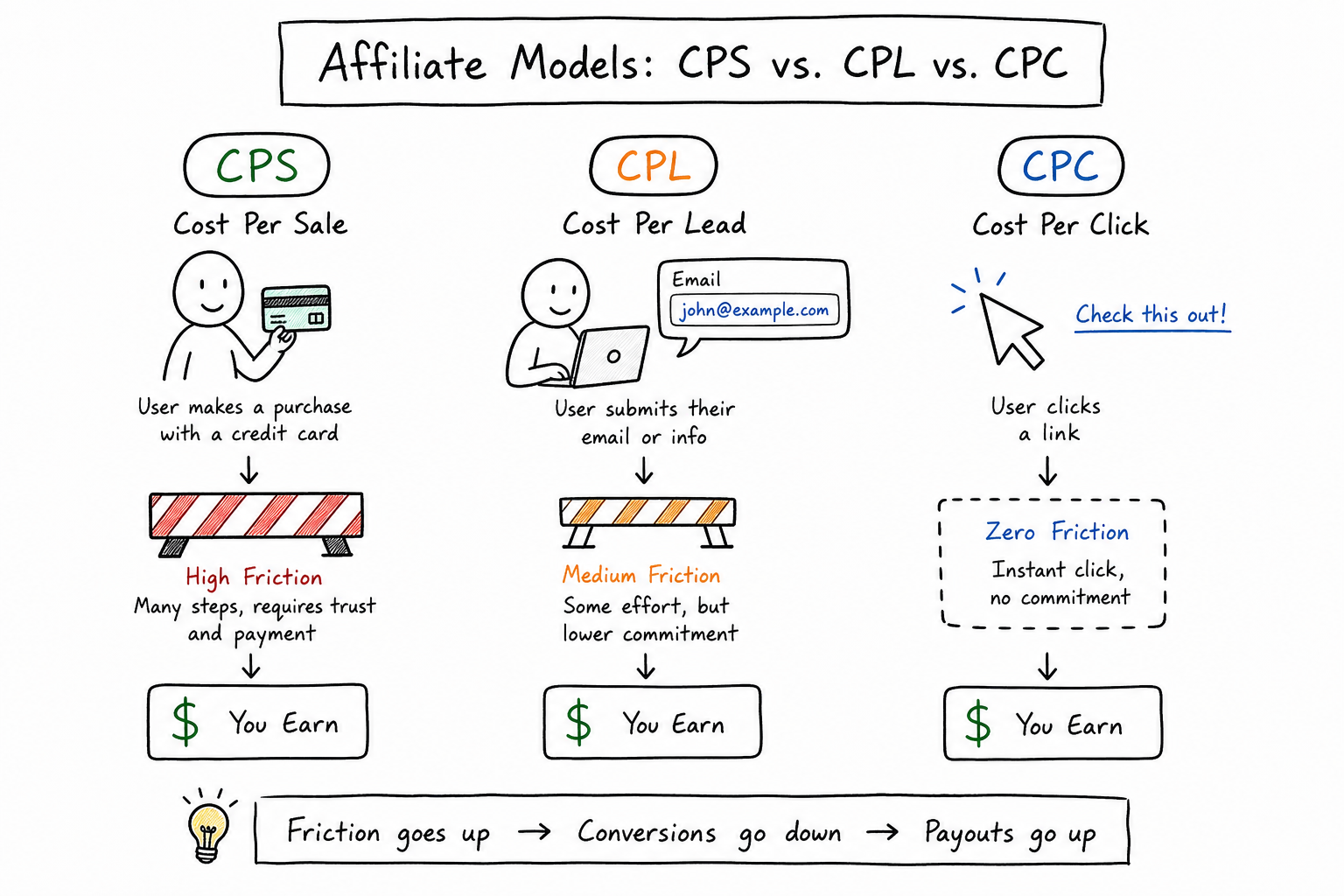
To understand why you might choose a PPC model over traditional affiliate marketing, let's look at the underlying math and friction involved in the three main models.
1. CPS (Cost Per Sale)
How it works: You only get paid when a user pulls out their credit card and completes a purchase. The Reality: The payouts are massive (often found in high paying affiliate programs), but the conversion rate is drastically lower. You are responsible for warming up the traffic so thoroughly that they are ready to buy.
2. CPL (Cost Per Lead)
How it works: You get paid when a user provides their information (email, phone number, or free trial sign-up). The Reality: Payouts range from $1 to $50 depending on the industry. It’s easier to convert because the user isn't spending money, but the merchant still gets tangible value.
3. CPC (Cost Per Click)
How it works: You get paid the moment the user clicks the link and loads the target page. The Reality: Payouts are micro-cents to a few dollars per click. You need significant volume, but your conversion rate on the action (the click itself) is incredibly high.
| Metric | CPS (Cost Per Sale) | CPL (Cost Per Lead) | CPC (Pay Per Click) |
|---|---|---|---|
| Action Required | Purchase | Form Submit / Free Trial | Link Click |
| User Friction | Very High | Medium | None |
| Average Payout | $20 - $1,000+ | $2 - $50 | $0.05 - $3.00 |
| Volume Needed | Low to Medium | Medium | High to Very High |
| Best Traffic Source | SEO, Deep Reviews | Social Media, Newsletters | Pinterest, Arbitrage, Display |
If your goal is to build a reliable affiliate marketing side hustle without writing 5,000-word buyer's guides to convince people to spend money, PPC and CPL programs offer a much lower barrier to entry.
Top 15 Pay Per Click & Pay Per Lead Affiliate Programs for 2026
Finding direct CPC programs requires digging. At AffiliList, our directory helps marketers bypass cluttered lists by providing clean, transparent payout data—specifically for SaaS and digital tools.
Here are the top platforms and networks offering PPC, CPL, and hybrid models in 2026.
1. Skimlinks
Skimlinks is a hybrid network that dominates the content monetization space. Instead of manually generating affiliate links for every product you mention, you install a snippet of code on your site. Skimlinks automatically turns your outbound links into affiliate links.
- How it pays: While they operate primarily on a CPA basis with thousands of merchants, they negotiate exclusive hybrid CPC/CPA deals. Because they pool data from thousands of publishers, they offer an "EPC" (Earnings Per Click) model that functions similarly to a PPC network for high-volume sites.
- Best for: Broad lifestyle, tech, and news blogs.
2. ShareASale (Pay-Per-Lead Merchants)
ShareASale is a massive traditional affiliate network, but it features an advanced search filter that allows you to sort merchants by "Pay Per Lead."
- How it pays: You will find hundreds of B2B and SaaS companies willing to pay $1 to $20 just for a free trial signup or email submission.
- Best for: B2B bloggers and SaaS reviewers looking for best niches for affiliate marketing.
3. ClickBank (Wait, isn't it CPA?)
ClickBank is traditionally known for high-ticket CPS digital products. However, top affiliates leverage ClickBank in a hybrid way.
- How it pays: While the core marketplace is CPA, many established vendors offer internal CPL bounties (e.g., $1-$2 per email submit) for proven affiliates to test traffic before a major product launch. Furthermore, affiliates heavily use PPC advertising (buying ads) to drive traffic to ClickBank offers.
- Best for: Health, wealth, and relationship niches.
4. PartnerStack
PartnerStack is the undisputed king of B2B SaaS affiliate programs. While AffiliList helps you discover these programs easily, PartnerStack is where many of the transactions actually happen.
- How it pays: Many SaaS companies on PartnerStack offer a CPL model alongside a CPA model. For example, a project management tool might pay you $5 for every free workspace created, plus 20% if they upgrade. This "pay per free action" mimics the low friction of PPC.
- Best for: Tech reviewers, software tutorials, and LinkedIn creators.
5. Mediavine / Raptive (Premium Display Networks)
While technically display ad networks rather than traditional "affiliate" links, these platforms are the ultimate "pay per click/impression" monetization method.
- How it pays: You earn based on RPM (Revenue Per Mille/Thousand impressions) and CPC. If you build a high-traffic affiliate marketing blog, integrating contextual ads is the most passive form of PPC.
- Best for: High-traffic niche sites (50k+ sessions/month).
6. Sovrn (Formerly VigLink)
Sovrn operates almost exactly like Skimlinks. It automatically monetizes existing links on your site.
- How it pays: Sovrn uses a CPC bidding model for certain merchants. If a merchant in their network prefers to pay for clicks rather than sales, Sovrn routes that payout directly to you.
- Best for: Forum owners, community managers, and content-heavy sites.
7. MaxBounty
MaxBounty is a premier CPA network, but they specialize heavily in CPL (Cost Per Lead) offers.
- How it pays: Sweepstakes, financial services, and insurance quotes. You can easily find offers paying $2 to $10 for a simple one-page email submit.
- Best for: Media buyers and email list owners.
8. Impact (Impact.com)
Impact is a partnership management platform that hosts some of the biggest brands in the world, including Canva, AppSumo, and HostGator.
- How it pays: Like ShareASale, you can negotiate direct CPL and CPC terms with brands. Once you prove your traffic quality, many SaaS brands will happily switch you from a CPA model to a guaranteed CPC model to guarantee they get your premium placements.
- Best for: Established creators negotiating direct deals.
9. Outbrain / Taboola (Arbitrage Networks)
If you are on the media buying side, these are native ad networks. However, as a publisher, you can place their widgets on your site.
- How it pays: You earn a CPC every time a reader clicks on those "Recommended for You" articles at the bottom of your blog posts.
- Best for: Viral content sites, news publishers, and arbitrageurs.
10. CJ Affiliate (Formerly Commission Junction)
CJ Affiliate has a robust advertiser base, particularly in the finance and travel sectors—two of the most profitable affiliate marketing niches.
- How it pays: Finance offers (like credit card applications or personal loan checks) frequently pay on a per-lead or per-click basis because the backend lifetime value of a customer is so high.
- Best for: Personal finance bloggers.
11. Ezoic
For sites that don't yet meet the 50,000-session threshold for Mediavine or Raptive, Ezoic is the go-to CPC/CPM ad network.
- How it pays: It uses AI to test ad placements and pays you based on clicks and impressions.
- Best for: Growing niche sites with 10k+ monthly visitors.
12. Grammarly Affiliate Program
The Grammarly program (often run through ShareASale or CJ) is a perfect example of a frictionless CPL program.
- How it pays: They historically pay a flat fee (e.g., $0.20) simply for a user installing their free browser extension, plus a larger bounty for premium upgrades.
- Best for: Educational, writing, and productivity sites.
13. SEMrush Affiliate Program
SEMrush offers one of the most lucrative hybrid SaaS programs available.
- How it pays: They pay $0.01 just for a new registration, $10 for a free trial activation, and $200 for a sale. The $10 free trial bounty functions exactly like a high-paying PPC/CPL offer.
- Best for: B2B marketing blogs.
14. Plaid / Financial APIs
Deep in the B2B tech space, API providers will often pay handsomely for developer leads.
- How it pays: CPL payouts for validated developer signups can range from $10 to $50.
- Best for: Coding tutorials and tech stacks.
15. Direct SaaS Partnerships via AffiliList
The best PPC programs aren't on public networks—they are negotiated directly. By using a directory like AffiliList, you can filter through over 10,000 SaaS and digital tools to find companies offering robust partner programs.
- How it pays: You can reach out directly to affiliate managers and say, "I drive 10,000 targeted SaaS clicks a month. My EPC is $1.50. I will place you in my #1 spot for a guaranteed $1 CPC."
- Best for: Advanced affiliates with proven traffic quality.
The Economics of CPC: How Much Can You Actually Make?
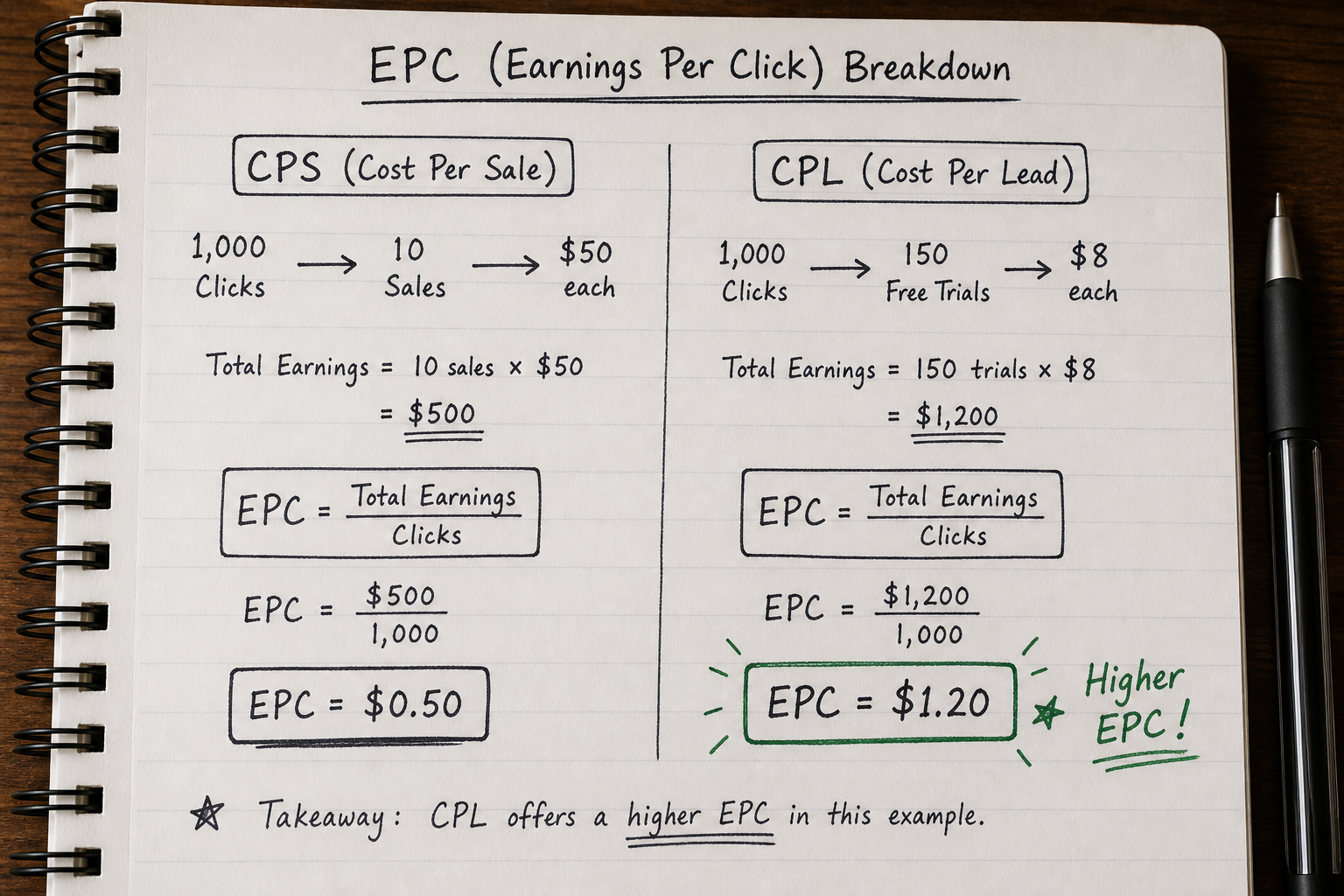
It is easy to look at a $500 CPA commission and scoff at a $0.50 CPC payout. However, top-tier affiliates know that raw payout numbers are irrelevant; the only metric that matters is Earnings Per Click (EPC).
Let’s break down the math between a traditional CPS offer and a PPC/CPL offer to see why the latter can actually be more profitable.
Scenario A: Traditional Cost Per Sale (CPS)
- Traffic Sent: 1,000 clicks
- Product Price: $100
- Commission Rate: 50% ($50 payout)
- Landing Page Conversion Rate: 1% (Standard for paid products)
- Sales Made: 10
- Total Earned: $500
- Your EPC: $0.50 per click ($500 / 1,000)
Scenario B: Cost Per Click / Free Trial (CPL/PPC)
- Traffic Sent: 1,000 clicks
- User Action: Sign up for a free trial (No credit card required)
- Bounty Payout: $8.00 per free trial
- Landing Page Conversion Rate: 15% (Because it's free and frictionless)
- Trials Generated: 150
- Total Earned: $1,200
- Your EPC: $1.20 per click ($1,200 / 1,000)
In this realistic scenario, the "lower paying" CPL offer generated more than double the revenue of the high-paying CPS offer. This is the secret to earning without making sales. Because there is less friction, your volume of successful actions is drastically higher.
However, merchants have strict limits on low-quality traffic. If you send 1,000 clicks from a cheap bot network, your conversion rate will be 0%, and you will be banned.
Traffic Strategies to Maximize PPC Earnings
To make a CPC or CPL model work, you need high volume and high intent. Here are three proven traffic strategies.
1. High-Intent SEO Content
The most reliable way to generate clicks that turn into leads is through search engine optimization. When a user searches for "best project management software for agencies," they are actively looking for a tool. If you provide a clean, unbiased list and link to free trials (CPL), your conversion rate will skyrocket.
If you aren't sure where to start, read our guide on how to pick a niche for affiliate marketing.
2. Pinterest Traffic for Broad Niches
Pinterest acts as a visual search engine and is excellent for driving massive volume to lifestyle, personal finance, and home decor niches. You can create pins that lead directly to CPC-monetized content (like a blog post heavily monetized with Skimlinks or Mediavine).
Pro Tip: Pinterest traffic can be "colder" than Google search traffic, making it perfect for low-friction CPL offers like "Free Budgeting Printables" or "Free Credit Score Checks." Learn more in our guide: Step-by-Step: Setting Up Affiliate Marketing on Pinterest.
3. Traffic Arbitrage (Advanced)
Traffic arbitrage is the practice of buying cheap clicks and routing them to pages where you earn a higher EPC.
- The Method: You buy clicks on Outbrain or Meta Ads for $0.05 each. You send them to an advertorial blog post on your site that features high-converting CPL finance offers (like auto insurance quotes) that pay $15 per lead.
- The Risk: If your math is wrong, you lose money quickly. Tracking is critical here. Media buyers rely heavily on advanced tracking software like Voluum or WeCanTrack to monitor which specific ad creatives result in positive ROI.
How to Protect Your Account from Click Fraud Bans
The biggest threat to any affiliate relying on CPC or CPL offers is getting flagged for click fraud.
Merchants are highly sensitive to bot traffic. If a SaaS company pays you $10 for a free trial, and none of those users ever log in again, the merchant realizes your traffic is worthless. They will use advanced fraud detection software like CHEQ.ai to monitor your inbound clicks. If their systems detect bots, VPN abuse, or click farms, your affiliate account will be suspended, and your commissions voided.
To ensure your efforts remain legitimate and secure:
- Never Buy "Fiverr Traffic": Gigs promising "10,000 real human visitors for $5" are 100% bots. Sending this traffic to a CPC link will result in an immediate ban.
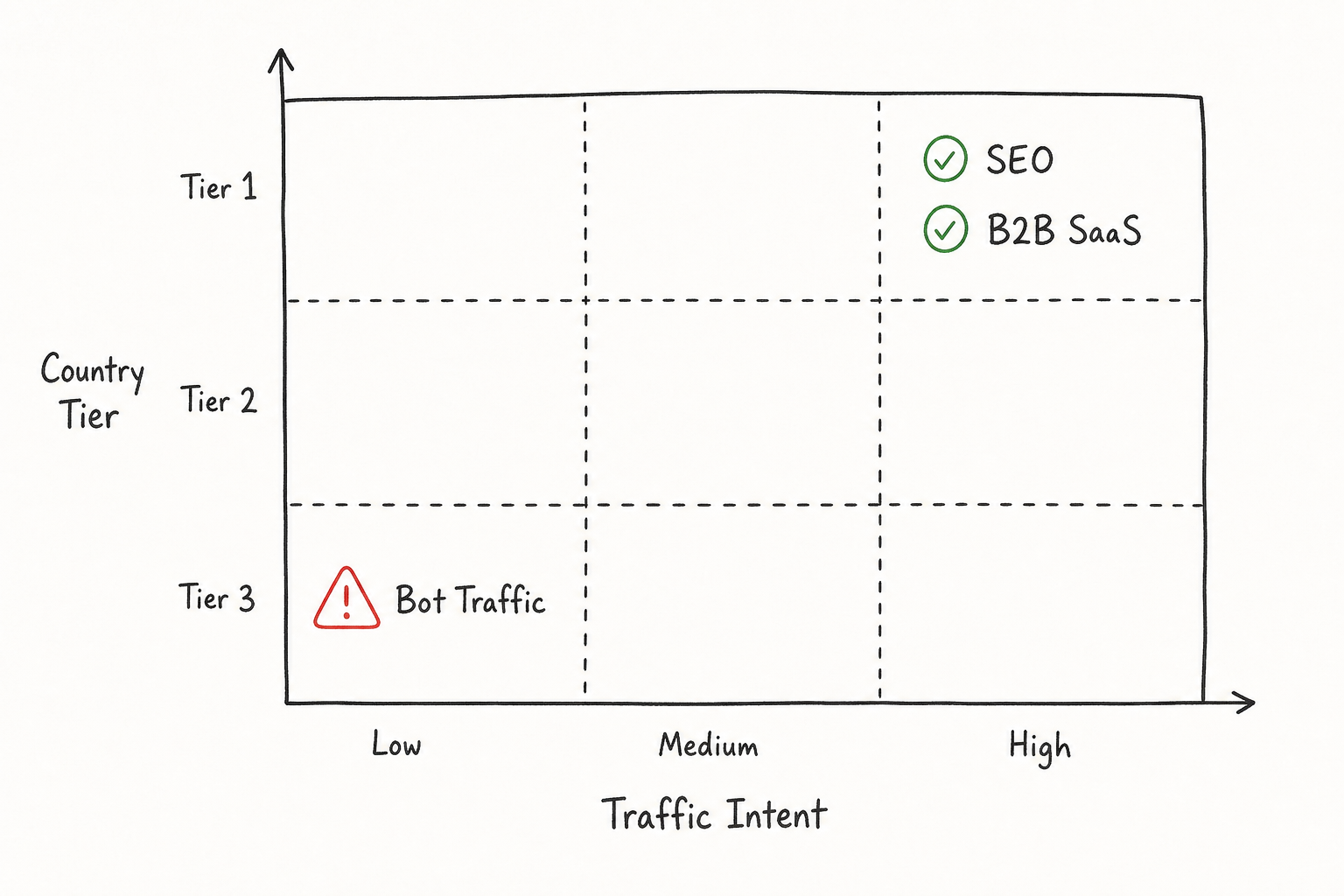
- Monitor Your Traffic Quality (Tier 1 vs Tier 3): Tier 1 countries (US, UK, Canada, Australia) command higher payouts because the users have more purchasing power. If your traffic suddenly spikes with clicks from Tier 3 countries, merchants may view it as suspicious.
- Stay Transparent: When applying for programs via AffiliList or direct networks, be completely honest about how you generate traffic. If you use Pinterest, say so. If you use SEO, link your blog.
If you are ever worried about the legitimacy of a program or network, consult our guide: Is Affiliate Marketing Legit? (How to Spot Real Offers).
Frequently Asked Questions (FAQ)
Can I use paid ads (Google Ads) to promote PPC affiliate links?
Generally, no. Most affiliate programs explicitly forbid "brand bidding" (bidding on the merchant's trademarked name in Google Ads). Furthermore, buying Google Ads to send traffic directly to an affiliate link (direct linking) is often penalized by Google itself. You should send paid traffic to your own landing page first, capture the email, and then present the affiliate offer.
What is the difference between CPC and EPC?
CPC (Cost Per Click) is what a merchant pays you, or what you pay an ad network, for a single click. EPC (Earnings Per Click) is a mathematical average used to measure performance. If you send 100 clicks to a CPA offer and earn one $50 commission, your EPC is $0.50. You weren't paid per click, but your traffic is worth $0.50 per click.
Are there affiliate marketing jobs that focus purely on PPC?
Yes. Many large media companies and SaaS brands hire affiliate managers specifically to manage their PPC and CPL partnerships. If you master media buying or traffic generation, you can easily pivot into an in-house role. Explore the landscape in our guide to affiliate marketing jobs for 2026.
How do I find specific SaaS companies offering pay-per-lead?
Traditional directories are often cluttered with outdated links to defunct programs. The most efficient method is to use a curated database. AffiliList allows you to filter through over 10,000 active programs, ensuring you find profitable affiliate marketing niches and direct SaaS offers that fit your exact traffic demographic.
The Bottom Line
Earning without making sales is not a myth, but it requires a fundamental shift in how you view affiliate marketing. Instead of acting as a digital salesperson trying to close a high-ticket deal, your job becomes a digital matchmaker—connecting high-intent users with frictionless, free solutions.
Whether you leverage hybrid networks like Skimlinks, hunt for CPL bounties on ShareASale, or negotiate direct CPC deals with SaaS founders you discover on AffiliList, the pay-per-click model is one of the most stable ways to monetize digital traffic in 2026. Focus on building high-quality, organic traffic, protect your reputation from bot flags, and watch how quickly micro-conversions can scale your income.