
SaaS affiliate commission rates and cookie duration benchmarks 2026
Explore SaaS affiliate commission rates, cookie duration benchmarks, and payout models to maximize your revenue as an SEO specialist in 2026.
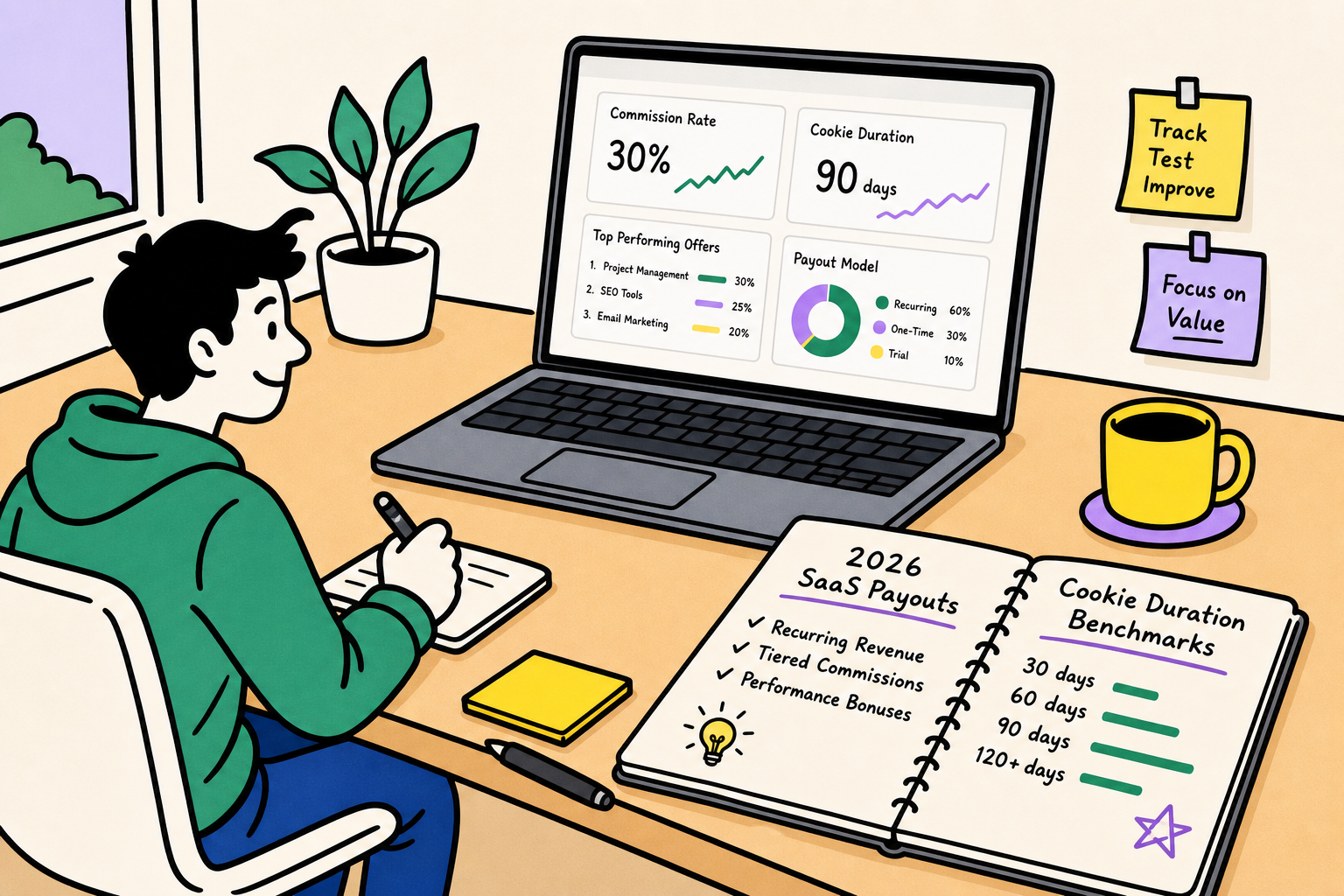
Every time you conduct a site audit, build a backlink strategy, or restructure a client’s content architecture, you rely on a specific stack of software. For SEO specialists, those daily tool recommendations hold immense monetization potential. Your clients, agency partners, and audience members are constantly looking for reliable software to replicate your results.
But casually dropping a link to your favorite keyword research tool leaves money on the table. Understanding the structural differences between one-time Cost Per Action (CPA) payouts and lifetime recurring revenue models fundamentally changes how you build an affiliate portfolio.
As an SEO specialist, promoting tools your network already uses or needs is highly lucrative. Top SaaS programs currently offer payouts ranging from $200 per sign-up to 50% lifetime recurring commissions [Increv]. However, the SaaS landscape in 2026 has introduced stricter tracking policies, longer B2B buying cycles, and complex attribution models.
This guide breaks down the standard commission rates, payout terms, and cookie duration benchmarks for the most profitable SEO and digital marketing software available today.
The 2026 benchmark data for SEO SaaS affiliate programs
SaaS affiliate programs operate differently from traditional retail or e-commerce networks. Because software companies rely on Customer Lifetime Value (CLV), their affiliate economics are built to reward partners who bring in highly qualified, low-churn users.
When evaluating an affiliate offer in the SaaS space, you are looking at three critical levers: the commission structure, the cookie duration, and the payout threshold.
Standard commission rate benchmarks
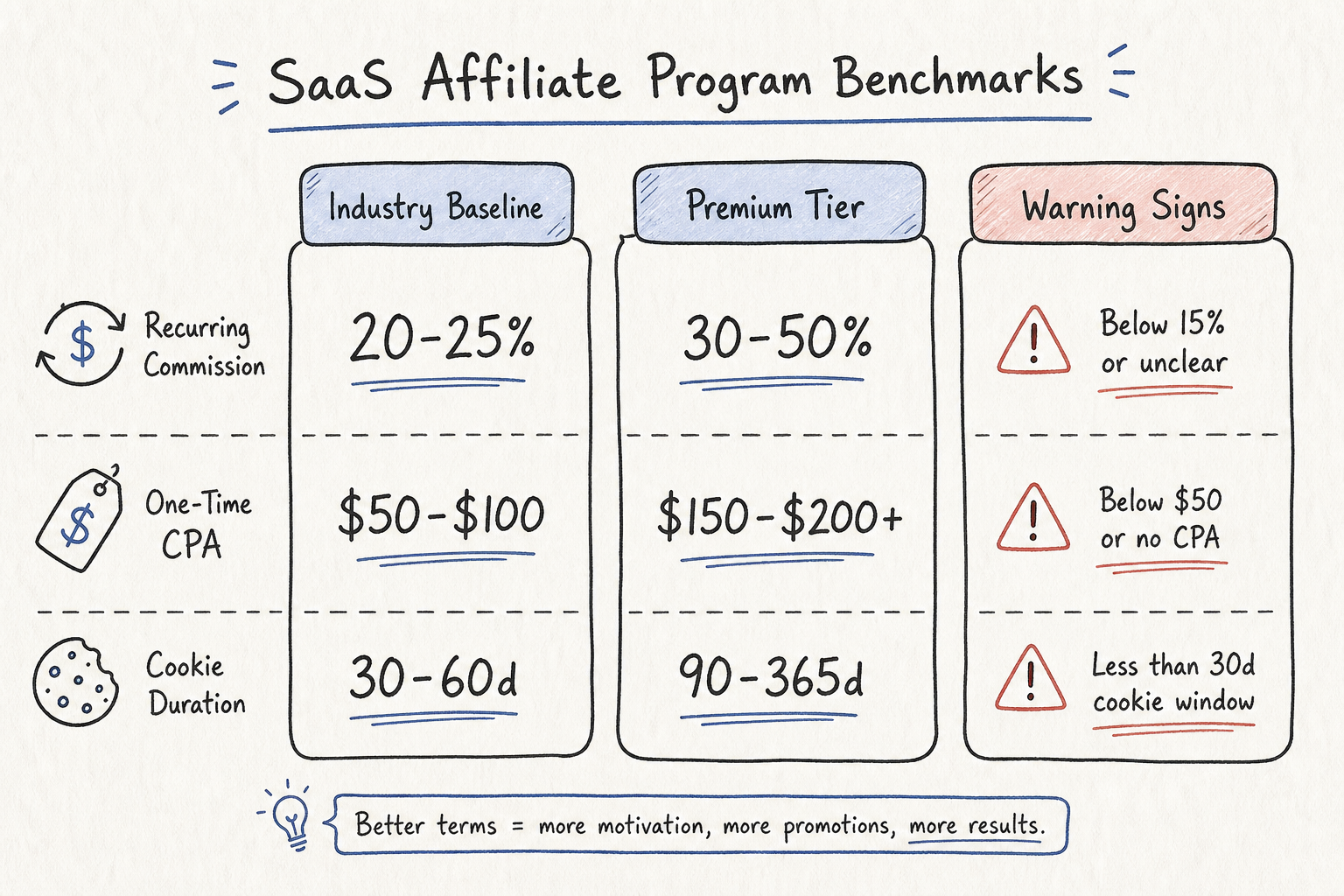
The industry averages for B2B SaaS and SEO tools have stabilized into two distinct categories: high-ticket CPA and mid-percentage recurring.
| Metric | Industry Baseline | Premium Tier | Warning Sign (Too Low) |
|---|---|---|---|
| Recurring Commission | 20% - 25% | 30% - 50% | Under 15% |
| One-Time CPA | $50 - $100 | $150 - $200+ | Under $30 |
| Cookie Duration | 30 - 60 days | 90 - 365 days | Under 14 days |
| Payout Threshold | $50 - $100 | No minimum | Over $250 |
 If a software company offers a 10% recurring commission on a $29/month product, the unit economics simply do not support dedicated content creation. You would need thousands of conversions to generate a meaningful income. Conversely, programs offering 30% or more allow you to build a sustainable affiliate marketing side hustle with a much smaller, highly targeted audience.
The mechanics of B2B SaaS cookie windows
In consumer retail, a 24-hour cookie (like Amazon's) is standard because the purchase decision is immediate. In B2B SaaS, the buying cycle is entirely different.
When you recommend an enterprise SEO crawler to a marketing director, they do not pull out their credit card on the spot. They read your review, sign up for a free trial, present the tool to their team, wait for the next billing cycle, and finally upgrade to a paid tier. This process routinely takes 45 to 60 days.
Therefore, a 30-day cookie in the B2B SaaS space is practically a broken link. Top-tier SaaS affiliate programs recognize this and offer 90, 120, or even 365-day cookie windows. Some modern programs use "lifetime attribution" for leads—if a user creates a free account through your link, they are hardcoded to your affiliate ID permanently, regardless of when they upgrade.
Top high-paying SaaS affiliate programs for SEO specialists
The most profitable programs for SEO professionals span specific niches: all-in-one SEO platforms, specialized managed services, and granular tools like rank trackers. Here is a detailed breakdown of the programs setting the standard in 2026.
Semrush: The micro-conversion CPA model
Semrush offers one of the most aggressive and generous affiliate payouts in the digital marketing space. Instead of a standard percentage, they utilize a tiered CPA model that rewards you at multiple stages of the user journey.
You earn $200 for every new paid subscription, $10 for every trial activation, and crucially, $0.01 for every new free sign-up [Jotform] [Time2book].
This micro-conversion structure is a massive advantage for content creators. Getting a user to part with their credit card is difficult, but convincing them to create a free account to test a keyword tool is low friction. Earning $10 just for a trial activation allows affiliates to monetize top-of-funnel traffic long before the actual sale occurs. They also provide a 120-day cookie life, which aligns perfectly with the longer consideration phase of enterprise SEO tools.
The HOTH: Managed services and high recurring rates
While SaaS tools are lucrative, productized SEO services offer a unique monetization angle. The HOTH, known for its white-label link building and managed SEO services, is highly popular among SEO professionals and agencies.
They offer a massive 50% recurring commission on specific managed SEO products [Jotform] [Time2book].
Selling a managed service requires a different approach than selling software. Trust is the primary conversion factor. If you run an agency or consult for small businesses, you can essentially outsource fulfillment to a provider like The HOTH while retaining a 50% margin through their affiliate backend. Because these are often high-ticket monthly retainers, a single referral can result in hundreds of dollars per month in passive income.
Mangools: Streamlined tools with competitive recurring payouts
Not every client or reader needs an enterprise-grade platform. For bloggers, niche site builders, and local businesses, streamlined toolsets are an easier sell. Mangools—the creators of KWFinder and SERPChecker—occupies this space perfectly.
They provide a competitive recurring commission of up to 35% for as long as your referral remains an active subscriber [Jotform].
A 35% lifetime recurring rate is incredibly sticky. If a user signs up for a $49/month plan, you earn roughly $17 every month. While the initial payout is much lower than a $200 CPA offer, the compounding nature of recurring commissions makes it one of the most profitable affiliate marketing niches if you can target users with low churn rates.
CPA vs. Lifetime Recurring: Which monetization model wins?
The most common dilemma SEO affiliates face is choosing between a high one-time payout (CPA) and a lower, but continuous, recurring percentage.
Let’s look at a realistic scenario over a 24-month timeline to understand the mathematics of churn and compounding revenue.
Scenario A: The High-Ticket CPA You refer 10 new customers a month to a program paying a flat $200 per sale.
- Monthly revenue: $2,000.
- Total revenue over 24 months: $48,000.
- The benefit: Immediate cash flow. You can reinvest this money into paid ads, content writers, or superior hosting immediately.
Scenario B: The 30% Lifetime Recurring You refer 10 new customers a month to a program costing $100/month, earning a 30% commission ($30/month per user). Assuming a conservative 5% monthly churn rate (users canceling their subscription), the math looks vastly different.
- Month 1 revenue: $300.
- Month 6 revenue: ~$1,600.
- Month 12 revenue: ~$2,800.
- Month 24 revenue: ~$4,200.
- Total revenue over 24 months: ~$58,000.
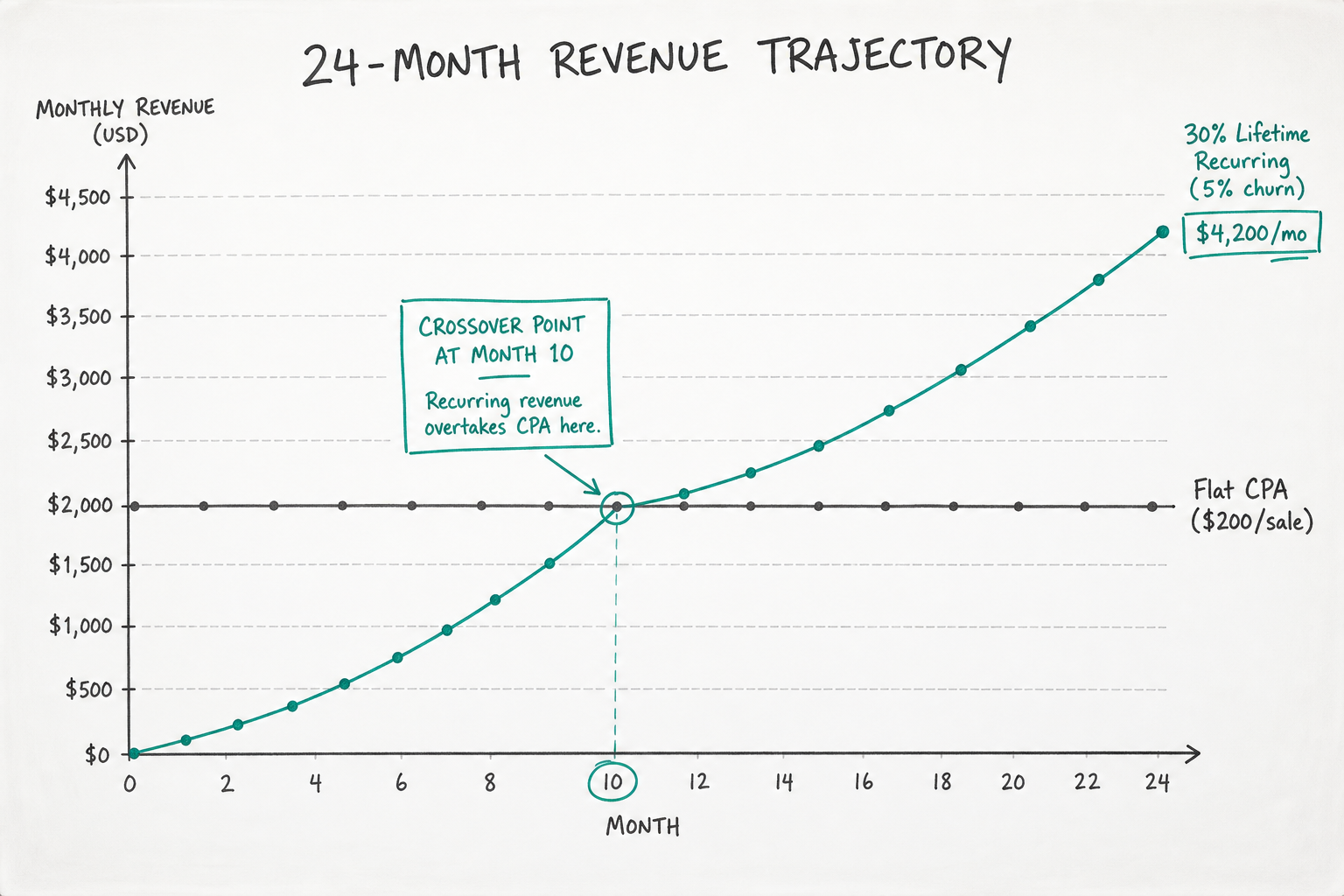 By Month 10, the recurring model surpasses the CPA model in monthly income. By Month 24, it has generated $10,000 more in total revenue, and it continues to pay out even if you stop generating new referrals.
The determining factor is churn. If the software you promote is something a business sets up once and forgets (like managed hosting), the churn is low, making recurring commissions highly attractive. If the software is something users subscribe to for one specific project and then cancel, you are better off taking the upfront CPA payout. Finding high paying affiliate programs requires analyzing how sticky the product actually is.
The hidden high-ticket SaaS sub-niches for SEOs
While keyword research tools and rank trackers are the obvious choices, the broader ecosystem of website management provides equally lucrative opportunities. When you handle SEO for a client, you often dictate their entire technical stack.
CMS and website builders
Site speed, technical structure, and rendering are foundational to SEO. Recommending a migration to a more efficient CMS is a standard technical SEO recommendation.
Platforms like Webflow have robust affiliate programs tailored for developers and marketers [SearchEye]. Because a CMS migration is a permanent, foundational change to a business, the churn rate on these subscriptions is nearly zero. When you lock a client into a platform via your affiliate link, you often secure years of continuous payout.
Hosting and infrastructure
Moving a client from shared hosting to a dedicated cloud environment (like Cloudways, WP Engine, or Kinsta) instantly improves their Core Web Vitals. Hosting affiliate programs are notoriously competitive, often paying out between $50 and $200 per referral, or offering generous recurring terms.
Integrating infrastructure recommendations into your technical SEO audits is one of the easiest ways to monetize client work beyond your hourly or retainer rate. If you are exploring the best niches for affiliate marketing, technical infrastructure is a massive vertical.
Myth-busting: "Last-click attribution always ruins your payouts"
A pervasive myth in the affiliate industry is that Last-Click attribution steals your hard-earned commissions. The fear is that a user will read your comprehensive 3,000-word review of an SEO tool, click your link, but then Google "ToolName discount code" right before checkout, awarding the commission to a coupon site instead.
While this absolutely happens in consumer retail, the SaaS industry has evolved.
Many top-tier SaaS tracking platforms (like PartnerStack, Impact, or custom FirstPromoter setups) have introduced protective measures for content creators.
- Discount Code Whitelisting: Many programs now assign specific promo codes to specific affiliates. Even if the user doesn't click your link, if they use your exclusive code, you get the credit.
- Extended First-Click Models: Some enterprise tools lock the affiliate ID to the user's email address the moment they sign up for a free trial or webinar. Even if they use a different device or clear their cookies before upgrading to a paid plan 60 days later, the commission remains yours.
Before dedicating weeks of content creation to a specific software, read their attribution policy. If they rely strictly on a 7-day last-click cookie without email-locking, your content efforts will likely be cannibalized by coupon aggregators. Knowing how to spot real offers with creator-friendly terms is what separates hobbyists from professionals.
Strategic promotion: Integrating SaaS links without looking spammy
Slapping banners on your sidebar or aggressively inserting text links into every paragraph no longer works. Modern buyers of B2B SaaS are highly skeptical. They know what an affiliate link looks like, and they will only click it if you provide genuine, un-replicable value.
Publish specific, use-case driven comparison pages
Instead of writing a generic "Ahrefs vs Semrush" article—which puts you in direct competition with massive media publications—niche down your comparisons.
Write "The Best SEO Tool for Shopify Store Owners" or "Semrush vs Mangools for Local Plumbers." High-intent, long-tail queries have drastically lower search volumes but convert at 5% to 10% because the intent matches the solution perfectly. Learning how to pick a niche for affiliate marketing often comes down to targeting specific buyer personas rather than broad software categories.
Create standard operating procedures (SOPs) as lead magnets
Instead of saying "buy this tool," show your audience exactly how you use it to generate revenue.
Create an SOP titled "How to Audit a 10,000-Page E-commerce Site in 45 Minutes." Walk through the process step-by-step, heavily featuring the specific software you use. Provide the SOP as a free download or a public blog post, with your affiliate links integrated naturally into the instructions. When readers see the exact workflow and the results it produces, purchasing the tool becomes a necessary step to replicating your success, rather than a forced recommendation.
If you are just figuring out how to start a profitable affiliate marketing blog, focusing entirely on actionable tutorials rather than purely promotional reviews is the fastest path to building trust.
Leverage non-traditional traffic sources
While SEO is your primary skill set, relying solely on organic search for affiliate revenue introduces algorithmic risk. Diversifying your traffic sources stabilizes your income.
Many SEO specialists ignore visual platforms, assuming B2B software won't perform there. However, creating highly technical infographics detailing algorithm updates, site architecture flows, or backlink strategies performs exceptionally well on platforms designed for visual search. An affiliate marketing program for Pinterest strategy doesn't have to be limited to recipes and fashion; technical marketers use these platforms to curate swipe files and process diagrams, linking back to their core SaaS recommendations.
Navigating the application process for premium SaaS programs
Unlike Amazon Associates, premium SaaS programs do not accept everyone. High-tier programs are fiercely protective of their brand reputation and heavily vet their applicants.
If you apply to a program offering $200 per CPA with a brand-new website with zero traffic, you will be rejected. Affiliate managers are looking for partners who will not resort to spammy tactics, unauthorized brand bidding on Google Ads, or misleading claims.
To ensure approval, ensure your platform meets these criteria:
- Professional presentation: Your site must have a clear about page, contact information, and professional design.
- Relevance: Your existing content must align strictly with digital marketing, business growth, or SEO.
- Traffic verification: Be prepared to share your Google Analytics data or your email list size if your site is new but your audience lives elsewhere.
- Disclosures: Ensure your site has clear, FTC-compliant affiliate disclosures easily visible on every page.
If you currently work in an agency and don't have a personal site, you can often apply as a consultant. When asked for a website, provide your LinkedIn profile and explain in the application notes that you recommend software directly to a portfolio of active agency clients. Many affiliate marketing jobs and in-house affiliate managers prioritize high-converting consultants over high-traffic, low-converting blogs.
FAQs on SaaS affiliate benchmarks
What is a good cookie duration for a SaaS affiliate program? In the SaaS space, anything under 30 days is unacceptable due to the length of the B2B buying cycle. A standard, competitive cookie duration is 60 to 90 days. Top-tier programs offer 120 days or even lifetime attribution once an email is captured.
Do recurring commissions decrease over time? Usually, no. Most lifetime recurring programs lock in your percentage for as long as the user remains a paying customer. However, you must carefully read the terms of service. Some programs cap recurring commissions at 12 or 24 months, while others reduce the percentage after the first year. Always check for "lifetime" versus "first-year" recurring clauses in the agreement.
Can I bid on the software company’s brand name in Google Ads? Almost never. Bidding on branded terms (e.g., buying ads for the keyword "Semrush discount" or "buy Mangools") is strictly prohibited by 99% of SaaS affiliate programs. Doing so will result in immediate termination from the program and the forfeiture of your earned commissions. You must bid on generic terms or direct paid traffic to your own landing pages and tutorials first.
What happens if a user upgrades or downgrades their plan? If you are on a percentage-based recurring model, your commission typically scales with the user. If they upgrade from a $99/month plan to a $399/month agency plan, your commission increases proportionately. This highlights the hidden power of B2B SaaS affiliate marketing: you benefit directly from the software company's internal upselling efforts.