
Shareasale Alternatives for Where to Look Up Cookie Duration for Affiliate Programs
Tired of login walls? Discover the best ShareASale alternatives and transparent directories to easily look up affiliate program cookie duration and terms.
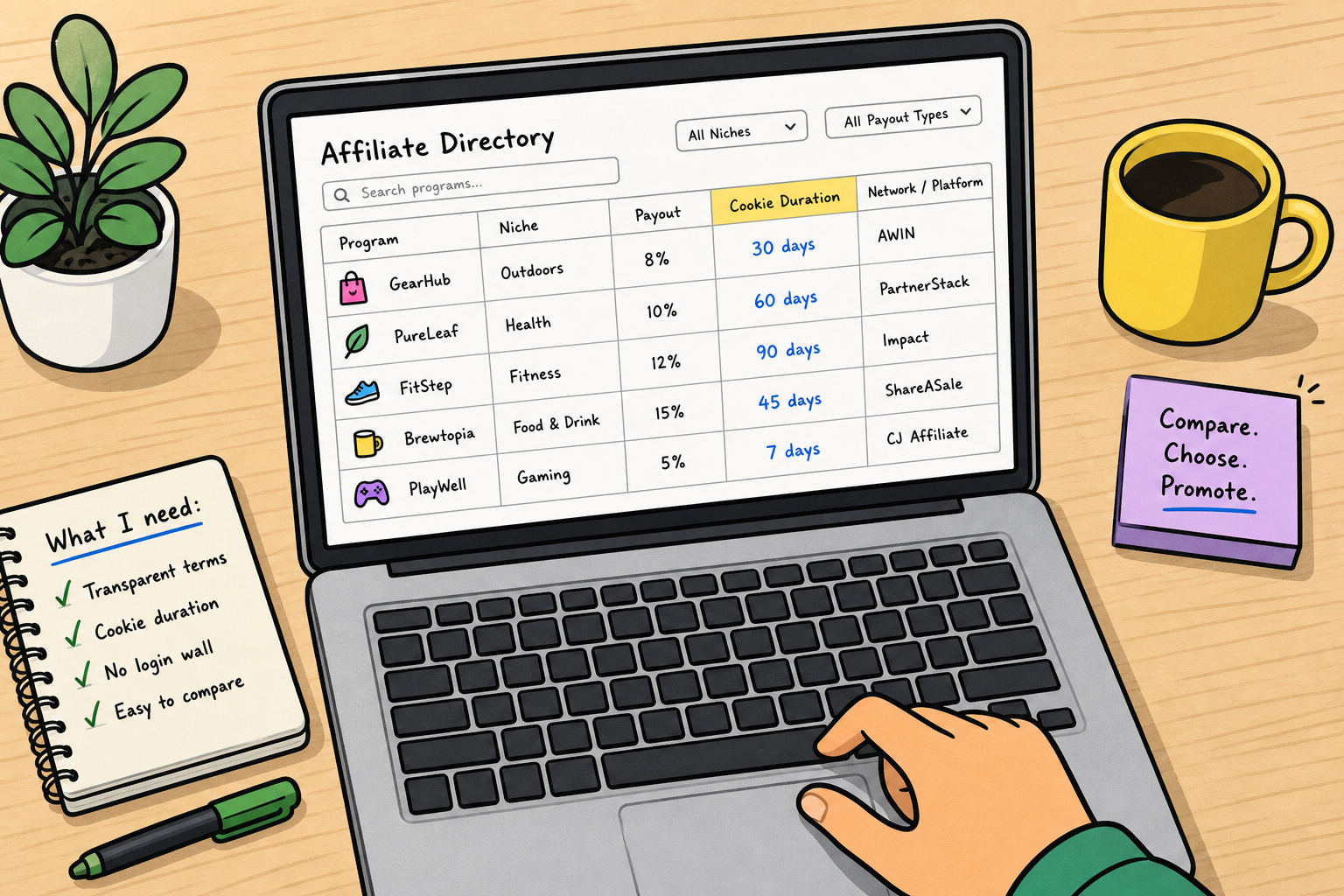
You spend hours evaluating a new software product to promote. The landing page looks great, the commission rate is competitive, and you know your audience will buy it. You click the “Join our Affiliate Program” link, fully expecting to see the program terms.
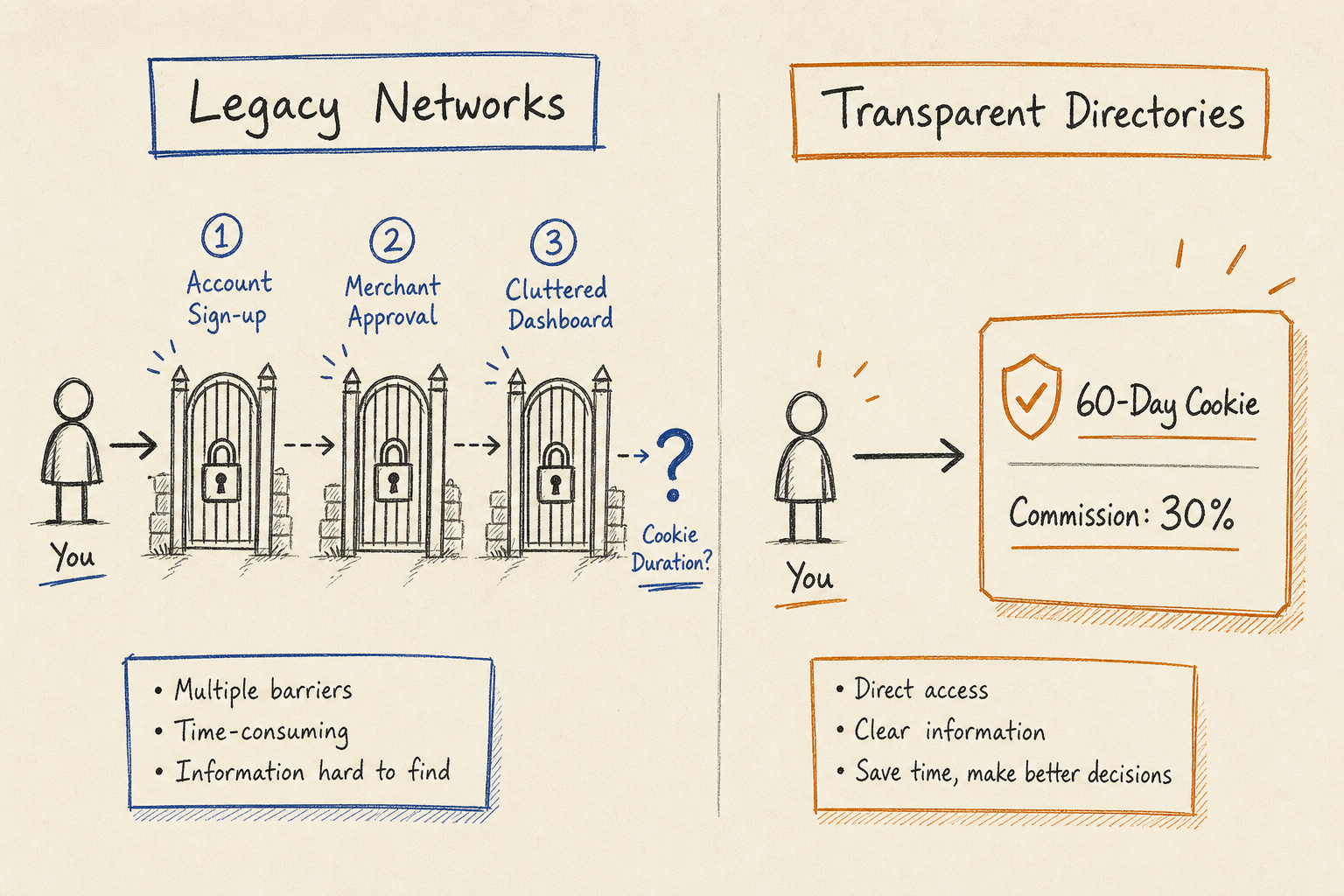
Instead, you hit a login wall for a legacy network like ShareASale or CJ Affiliate.
To find out if this merchant offers a 24-hour cookie or a 90-day cookie, you have to create an account, wait for network approval, apply to the specific merchant, wait for their approval, and finally navigate a cluttered 2000s-era dashboard just to read the fine print.
By the time you discover they offer a virtually useless three-day tracking window for a $2,000 B2B software product, you’ve wasted half your week.
This "walled garden" approach to affiliate data is a massive friction point for publishers trying to build an affiliate marketing side hustle. You should not have to hand over your personal data and endure a multi-day vetting process just to view a program's basic economic terms.
Fortunately, the industry is shifting. This guide breaks down the best alternatives to legacy networks for researching cookie durations, how to interpret those tracking windows, and why standard browser cookies might be failing you anyway.
The Problem with Legacy Affiliate Networks
For years, platforms like ShareASale operated under a closed-door model. Their primary customer is the merchant, not the affiliate. To protect merchant data and force affiliate registration, these networks hide crucial details—like commission structures, EPC (Earnings Per Click), and cookie duration—behind steep registration walls.
This creates several distinct problems for modern publishers:
- The Approval Bottleneck: You cannot simply browse a directory to compare the cookie durations of three competing email marketing tools. You have to apply to all three and wait.
- Outdated Dashboards: Even after you gain access, finding the cookie duration often requires clicking through multiple nested tabs (e.g., Merchant Details > Program Terms > Tracking).
- Ghost Programs: Many programs listed on legacy networks are inactive. You might jump through all the hoops only to realize the merchant hasn't approved an affiliate in two years.
If you are writing a guide on how to start a profitable affiliate marketing blog, you need to move fast. You need open data to make quick, accurate decisions about which products deserve your limited editorial space.
Where to Look Up Cookie Duration (The Top Alternatives)
When you refuse to play the legacy network waiting game, you have several highly effective avenues for finding cookie data instantly.
1. Transparent Affiliate Directories (The AffiliList Approach)
The most efficient alternative to a closed network is an open, curated directory built specifically for affiliate marketers. Platforms like AffiliList were designed to solve the exact problem of hidden terms.
Instead of requiring sign-ups to view basic data, AffiliList provides an open database of over 10,000 affiliate programs, with a heavy emphasis on SaaS and digital tools. When you search for a program, the commission percentage, payout terms, and the all-important cookie duration are listed front and center.
This transparency allows you to quickly filter out programs with sub-par tracking windows before you ever fill out an application. If you are comparing three HR software tools, you can line them up in the directory, see that one offers a 15-day cookie while another offers a 90-day cookie, and make your editorial choice immediately.
2. Direct Merchant Landing Pages (and the Footer Trick)
Many modern SaaS companies and digital product creators host their own affiliate programs using white-label software like PartnerStack, Rewardful, or trackdesk. Because they want to attract high-quality partners, they treat their affiliate landing page like a sales page.
To find the cookie duration directly from the merchant:
- Scroll to the absolute bottom of the company's homepage and look for "Partners," "Affiliates," or "Referral Program."
- Check the FAQ section on that specific landing page. Most transparent companies will explicitly state their terms here.
- If it is not in the FAQ, check the Affiliate Terms of Service (usually linked in small print near the application button). Run a quick
Ctrl+Ffor "days" or "cookie."
3. Third-Party Calculators and Platform Knowledge Bases
Sometimes, you need to understand not just what a duration is, but how it impacts your bottom line. Platform blogs and knowledge bases are excellent resources for benchmarking.
For example, you can use the Cookie Duration Impact Calculator from PostAffiliatePro to visualize how different tracking windows will impact your conversion rates and overall commissions. This is particularly useful if you are evaluating an in-house program and trying to decide if their stated cookie window is worth your traffic.
Similarly, advertiser-focused guides, such as those published by UpPromote, explain how merchants set up these timeframes. Reading the documentation aimed at advertisers gives you a massive advantage—you learn exactly how the tracking software is configured and where the loopholes are.
4. Advanced Search Operators (Google Dorks)
If a merchant uses a legacy network but doesn't state their terms on their public site, you can often bypass the network login by using specific search operators on Google. Network affiliates or the merchants themselves often accidentally leave PDF terms or older landing pages indexed.
Try these specific queries in Google:
site:shareasale.com "Merchant Name" "cookie""Merchant Name" affiliate program "cookie duration"site:merchantwebsite.com filetype:pdf affiliate terms
Often, you will find a cached page or a partner presentation that openly states the 30, 60, or 90-day tracking window without requiring you to log in to the network.
Why Cookie Duration Varies (and What to Expect)
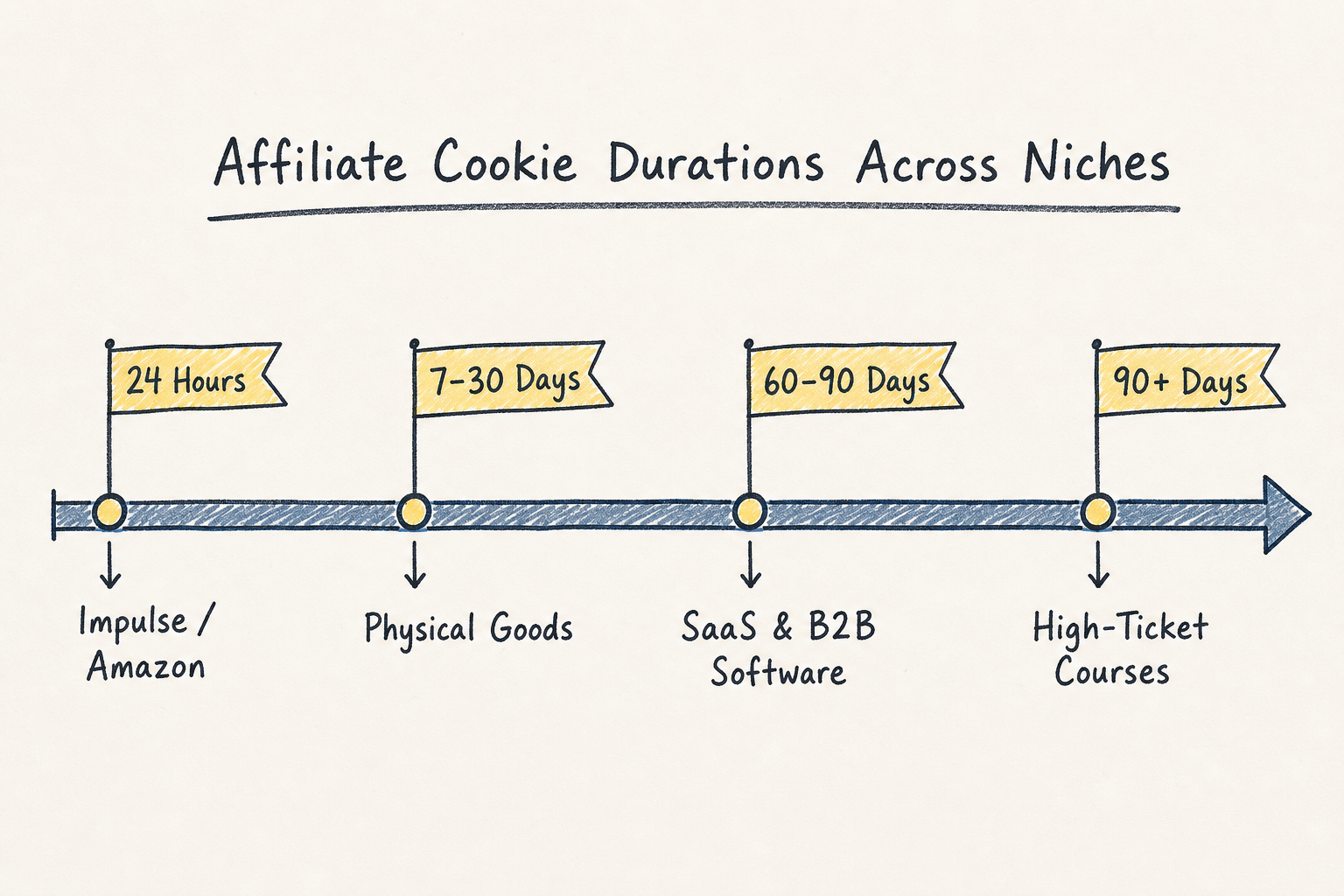
Not all tracking windows are created equal, and comparing them requires understanding the underlying purchase cycle. A 30-day window is widely considered the industry baseline. According to extensive platform data, 30 days is standard because it gives a consumer enough time to research a moderately priced product, wait for their next paycheck, and make the purchase.
However, as highlighted by industry research on how these windows work, cookie duration varies significantly based on purchase cycles, meaning a one-size-fits-all approach to evaluating offers is deeply flawed.
Here is what you should expect when looking up terms across different sectors.
SaaS and B2B Software
The B2B software niche is highly lucrative, making it one of the 11 best niches for affiliate marketing (SaaS & digital). Because business software requires team buy-in, budget approval, and migration planning, the sales cycle is long.
- Standard Expectation: 60 to 90 days.
- Red Flag: Anything under 30 days. If a CRM company expects an enterprise client to convert in 14 days, they are actively trying to shave affiliate commissions.
High-Ticket Courses and Coaching
When promoting a $2,000 digital course, buyers rarely click and purchase on the same day. They opt into a webinar, join an email sequence, and eventually buy on the last day of a launch.
- Standard Expectation: 90 to 365 days, or "lifetime" cookies.
- Red Flag: Programs that tie the cookie to the initial opt-in rather than the sales page. Ensure the tracking window covers the entire length of the merchant's email funnel. (If you want to explore this space, read about 11 high paying affiliate programs for $500+ commissions).
E-commerce and Physical Goods
Physical goods rely heavily on impulse buying. Amazon Associates famously offers a 24-hour cookie. While controversial, this matches the reality of consumer behavior on mega-retailers: if someone is going to buy a phone case, they buy it immediately.
- Standard Expectation: 7 to 30 days (excluding Amazon).
- Red Flag: 24-hour cookies on high-consideration physical items like mattresses or specialized outdoor gear.
Social Traffic (Pinterest, Instagram)
If you drive traffic primarily through visual discovery engines, the consideration phase changes. Users on Pinterest often save a pin to a board and return to it weeks later. If you are setting up affiliate marketing on Pinterest, you must prioritize programs with 60-day or 90-day cookies. A standard 30-day cookie will result in significant lost revenue due to the platform's delayed-action user behavior.
The Contrarian Truth: Why a Shorter Cookie Might Actually Make You More Money
Here is a reality most affiliate courses skip: a 90-day cookie is not inherently better than a 7-day cookie. It entirely depends on the merchant's attribution model.
When looking up program terms, you must look for the words First-Click or Last-Click.
- First-Click Attribution: The first affiliate whose link is clicked gets the commission, regardless of who drives the final sale.
- Last-Click Attribution: The last affiliate whose link is clicked right before the purchase gets the commission.
If you run a bottom-of-the-funnel review site—meaning your audience searches for "Hubspot vs Salesforce" right before they buy—you want Last-Click attribution.
Imagine you write a brilliant, high-converting review. A buyer reads it, clicks your link, and is ready to buy. But wait—80 days ago, that same user clicked a generic promotional link on a random coupon site that had a 90-day First-Click cookie. That coupon site steals your commission.
In this scenario, if the merchant offered a shorter 14-day tracking window, that old coupon click would have expired, and your fresh, high-intent last click would have secured the payout. When evaluating directories and program terms, do not just blindly sort by the longest duration. Finding the "sweet spot" requires matching the cookie duration timeframe to your specific traffic temperature.
The Hidden Threat: ITP and the Death of the 30-Day Stated Cookie
You looked up the program on AffiliList. You verified it has a 60-day tracking window. You published your content. Everything looks perfect.
Then you realize your conversions are suspiciously low.
What the merchant's terms page rarely tells you is that standard, client-side cookies are actively being blocked by modern web browsers. Apple's Intelligent Tracking Prevention (ITP) in Safari, Mozilla’s Enhanced Tracking Protection (ETP) in Firefox, and Google Chrome's ongoing privacy updates heavily restrict third-party tracking.
In Safari, if an affiliate tracking script uses a standard third-party cookie, ITP will frequently cap its lifespan at 7 days or sometimes 24 hours, regardless of what the merchant's affiliate terms say.
The merchant isn't lying when they say they offer a 60-day window; their tracking software simply cannot enforce it on an iOS device.
How to Protect Yourself
When researching programs in the most profitable affiliate marketing niches, you must ask one specific technical question before you commit heavy traffic: "Do you use server-side tracking?"
Server-side tracking (or server-to-server tracking) bypasses browser-level cookie blocking. Instead of storing the affiliate ID in the user's browser, the merchant's server records the click and the affiliate ID in their own database. When the user eventually buys, the server matches the purchase to the click internally.
This is the only way a 90-day window actually behaves like a 90-day window in today's privacy-focused web. If you cannot find this information in a transparent directory, it is worth reaching out to the affiliate manager directly to confirm.
Negotiating Your Own Cookie Duration
Many affiliates mistakenly believe the terms they look up are carved in stone. If you are wondering is affiliate marketing legit or if it's all just rigid corporate rules, understand that affiliate terms are a business contract, and business contracts are negotiable.
Once you are driving a baseline of 10 to 20 sales a month for a merchant, you have leverage. You can bypass the standard tracking limitations entirely.
- Email the Affiliate Manager: Do not use the generic support email. Find the dedicated affiliate manager (often listed in open directories or via LinkedIn).
- Present Your Conversion Data: Show them that your traffic is high-quality with a low refund rate.
- Ask for a Custom Tracking Window: Request an extension from their standard 30 days to 60 or 90 days. Many modern tracking platforms allow managers to set custom rules for specific, high-performing affiliates with a few clicks.
Additionally, as the industry grows, there are more full-time affiliate marketing jobs specifically focused on partner management. These managers are paid based on the revenue they generate through partners. If extending your cookie duration gets you to promote them over a competitor, a good affiliate manager will make it happen.
Red Flags to Watch For When Researching Terms
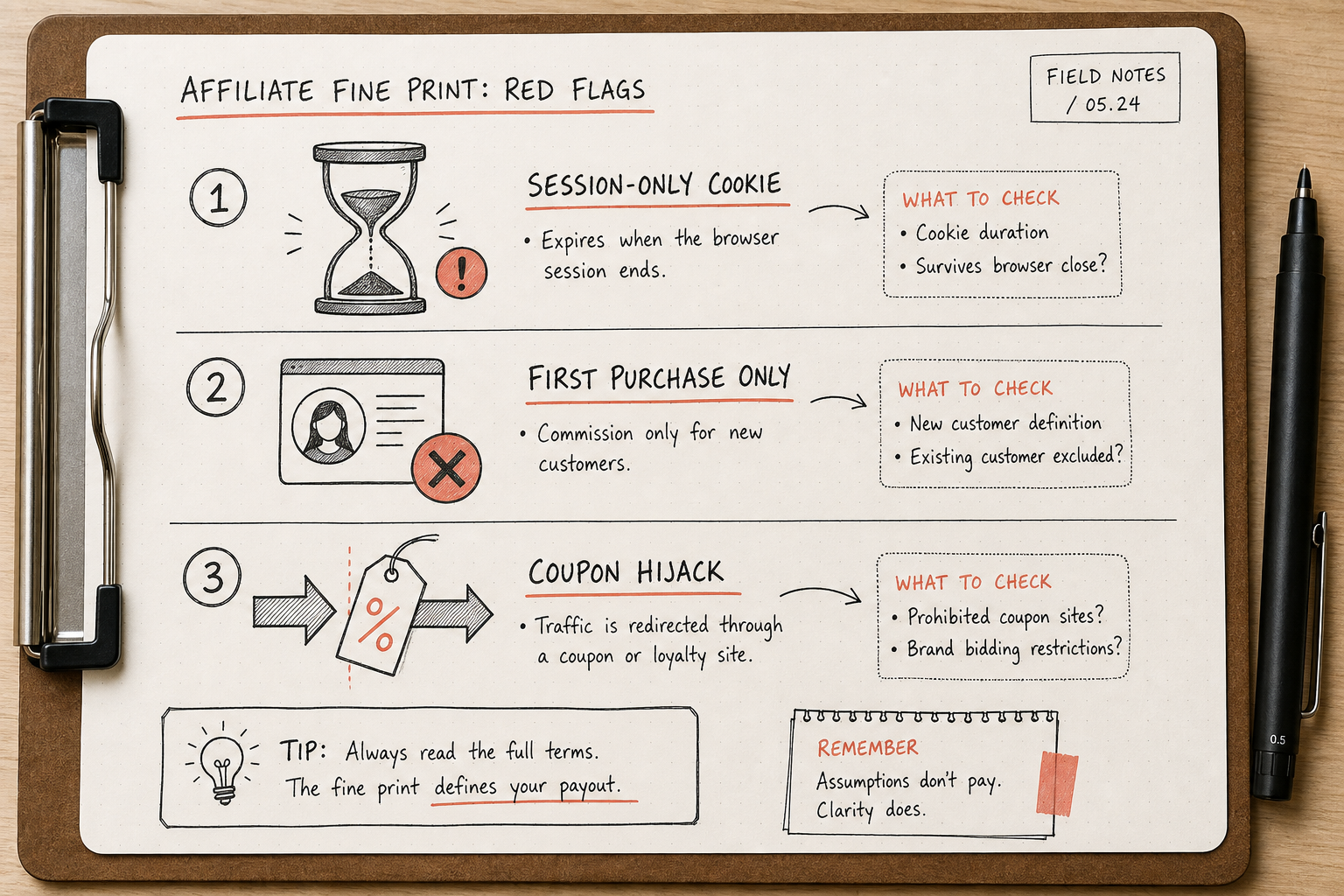
As you bypass ShareASale and use transparent directories or direct merchant pages to look up terms, keep an eye out for these subtle traps hidden in the fine print.
- "Session-Only" Cookies: This is the absolute worst-case scenario. A session cookie expires the moment the user closes their browser tab. If they click your link, read the sales page, close their laptop to eat dinner, and buy on their phone an hour later, you get nothing. Never promote a session-only program unless the payout is astronomical and the product is a sheer impulse buy.
- The "First Purchase Only" Clause: You might find a generous 90-day window, but the terms stipulate it only applies to the first item placed in the cart, or the first purchase made by a completely new customer. If the user previously bought a $5 ebook from the merchant three years ago, your 90-day cookie on a $1,000 course is voided.
- Overwritten by Coupon Sites: Check if the merchant works with massive discount code sites (like Honey or RetailMeNot). Often, if a user clicks your link, gets to the checkout page, and uses a browser extension to automatically test coupon codes, the coupon site’s tracking script overwrites yours instantly.
Frequently Asked Questions (FAQs)
What is a standard cookie duration for affiliate programs?
A 30-day tracking window is widely considered the industry standard across most general affiliate programs. However, this varies heavily by niche. High-ticket software and digital courses typically offer 60 to 90 days, while physical consumer goods often range from 24 hours to 7 days. When choosing how to pick a niche for affiliate marketing in 5 steps, always factor the average tracking window into your financial modeling.
How do I check if an affiliate cookie is actually working?
You can manually test a tracking link using your browser's developer tools. Click your own affiliate link (preferably in an incognito window or clear browser). Right-click on the destination page, select "Inspect," and navigate to the "Application" or "Storage" tab. Under the "Cookies" section, look for the tracking platform's domain (e.g., trackdesk, rewardful) and check the "Expires/Max-Age" column. This will tell you the exact moment the cookie is set to die on that specific device.
Does cookie duration affect recurring commissions?
Usually, no. Cookie duration only dictates how long you have to secure the initial sale. If a user clicks your link and signs up for a $100/month software subscription within the 30-day window, you have secured the referral. From that point on, the tracking window is irrelevant. Your recurring commissions are logged via the merchant's billing software, not your original browser cookie.
Moving Beyond Walled Gardens
The days of blindly applying to legacy networks just to see a merchant's basic terms are ending. Your time as a publisher is too valuable to spend navigating clunky, 15-year-old dashboards that actively hide the data you need to run your business.
By leveraging transparent directories like AffiliList, checking direct merchant footers, understanding the impact of attribution models, and asking tough questions about server-side tracking, you take control of your affiliate strategy. Stop settling for platforms that treat you as an afterthought, and start partnering with merchants who are proud to display their terms out in the open.