
Shareasale Alternatives for Affiliate Tools for Web Developers Looking to Monetize
Discover modern ShareASale alternatives for web developers. Monetize your technical audience with recurring SaaS commissions, developer APIs, and cloud tools.

Web developers possess a rare edge in digital marketing. While traditional creators rely on generic review blogs and manual social media posts, developers can build interactive tools, dynamic comparison engines, automated calculators, and API-driven directories. Yet, many engineers who decide to monetize their technical audience start by signing up for legacy networks like ShareASale, only to run into clunky interfaces, strict approval friction, outdated tracking pixels, and a catalog heavily tilted toward physical retail and lifestyle brands rather than developer infrastructure.
If your audience consists of software engineers, DevOps practitioners, front-end designers, or agency builders, pushing generic consumer goods will fall flat. You need high-utility developer tools, reliable cloud platforms, developer productivity suites, and modern affiliate networks equipped with clean REST APIs and multi-touch attribution.
Exploring alternatives to ShareASale allows you to connect directly with B2B SaaS platforms and developer-centric partner programs. These ecosystems offer higher payouts, recurring software-as-a-service (SaaS) commissions, and the technical tooling required to integrate monetization natively into your web applications.
Why ShareASale Often Falls Short for Modern Web Developers
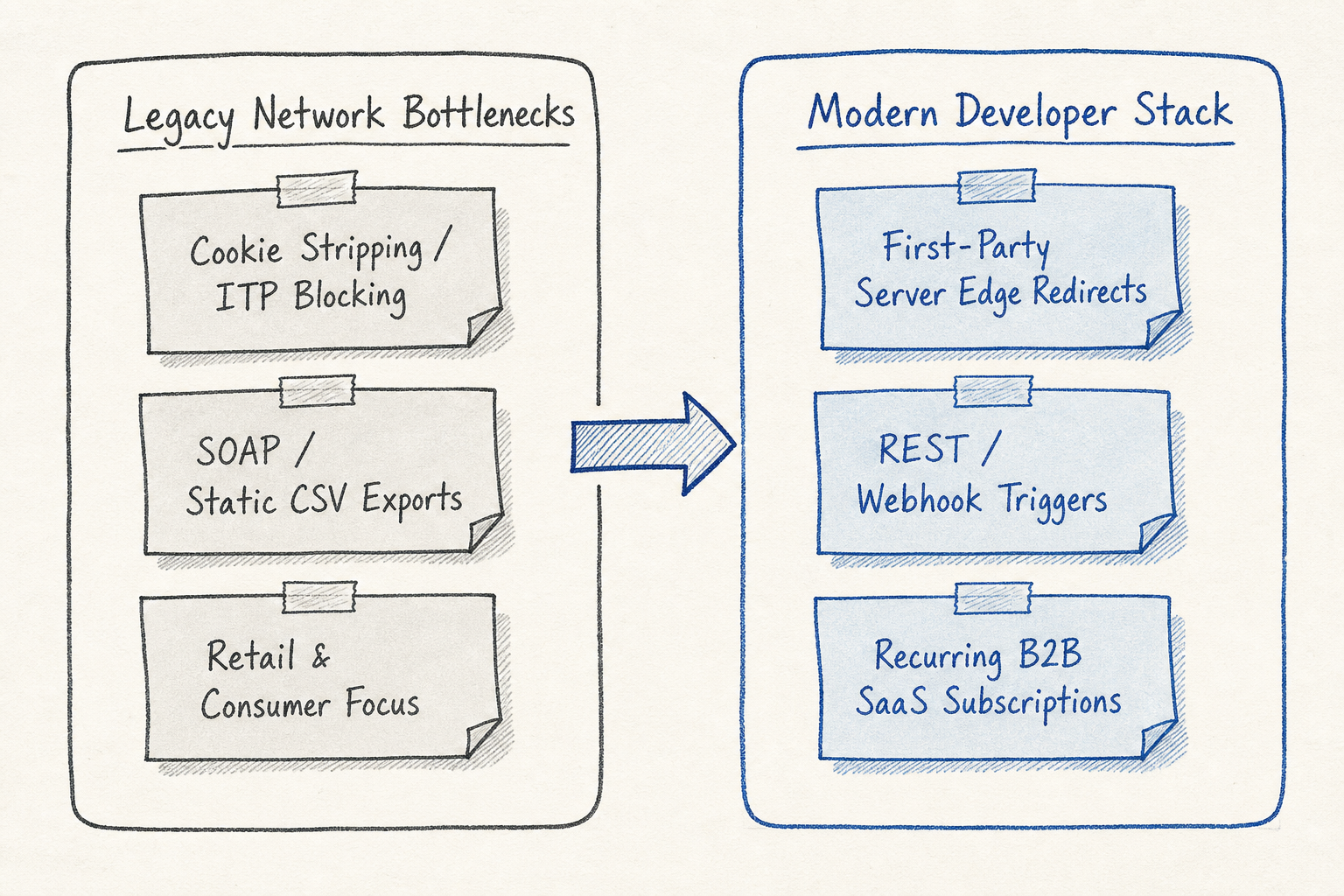
ShareASale has been a cornerstone of affiliate marketing for decades. However, its architecture and merchant base were largely designed for traditional retail, lifestyle blogging, and coupon websites. When a web developer attempts to build modern programmatic monetization workflows, several distinct roadblocks emerge.
1. Limited Developer and SaaS Merchant Inventory
The bulk of merchants on legacy networks operate in e-commerce, home goods, fashion, and consumer accessories. While you might find an occasional web hosting company or legacy software vendor, modern developer stacks—such as serverless platforms, automated CI/CD pipelines, headless CMS platforms, and AI code assistants—rarely list their partner programs on ShareASale.
2. Clunky APIs and Lack of Webhook Infrastructure
Developers want to manage affiliate assets programmatically. If you are building a dynamic tech-stack selector or an interactive cloud pricing calculator, you need real-time data:
- Programmatic link generation with custom sub-IDs
- Real-time conversion webhooks to sync data with your internal analytics
- Clean REST or GraphQL endpoints to fetch updated merchant pricing and commission rates
Legacy platforms often rely on scheduled CSV downloads, SOAP APIs, or static tracking links that make automated deep-linking and dynamic tracking frustrating to maintain.
3. Outdated Client-Side Tracking
Modern privacy standards, Safari's Intelligent Tracking Prevention (ITP), and ad-blocking extensions frequently strip traditional third-party cookies. If an affiliate network does not support robust first-party server-side tracking or custom domain link routing, a developer audience—who almost universally run script blockers and privacy extensions—will trigger attribution loss, cutting your earned revenue significantly.
Top Network and Platform Alternatives for Developer Tool Monetization
To replace legacy affiliate networks, developers should look toward modern partner ecosystems and dedicated B2B SaaS platforms. These networks specialize in digital products, provide modern developer tooling, and host the software services that engineering audiences actually use.
| Platform / Network | Primary Focus | Best For | Tracking & Tech Capabilities |
|---|---|---|---|
| PartnerStack | B2B SaaS & Tech Ecosystems | Cloud tools, CRM, marketing automation, dev tooling | Automated payouts, robust dashboard, sub-ID reporting |
| Impact.com | Enterprise & Tech Brands | Large cloud providers, enterprise software, developer tools | Advanced REST APIs, cross-device tracking, deep-linking engines |
| Rewardful | Stripe-Powered SaaS Programs | Independent developer tools, indie SaaS, developer utilities | Direct Stripe integration, transparent recurring commission tracking |
| FirstPromoter | SaaS & Subscription Software | Developer APIs, productivity tools, specialized software | Clean affiliate portals, server-to-server tracking, webhook support |
| CJ Affiliate / Rakuten | Broad Tech & Digital Hosting | Established hosting brands, enterprise hardware, domain registrars | Reliable enterprise tracking, established corporate merchant catalogs |
| AffiliList | Curated Affiliate Directory | Researching SaaS & developer programs with public terms | Open access to commission rates, category filtering, zero-signup search |
1. PartnerStack: The Hub for B2B Software and Tech Stacks
PartnerStack has emerged as the premier affiliate and partner network for software companies. Unlike traditional networks, PartnerStack is designed specifically for software subscriptions.
Because the merchants on PartnerStack run recurring subscription models, many programs offer ongoing revenue share (for example, 15% to 30% monthly recurring commission for the lifetime of the customer) rather than one-time flat bounties.
Programs frequently found within the PartnerStack ecosystem include team collaboration tools, project management software, marketing automation platforms, and developer-adjacent productivity software. If you are building tutorials on engineering team workflows, continuous delivery, or client management, PartnerStack's merchant directory provides high-converting matches.
2. Impact.com: Enterprise-Grade Tracking and Developer APIs
Impact (formerly Impact Radius) is built for sophisticated creators and developers who demand granular control over their partnership data.
Impact provides a comprehensive API that allows developers to:
- Generate tracked deep links on the fly using simple endpoint requests.
- Extract daily performance, conversion paths, and multi-touch attribution metrics programmatically.
- Access major tech and enterprise software merchants who have migrated away from legacy networks.
For developers operating high-traffic documentation portals, technical blogs, or open-source sponsor pages, Impact’s flexible contract terms and first-party tracking scripts drastically reduce attribution loss caused by client-side browser restrictions.
3. Rewardful and FirstPromoter: The Indie SaaS and Developer Tool Layer
Many of the most innovative developer tools—such as database GUIs, screenshot APIs, uptime monitoring services, and specialized CSS generators—are built by independent software teams or bootstrapped startups.
These companies rarely join massive enterprise networks. Instead, they run their partner programs directly using platforms like Rewardful or FirstPromoter, which connect directly to their Stripe billing architecture.
When you partner with tools powered by these platforms, you enjoy direct relationships with product founders, real-time conversion updates tied to Stripe invoices, and reliable recurring commissions. As noted by DEV Community, selecting programs that align precisely with tools you use daily is the fastest way to build sustainable monetization without alienating your audience.
4. AffiliList: Streamlined Directory for Finding Developer and SaaS Offers
Navigating dozens of closed networks just to view commission structures wastes valuable development time. AffiliList solves this by providing a comprehensive, open-access directory of over 10,000 affiliate programs, with a heavy emphasis on SaaS, infrastructure, and digital tools.
Instead of registering an account, submitting your tax documents, and waiting days for approval just to see if a merchant offers competitive terms, you can use AffiliList to filter by commission rate, payment model (bounty vs. recurring), and specific technical niches. This streamlined transparency makes it an essential research tool before you commit to building a dedicated integration or comparison tool around a specific software category.
High-Yield Developer Tool Categories to Monetize
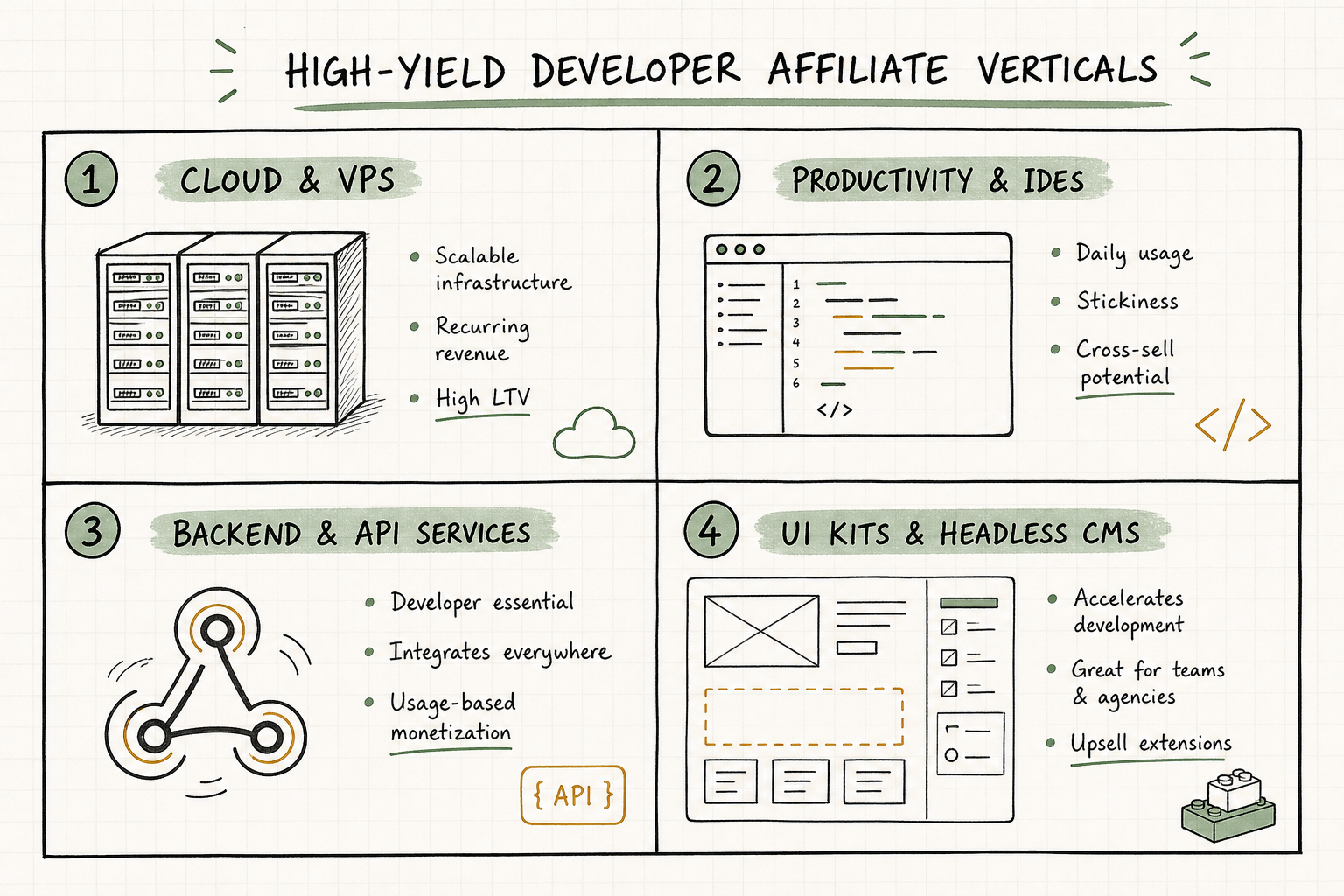
Web developers often make the mistake of only promoting domain registrars or cheap shared hosting. While these programs can work, they represent a fraction of the available monetization landscape. Engineering audiences invest heavily in tools that save them time, secure their infrastructure, or improve code quality.
1. Cloud Infrastructure, Managed Hosting, and Serverless Backends
Hosting remains one of the highest-paying verticals in digital marketing. However, modern developers have moved beyond standard cPanel shared hosting to scalable virtual private servers (VPS), cloud platforms, and managed application infrastructure.
- Cloud Infrastructure Platforms: Services like DigitalOcean, Vultr, and Linode offer referral credit models as well as cash partner programs. DigitalOcean, for example, is widely discussed on YouTube for its balance of high conversion rates and generous developer onboarding incentives.
- Specialized Managed Application Hosting: Platforms like Kinsta, WP Engine, and Cloudways offer substantial affiliate payouts. Many of these programs feature hybrid structures combining a large upfront bounty ($50 to $200+) with a 10% lifetime recurring commission. For developers interested in identifying these premium tiers, our guide to high paying affiliate programs breaks down the math behind four-figure monthly payouts.
- Edge and Serverless Deployment Platforms: Tools that simplify continuous deployment from GitHub or GitLab to edge networks frequently offer referral incentives, team expansion credits, or partner kickbacks for agency referrals.
2. Developer Productivity, IDEs, and Code Quality Tools
Software engineers spend hours daily inside integrated development environments (IDEs) and terminal workflows.
According to insights published on SitePoint, tools that enhance developer ergonomics—such as JetBrains IDE licenses, specialized Git clients, automated code documentation software, and AI-assisted linting platforms—carry strong brand loyalty. When an engineer recommends a tool that meaningfully speeds up debugging or refactoring, conversion rates are exceptionally high because the return on investment for the buyer is immediate.
3. API Services and Backend-as-a-Service (BaaS)
Modern web development is modular. Developers frequently stitch together third-party APIs rather than building every microservice from scratch:
- Data & Scraping APIs: Proxy networks, headless browser APIs, and web scraping pipelines.
- Security & Geolocation APIs: IP lookup tools (such as IPstack), automated fraud detection, and bot mitigation services.
- Communication & Transactional Services: Email delivery engines (SendGrid, Postmark, Resend), SMS gateways, and automated push notification services.
These services operate on recurring usage-based billing models. When an affiliate program offers a percentage of ongoing API consumption, a single high-volume application referred by your tutorial can generate hundreds of dollars per month in passive commission.
4. UI Component Libraries, Templates, and Design Systems
Front-end developers and freelance agency owners constantly look for assets that accelerate project delivery.
Programs offering affiliate partnerships in this space include:
- Tailwind CSS and React UI Kits: Commercial component libraries that sell multi-site developer licenses.
- Figma and Design Tooling: Prototyping tools and UI kits designed for web application mockups.
- Website Builders and Headless CMS: Platforms like Webflow, Framer, and Sanity that cater to developers delivering client work on tight deadlines.
For creators wanting to build dedicated authority around these software stacks, learning how to pick a niche for affiliate marketing and understanding the best niches for affiliate marketing will ensure you target software categories with both high search volume and high commercial buyer intent.
Technical Implementations: Building Monetization Tools Instead of Basic Links
A major differentiator for software engineers is the ability to move beyond static anchor text links. By building purpose-driven web utilities, you provide immediate value to users while naturally driving affiliate conversions.
+-------------------------------------------------------------------+
|                        Client-Side Layer                          |
|  - Interactive Inputs (Sliders, Dropdowns, Toggles)               |
|  - Dynamic UI Updates via React / Vue / Vanilla JS                |

+---------------------------------+---------------------------------+
                                  |
                                  v
+-------------------------------------------------------------------+
|                       Edge / API Engine Layer                     |
|  - Real-time Pricing Calculations                                 |
|  - Geolocation & Platform Detection                               |
|  - Programmatic Sub-ID Generation (Campaign / Content ID)        |

+---------------------------------+---------------------------------+
                                  |
                                  v
+-------------------------------------------------------------------+
|                     Attribution & Destination                     |
|  - First-party Redirect (`/go/partner-name?subid=123`)            |
|  - Destination Partner Landing Page (Impact / PartnerStack / etc) |

+-------------------------------------------------------------------+
1. Interactive Cloud Cost and Bandwidth Calculators
Cloud pricing models are notoriously complex. Developers frequently struggle to estimate monthly infrastructure costs across providers like AWS, DigitalOcean, Google Cloud, and Hetzner.
By building a single-page application (SPA) that lets users input their projected monthly compute hours, RAM, CPU cores, and outbound bandwidth, your tool can output an automated comparison matrix showing exact monthly costs across five different platforms.
Inside that matrix, each provider's "Launch Instance" button contains your structured affiliate link. The user gets an instant, unbiased cost estimate, and when they click through to deploy their virtual machine, your affiliate cookie tracks the conversion.
2. Programmatic Tech Stack Recommendation Engines
Beginner developers and startup founders often face decision paralysis when choosing their technology stack:
- Which database should I use for a high-traffic SaaS?
- What headless CMS works best with Next.js 15?
- Which transactional email service has the simplest Node.js SDK?
You can create an interactive questionnaire that asks 4–5 targeted questions about their project scale, preferred language, and deployment budget. Based on their answers, the engine outputs a recommended architecture diagram with direct, deeply-linked affiliate recommendations for the hosting, database, and monitoring providers selected.
3. Deep Link Redirection Engines with First-Party Tracking
Rather than hardcoding raw affiliate URLs across dozens of markdown files or database tables, build a lightweight serverless redirection handler on your domain (e.g., using Cloudflare Workers, Next.js Middleware, or Fastly).
A first-party redirect architecture provides several technical benefits:
- Clean URL Structure: Links appear as
yoursite.com/go/digitaloceanrather than complex network tracking strings with multiple redirects. - Centralized Link Management: If an affiliate program migrates from ShareASale to PartnerStack or changes its tracking domain, you update one key-value store or environment variable rather than refactoring hundreds of published articles.
- Automated Sub-ID Appending: Your middleware can dynamically read the referring page path, device type, or UTM parameters from the incoming request and inject them into the target network's
subidorsubId1parameter before redirecting the user. This gives you exact data on which specific blog post, tool button, or code snippet drove the conversion.
4. Dynamic API-Driven Comparison Grids
Static comparison tables age quickly. SaaS companies adjust their pricing tiers, deprecate features, and launch new integrations regularly.
By utilizing headless CMS platforms or scheduled cron functions that fetch updated feature sets and pricing tiers, your comparison tables remain 100% accurate. Developers trust data-dense, accurate tables far more than vague marketing prose. Including toggleable filters (e.g., "Filter by PostgreSQL support" or "Show only providers with European data centers") turns a standard affiliate table into an indispensable utility.
Case Study: Monetizing an Open-Source Developer Boilerplate
To see how technical monetization functions in practice, consider a scenario where an engineer builds a popular open-source boilerplate repository.
The Scenario
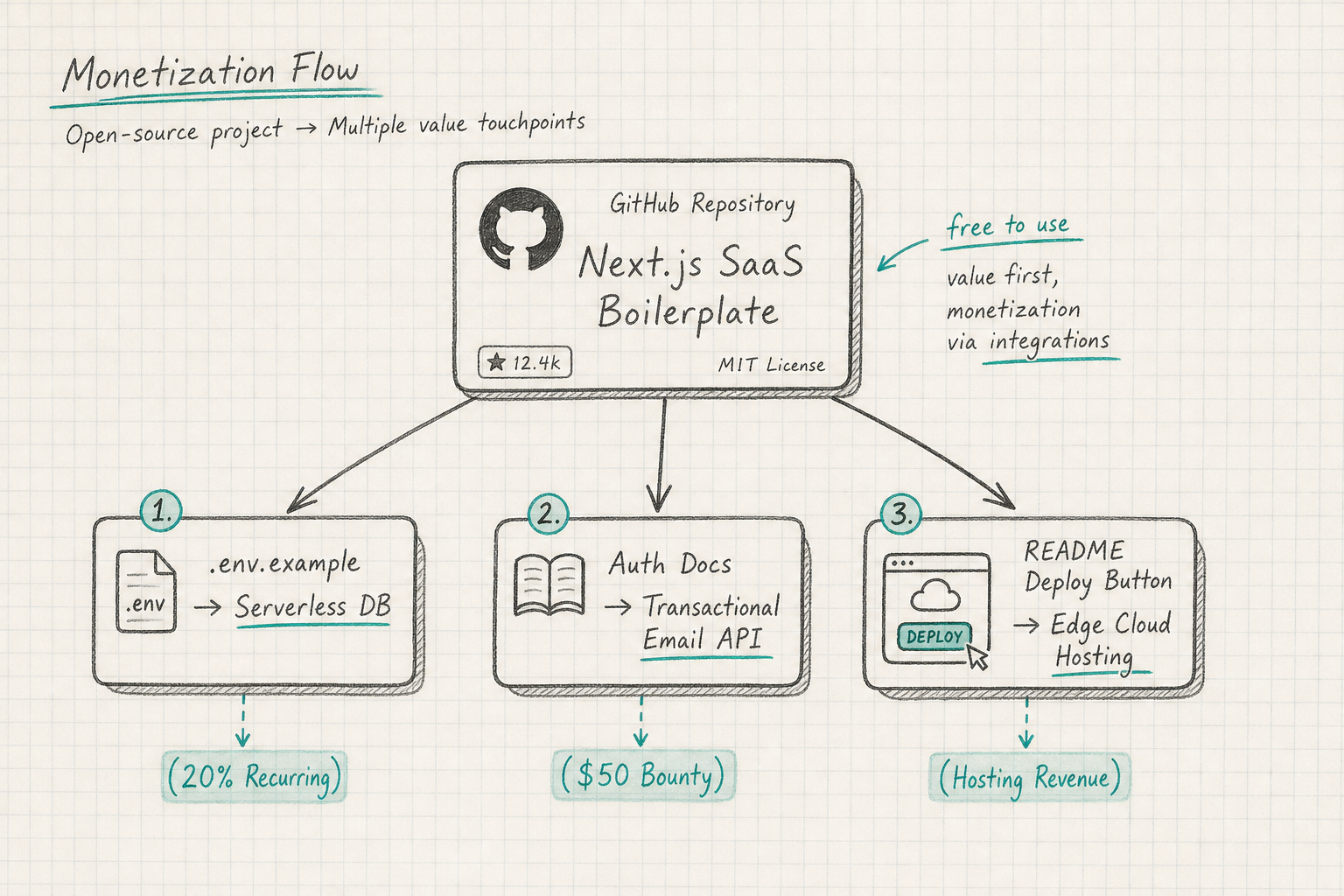
Alex, a full-stack developer, created an open-source Next.js SaaS starter kit hosted on GitHub. The repository includes authentication, database migrations, Stripe billing webhooks, and UI components. Within six months, the repository gained 3,500 GitHub stars and generated 12,000 monthly visits to its documentation site.
Initially, Alex added generic banner ads and a ShareASale affiliate link to a generic web hosting provider. After three months, the banner ads yielded less than $35 total, and the hosting link recorded zero conversions because modern Next.js developers rarely use standard cPanel shared hosting.
The Strategy Shift
Alex restructured the project’s monetization by integrating modern developer affiliate tools into the actual onboarding documentation:
- Database Integration: In the
.env.examplefile and the database setup guide, Alex recommended a managed serverless PostgreSQL platform (monetized via a direct SaaS partner program offering 20% recurring monthly commissions). - Transactional Email Setup: In the authentication email tutorial, Alex linked to an email API provider via PartnerStack that offered a $50 bounty per paid team upgrade.
- Deployment One-Click Buttons: In the
README.mdand live demo dashboard, Alex added "Deploy to Cloud" buttons using affiliate parameters for a modern VPS host and edge deployment platform. - Transparent Research: Rather than guessing commission rates, Alex researched viable SaaS alternatives on AffiliList to find tools offering long cookie durations and transparent attribution terms.
The Outcome
Because the tools recommended were functional prerequisites for launching the starter kit, the conversion friction dropped to zero.
- Over 90 days, 140 developers deployed projects using the recommended database and hosting setups.
- The recurring commissions from the database and infrastructure providers scaled to $1,450 per month in passive revenue.
- The transactional email bounties generated an additional $600 in one-time payouts.
By aligning the monetization directly with the developer workflow, Alex transformed an open-source hobby project into a sustainable affiliate marketing side hustle without degrading code quality or user experience.
Critical Differences: Direct SaaS Programs vs. Legacy Networks
When shifting away from networks like ShareASale, you will encounter two primary partnership models: large aggregators (like Impact) and direct, merchant-managed partner programs (often hosted on Rewardful or FirstPromoter). Understanding the tradeoffs between these models is essential for optimizing your development time.
| Evaluation Metric | Legacy Networks (ShareASale, CJ) | Modern Aggregators (Impact, PartnerStack) | Direct SaaS Programs (Rewardful, FirstPromoter) |
|---|---|---|---|
| Merchant Quality | Broad consumer retail, older tech brands | High-growth B2B SaaS, enterprise cloud | Developer-first tools, indie software, micro-SaaS |
| Commission Model | Predominantly one-time CPA bounties | Hybrid: High CPA or recurring revenue share | Predominantly recurring lifetime revenue share (15–30%) |
| Developer APIs | Basic XML / SOAP / Scheduled CSVs | Full REST APIs, webhooks, automated link builders | Webhook triggers via Stripe, direct developer access |
| Payment Thresholds | Strict monthly net-30/60 schedules | Multi-currency, automated direct deposits | Monthly automated payouts via Stripe or PayPal |
| Audience Fit | Low alignment with software engineers | Moderate to high technical alignment | Exceptional alignment with niche engineering problems |
While managing individual logins for direct SaaS programs requires slightly more administrative overhead than managing a single unified network dashboard, the significantly higher commission rates and recurring revenue streams almost always justify the setup.
For creators mapping out their long-term digital strategy, exploring our breakdown of the most profitable affiliate marketing niches highlights why recurring software tools consistently outperform one-off consumer retail programs over a multi-year horizon.
Technical Mistakes Developers Make When Monetizing
Monetizing technical traffic requires a different set of rules than standard affiliate blogging. Software developers are naturally skeptical of marketing claims, highly protective of their user privacy, and quick to spot disingenuous endorsements.
Common Mistakes vs. High-Conversion Developer Tactics

[ Common Mistake: Generic Banner Ads & Cookie-Cutter Reviews ]
                             |
                             v
   (Result: Ad-blocked, ignored by devs, zero trust established)

-----------------------------------------------------------------

[ Better Approach: Real Implementation & Architecture Guides ]
                             |
                             v
   - Complete GitHub repositories with reproducible code
   - Edge-redirected links with granular sub-ID tracking
   - Transparent, open-access commission vetting via AffiliList
   - Clear disclosure of technical limitations & trade-offs
1. Promoting Products Without Providing Reproducible Code
A standard review article stating "Tool X is the best API for authentication" will not convert developers.
Developers convert when they see:
- Complete, copy-pasteable code examples using modern syntax (TypeScript, Go, Python).
- A public GitHub repository demonstrating how to integrate the SDK into a production framework.
- Honest benchmarks comparing latency, memory overhead, and pricing tiers against alternative libraries.
If your content answers the specific technical edge cases—such as how a tool handles rate limiting, token expiration, or edge deployment—readers will gladly use your affiliate link to sign up.
2. Failing to Disclose Affiliate Relationships Cleanly
Technical audiences value transparency above all else. Attempting to hide affiliate tracking parameters behind deceptive redirects damages credibility.
Always include clear, honest disclosures:
- Add a visible statement at the top of your documentation or blog post stating that some outgoing links generate partner commissions.
- State clearly that commissions do not increase the user’s price (and often provide exclusive signup discounts or extended trial credits).
- Keep your technical evaluations objective by pointing out where a tool is not a good fit (e.g., "Use Provider A if you need fast Redis caching; use Provider B if your workload requires complex ACID-compliant relational transactions").
As explored in our analysis on is affiliate marketing legit, building long-term trust through objective, honest reviews is the single greatest predictor of sustainable affiliate revenue.
3. Ignoring Server-Side Conversion Tracking
If you run high-traffic applications, relying solely on client-side JavaScript tags to record conversions means leaving significant revenue on the table. Tech-savvy visitors frequently browse with JavaScript blockers, strict ad-block filters, or custom DNS configurations (like Pi-hole).
Whenever an affiliate partner program supports Postback URLs, Server-to-Server (S2S) tracking, or Webhook attribution, take the time to configure server-side tracking. By passing click IDs via secure server endpoints, your conversions are recorded reliably even when the user's browser suppresses third-party tracking scripts.
If you are just launching your site architecture, reviewing how to start a profitable affiliate marketing blog will help you establish clean URL routing, structured schema markup, and robust tracking right from day one.
Frequently Asked Questions
Can web developers legally cloak or programmatically route affiliate links?
Yes, link cloaking via first-party server redirects (e.g., yoursite.com/go/brand) is standard industry practice. It improves user experience, prevents broken links across large codebases, and allows for centralized sub-ID management. However, you must comply with regulatory requirements (such as the FTC in the United States) by clearly disclosing that the destination URL is an affiliate partner link. Additionally, ensure you review the specific program terms, as a small number of retail programs (like Amazon Associates) have strict rules regarding how cloaked links are displayed.
What is the best commission model for developer-focused affiliate tools?
For technical products, a monthly recurring revenue share (20% to 30%) is generally far more lucrative over time than a one-time Cost Per Acquisition (CPA) bounty. Developer tools exhibit high switching costs: once an engineering team integrates an API, database, or monitoring suite into their codebase, they rarely cancel their subscription. A recurring commission ensures you earn monthly revenue for years from a single referral.
How do I find affiliate programs for niche open-source or developer tools?
Many developer-first companies do not advertise their partner programs on their public homepage. To find them:
- Check the footer for links labeled "Partners," "Affiliates," or "Referrals."
- Search open directories like AffiliList to review verified commission structures, cookie lengths, and payment terms without having to register first.
- Look at the documentation of tools you already use in production to see if they offer team referral credits, agency kickbacks, or specialized partner tiers.
Are traditional networks like ShareASale ever worth using for web developers?
ShareASale can still be viable if you specifically recommend consumer electronics, hardware devices (such as ergonomic keyboards, developer desks, or development boards), or legacy web hosting brands that remain exclusive to the network. However, for modern software, cloud services, and developer SaaS, newer platforms like PartnerStack, Impact, and direct Stripe-backed partner programs offer significantly better software catalogs, modern APIs, and higher recurring commissions.
Building a Sustainable Developer Monetization Stack
Transitioning away from legacy affiliate networks like ShareASale opens up a far more lucrative ecosystem of modern developer tools, cloud infrastructure, and B2B SaaS platforms.
By leveraging your technical capabilities to build real-world tools—such as interactive pricing calculators, dynamic tech stack recommenders, and robust server-side deep link routers—you bridge the gap between high-value technical documentation and sustainable monetization.
Rather than chasing low-ticket consumer products, focus on high-retention software that solves legitimate engineering problems. Combine objective technical evaluations with transparent partner directories like AffiliList to find high-converting offers, build reproducible code examples, and establish an automated, recurring revenue stream that scales alongside your technical career.