
Shareasale Alternatives for Choose Lucrative Affiliate Programs for Tech Blogs
Learn how to choose lucrative affiliate programs for tech blogs. Discover top SaaS networks, recurring revenue models, and alternatives to ShareASale.
- Why Traditional Retail Networks Fall Short for Tech Publishers
- The Tech Affiliate Gold Standard: Recurring SaaS Revenue
- Matching the Buying Journey to Cookie Duration
- Top ShareASale Alternatives for Discovering Tech Programs
- Key Metrics to Analyze When Choosing Tech Programs
- How to Match Tech Products to Your Specific Audience Intent
- Red Flags in Tech Affiliate Programs
- Building a Tech Affiliate Strategy That Converts
- FAQs About Choosing Tech Affiliate Programs
- Final Strategic Thoughts
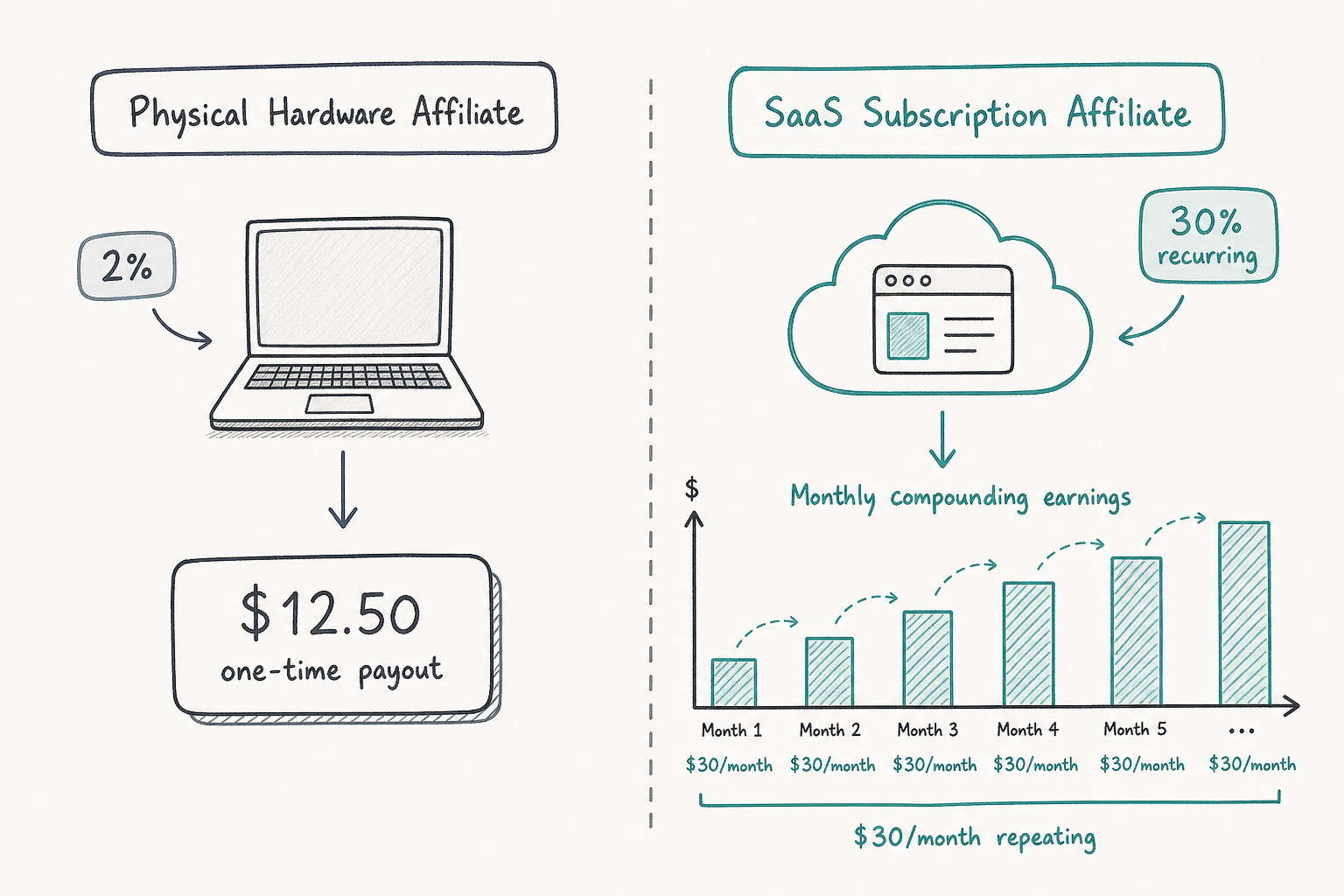
You just spent a week writing a 4,000-word comparative review of enterprise cloud hosting infrastructure. You optimized the on-page SEO, sourced custom diagrams, and finally ranked on the first page of Google. A reader clicks your affiliate link, buys a $3,000 annual server package, and your dashboard updates with a commission of $12.50.
If you are running a tech blog and relying on generalized, retail-heavy affiliate networks, this scenario is painfully familiar.
Choosing lucrative affiliate programs for a tech blog requires an entirely different playbook than lifestyle, fashion, or travel blogging. Tech buyers—whether they are developers evaluating API integrations, agency owners shopping for CRM software, or enthusiasts building custom PCs—are deeply analytical. They do not buy on impulse. They read documentation, compare specifications across a dozen tabs, and consult their teams before pulling out a credit card.
General affiliate networks like ShareASale built their infrastructure around retail consumer goods. While they do host some software merchants, their ecosystems are often cluttered with physical products offering single-digit commission rates and incredibly short cookie windows. To maximize the earning potential of your tech traffic, you need to abandon the retail mindset, prioritize high-yield SaaS partnerships, and utilize directories built specifically for digital products.
Here is a deep dive into why generic networks fail tech publishers, what you should be looking for instead, and how to build a portfolio of highly profitable tech partnerships.
Why Traditional Retail Networks Fall Short for Tech Publishers
To understand how to choose lucrative affiliate programs for tech blogs, you first have to understand the systemic mismatch between how traditional networks operate and how tech audiences actually buy.
Most legacy affiliate networks treat all traffic exactly the same. The tracking infrastructure, the merchant discovery process, and the payout models were designed around the concept of a user seeing a product, clicking a link, and buying a physical item within a few days.
The Problem with Physical Goods Margins
Physical technology products—laptops, graphics cards, hard drives, and smart home devices—operate on razor-thin profit margins. When a merchant is selling a $1,200 laptop, the cost of manufacturing, shipping, warehousing, and retailer markup eats up the vast majority of that price tag. By the time the affiliate network takes its cut, there are only pennies left for the publisher.
This is why hardware affiliate programs typically cap out at 1% to 4% per sale. Even if you drive hundreds of thousands of dollars in revenue for a hardware manufacturer, your actual take-home pay remains negligible. If your tech blog is entirely focused on hardware reviews, your volume must be astronomical to make the math work.
The "Impulse" vs. "B2B" Divide
Tech products often blur the line between consumer purchases and business-to-business (B2B) investments. Even if you are writing about consumer-grade productivity software, your reader is likely buying it to solve a professional problem.
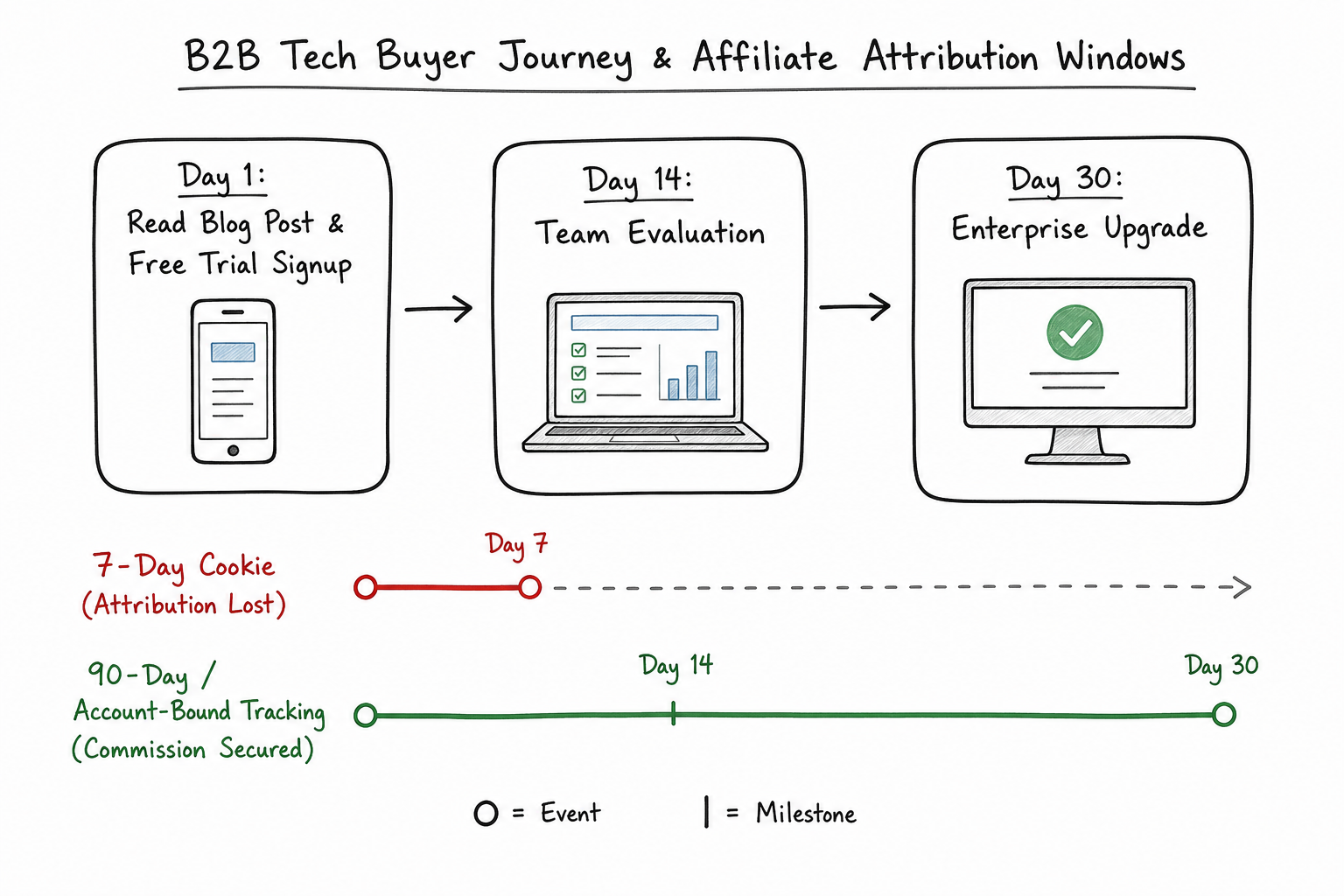
Professional purchases require approval. If a marketing manager reads your review of an SEO auditing tool, they cannot simply click and buy. They have to sign up for a free trial, test the software for two weeks, pitch the cost to their financial department, and finally upgrade to a paid tier a month later.
Traditional networks that default to 7-day or 14-day tracking cookies are fundamentally incompatible with this reality. You did the heavy lifting of introducing the customer to the brand, but because the software evaluation process took 21 days, you receive zero compensation.
The Tech Affiliate Gold Standard: Recurring SaaS Revenue
If you want to build a sustainable, high-revenue tech blog, you have to pivot your monetization strategy away from physical hardware and toward Software as a Service (SaaS).
In the software world, the cost of replication is zero. Once a company builds a piece of software, it costs them virtually nothing to allow one more user to download or access it. Because their profit margins are incredibly high, they can afford to pay affiliates aggressively to acquire new users.
Predictable Income vs. One-Off Sales
The defining feature of the SaaS industry is the subscription model, and the defining feature of lucrative tech affiliate programs is the recurring commission.
Instead of earning a one-time bounty when a user signs up, recurring programs pay you a percentage of the customer's subscription fee every single month for as long as they remain a paying customer. In the tech space, you should be looking for programs offering anywhere from 20% to 50% in recurring monthly commissions.
The mathematics of recurring revenue entirely change how you value your content. If you refer 50 customers to a $100/month project management tool, and the program offers a 30% recurring commission, you are earning $1,500 in predictable, passive income every single month. Even if your traffic drops the following month and you refer zero new customers, your baseline revenue remains intact.
Evaluating Churn and Customer Lifetime Value (CLV)
When evaluating a SaaS affiliate program, the commission percentage is only half the equation. The other half is the product's churn rate—the percentage of users who cancel their subscription each month.
A 50% recurring commission sounds fantastic, but if the software is buggy, difficult to use, or easily outgrown, users will cancel after a month or two. Conversely, a 20% commission on a deeply integrated infrastructure tool (like cloud hosting, CRM software, or payment processors) can be vastly more profitable.
Tech users rarely switch core infrastructure once it is implemented. The friction of migrating a 100-page website to a new host, or moving a 10,000-person email list to a new provider, is too high. If you can successfully refer a customer to these "high-friction" SaaS products, your recurring commission can last for years.
To identify 11 Best Niches for Affiliate Marketing (SaaS & Digital), you must analyze how integral the software becomes to the buyer's daily workflow. The stickier the product, the more valuable the affiliate partnership.
Matching the Buying Journey to Cookie Duration
In tech marketing, attribution is everything. Because the consideration phase is so long, the duration of the tracking cookie dictates whether you get paid for your work.
If a program limits your cookie window to 24 hours (a standard practice for massive retail aggregators), you are effectively working for free. You are doing the top-of-funnel educational work, but the final purchase will inevitably happen outside your attribution window.
Hunting for Extended Tracking Windows
When browsing alternatives to legacy networks, mandate a minimum cookie duration based on the complexity of the software:
- Low-complexity tools (browser extensions, simple graphic design apps, basic VPNs): Minimum 30-day cookie.
- Medium-complexity tools (email marketing platforms, project management software, SEO suites): Minimum 60-day cookie.
- High-complexity B2B software (enterprise CRM, cybersecurity infrastructure, payroll software): Minimum 90-day to lifetime cookies.
A lifetime cookie (or a program that hard-codes your affiliate ID to the user's account upon their first free trial signup) is the ultimate prize in tech affiliate marketing. This ensures that even if the user stays on the free tier for six months before finally upgrading, your account is still credited with the sale.
Cross-Device Tracking Realities
Tech audiences consume content differently than general audiences. A developer might read your blog post on their mobile phone during their morning commute, but they will wait until they are sitting at their dual-monitor desktop setup to actually download, install, and purchase the software.
If the affiliate program uses rudimentary, cookie-only tracking, that mobile-to-desktop transition breaks the attribution chain. When researching how to choose lucrative affiliate programs for tech blogs, dig into the program's technical documentation to see if they offer cross-device tracking or lead-based attribution. The best SaaS programs track the user's email address upon a free trial signup, bypassing browser cookies entirely and ensuring you get paid no matter what device the user ultimately purchases on.
Top ShareASale Alternatives for Discovering Tech Programs
The biggest hurdle in building a profitable tech blog is simply finding the right partners. Manually searching "software name + affiliate program" on Google yields outdated landing pages, broken links, and programs that have quietly shut down.
Signing up for a dozen different legacy networks just to view their merchant directories is a massive waste of time. You often have to submit your website for approval, wait weeks for an account manager to review it, and sign complex terms of service—all before you are even allowed to see if they have tech programs worth promoting.
AffiliList: The Directory for SaaS and Digital Tools
This lack of transparency is exactly why specialized directories have become essential for tech publishers. AffiliList serves as a streamlined, clutter-free directory specifically engineered to solve this discovery problem.
Instead of hiding critical data behind network logins and approval walls, AffiliList maintains an open, curated database of over 10,000 affiliate programs, with a heavy emphasis on SaaS, digital tools, and high-ticket B2B software.
For a tech blogger, this level of access changes the research phase entirely. You can utilize advanced filtering options to strictly view programs offering recurring commissions, or sort by specific software sub-niches like HR software, crypto infrastructure, or AI development tools. You can immediately see the commission percentages, payout terms, and cookie durations without having to join a network first.
By prioritizing verified data and user-friendly navigation, AffiliList helps you bypass the outdated, cluttered lists found elsewhere on the web, allowing you to quickly compare opportunities and choose the most lucrative options for your specific audience.
Specialized SaaS Networks
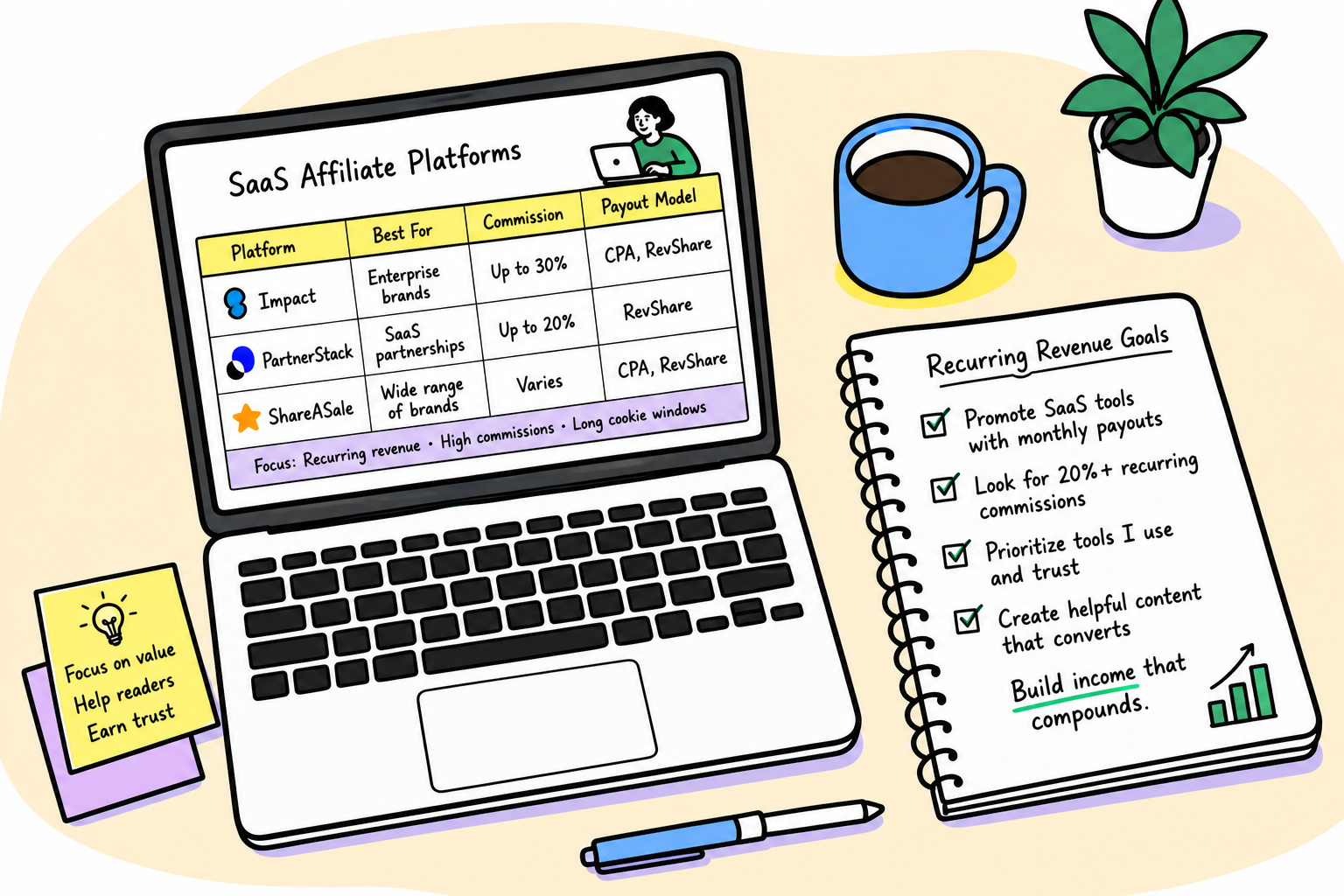
If you are stepping away from retail-focused networks, you will likely encounter merchants using platforms tailored specifically for software and digital subscriptions. Networks like PartnerStack and Impact have recognized the shift toward SaaS and built their attribution models to handle B2B sales cycles, recurring payouts, and trial-to-paid conversions.
However, even on these specialized networks, finding the right merchant can be overwhelming. Using a transparent directory to pre-qualify the merchants before you go through the hassle of applying to their specific network is the most efficient workflow for a busy content creator.
In-House Programs vs. Aggregators
Many of the most lucrative tech affiliate programs are run entirely in-house. Software companies with massive marketing budgets often prefer to build their own affiliate tracking software rather than pay a percentage to a third-party network.
These in-house programs frequently offer the best terms—higher commissions, longer cookies, and direct access to affiliate managers—but they are notoriously difficult to find because they aren't listed on standard networks. This is where comprehensive databases that aggregate both network-based and in-house programs become invaluable, ensuring you aren't leaving money on the table simply because a merchant chose to build their own tracking stack.
Key Metrics to Analyze When Choosing Tech Programs
When you pull up a list of potential software partnerships, the initial data can be overwhelming. Beyond the baseline commission rate and the cookie window, you need a framework for evaluating whether a program will actually convert your traffic into cash.
The Earnings Per Click (EPC) Reality Check
Traditional networks prominently display EPC (Earnings Per Click) as a primary metric for merchant quality. If a merchant has a $100 EPC, it implies that affiliates earn an average of $100 for every 100 clicks they send.
In the tech space, network-reported EPC is often highly misleading.
SaaS EPCs are frequently inflated by coupon sites and highly targeted brand-bidding PPC (Pay-Per-Click) affiliates. A coupon site ranking for "SoftwareName discount code" will capture users who already have their credit card in hand. Their conversion rate will be astronomical, driving the average EPC sky-high.
As a tech blogger writing educational content, tutorials, and comparative reviews, your traffic is higher in the funnel. Your readers are still making a decision. Your personal EPC will almost certainly be lower than the network average. Instead of relying on blended EPC data, look for programs that offer transparent conversion rates for content publishers, or test the offer with a small amount of traffic to establish your own baseline.
Commission Tiers and Performance Bumps
The best tech programs incentivize volume. While a program might advertise a standard 20% recurring commission, dig into their terms to see if they offer tiered performance bumps.
Many high-quality B2B software companies will bump your commission to 30% once you refer 50 active customers, and up to 40% once you cross the 100-customer threshold. When you are evaluating 11 High Paying Affiliate Programs for $500+ Commissions, factor in where those tiers begin. A program that starts slightly lower but scales aggressively is often more profitable long-term than a program with a flat, immovable rate.
| Metric | Flat Rate Model | Tiered Performance Model |
|---|---|---|
| Initial Commission | 30% recurring | 20% recurring |
| At 50 Active Users | 30% recurring | 30% recurring |
| At 100 Active Users | 30% recurring | 40% recurring |
| Long-Term Growth | Stagnant | Highly Scalable |
Analyzing Reversal Rates
In the affiliate world, a "reversal" occurs when a merchant cancels your commission after a sale is recorded. In the physical goods space, this happens when a customer returns a defective product.
In the SaaS and digital tools space, reversals happen due to credit card fraud, chargebacks, or immediate cancellations of paid accounts. Before heavily committing to a tech program, look at their historical reversal rate. If a software company is aggressively reversing more than 5% to 10% of their affiliate sales, it is a massive red flag. It indicates either a fundamental problem with the software's quality (causing users to demand immediate refunds) or a predatory affiliate management team that uses aggressive fraud filters to deny legitimate publisher payouts.
How to Match Tech Products to Your Specific Audience Intent
A common mistake new tech bloggers make is assuming "tech" is a monolith. The reality is that the tech space is heavily segmented, and promoting the wrong type of product to the wrong sub-niche guarantees a zero percent conversion rate.
If you want to know How to Pick a Niche for Affiliate Marketing in 5 Steps, you must start by deeply understanding your reader's technical proficiency and budget authority.
Developers vs. Marketers vs. Consumers
Consider how differently these three audiences interact with software:
- The Developer: Developers are highly skeptical of marketing copy. If your blog targets software engineers, do not promote generic website builders or low-tier hosting. They will see right through it. Instead, you need to promote infrastructure tools: API services, advanced cloud environments (AWS, DigitalOcean integrations), specialized IDEs, and deployment pipelines. These programs often require a highly technical pitch, but the lifetime value of an enterprise developer account is massive.
- The Digital Marketer: If your blog targets marketers, SEOs, or agency owners, the friction is lower, but the competition is fierce. This audience wants tools that save them time or make them money. CRM software, automated outreach tools, and analytics platforms convert incredibly well here. Because this audience buys software constantly, they are more willing to try new SaaS products.
- The Prosumer/Consumer: If you run a YouTube channel or blog focused on video editing, podcasting, or gaming, your audience is largely consumers or "prosumers" (professional consumers). They are looking for one-off software licenses, premium plugins, hardware peripherals, and creative subscriptions. The recurring revenue potential is lower here, but the sheer volume of traffic can make up for it.
High-Ticket Hardware vs. Low-Friction Software
While SaaS is the gold standard, hardware still has a place in a balanced tech portfolio—provided you target high-ticket, specialized gear.
If you are writing about $50 keyboards, a 4% commission yields $2. You would need thousands of clicks to see meaningful revenue. However, if your tech blog targets enterprise IT professionals buying $10,000 server racks, or audio engineers buying $4,000 mixing consoles, that same small percentage suddenly becomes highly lucrative.
The key is aligning the product's price point with the reader's intent. If your reader is searching for "best budget routers," they have a low intent to spend. If they are searching for "enterprise firewall solutions for hybrid offices," they have a massive budget and a high intent to purchase.
Red Flags in Tech Affiliate Programs
Not all high-paying programs are created equal. The tech industry moves fast, and some merchant programs are built with terms that actively sabotage publishers. When auditing a new program found on AffiliList or a specialized network, watch out for these critical failure modes.
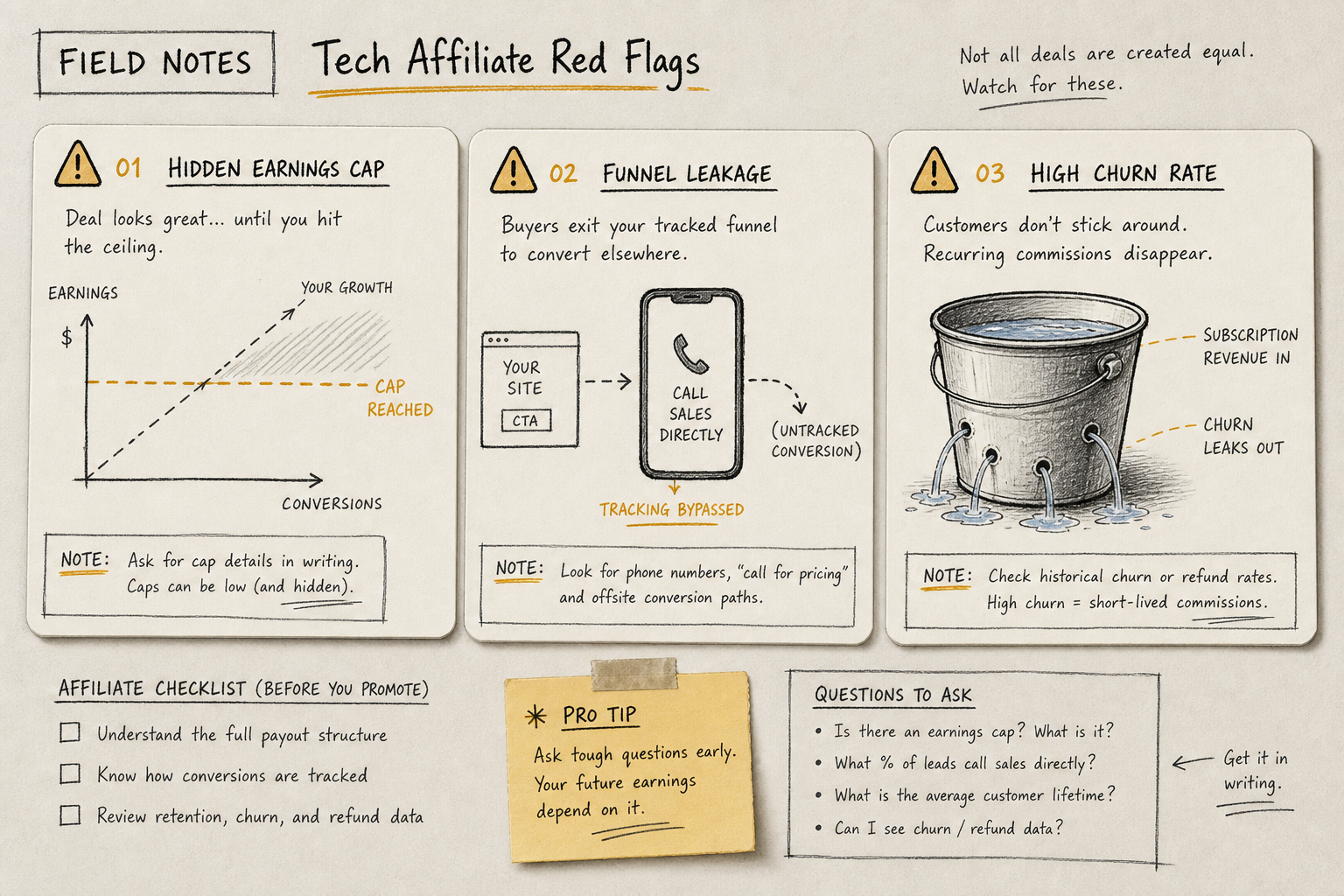
Hidden Earnings Caps
You write a brilliant case study on how a specific enterprise software saved a business $50,000. A massive corporation reads your post, clicks your link, and signs a $100,000 annual contract. You eagerly check your dashboard for your 20% commission ($20,000), only to find a payout of $500.
You fell victim to a hidden earnings cap.
Many B2B tech programs bury a clause in their terms of service stating that commissions are capped at a specific dollar amount per referral, regardless of the deal size. If you are targeting enterprise tech buyers, an earnings cap destroys your upside potential. Always read the fine print to ensure your high-ticket referrals are uncapped.
Sales Funnel "Leakage"
Leakage occurs when a merchant's landing page provides multiple ways for a user to convert that bypass your affiliate tracking.
In the tech space, the most common form of leakage is a prominent "Call Sales to Book a Demo" phone number. If your reader clicks your affiliate link, lands on the software homepage, and decides to call the phone number instead of filling out the online form, the affiliate tracking cookie is entirely bypassed. The merchant gets a lucrative enterprise lead, and you get nothing.
Before promoting a high-ticket software tool, click your own affiliate link and evaluate the landing page. Are they aggressively pushing phone calls or non-tracked live chats? If the page is highly leaky, your conversion rates will plummet, no matter how good your content is. Look for merchants that use dedicated affiliate landing pages without conflicting calls to action.
Predatory Bidding Policies
Virtually all tech affiliate programs prohibit you from bidding on their trademarked brand name in Google Ads (e.g., you cannot run ads targeting the keyword "Buy HubSpot"). This is standard practice.
However, predatory programs go a step further. They will prohibit you from bidding on non-branded industry keywords, or worse, they will claim the right to cancel your commissions if you even organically rank for certain highly competitive terms. Ensure the program's promotional guidelines are reasonable and do not restrict your ability to leverage SEO effectively.
Building a Tech Affiliate Strategy That Converts
Finding the right programs is only the first step. To actually generate revenue, you must adapt your content strategy. The tactics used by lifestyle bloggers simply do not work for complex digital products.
If you are looking at How to Start a Profitable Affiliate Marketing Blog in the tech space, you must transition away from superficial listicles and toward deep, implementation-focused content.
Stop Writing Broad Lists, Start Writing Deep Tutorials
A generic article titled "Top 10 Project Management Tools" is incredibly difficult to rank for, and even if it does, the conversion rate is often abysmal. The reader is overwhelmed by choices and suffers from analysis paralysis.
Tech buyers convert when they see exactly how a tool solves their specific problem. Instead of broad lists, write deep, hyper-specific tutorials.
- Instead of: "5 Best CRM Platforms"
- Write: "How to Automate Client Onboarding Using [CRM Name] and Zapier"
In the second example, you aren't just telling the reader about the software; you are showing them how to build a valuable system with it. By the time they finish the tutorial, they don't just want the software—they need it to implement the solution you just taught them. This drastically increases your trial-to-paid conversion rate.
Leverage Software Integration Stacks
Tech products do not exist in a vacuum. A business using Shopify for ecommerce is likely also using Klaviyo for email, Ahrefs for SEO, and Zendesk for support.
You can multiply your affiliate revenue by creating content that showcases how different software tools integrate with one another. If you write an exhaustive guide on building an automated e-commerce tech stack, you can naturally embed affiliate links for the hosting provider, the email platform, the analytics tool, and the payment gateway all within the same article.
This strategy provides immense value to the reader (who needs to know how to connect these systems) while allowing you to monetize a single visitor across multiple high-yield SaaS programs.
The Power of the "Alternatives" Keyword
One of the highest-converting keywords in the tech affiliate space is the "[Competitor Name] Alternatives" structure.
When a user searches for "Mailchimp Alternatives," their intent is crystal clear: they are currently using a specific software, they are unhappy with it (due to price, features, or support), and they have their credit card ready to switch to a competitor.
If you can use a directory to find emerging, high-paying software programs that directly compete with industry giants, you can build highly profitable comparison pages. Position the lucrative affiliate product as the superior alternative, highlighting exactly where it outperforms the legacy software.
Before trying to rank these pages, it's worth understanding the fundamentals and avoiding scams. Check out our guide on Is Affiliate Marketing Legit? (How to Spot Real Offers) to ensure the alternative products you promote are actually delivering value to the user and not just padding their commission rates to hide a substandard product.
FAQs About Choosing Tech Affiliate Programs
Are hardware or software affiliate programs more profitable?
In the vast majority of cases, software (SaaS) is significantly more profitable for tech bloggers. Software offers high margins, recurring monthly commissions, and longer tracking cookies. Hardware relies on low-margin, one-time payouts and short retail cookie windows. Hardware is only highly profitable if you are targeting massive enterprise-level infrastructure purchases.
How do I know if a SaaS program is actually converting?
You cannot rely solely on network-provided EPC data. The best way to test a program is to drive a small, controlled amount of targeted traffic to it and measure the trial sign-up rate. If the software offers a 14-day free trial, track how many of those free users upgrade to paid. If your trial-to-paid ratio is below 10%, the software either has a poor onboarding process, or it is a mismatch for your audience's needs.
Can I join high-ticket tech affiliate programs without a massive audience?
Yes. B2B software companies care far more about the quality and relevance of your audience than the sheer volume of your traffic. An enterprise cybersecurity company will happily approve a tech blog with only 1,000 monthly visitors if those visitors are IT directors and system administrators. When applying to specialized programs, emphasize your niche authority and the specific intent of your readers.
Why is discovering good tech programs so difficult?
Legacy networks group thousands of merchants together with poor filtering systems, forcing you to wade through irrelevant physical products to find decent software deals. Additionally, many great software companies run their programs in-house, keeping them off standard networks entirely. Utilizing a dedicated digital directory that aggregates both in-house and network programs is the fastest way to solve this bottleneck.
Final Strategic Thoughts
Choosing lucrative affiliate programs for tech blogs is not about finding the single highest commission percentage on the internet. A 90% commission on a terrible piece of software that everyone cancels after a month is worthless.
Your goal is to build a portfolio of reliable, high-retention SaaS tools that fundamentally improve your readers' professional lives. Focus on recurring revenue models, demand extended cookie durations to accommodate the B2B evaluation process, and meticulously analyze the conversion friction of the landing pages you send traffic to.
Stop wasting hours digging through generalized retail networks that weren't built for digital products. Leverage specialized, transparent directories that put the vital metrics—commission structures, software categories, and payout terms—front and center. By aligning your deeply technical content with high-yield software partnerships, you can transform a standard tech blog into a highly scalable, passive revenue engine.