
Shareasale Alternatives for Find Vetted Affiliate Programs Online
Discover the best ShareASale alternatives and learn how to find vetted affiliate programs with reliable tracking, transparent payouts, and zero dead links.
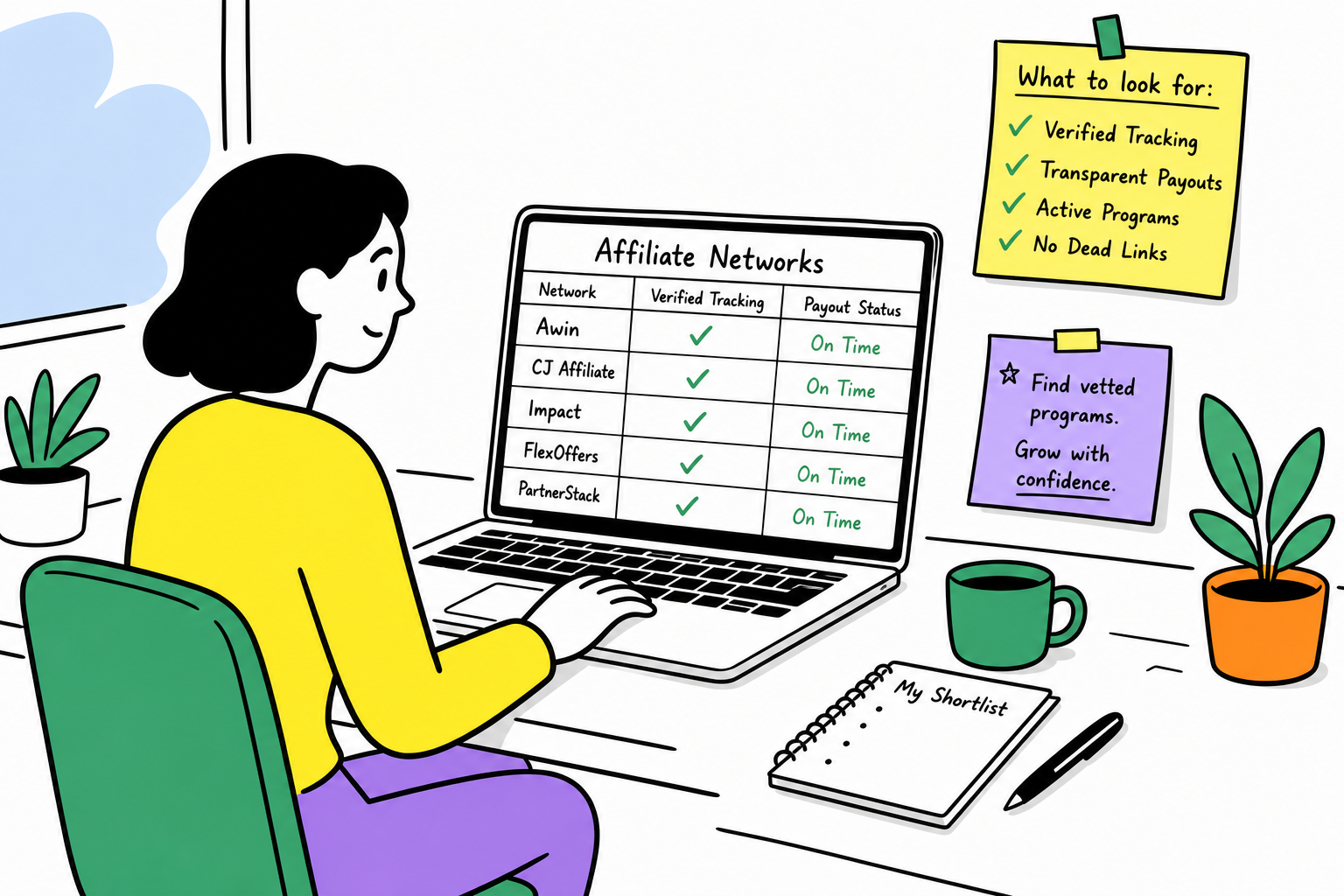
You spend hours researching a topic, structuring a comprehensive guide, and optimizing your content to rank. The traffic starts flowing. Clicks on your affiliate links are registering. But when you log into your affiliate dashboard at the end of the month, your commission balance reads zero.
This is the harsh reality of partnering with unvetted affiliate programs. Often, the issue is not your traffic or your conversion copy. The problem lies with legacy affiliate networks hosting "zombie" merchants, outdated tracking pixels that fail on modern browsers, or leaky sales funnels that strip your attribution before the checkout page.
For years, affiliates have relied on massive legacy networks like ShareASale simply because they were the default. But the affiliate landscape has evolved. Finding vetted affiliate programs—partnerships with verified liquidity, transparent commission structures, and reliable attribution technology—requires looking past the cluttered, gatekept directories of the past.
Whether you are monetizing a niche blog, building an email list, or driving traffic through social media, your profitability depends entirely on the integrity of the programs you promote. This guide breaks down the exact mechanisms for finding high-converting, strictly vetted affiliate programs online, and explores the modern alternatives to traditional networks.
The Problem with Legacy Affiliate Networks
ShareASale and its contemporaries helped build the affiliate marketing industry. However, as the digital economy shifted heavily toward SaaS, subscription models, and high-ticket digital tools, the cracks in these older platforms became obvious.
To understand why modern affiliates are looking for alternatives, you have to understand the friction points built into legacy systems:
- Gatekept Commission Data: On many traditional networks, you cannot see a merchant's full terms, cookie duration, or exact payout structure until you create an account, apply to the specific program, and wait for approval. You waste days applying for programs that turn out to offer a dismal 2% commission.
- The "Zombie Merchant" Problem: Legacy networks are filled with merchants who launched an affiliate program five years ago, left the company, and never updated their assets. You might promote a product only to find out the merchant's tracking link redirects to a 404 page.
- Cluttered Interfaces and Poor Data: Filtering for specific niches, recurring commission models, or specific payout thresholds on older platforms often feels like using software from 2010. The data is rarely standardized, making side-by-side comparisons nearly impossible.
- Approval Bottlenecks: Many legacy merchants require manual approval for new affiliates. If the merchant doesn't have an active affiliate manager checking the queue, your application could sit in pending status for months.
If you are treating your site as a serious business, you cannot afford to wait weeks just to discover a program's basic terms. You need an approach that prioritizes transparency and speed.
What Makes an Affiliate Program Truly "Vetted"?
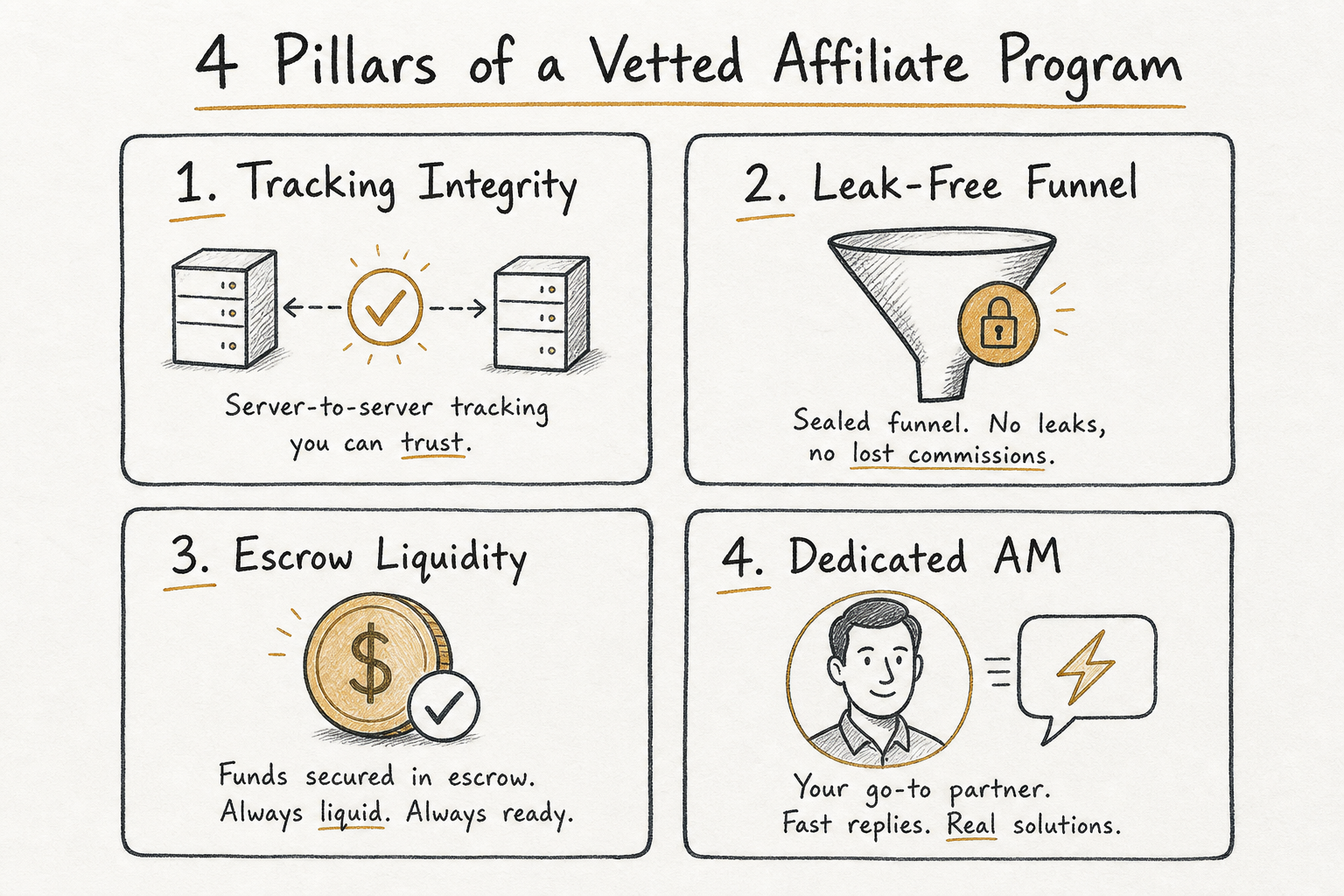
Before you start hunting for ShareASale alternatives, you need a clear definition of what a "vetted" program actually looks like. Vetting goes far beyond confirming the company is a legal entity. A rigorously vetted affiliate program meets four critical criteria.
1. Reliable Tracking and Attribution Integrity
If a merchant is running a homegrown affiliate script they bought for $50 in a marketplace, your clicks are at risk. Vetted programs use enterprise-grade tracking software (like Impact, PartnerStack, Rewardful, or FirstPromoter) that relies on server-to-server tracking or robust first-party cookies. This ensures that when Apple or Google updates their browser privacy policies (like Intelligent Tracking Prevention), your commissions do not vanish.
2. A Closed, "Leak-Free" Sales Funnel
A leaky funnel is an affiliate's worst nightmare. You send a highly qualified lead to a merchant's landing page, but the page features a prominent "Call for Custom Pricing" button. If the user calls, the sales rep closes the deal over the phone, the affiliate cookie is never fired at checkout, and you lose the commission. Vetted programs structure their funnels so that offline sales, cross-sells, and phone upgrades still map back to the original affiliate's ID.
3. Transparent Liquidity and Payout History
A program can promise a 50% recurring commission, but if they lack the cash flow to pay you on time, the percentage is meaningless. Vetted programs—especially those hosted on major modern networks or curated directories—often have to pre-fund their affiliate accounts. If a merchant runs out of funds in their escrow account, the network pauses their links immediately, protecting affiliates from driving free traffic.
4. Active Program Management
Vetted programs have dedicated affiliate managers. These are actual humans who review applications quickly, provide updated promotional assets, communicate upcoming promotional calendars, and are available to resolve missing transaction queries.
5 Methods to Find Vetted Affiliate Programs Online
Finding these high-quality programs requires bypassing the noisy "get rich quick" blogs and going straight to trusted infrastructure. Here are the most effective, streamlined strategies to source vetted affiliate partnerships today.
1. Leverage Curated Open-Access Directories (The AffiliList Method)
The most efficient way to bypass the friction of legacy networks is to use a modern, curated database. Instead of signing up for a dozen different networks just to see what is out there, successful affiliates use centralized hubs that aggregate and verify program data.
AffiliList was built specifically to solve the data-obscurity problem. As a comprehensive directory focusing heavily on SaaS and digital tools, AffiliList maintains a curated database of over 10,000 affiliate programs.
The primary advantage here is open access. You do not need to sign up for an account to view critical program details. You can instantly filter the database to find exactly what you need, viewing the commission percentages, cookie durations, and payout types (one-time vs. recurring) immediately. By prioritizing transparency and user-friendly navigation, AffiliList helps you bypass outdated lists and easily compare different opportunities to choose the most lucrative options for your specific audience.
Because the data is actively maintained and categorized with an extensive tagging system, you can quickly locate high-converting offers across hundreds of specific sub-niches without wasting time on dead links or zombie programs.
2. Focus on Tier-1 SaaS and Tech Networks
If you are moving away from physical retail products (which traditionally offer low margins and short cookies), SaaS is where the leverage is. Software companies have high profit margins and rely heavily on partner ecosystems for acquisition.
Networks designed specifically for B2B software and digital tools inherently vet their merchants more thoroughly. The cost to integrate with platforms like PartnerStack or Impact is significantly higher than older networks, which creates a natural barrier to entry. Only companies with serious marketing budgets and validated products can afford to join them. If you are exploring the best niches for affiliate marketing, targeting the programs hosted on these premium tech networks is a proven path to profitability.
3. Conduct Competitor Backlink Audits
Your competitors have already spent hundreds of hours vetting affiliate programs. You can ethically reverse-engineer their research.
Using an SEO tool like Ahrefs or Semrush, plug in a highly successful blog in your niche. Go to the "Outgoing Links" or "Linked Domains" report. Filter the outgoing links to show domains that include common affiliate tracking parameters like:
?ref=?via=?aff=go.out.track.
By exporting this list, you can see exactly which programs your competitors are actively promoting. If a dominant player in your space is heavily linking to a specific software tool, it is highly probable that the program converts well and pays reliably.
4. Utilize Advanced Search Operators
While standard Google searches often yield outdated listicles, using advanced search operators can uncover independent affiliate programs hosted on reliable tracking software like FirstPromoter, Rewardful, or Tapfiliate.
Since these SaaS tracking platforms use predictable URL structures for their sign-up pages, you can search for them directly. Try entering these strings into Google, replacing "your niche" with your actual topic:
"your niche" inurl:firstpromoter.com"your niche" inurl:rewardful.com"your niche" + "powered by Tapfiliate"
This method bypasses the networks entirely and connects you with independent, modern SaaS companies that manage their own highly lucrative programs.
5. Direct Interrogation of Tech Stacks
If you find a product you love and want to promote it, but you cannot find an affiliate link in their website footer, look at their tech stack. Many companies have private, invite-only affiliate programs for vetted creators.
Use a tool like Wappalyzer or BuiltWith to scan the company's website. If you see they have an affiliate tracking script installed (like Post Affiliate Pro or Impact) but no public sign-up page, they are running a private program. Reach out to their marketing department directly, pitch your traffic metrics, and ask for an invite. Private programs usually offer the highest commissions because they aren't diluted by thousands of inactive affiliates.
Top ShareASale Alternatives for Modern Affiliates
If you are ready to migrate away from older platforms, here are the most robust alternatives that prioritize vetted merchants, accurate tracking, and transparent payouts.
Impact.com (Best Overall Alternative)
Impact (formerly Impact Radius) has aggressively captured the modern affiliate market. They moved away from the traditional "affiliate network" model and positioned themselves as a "partnership management platform."
Why it’s vetted: Impact requires merchants to undergo strict compliance checks. Their platform attracts massive, well-funded brands (like Canva, HubSpot, and HostGator). The Advantage: Their user interface is remarkably clean. Impact allows for incredibly complex, customized payout structures. A merchant can automatically increase your commission rate once you pass a certain number of sales per month, or pay you a flat bounty for a free trial sign-up, followed by a percentage if the user upgrades to a paid plan.
PartnerStack (Best for B2B SaaS)
If your audience consists of entrepreneurs, small businesses, or digital marketers, PartnerStack is the gold standard. It was built from the ground up specifically for software-as-a-service (SaaS) companies.
Why it’s vetted: PartnerStack is expensive for merchants to use, which automatically weeds out fly-by-night operations. The platform is home to high-ticket, recurring commission software like Monday.com, Webflow, and Notion. The Advantage: PartnerStack natively understands recurring revenue. The dashboard shows your active referrals, trial conversions, and expected recurring lifetime value with perfect clarity. They also consolidate all your payouts across different software programs into a single monthly payment via Stripe or PayPal, drastically reducing administrative overhead.
Awin (Best for Global E-commerce and Retail)
Awin actually acquired ShareASale a few years ago, but the Awin platform itself operates on a different, more globally focused infrastructure. If you are in the fashion, finance, or physical goods space, Awin is a necessary upgrade.
Why it’s vetted: Awin operates heavily in the European market, which means they maintain strict adherence to GDPR and advanced compliance standards. They monitor their merchants for financial stability to ensure affiliates are protected. The Advantage: Awin offers a massive directory of high-street brands, financial institutions, and telecommunications companies. Their tracking technology, including their "bounceless" tracking (which avoids unnecessary redirects that can trigger ad blockers), ensures higher attribution rates for mobile traffic.
AffiliList (Best for Immediate Discovery and Transparency)
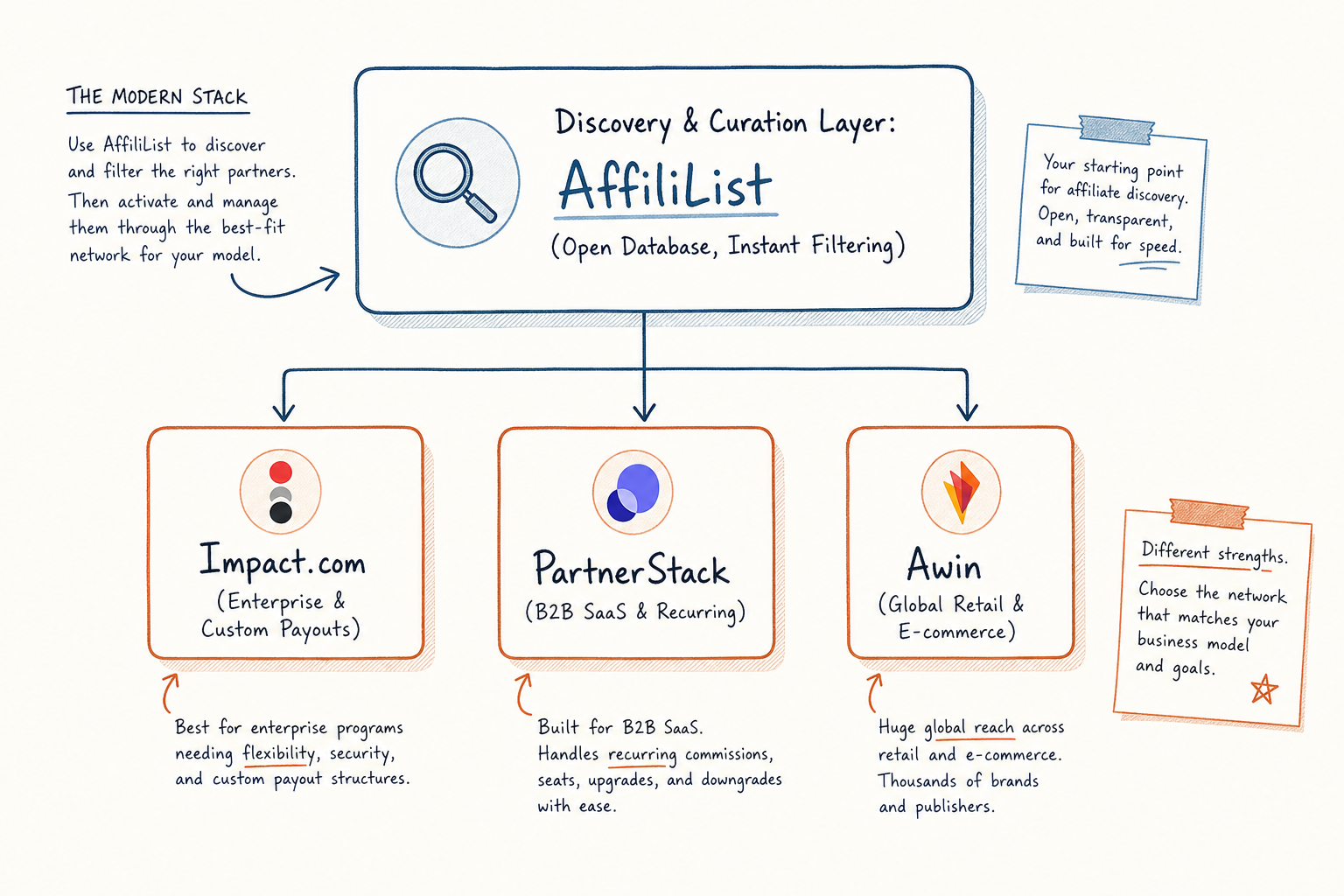
While Impact, PartnerStack, and Awin are networks (meaning they handle the tracking and payments), AffiliList operates as the discovery engine layer above them.
Why it’s vetted: The platform curates data, weeding out the noise and focusing on legitimate opportunities, particularly in the SaaS and digital tools space. The Advantage: You can use AffiliList's advanced filtering options to locate programs with specific commission rates across diverse categories—ranging from finance and crypto to HR software and YouTube marketing tools. Once you find the perfect program on AffiliList, you can click through to join it directly, whether it is hosted on Impact, PartnerStack, or an independent platform. It functions as your centralized research command center.
Red Flags: How to Spot Unvetted, Toxic Affiliate Offers
Even when using reputable discovery tools or modern networks, you must still conduct your own due diligence before committing your traffic to a specific merchant. If you are wondering, "is affiliate marketing legit?", the answer is yes—but only if you avoid operators who use predatory terms to cheat affiliates out of their earnings.
When reviewing a program's Terms of Service or evaluating their landing page, watch out for these massive red flags:
1. The "Last Cookie Wins" Loophole (Coupon Site Hijacking)
Most affiliate programs operate on a "last click wins" model, meaning the last affiliate link the user clicks before buying gets the commission. This is standard. However, unvetted programs often allow spammy coupon websites into their network.
Here is what happens: You write a massive review of a software tool. The reader clicks your link, goes to the checkout page, and sees a "Promo Code" box. They leave the checkout page, Google "[Brand Name] promo code", and click on a massive coupon aggregator site. That coupon site drops a new cookie on the user's browser. The user goes back, completes the purchase without a code, but the coupon site steals your commission.
Vetted, high-quality programs actively ban coupon and trademark-bidding affiliates to protect the content creators who actually drive the initial discovery. Check the program's terms to ensure coupon sites are restricted.
2. Disproportionately Short Cookie Durations
The cookie duration dictates how long after the initial click you are eligible to receive a commission. If you are promoting a $10 impulse buy on Amazon, a 24-hour cookie is acceptable.
However, if you are promoting a $2,000 B2B software package or looking for high paying affiliate programs with $500+ commissions, a 7-day cookie is a glaring red flag. High-ticket items require consideration, approval from management, and multiple touchpoints. A vetted high-ticket program will offer a 60-day, 90-day, or even lifetime cookie to ensure you are fairly compensated for introducing the lead to their ecosystem.
3. Extremely High EPCs with Unrealistic Conversion Rates
EPC stands for Earnings Per Click. It is a metric networks display to show how well an offer converts. If you see an offer promising an EPC of $15.00 on a $50 product, be incredibly skeptical.
Often, unvetted networks manipulate EPCs by only counting clicks that reach the final checkout page, rather than all raw clicks sent to the landing page. Alternatively, a sky-high EPC might indicate that the merchant has exceptionally high refund rates or chargebacks, which will eventually be deducted from your account. Always prioritize merchants with transparent, steady historical data over those promising mathematically improbable returns.
4. Poorly Designed Landing Pages
As an affiliate, your job is to drive the click. The merchant's job is to close the sale.
Before you join a program, click their affiliate link on both desktop and mobile. If their landing page takes four seconds to load, lacks clear calls to action, or features broken images, run away. It does not matter if they offer an 80% commission if their website converts at 0.1%. Vetted merchants invest heavily in Conversion Rate Optimization (CRO) because they view affiliates as valuable partners, not cheap traffic sources.
Step-by-Step Workflow for Vetting an Independent Offer
Sometimes, the best opportunities are not on any major network. A startup might reach out to you directly, or you might find a localized niche tool that runs an independent affiliate program using software like Tapfiliate or FirstPromoter.
When you do not have a network acting as an intermediary to enforce compliance, you must act as your own compliance officer. Here is the exact workflow for vetting an independent program before you start building content around it.
Step 1: Test the Tracking Parameter
Sign up for the program and get your affiliate link. Open an "Incognito" or "Private Browsing" window. Click your own link. Then, right-click on the landing page and select "Inspect" to open the browser developer tools.
Navigate to the "Application" or "Storage" tab, and look at the Cookies. You should be able to clearly see your affiliate ID or the tracking software's cookie actively stored in your browser. If you don't see it, their tracking is broken, and you won't get paid.
Step 2: Analyze the Payout Thresholds
Read the fine print regarding minimum payouts. A company might offer a generous 40% commission, but quietly stipulate a $500 minimum payout threshold. If you are a newer creator testing the waters or building an affiliate marketing side hustle, it could take you a year to hit that threshold, effectively giving the merchant a free loan of your earnings. Standard, vetted programs usually set their payout thresholds between $50 and $100.
Step 3: Check the Payment Schedule (Net-30 vs. Net-60)
When do you actually get the money? Most vetted programs operate on Net-30 terms. This means commissions earned in January are paid out at the end of February. This 30-day buffer allows the merchant to account for refunds or fraudulent credit card purchases.
If an independent program states they operate on Net-60 or Net-90 terms, proceed with extreme caution. Startups that stretch their affiliate payments to 90 days often have cash flow problems and are using affiliate earnings as working capital.
Step 4: Submit a Support Ticket
Before you send a single visitor to their site, email their affiliate support desk with a basic question. (e.g., "Hi, do you have any updated banner creatives for the Q3 feature launch?")
Track how long it takes them to respond. If you receive an automated reply and no human follow-up within 72 hours, abandon the program. If they will not answer a simple question when you are onboarding, they certainly will not respond when you are trying to track down a missing $1,000 commission.
The Role of Dedicated Affiliate Managers
One of the most overlooked aspects of finding vetted programs is evaluating the human infrastructure behind the software. When exploring profitable affiliate marketing niches, you will quickly notice that the most lucrative spaces—like finance, enterprise software, and high-end health products—employ dedicated Affiliate Managers (AMs).
A good affiliate manager is not just a customer service rep; they are your internal advocate at the merchant's company.
When evaluating a new program, finding out if they have an active AM can be the deciding factor. You can usually verify this by searching LinkedIn for "[Company Name] Affiliate Manager" or "[Company Name] Partnerhips Manager."
An active AM will proactively offer you:
- Custom Landing Pages: Co-branded pages with your logo (e.g., "Special offer for readers of [Your Site]").
- Exclusive Promo Codes: Custom discount codes that also act as a tracking mechanism (even if the user clears their cookies).
- Performance Bumps: The authority to temporarily increase your commission rate by 10% during a Black Friday push or special webinar.
- Early Access: Advance notice of upcoming product features or price changes so you can update your content before your competitors.
Programs on legacy networks like ShareASale often lack dedicated AMs, leaving thousands of affiliates to rely on automated generic newsletters. Vetted programs, specifically those highlighted on curated directories like AffiliList, prioritize active relationship management.
Navigating the B2B vs. B2C Vetting Divide
As you move away from generalist networks, you must adjust your vetting criteria based on the audience you serve.
If you run a consumer-facing site (B2C) reviewing kitchen gadgets, your primary vetting concern is conversion rate and volume. You want a program that removes all friction from the checkout process because consumer decisions are made in minutes.
However, if you are operating in the B2B space—perhaps running an affiliate marketing blog teaching people how to use email marketing software—your vetting process must account for long sales cycles. B2B software decisions can take weeks. Multiple stakeholders might visit the site. The user might sign up for a free trial on their work laptop but upgrade to a paid plan on their phone.
When vetting B2B SaaS programs, prioritize platforms that utilize cross-device tracking and lead lifecycle tracking. Programs hosted on PartnerStack or Impact excel at this. They track the initial lead capture (the email sign-up) rather than just dropping a temporary browser cookie. When that lead eventually converts to a paid customer 45 days later, the backend system maps the email address back to your original affiliate referral, securing your commission.
Frequently Asked Questions
Do I have to pay to join a vetted affiliate network or directory? Legitimate affiliate programs and networks will never charge you a fee to join. If a program requires an "application fee" or forces you to buy their product before you can promote it, it is likely a multi-level marketing (MLM) scheme, not a true affiliate program. Directories like AffiliList provide open access to data for free, and tier-1 networks like Impact and PartnerStack are completely free for affiliates (the merchants pay the platform fees).
Why was my application to a vetted program rejected? High-quality programs protect their brand aggressively. If you were rejected, it is usually because your website lacks sufficient traffic, your content is not aligned with their target demographic, or your site lacks basic trust signals (like a clear About page, Privacy Policy, and professional design). Ensure you have a functioning website with niche-relevant content before applying to premium networks.
Are independent in-house programs better than network programs? It depends on the company's infrastructure. In-house programs often offer higher commissions because they aren't paying a 20% network override fee to a platform like ShareASale. However, in-house programs require you to log into a separate dashboard, manage separate tax forms, and track independent payout schedules. Using a network consolidates your reporting and payments, which is highly beneficial if you are promoting dozens of tools.
How do I find programs that support specific promotional methods, like Pinterest? Different merchants have strict rules regarding traffic sources. Some allow direct linking from social media, while others strictly forbid it. If you are building an affiliate marketing program for pinterest, you must read the program's Terms of Service specifically regarding "Direct Linking" and "Social Media Promotion." Curated directories often tag programs based on allowed traffic sources, saving you the hassle of reading through 20 pages of legal jargon.
Structuring Your Affiliate Portfolio
Finding vetted programs is not a one-time task; it is an ongoing process of portfolio management. The digital landscape changes rapidly. A merchant that was a top performer in 2024 might reduce their commissions, get acquired, or shut down their affiliate program entirely by 2026.
To protect your income, treat your affiliate links like a diversified investment portfolio. Do not rely on a single merchant for 90% of your revenue. Use platforms like AffiliList to continuously discover emerging software tools and new disruptors in your niche. As the industry evolves, those who utilize modern discovery tools, demand transparent commission structures, and rigorously vet their partners will consistently outperform those clinging to the outdated directories of the past.