
Shareasale Alternatives for Websites With Lists of Fintech Affiliate Programs
Explore top ShareASale alternatives for finding fintech affiliate programs. Compare modern partner networks, open directories, and high-paying SaaS offers.

You know the frustrating routine: you spend hours researching financial software, decide to build a content cluster around it, and then hit a wall. To find out if the company even has an affiliate program, you have to dig through their website footer. To find out what their commission structure actually is, you have to sign up for a legacy network like ShareASale, fill out a detailed application, wait a week for approval, and finally log in—only to discover the payout is a dismal 2% with a 24-hour cookie.
For years, affiliate marketers operating in the lucrative financial technology (fintech) space have accepted this walled-garden approach as the cost of doing business. You want access to the offers, so you jump through the hoops.
But the affiliate marketing ecosystem is shifting. The demand for transparent, easily accessible data on commission structures and payout terms has led to a rise in new platforms and curated directories. If you are hunting for high-converting fintech offers—whether that means consumer budgeting apps, B2B payroll software, or crypto trading platforms—you no longer have to rely solely on clunky, closed-off legacy networks.
This article breaks down the best alternatives to ShareASale for finding comprehensive lists of fintech affiliate programs. We will examine the top modern affiliate networks, the most reliable resource blogs, and how transparent directories are changing how marketers discover high-paying partnerships.
Why Affiliate Marketers Are Moving Away From Legacy Networks
Before exploring the alternatives, it helps to understand why the shift is happening. Legacy networks were built for an era of affiliate marketing that prioritized merchant privacy over publisher experience.
When you log into older platforms, the interface often feels like a relic from 2012. More importantly, the data you need to make intelligent business decisions is intentionally obscured.
The Walled Garden Problem
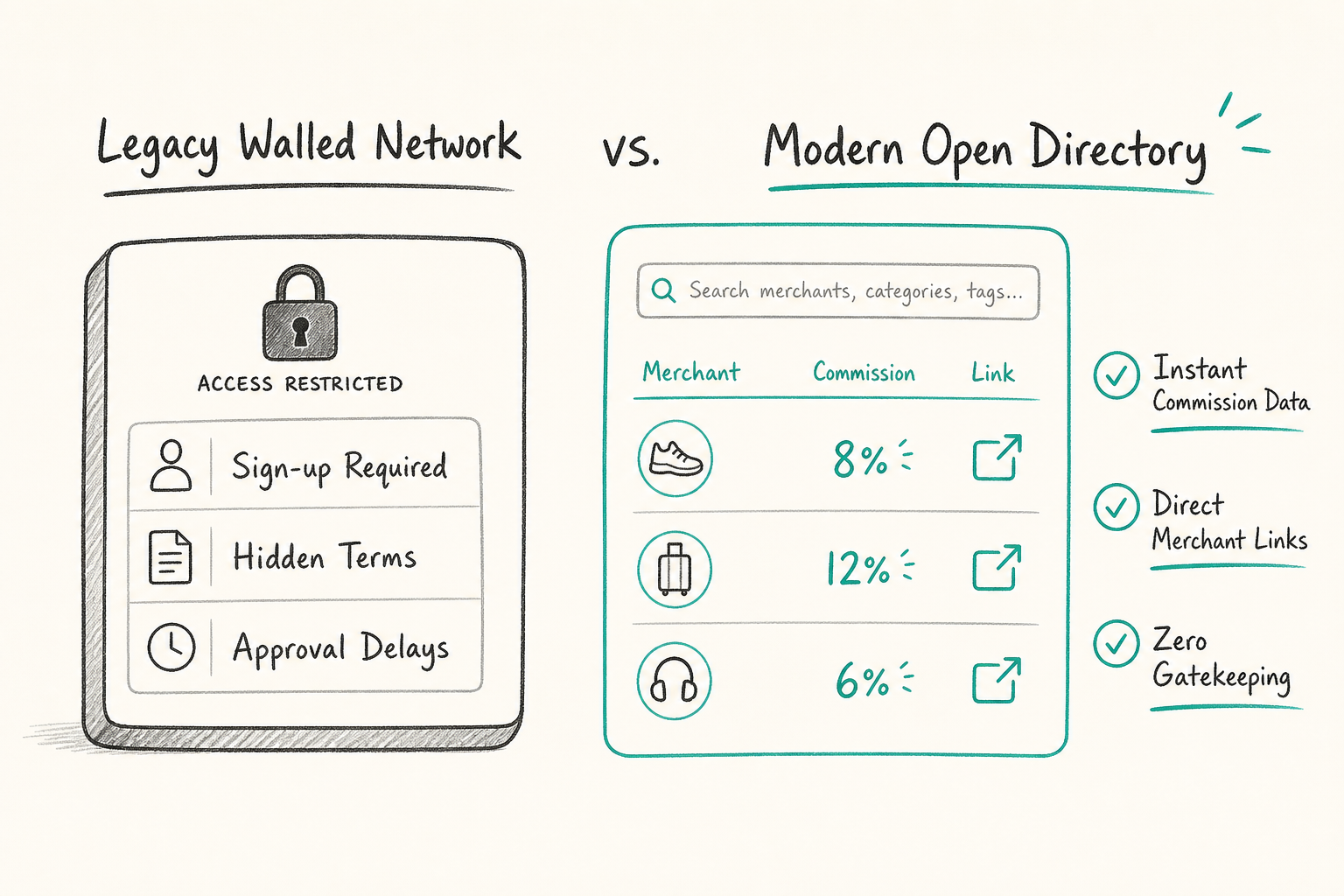
In the traditional network model, you cannot browse a comprehensive list of program details without an approved account. Even after you create a publisher account, many networks hide the exact terms, EPC (Earnings Per Click), and conversion rates of specific fintech programs until you apply and are accepted by the individual merchant.
This creates a massive bottleneck. Content creators need to know the potential ROI of an offer before they invest time in writing reviews, recording videos, or building email sequences.
Fragmented Program Management
The fintech industry is vast. It encompasses everything from peer-to-peer lending and digital banking to HR software and tax prep tools. On legacy networks, these sub-niches are often poorly categorized. You might find a great B2B invoicing tool categorized under "General Business" rather than "Finance," making it difficult to find comprehensive lists of related programs within the network itself.
The Rise of High-Ticket B2B Fintech
Many of the most profitable opportunities in 2026 are not consumer-facing apps, but B2B SaaS financial tools. Companies selling enterprise payroll, automated accounting, or corporate credit cards often bypass traditional affiliate networks entirely. They prefer to host their programs on modern SaaS-focused partner platforms or rely on specialized directories to attract professional marketers. If you only search ShareASale, you are missing out on the majority of the B2B fintech market.
The Top Affiliate Network Alternatives for Fintech
If you prefer the network model—where one dashboard tracks clicks and payments across multiple merchants—there are several powerful alternatives that handle fintech better than the older platforms.
Impact.com (The Modern Standard)
Impact has aggressively courted modern fintech, banking, and crypto brands over the last few years. Widely considered the leading network for contemporary digital tools, Impact offers a significantly better user interface and deeper data transparency than its older competitors.
You will find major consumer players here, such as Chime, Acorns, and various robo-advisors. Impact's directory allows you to filter specifically by "Finance" or "Insurance," and it generally provides better visibility into cookie durations and baseline commission rates before you hit the "apply" button. Furthermore, their cross-device tracking technology is highly accurate, which is crucial for financial products where a user might click a link on their phone but complete a complex sign-up process on their desktop.
CJ Affiliate (For Traditional Finance)
Formerly known as Commission Junction, CJ Affiliate remains a powerhouse, particularly if your content bridges the gap between modern fintech and traditional financial institutions.
While CJ’s interface is still quite corporate, their directory is heavily populated with established online brokerages, major credit card offers (like Chase or American Express), and traditional banking products. CJ is notoriously strict with approvals—both at the network level and the merchant level—so it is best suited for established marketers with proven traffic rather than beginners. However, if you can gain access, their lists of financial programs are among the most robust in the industry.
FlexOffers (The Volume Play)
FlexOffers is known for having a highly comprehensive financial category. If you are building a broad personal finance site and need everything from auto loan aggregators to credit repair services and digital banking apps, FlexOffers is a strong alternative.
The trade-off with FlexOffers is the sheer volume of data. Their directory is massive, which can sometimes make finding the true "hidden gems" difficult. Additionally, they often operate as a sub-affiliate network. This means they aggregate programs from other networks, allowing you to access them through a single FlexOffers account. The convenience is great, but be aware that they take a small cut of the commission in exchange for this aggregation.
PartnerStack (The B2B SaaS Hub)
If your definition of fintech leans toward B2B software—invoicing, payroll, expense management, and HR tech—PartnerStack is the primary network to target.
PartnerStack was built specifically for SaaS partnerships. You will not find consumer credit cards here; instead, you will find high-ticket business software that often pays recurring revenue (RevShare) rather than one-time CPA (Cost Per Action) payouts. Their directory is highly curated, and the platform makes it exceptionally easy to track recurring commissions over the lifetime of a customer.
The Flaw With Static "Top 10" Resource Blogs
If you aren't searching directly inside an affiliate network, your next instinct is likely to Google "best fintech affiliate programs." This will lead you to dozens of resource blogs and marketing sites that curate detailed lists.
Notable sites like Authority Hacker and Niche Pursuits do an excellent job of breaking down financial niches. They provide highly analytical, data-driven lists that detail commission structures, target audiences, and promotional strategies.
However, relying entirely on static blog posts for your program discovery introduces a major point of failure: data decay.
The fintech industry moves incredibly fast. Commission structures are highly sensitive to macroeconomic factors like Federal Reserve interest rates and venture capital funding. A static blog post written in early 2025 might proudly list a crypto platform offering a $150 CPA. But by the time you read that post in 2026, the company may have slashed its payout to $25, or paused its affiliate program entirely.
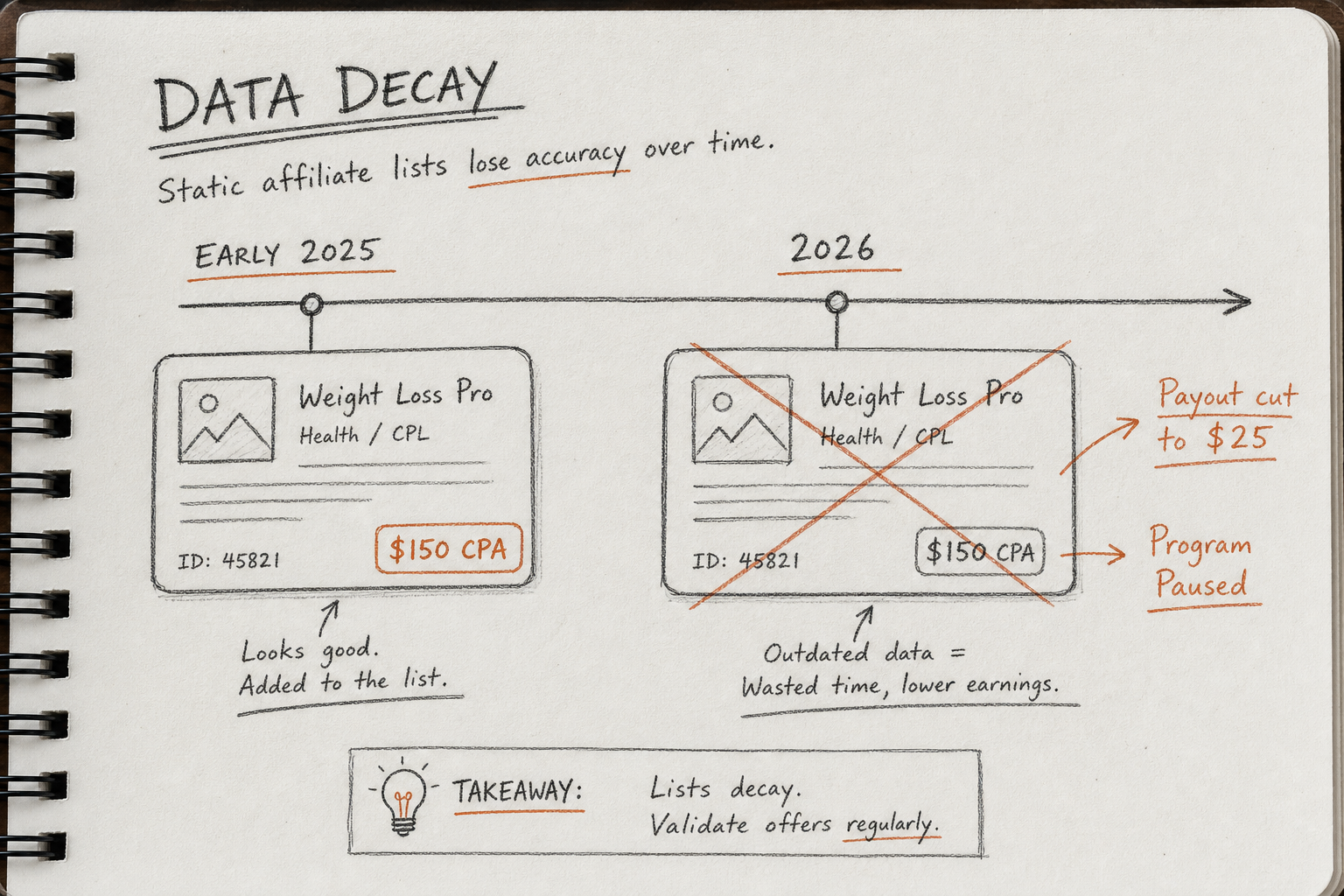 Imagine finding a great trading app on a static list. You decide this is the perfect anchor for a new content strategy. You spend weeks building a site architecture, mapping out keywords, and writing comparison guides. You finally apply for the program, only to realize the terms changed six months ago and the offer is no longer viable.
Static lists are great for brainstorming and learning about 9 Profitable Affiliate Marketing Niches to Start in 2026, but they are dangerous to use as your definitive source of truth for current commission data.
Enter AffiliList: The Modern Directory for Fintech Offers
The gap between restrictive, walled-garden networks and quickly outdated static blog posts has created the need for a third option: the open-access, dynamic directory.
This is where AffiliList changes the workflow for affiliate marketers. Instead of hiding data behind sign-up forms or relying on manually updated blog lists, AffiliList operates as a comprehensive, streamlined directory of over 10,000 affiliate programs, with a heavy emphasis on SaaS, digital tools, and fintech.
Total Transparency Without the Hoops
A key differentiator for AffiliList is its emphasis on simplicity and open access. You do not need to create an account, verify your website traffic, and wait for a network manager to approve you just to see what a company pays.
Program details—including commission percentages, flat-rate payouts, cookie durations, and specific sub-niches—are fully visible. This allows marketers to quickly scroll, compare dozens of fintech opportunities side-by-side, and immediately weed out the low-paying offers. By focusing on verified data, the directory bypasses the cluttered, unreliable lists found elsewhere on the web.
Advanced Filtering for Specific Sub-Niches
"Fintech" is too broad of a category for effective niche site planning. A marketer focusing on YouTube marketing tools for crypto influencers needs vastly different programs than a blogger writing about HR software for small businesses.
AffiliList features an extensive tagging system and advanced filtering options. You can sort by:
- Commission Type: Filter by one-time CPA, recurring RevShare, or tiered structures.
- Commission Rate: Instantly find 11 High Paying Affiliate Programs for $500+ Commissions without digging through low-ticket offers.
- Category: Drill down into highly specific areas like crypto, accounting, personal finance, or payment gateways.
The Direct-to-Merchant Connection
Because AffiliList is a directory and not a middleman network, it connects you directly to the merchant’s preferred sign-up portal. If a high-paying B2B invoicing tool hosts their program on PartnerStack, AffiliList provides the data and points you there. If a crypto exchange runs an in-house program managed via specialized tracking software, AffiliList directs you straight to their internal application.
This eliminates the guesswork of trying to figure out which network actually holds the contract for the brand you want to promote. It serves as a central hub, allowing you to discover the opportunity and immediately take action.
Evaluating a Fintech Affiliate Program: What to Look For
Whether you are browsing a modern directory or evaluating offers inside a network, not all financial programs are created equal. Fintech products require a high degree of trust from the consumer, meaning they are inherently harder to sell than a $20 pair of shoes.
To ensure your efforts are profitable, you must evaluate fintech programs against a strict set of criteria.
1. CPA vs. Lifetime RevShare
In fintech, you will generally encounter two payout models.
- CPA (Cost Per Action): You get a flat fee when a user opens an account, funds a wallet, or takes out a loan. These can be massive—sometimes ranging from $100 to $500+ per funded account.
- RevShare (Revenue Share): You earn a percentage of the revenue the company generates from that user over time. This is highly common in trading platforms (you get a percentage of their trading fees) and B2B SaaS accounting tools (you get a percentage of their monthly subscription).
The Strategy: For consumer finance (like budgeting apps or basic checking accounts), take the high CPA. Consumers switch apps frequently. For B2B financial software or active trading platforms, lifetime RevShare is usually much more lucrative, as business clients tend to stick with their software for years.
2. The Conversion Action (What Triggers the Payout?)
Always read the fine print on what constitutes a "conversion." In the fintech space, this is notorious for being overly complex.
A program might advertise a "$150 commission," but the terms state the user must not only open an account but also deposit at least $1,000 within the first 14 days and hold it there for 30 days. If your audience consists of college students looking for budgeting tips, you will likely see hundreds of sign-ups but zero actual payouts because they fail to meet the funding threshold.
Look for programs that pay a small tier for a qualified lead (e.g., $10 just for opening the account) and a larger bonus for funding it.
3. Cookie Duration
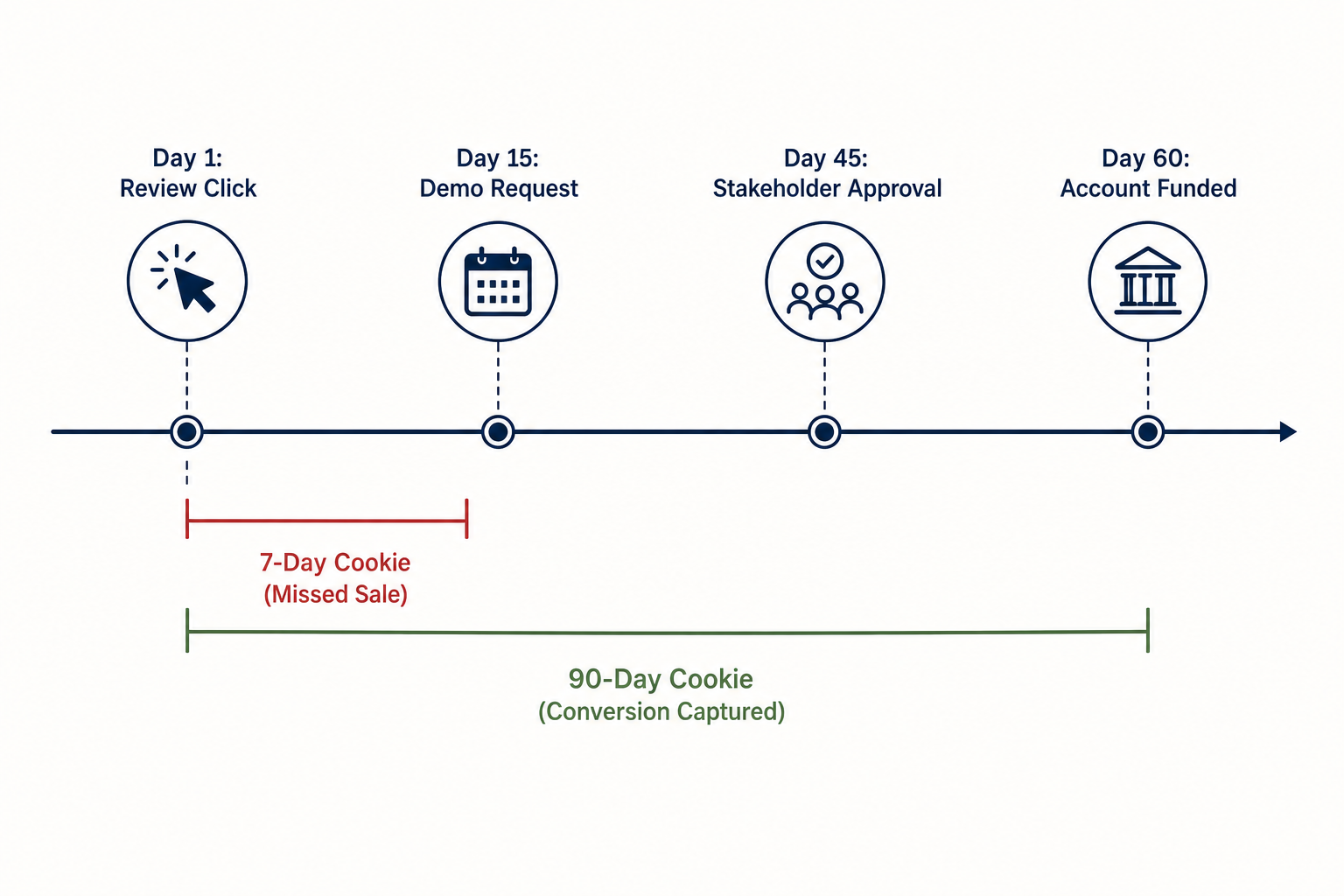
Financial decisions require time. A small business owner is not going to migrate their entire payroll system to a new software after reading one blog post. They will click your link, read your review, talk to their co-founder, search for competitors, and maybe sign up a month later.
If you are promoting high-ticket B2B fintech, a 7-day cookie is virtually useless. You should look for programs offering at least a 60-day to 90-day cookie window.
4. Regulatory Compliance and Support
If you are wondering, Is Affiliate Marketing Legit? (How to Spot Real Offers), the fintech space is where legitimacy matters most. Promoting financial products means brushing up against strict FTC regulations and financial advertising laws.
The best fintech affiliate programs provide their affiliates with comprehensive compliance guidelines. They will supply you with the exact disclaimer language you must use on your site (e.g., "We are not financial advisors; this content is for educational purposes"). If a program does not have strict brand guidelines or compliance checks, it is a massive red flag. Promoting predatory lending or unregulated crypto schemes can result in your site being penalized by search engines or shut down entirely.
Top Fintech Sub-Niches to Target in 2026
If you are planning to build a site or expand your current content, the broad "finance" category is far too competitive. Instead, use a directory to drill down into highly specific sub-niches where you can establish topical authority.
Here are a few of the most profitable sectors right now:
B2B Payroll and HR Software
With the continued normalization of remote and global teams, software that handles international payroll, tax compliance, and HR is booming. Platforms like Deel, Gusto, and Rippling fall into this category. These tools target business owners and HR managers, meaning the lifetime value of a customer is astronomical. Consequently, the affiliate commissions in this sub-niche are some of the highest in the industry.
Automated Accounting and Invoicing
Every freelancer, side-hustler, and small business needs accounting software. Products like QuickBooks, FreshBooks, and specialized invoicing tools offer incredibly sticky products. Once a business sets up their books on a platform, they rarely leave. Look for programs in this space that offer recurring revenue shares.
Alternative Asset Investing
While traditional stock brokerages have slashed their affiliate payouts in recent years, alternative asset platforms are aggressively acquiring customers. This includes platforms for investing in fractional real estate, fine art, wine, and vetted startup equity. Because these platforms require higher minimum deposits, they often offer substantial CPA payouts for qualified leads.
Niche Tax Software
Generic tax software is heavily dominated by massive corporate sites. However, specialized tax software—such as tools specifically designed to calculate crypto trading taxes, or tools built solely for expat freelancers—is a wide-open market. Content creators who can explain complex tax concepts simply and link to these specialized SaaS tools see massive conversion rates in Q1 of every year.
How to Effectively Promote Fintech Offers
Once you have bypassed the legacy networks and used a transparent directory to find the right offers, you have to drive qualified traffic. Financial products require a higher level of trust than almost any other niche.
Focus on High E-E-A-T SEO Content
Google applies extremely strict scrutiny to financial content, categorizing it as YMYL (Your Money or Your Life). If you are learning How to Start a Profitable Affiliate Marketing Blog in the fintech space, your primary focus must be on establishing Experience, Expertise, Authoritativeness, and Trustworthiness (E-E-A-T).
You cannot simply write a generic "Top 10 Budget Apps" post and expect it to rank. You need to demonstrate firsthand experience. Show screenshots of the software in action. Explain the specific setup process. Detail the flaws and limitations of the platform, not just the benefits. Authentic, balanced reviews convert much higher than overly promotional sales pitches.
Leverage Email Marketing for Complex Funnels
Because financial decisions take time, your goal should not always be a direct click-to-sale. Often, it is better to drive traffic to an email opt-in.
For example, offer a free downloadable template for "Small Business Expense Tracking." Once a user joins your list, you can send them a multi-day educational sequence explaining why automated accounting software is a better long-term solution, naturally weaving in your affiliate links for platforms like Xero or FreshBooks. Email allows you to build the trust necessary to convert high-ticket fintech offers.
Utilize Visual Platforms for Consumer Finance
While B2B software is best sold via search and email, consumer finance apps—particularly budgeting tools and side-hustle banking apps—perform incredibly well on visual search engines.
Creating infographics about budget breakdowns, saving challenges, or debt-snowball methods can drive massive traffic. If you master Step-by-Step: Setting Up Affiliate Marketing on Pinterest, you can funnel highly motivated users directly into consumer fintech affiliate programs.
FAQs About Fintech Affiliate Programs
Are fintech affiliate programs hard to get approved for? It depends on the sub-niche. Consumer apps (budgeting, basic banking) are generally easy to get into, often automatically approving established sites. B2B software, trading platforms, and major banks are much stricter. They usually require you to have an active website with verifiable finance-related traffic, an explicit privacy policy, and visible FTC disclaimers before they will approve your application.
Do I need a formal background in finance to promote these offers? No, you do not need to be a CPA or a certified financial planner. However, you must be extremely careful not to give specific, personalized financial advice. Frame your content around education, software reviews, and sharing your personal experience with a tool. Always include standard disclaimers clarifying that your content is for informational purposes only.
What is the difference between a fintech affiliate network and a directory? A network (like CJ or Impact) actually hosts the tracking links, manages the cookies, and pays you directly. You have to sign up and be approved by the network. A directory (like AffiliList) is a searchable database that curates data on thousands of programs across the internet. It allows you to see payout terms, compare opportunities, and find exactly where to sign up without being forced into a walled garden just to do your research.
By utilizing modern directories to bypass outdated lists and clunky legacy interfaces, you can streamline your research, find better-paying offers, and spend more of your time doing what actually generates revenue: creating high-quality content for your audience.