
Shareasale Alternatives for New Affiliate Programs to Promote
Discover the best ShareASale alternatives to find high-paying affiliate programs. Explore modern networks, SaaS directories, and direct partnership tactics.

Finding a high-quality affiliate program used to mean logging into ShareASale, squinting at an interface that hasn't changed since 2005, and sifting through thousands of inactive merchants just to find a handful of relevant offers. You apply to a program, wait three weeks in application purgatory, and finally get approved—only to realize the merchant’s landing page looks like a spam site, rendering your conversion rate mathematically insignificant.
For affiliate marketers, niche site owners, and content creators, the discovery phase of monetization is often the most frustrating bottleneck. The digital economy has shifted. Today’s highest-converting programs are heavily concentrated in SaaS, digital tools, and independent B2B platforms—many of which bypass legacy networks entirely in favor of modern tracking software or direct partnerships.
If you are wondering where to find new affiliate programs to promote, relying on a single legacy network is a losing strategy. To build a diversified, high-converting portfolio of offers, you need to look beyond the traditional walled gardens. This guide breaks down the most effective ShareASale alternatives, from modern networks and independent directories to stealthy competitor analysis techniques, helping you uncover the most lucrative partnerships in your niche.
The Problem with Legacy Affiliate Networks
Before diving into where to find new programs, it is worth understanding why so many top-tier publishers are moving away from traditional networks as their primary discovery tool.
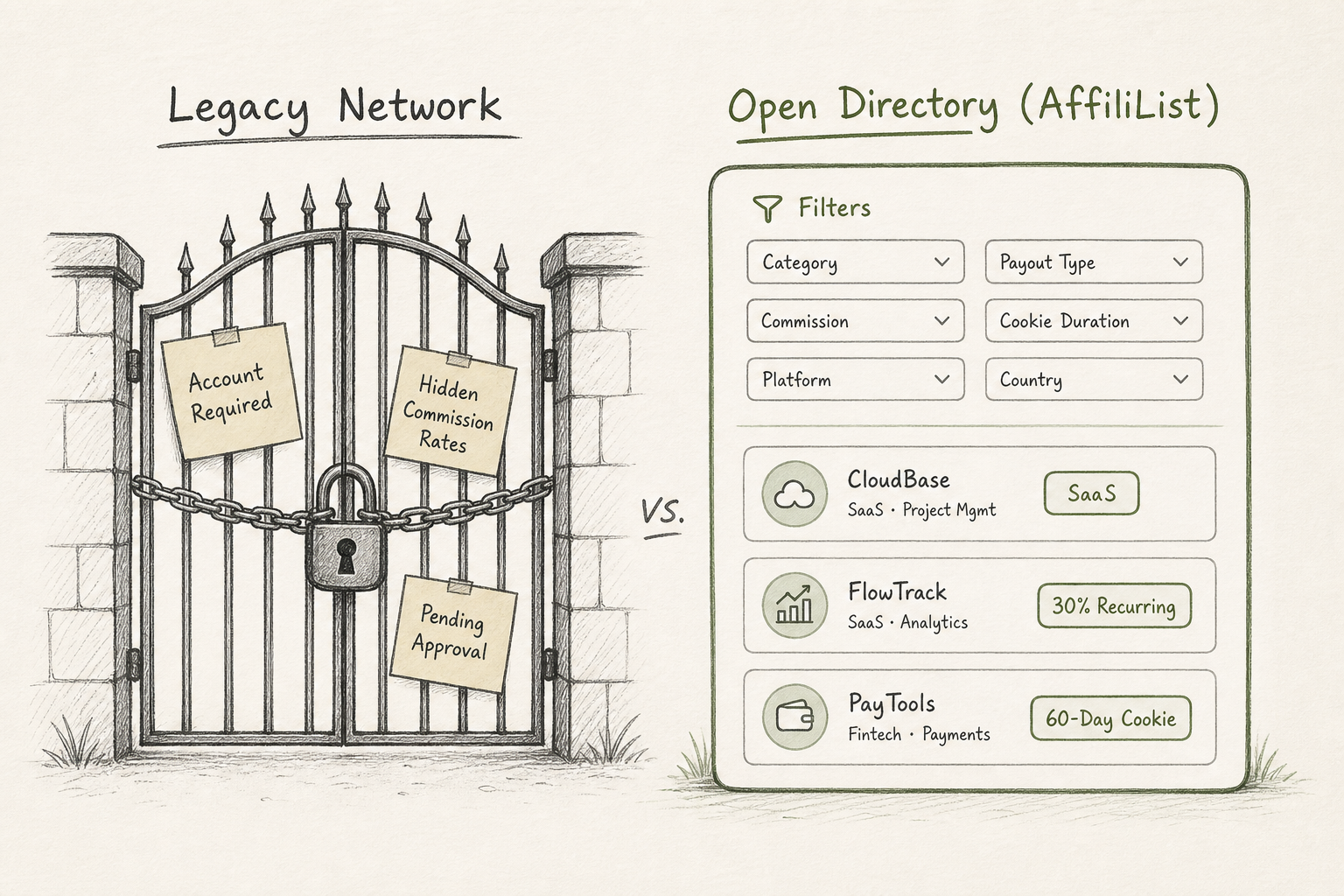
Legacy platforms were built for a different era of the internet. They operate as walled gardens. To even see a merchant’s baseline commission rate, cookie duration, or promotional rules, you typically have to create an account, verify your website, wait for network approval, and then manually search their internal directory.
This creates several distinct problems for modern publishers:
- Data Obscurity: You cannot easily compare offers across different networks without managing a dozen logins.
- Stale Inventories: Many merchants on older networks set up their programs years ago and abandoned them. You might spend hours crafting content around a product, only to find the merchant routinely runs out of budget or pauses payouts.
- The "Apply to Apply" Loop: Getting accepted into the network does not mean you are accepted by the brand. You often have to write individual pitches to program managers who rarely check their network inboxes.
When you are trying to figure out how to start a profitable affiliate marketing blog, you need velocity. You need to quickly assess market viability, compare commission structures, and get tracking links live. This requirement has given rise to a new ecosystem of affiliate discovery.
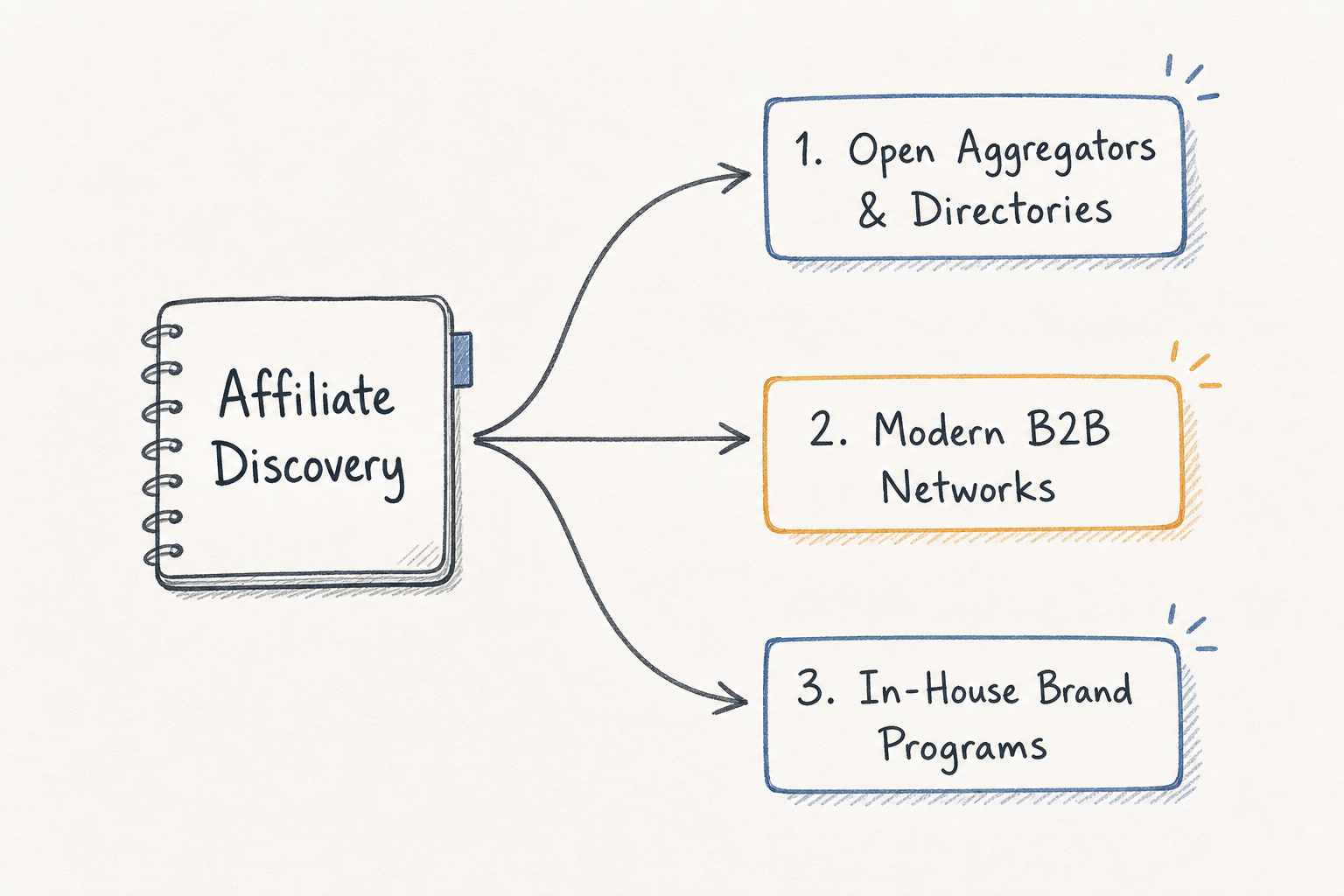
1. Affiliate Directories and Aggregators (The Clean Approach)
The most efficient alternative to browsing a closed network is using an open affiliate directory. Directories separate the discovery process from the tracking process. Instead of hosting the tracking links themselves, directories aggregate program data from across the web—including independent programs and those housed on various networks—into one searchable database.
AffiliList
For marketers in the digital and software space, finding verified program data is critical. AffiliList operates as a comprehensive directory specifically designed to bypass the clutter of legacy networks. With a curated database of over 10,000 affiliate programs, it focuses heavily on SaaS, digital tools, and high-ticket B2B offers.
The primary advantage of a directory model is transparency. Unlike traditional networks that require extensive sign-ups just to view terms, AffiliList offers open access to program details. You can instantly view commission percentages, payout models (CPA vs. recurring), cookie durations, and specific niche tags without hitting a registration wall. This allows you to rapidly filter for the exact criteria your audience needs.
If you are targeting one of the 11 best niches for affiliate marketing (SaaS & digital), an aggregator drastically reduces your research time by standardizing the data format across hundreds of categories, from YouTube marketing tools to HR software.
Affiliate.Watch
Another option in the aggregator space is Affiliate.Watch, which allows publishers to browse platforms and sort by payouts, categories, and payment methods. Aggregators like this are particularly useful when you want to cast a wide net across different physical and digital product categories, helping you sort through the noise to find programs that align with your specific traffic demographic.
2. Modern Affiliate Networks (Direct ShareASale Alternatives)
If you still prefer the consolidated payout structure of an affiliate network—where one dashboard handles the tax forms, reporting, and payments for multiple brands—you should look at modern alternatives that have captured the market share ShareASale used to dominate.
PartnerStack (The B2B and SaaS King)
If your audience consists of business owners, freelancers, or digital marketers, PartnerStack is arguably the most important network to join. Unlike retail-focused platforms, PartnerStack was built from the ground up for software companies.
This network hosts some of the most lucrative B2B programs available, heavily featuring recurring commission models. When you promote a SaaS product through PartnerStack, you often earn a percentage of the customer's subscription fee for as long as they remain a customer. The UI is heavily tailored toward enabling partners, often providing pre-made assets, email templates, and direct lines of communication with brand managers.
Impact (Impact.com)
For publishers looking for global brand partnerships, Impact (formerly Impact Radius) has become the gold standard. As noted in resources covering best affiliate programs, platforms like Impact allow you to manage partnerships seamlessly across social media, email newsletters, and web channels.
Impact’s interface is exceptionally modern. They offer dynamic tracking links, cross-device tracking, and granular reporting. Many massive consumer brands and fast-growing tech startups have migrated their affiliate programs exclusively to Impact because of its robust anti-fraud features and flexible commissioning structures (e.g., paying different rates for new vs. returning customers).
FlexOffers
If you need a sheer volume of programs that rivals legacy platforms but with better account management, FlexOffers is a dominant player. They boast tens of thousands of affiliate programs across nearly every conceivable category—from automotive and travel to financial services and retail.
FlexOffers operates as a sub-affiliate network in many cases. This means they use their massive leverage to secure premium commission rates with brands, and then pass those offers down to publishers. While they take a small cut of the commission for facilitating this, it often allows newer publishers to gain access to premium brands that would otherwise reject a direct application.
Comparison: Network vs. Directory vs. Direct
| Feature | Affiliate Directory (e.g., AffiliList) | Modern Network (e.g., Impact) | Direct Brand Program |
|---|---|---|---|
| Primary Function | Discovery and data aggregation | Tracking, attribution, and payouts | In-house management |
| Account Required to View Offers? | No | Yes | Usually No |
| Data Transparency | High (Open access to commission terms) | Medium (Varies by merchant settings) | Low (Often requires reading dense TOS) |
| Payout Management | Handled by the respective brand/network | Consolidated (One check for all brands) | Individual (Requires separate tax forms) |
| Best For | Finding new, high-paying niche offers rapidly | Managing large portfolios of established brands | Maximizing commission rates |
3. Uncovering Private Programs Directly from Brands
Many of the highest-paying affiliate programs are not listed on any network. Companies with strong margins—particularly in the software, online education, and financial sectors—often choose to run their affiliate programs in-house using white-label tracking software like Post Affiliate Pro, Rewardful, or Tapfiliate.
They do this to avoid paying the network override fees (often 20% to 30% of the affiliate commission) and to maintain stricter quality control over who promotes their brand. Because these programs are isolated, they are often less saturated, giving you a competitive advantage.
The "Footer Hunt" Technique
The most reliable way to find in-house programs is the manual "footer hunt." Most companies host private affiliate programs rather than relying on networks.
Make a list of the software, tools, and services you use every day to run your business or manage your life. Navigate to their homepage, scroll to the absolute bottom footer menu, and look for links titled:
- Affiliates
- Partners
- Refer-a-Friend
- Ambassadors
- Earn Money
For example, if you are teaching your audience about email marketing, you might look into highly-rated software programs that offer lucrative recurring commissions, such as GetResponse. Brands that manage their own programs typically offer better onboarding, dedicated affiliate managers, and higher baseline payouts because they aren't splitting the margin with a third-party network.
Searching by Technology Footprint
If you want to scale the direct discovery process, you can use technology lookup tools like BuiltWith. If you know that a specific white-label affiliate software (like FirstPromoter, which is wildly popular among SaaS startups) is used to track commissions, you can search for websites utilizing that specific script. This is an advanced tactic, but it allows you to generate a list of companies running in-house programs in your specific niche before your competitors find them.

4. Competitor Analysis: The Stealth Strategy
If you want to know exactly what programs are converting well right now, let your competitors do the heavy lifting for you. Successful niche sites and authoritative bloggers obsessively split-test their affiliate offers. If a massive site in your niche is prominently placing a specific tool's link in their primary navigation or top-ranking articles, it is highly likely that program has a strong Earnings Per Click (EPC).
Discussions in communities like Reddit's Affiliate Marketing echo this sentiment: users strongly recommend researching competitors' sites and checking their footer disclosures to find out exactly which networks they use and which private programs they promote.
How to Reverse-Engineer Competitor Links
1. Inspect Outbound Links: Hover over the outgoing links on a competitor’s review post. Look at the URL structure in the bottom left corner of your browser.
- If you see
shareasale.com/r.cfm?, you know they are using ShareASale. - If you see
impactradius.comorpxf.io, they are on Impact. - If you see a vanity URL like
competitorsite.com/go/brandname, they are using a link cloaking plugin (like ThirstyAffiliates or Pretty Links).
2. Follow the Redirect Path: To uncloak a hidden link, simply click it and watch the URL bar as the page loads, or use a free Chrome extension like "Redirect Path." The extension will show you every hop the link takes between the competitor's site and the final merchant page. The intermediate URLs will expose the affiliate network or tracking software being used.
3. Analyze Their Disclosure Pages: FTC regulations require affiliates to disclose their relationships. Many publishers include a detailed disclosure page that explicitly lists the major networks and direct programs they are partnered with. Reading a competitor's disclosure page is often a shortcut to discovering a curated list of active, paying programs in your exact niche.
This technique is incredibly effective if you are exploring most profitable affiliate marketing niches where the landscape of available tools changes rapidly.
5. Evaluating a New Affiliate Program Before You Promote
Finding a ShareASale alternative is only half the battle. Once you locate a new program—whether through an aggregator like AffiliList, a modern network, or a direct footer link—you need to evaluate whether it is actually worth your traffic.
It is easy to get blinded by a high commission percentage, but percentage is just one variable in a much larger equation. Before dedicating hours of content creation to a new offer, evaluate these four critical criteria.
Commission Structure: CPA vs. Recurring
Does the program pay a one-time flat fee (Cost Per Action / CPA), a percentage of the initial sale, or a recurring percentage for the lifetime of the customer?
If you are promoting a physical product, you are almost always looking at a one-time percentage (usually 3% to 10%). If you are promoting SaaS, you should actively hunt for recurring commissions (often 20% to 40% monthly). A $10/month commission doesn't sound like much until you retain 100 referrals who stick with the software for three years. For strategies on building this type of income, reviewing an affiliate marketing side hustle blueprint can help you model the math.
Cookie Duration and Attribution
When a user clicks your link, a tracking cookie is placed in their browser. The "cookie duration" determines how long you have for that user to make a purchase and still grant you the commission.
- 24 Hours: Typical for major retail aggregators (e.g., Amazon). Very difficult to monetize unless you capture high-intent, bottom-of-funnel traffic.
- 30 Days: The industry standard for most digital products and networks.
- 90+ Days to Lifetime: Often found in direct B2B programs and high-ticket courses.
Equally important is the attribution model. Most affiliate programs use "Last Click" attribution, meaning the last affiliate link the customer clicked before buying gets 100% of the commission. Beware of programs that use "First Click" attribution if you operate in a niche where users do a lot of comparison shopping before converting.
Earnings Per Click (EPC)
If a network provides network-wide data, always look at the 7-day and 30-day EPC.
EPC calculates the average amount of money earned by affiliates for every 100 clicks sent to the merchant. If a merchant offers a $500 commission but has an EPC of $0.02, it means their landing page is terrible at converting traffic. A merchant with a $20 commission but an EPC of $1.50 is a much safer, more profitable bet. If you are targeting high paying affiliate programs, EPC is the only metric that confirms the high payout actually converts.
Deep Linking Capabilities
Can you link directly to a specific product page, or does the affiliate program force you to send all traffic to the merchant's homepage?
Forcing traffic to a homepage creates friction. If you write a detailed tutorial on a specific feature of a software tool, you want to send the user directly to the pricing page or the feature page. If the network or program does not support "deep linking," your conversion rates will suffer dramatically.

Matching the Right Offer to Your Traffic Source
The platform you use to find programs should align with the platform you use to generate traffic.
If you run a heavy visual operation and are focused on an affiliate marketing program for Pinterest, you need programs that feature highly visual consumer goods, DIY tools, or lifestyle software. In this case, networks like FlexOffers or aggregators that let you filter by consumer categories are ideal.
If you are a B2B consultant or run a tech-focused blog, your audience needs high-leverage digital tools. Here, utilizing a directory like AffiliList to bypass consumer noise and zero in on SaaS programs will save you countless hours of research. Similarly, direct-to-brand partnerships and networks like PartnerStack will yield the best results.
Always ask yourself: What is the exact search intent of my audience, and what problem are they trying to solve right now? The best affiliate marketers don't just sell products; they seamlessly integrate solutions into the natural workflow of their content.
Frequently Asked Questions (FAQs)
Is it better to join an affiliate network or an independent program?
There is no single answer, as both have distinct roles in a monetization strategy. Networks provide the convenience of consolidated tracking and unified payments. You only have to fill out one tax form to get paid by 50 different merchants. However, independent direct programs often offer higher commission rates, longer cookie durations, and better direct support because they aren't paying a middleman fee to a network. Most successful affiliates use a mix of both.
How can I spot a fake or low-quality affiliate offer?
When stepping outside of established networks, due diligence is critical. Be wary of programs that require you to pay a fee to join (a massive red flag), programs with broken landing pages, or merchants that offer commission rates that seem mathematically impossible (e.g., 90% recurring on a physical product). Always check for a physical business address and responsive affiliate support before sending traffic. For a deeper dive into vetting, review is affiliate marketing legit? (how to spot real offers).
Can I participate in multiple affiliate programs simultaneously?
Yes. In fact, relying on a single merchant is a dangerous point of failure. If that merchant suddenly changes their commission structure or closes their program, your revenue drops to zero. Diversifying your income by finding related, non-competing tools to promote is essential. Using an aggregator helps you quickly build this portfolio by finding complementary tools within your specific niche.
Are there entry-level roles where I can learn affiliate management?
If you are fascinated by the mechanics of affiliate marketing but aren't ready to launch your own site, many SaaS companies and agencies hire dedicated affiliate managers. These roles involve recruiting publishers, managing tracking software, and optimizing campaigns. Exploring affiliate marketing jobs can provide invaluable behind-the-scenes experience on how the most profitable programs operate.
Upgrading Your Affiliate Discovery Process
Relying exclusively on legacy networks like ShareASale to find new affiliate programs is akin to using a physical phone book to find a local business. The information is there, but the delivery mechanism is outdated, slow, and full of dead ends.
To maximize your revenue in 2026, you need to diversify your discovery process. Start by exploring modern, specialized networks that cater directly to your niche. Perform regular competitor analysis to see where the smart money is flowing. Hunt for direct brand partnerships by scouring the footers of the tools you use every day.
Most importantly, leverage modern directories to cut through the noise. By using a platform like AffiliList, you can instantly access transparent data on thousands of high-converting, heavily vetted programs without the friction of endless network applications. The more time you save on discovery, the more time you can spend creating the content that actually drives conversions.