
Shareasale Alternatives for Find Recurring Commission Programs for Affiliate Marketing
Discover the best ShareASale alternatives for recurring commission affiliate programs. Find high-paying SaaS networks, directories, and compounding payouts.

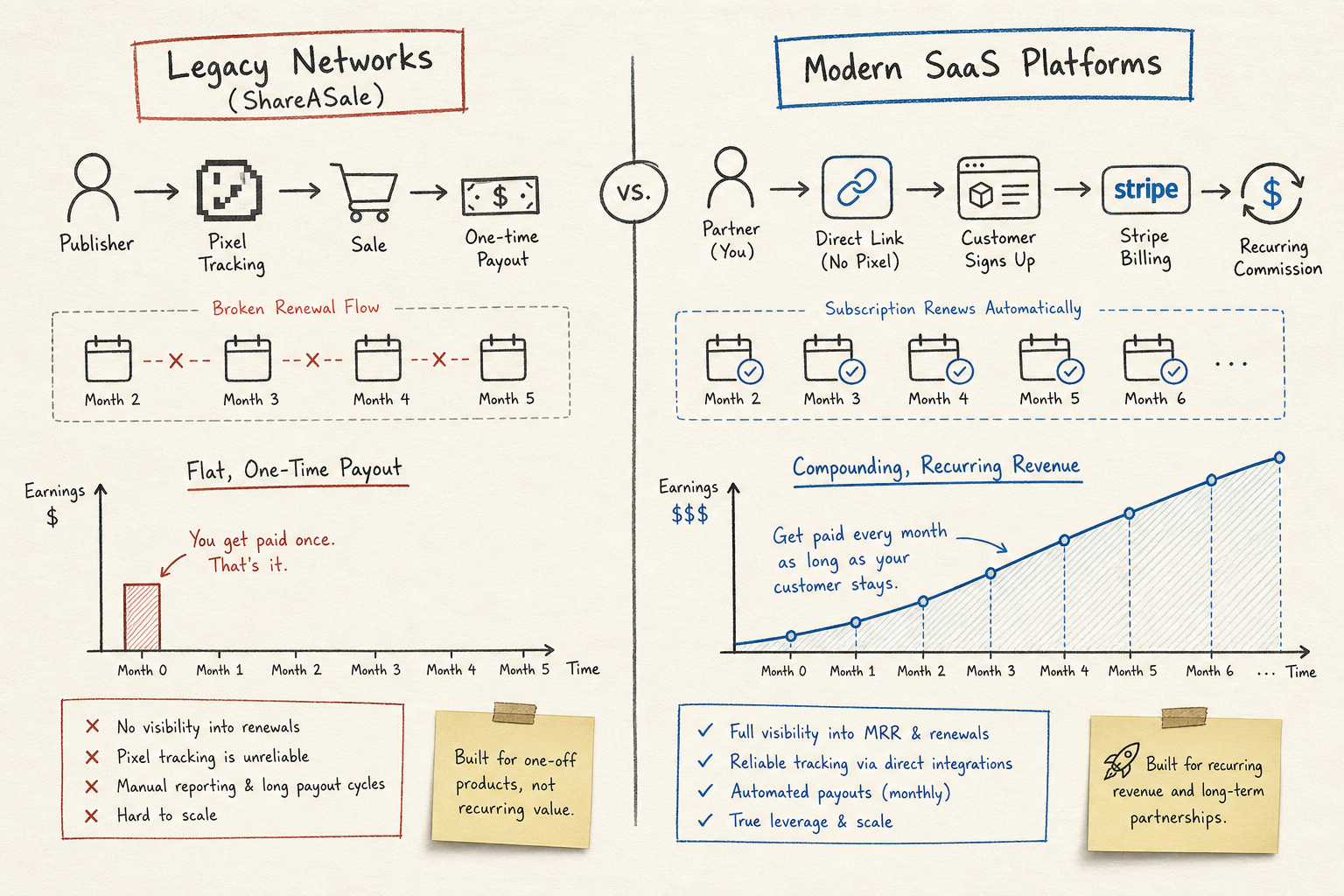
If you have spent any time trying to build a predictable, compounding income with affiliate marketing, you have likely run into the limitations of legacy affiliate networks. Platforms like ShareASale made their names connecting publishers with traditional retail brands, physical e-commerce goods, and one-off digital purchases. You generate a sale, earn a single 8% or $25 commission, and start the next month back at zero.
For publishers who want to escape the hamster wheel of one-time payouts, recurring commission programs represent the gold standard. When you refer a customer to a subscription-based product—such as cloud software, an email service provider, or a CRM platform—you earn a percentage of that customer's bill every month or year they stay active.
Finding reliable recurring programs on legacy networks like ShareASale can feel like searching for needles in a haystack. Most programs listed on traditional networks are structured around one-off cost-per-acquisition (CPA) models, have clunky tracking for renewals, or cap commissions after the first billing cycle. To scale monthly recurring revenue (MRR), you need dedicated platforms, curated SaaS directories, and modern affiliate networks built specifically for recurring subscriptions.
Why ShareASale Falls Short for Recurring Affiliate Marketing
ShareASale remains a massive player in the affiliate space, particularly for direct-to-consumer (DTC) brands, home goods, fashion, and physical products. When your primary objective is building an affiliate portfolio around subscription software and recurring payouts, the platform presents several distinct friction points.
1. Dominance of One-Time CPA Models
The vast majority of merchants on ShareASale operate on single-payout CPA terms. While you can find an occasional digital tool offering a recurring kickback, the platform is architected around point-of-sale retail transactions. Filtering specifically for recurring lifetime commissions is frustrating because the discovery interface does not categorize subscription renewals as a primary filter.
2. Opaque Renewal Tracking and Attribution
Tracking recurring subscription revenue requires deep integration with modern billing infrastructure like Stripe, Paddle, or Chargebee. Traditional networks were engineered around pixel-based tracking on a single thank-you page. When a referred customer renews their subscription in month six, legacy networks often fail to attribute the renewal accurately to the affiliate if the merchant has not configured complex server-side API webhooks.
3. High Network Overhead for Modern SaaS Founders
Early-stage and mid-market software companies—the very companies offering the most aggressive 30% to 50% lifetime recurring commissions—often avoid legacy networks entirely. Setting up a merchant account on legacy networks involves substantial upfront integration fees, monthly minimums, and network cut percentages. As a result, the best SaaS brands host their partner programs on lightweight, modern partner platforms or manage them directly.
The Top ShareASale Alternatives for Finding Recurring Affiliate Programs
To build a sustainable recurring revenue stream, you need to look where subscription software companies actually host and list their partner programs. The following platforms, directories, and networks provide far better discovery, tracking, and commission terms for recurring affiliate marketing.
| Platform / Source | Best For | Typical Commission Model | Primary Niches |
|---|---|---|---|
| AffiliList | Frictionless discovery across verified programs | 20% – 50% Recurring & High-Ticket | SaaS, AI Tools, Creator Software, B2B |
| PartnerStack | Established B2B & Enterprise SaaS | 15% – 35% Recurring (1–2 Years or Lifetime) | MarTech, Sales, HR, Productivity |
| Rewardful & FirstPromoter Directories | Bootstrapped SaaS & Micro-SaaS | 20% – 40% Lifetime Recurring | Developer Tools, Indie Apps, Niche SaaS |
| Impact.com | Premium Tech Brands & Global SaaS | Tiered Recurring & Hybrid Deals | Enterprise Software, Cloud Services |
| Direct Merchant In-House Portals | Maximum Payout Potential | 30% – 50% Lifetime Recurring | Email Marketing, SEO Software, Web Hosting |
1. Open SaaS Directories: AffiliList
Traditional networks force you to register an account, submit your website for manual screening, and wait days just to browse commission rates. This creates massive friction when researching whether a niche has viable recurring offers.
AffiliList solves this problem by offering a searchable database of over 10,000 affiliate programs with a dedicated focus on SaaS and digital tools. Instead of hiding program details behind a login wall, it provides open access to commission structures, payout terms, and affiliate links across hundreds of categories. You can instantly filter programs by commission type to isolate recurring offers, check baseline payout percentages, and verify cookie durations before applying.
If you are evaluating best niches for affiliate marketing or comparing software tools in finance, creator tech, or marketing automation, using an open directory gives you immediate clarity on which brands offer true recurring commissions versus one-off payouts.
2. PartnerStack
PartnerStack is the undisputed heavyweight network for high-growth B2B SaaS companies. If you create content targeting marketing agencies, sales teams, or corporate operators, PartnerStack is an essential ShareASale alternative.
Top-tier software vendors such as Monday.com, Webflow, Gorgias, and Notion run their partner ecosystems on PartnerStack. The dashboard provides transparent monthly reporting, automated payouts via Stripe or PayPal, and reliable tracking for recurring subscription billing.
- Pros: Home to reputable, enterprise-grade software with high retention rates and strong brand recognition.
- Cons: Vendor approval can be competitive; many enterprise programs require you to have relevant business traffic or industry authority before accepting your application.
3. The Rewardful and FirstPromoter Ecosystems
A massive portion of independent software-as-a-service companies run their partner programs using self-hosted affiliate software like Rewardful or FirstPromoter. Because these platforms integrate directly with Stripe billing, they handle recurring attribution cleanly. Every time a customer's card is charged on the 1st of the month, your affiliate commission is automatically logged.
While Rewardful and FirstPromoter are software platforms rather than centralized public marketplaces, many merchants run open partner programs powered by them. You can uncover these programs through curated discovery engines or by looking at the footer of emerging SaaS websites for links labeled "Affiliates" or "Partners."
- Typical Terms: 20% to 40% monthly recurring commissions, often for the lifetime of the account.
- Conversion Advantage: Micro-SaaS and indie tools often solve specific pain points with minimal bloat, leading to higher trial-to-paid conversion rates.
4. Impact.com
Impact (formerly Impact Radius) is a modern partnership cloud that bridges the gap between enterprise performance marketing and influencer partnerships. Major technology companies like Canva, Shopify, and Hostinger use Impact to manage their affiliate programs.
While Impact hosts many traditional retail brands, its technology suite allows SaaS brands to structure sophisticated recurring commission contracts. You can negotiate custom tiers, performance bonuses based on user retention, and multi-year recurring commission schedules directly inside the platform.
5. In-House Direct Programs (No Network Middleman)
Some of the most lucrative recurring commission programs in the affiliate marketing industry are managed entirely in-house by the merchant. By cutting out third-party network transaction fees, these companies pass higher commissions directly to affiliates.
Examples include foundational digital marketing platforms:
- ConvertKit (Kit): Offers a 30% recurring monthly commission on all paid creator accounts.
- AWeber: Provides tiered recurring commissions ranging from 30% to 50% for high-volume referrers.
- Systeme.io: Delivers a 40% to 50% lifetime recurring commission on all software subscriptions and digital course upgrades.
- ActiveCampaign: Offers 20% to 30% recurring payouts on high-tier business marketing automation packages.
High-Retention Niches for Recurring Affiliate Programs
Not all recurring programs produce equal financial outcomes. A program offering 50% recurring commissions is worthless if the average customer cancels their subscription after 45 days. To build long-term passive income, you must focus on products that exhibit low churn and high switching costs.
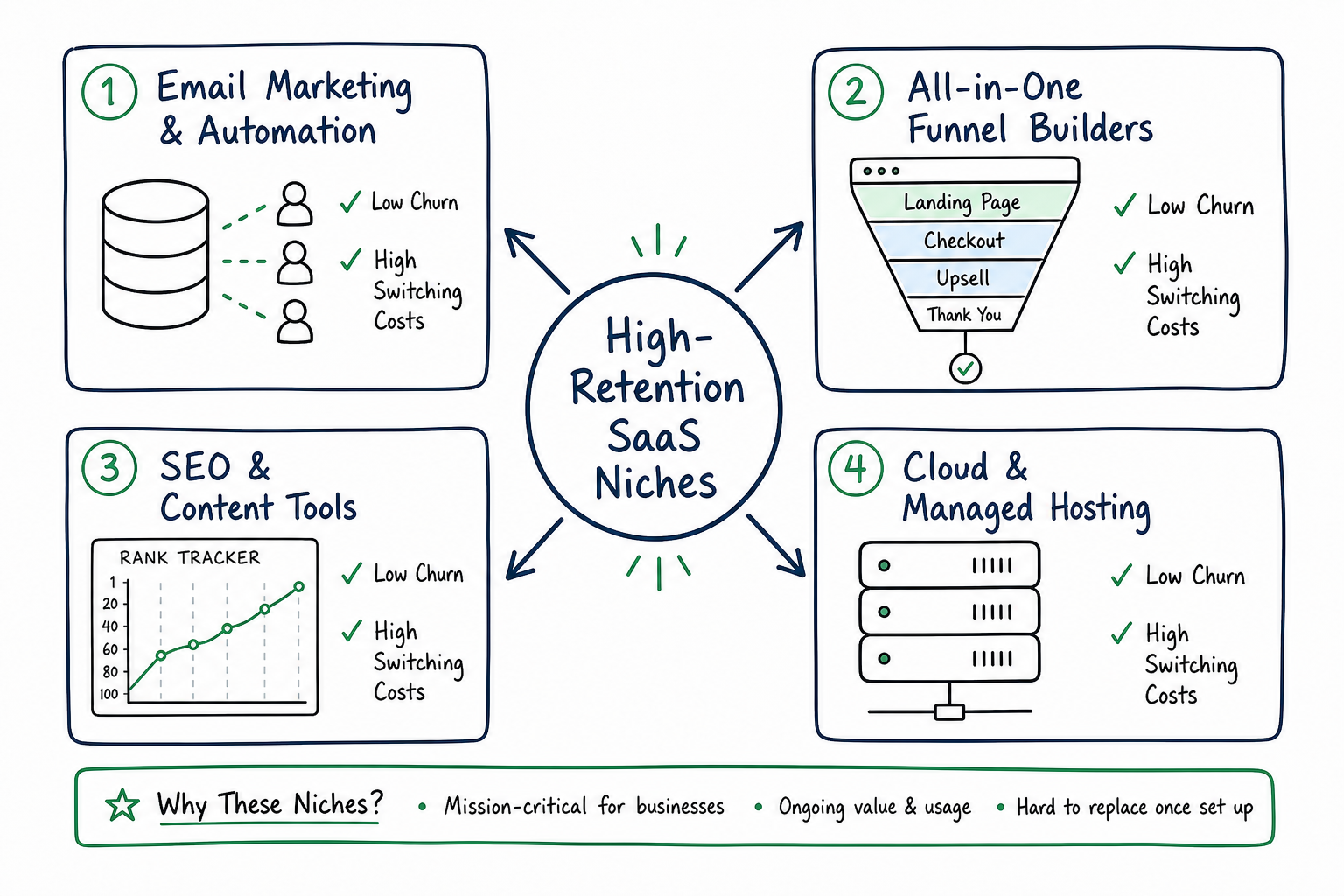 When businesses integrate a tool into their daily operational workflow, they rarely cancel it. Here are the top categories where recurring affiliate programs thrive.
Email Marketing and Automation
Email marketing platforms have some of the lowest churn rates in the digital economy. Once an entrepreneur, e-commerce brand, or creator builds an email list of 10,000 subscribers, sets up automated nurture sequences, and connects their payment gateways, switching providers requires technical migration and risk to revenue.
Because customers stay subscribed for years, earning a 30% monthly commission on a $150/month email plan will reliably pay you $45 every month for years from a single referral.
All-in-One Funnel Builders and E-Commerce Infrastructure
Platforms like ClickFunnels, Systeme.io, SamCart, and Kartra handle the core revenue engine for small businesses. Hosting checkouts, sales funnels, and membership areas on these platforms creates immense operational lock-in. Customers maintain their subscriptions as long as their business remains operational, making these tools prime targets when developing an affiliate marketing side hustle designed for compounding growth.
SEO, Data, and Content Intelligence Tools
Search engine optimization software (such as keyword research tools, rank trackers, and backlink monitors) commands high monthly subscription prices, typically ranging between $99 and $499 per month. Marketers and agencies view these tools as mandatory operating expenses. While some programs cap recurring payouts at 12 or 24 months, the high average order value (AOV) ensures substantial recurring cash flow during that window.
Managed Web Hosting and Cloud Servers
While traditional shared hosting companies typically pay a single flat CPA (e.g., $50 to $100 per signup), premium managed WordPress hosts and cloud infrastructure providers (such as Kinsta, Cloudways, and WP Engine) frequently offer recurring hybrid models. Cloudways, for instance, provides an option to earn a monthly recurring percentage on every client server invoice for life.
Evaluating Recurring Affiliate Programs: Key Metrics Beyond Commission Rate
When comparing programs, beginner affiliates often make the mistake of sorting exclusively by the highest advertised commission percentage. A 50% commission on a $10/month consumer tool that users cancel after two months yields just $10 total. A 20% commission on a $300/month B2B data suite where clients average a 36-month retention generates $2,160 in total affiliate earnings.
Before committing real estate on your site or investing in content creation, evaluate these four critical criteria.
1. Customer Churn Rate and Lifetime Value (LTV)
The true value of a recurring affiliate program is determined by:
$$\text{Affiliate Referral Value} = \text{Average Monthly Plan Price} \times \text{Commission Rate} \times \text{Average Retention Period in Months}$$
Ask the affiliate manager about their average customer lifetime or retention rate. B2B tools with an annual contract option generally have far lower churn rates (under 3% per month) than consumer-focused B2C apps (which often experience churn rates exceeding 8% to 12% per month).
2. Cookie Duration and Attribution Windows
The cookie window determines how long you retain credit for a visitor who clicks your link before signing up for a free trial. Software purchases often involve research and multiple touchpoints:
- Short Windows (14–30 days): Standard for consumer apps, but can cause you to lose attribution on complex software sales cycles.
- Long Windows (60–365 days): Standard for high-performing affiliate programs like AWeber or Systeme.io, giving prospects ample time to move through a sales funnel.
Additionally, verify whether the merchant credits commissions on First-Touch or Last-Touch attribution, and whether the cookie persists through a user signing up for a 14-day free trial before upgrading to a paid tier.
+---------------------------------------------------------------------------------------+
|                              RECURRING COMMISSION CHECKLIST                           |
+---------------------------------------------------------------------------------------+
| [ ] Payout Duration: Is the commission paid for true Lifetime or capped at 12 months? |
| [ ] Free Trial Attribution: Does the affiliate cookie persist across trial upgrades?  |
| [ ] Plan Expansion: Do you earn higher payouts when the customer upgrades their tier? |
| [ ] Refund / Clawback Window: What is the payout hold period (30, 45, or 60 days)?   |
| [ ] Payment Infrastructure: Does tracking integrate directly with Stripe/Paddle/API?  |

+---------------------------------------------------------------------------------------+
3. Lifetime vs. Capped Recurring Terms
Read the affiliate terms carefully to identify payout caps:
- True Lifetime Recurring: You get paid for as long as the customer maintains an active subscription, with no expiration date.
- Time-Capped Recurring (e.g., 12 or 24 Months): You receive monthly payouts for the customer's first year or two, after which the merchant keeps 100% of the revenue.
- Tier-Expansion Commissions: The best recurring programs increase your monthly payout as your referred customer grows their business and upgrades from a $29/mo starter plan to a $299/mo pro plan.
4. Payout Minimums and Payment Methods
Examine the payout mechanics. While some networks require you to reach a $100 threshold and wait 60 days to receive a check, modern partner programs process monthly deposits directly through PayPal, Stripe, or Wise with thresholds as low as $10 to $50.
The Compounding Math: One-Time CPA vs. Recurring Commissions
To visualize why pivoting away from one-off network models transforms an affiliate business, let us compare two publishers over a 12-month period.
- Publisher A (Traditional One-Time CPA): Promotes e-commerce software on a standard network offering a flat $100 CPA. They generate 20 new customers every month.
- Publisher B (Recurring SaaS Affiliate): Promotes a subscription platform on an open directory offering 30% recurring commission on an average $75/month plan ($22.50/month per user). They also generate 20 new customers every month, with a realistic monthly churn rate of 4%.
| Month | Publisher A Monthly Income ($100 Flat CPA) | Publisher B Active Subscribers | Publisher B Monthly Income (30% Recurring) |
|---|---|---|---|
| Month 1 | $2,000 | 20 | $450 |
| Month 3 | $2,000 | 57 | $1,282 |
| Month 6 | $2,000 | 108 | $2,430 |
| Month 9 | $2,000 | 154 | $3,465 |
| Month 12 | $2,000 | 196 | $4,410 |
| Total Annual Earnings | $24,000 | — | $29,632 |
Monthly Earnings Comparison Over 12 Months
Publisher A (Flat $100 CPA) vs. Publisher B ($22.50/mo Recurring with 4% Churn)

Month 01: [A: $2,000] [B: $450]
Month 03: [A: $2,000] [B: $1,282]
Month 06: [A: $2,000] [B: $2,430]  <-- Crossover point around Month 5
Month 09: [A: $2,000] [B: $3,465]
Month 12: [A: $2,000] [B: $4,410]  <-- Publisher B earns more than 2x per month by year-end
By Month 5, Publisher B overtakes Publisher A in monthly cash flow. By Month 12, Publisher B earns more than double the monthly revenue of Publisher A while doing the exact same amount of marketing work. If Publisher B takes a vacation in Month 13 and refers zero new customers, they still earn over $4,200 in recurring revenue from their existing base, whereas Publisher A earns exactly $0.
For a broader breakdown of monetization models and high-ticket earnings, check out our guide on high paying affiliate programs.
Step-by-Step Strategy to Promote Recurring SaaS Programs
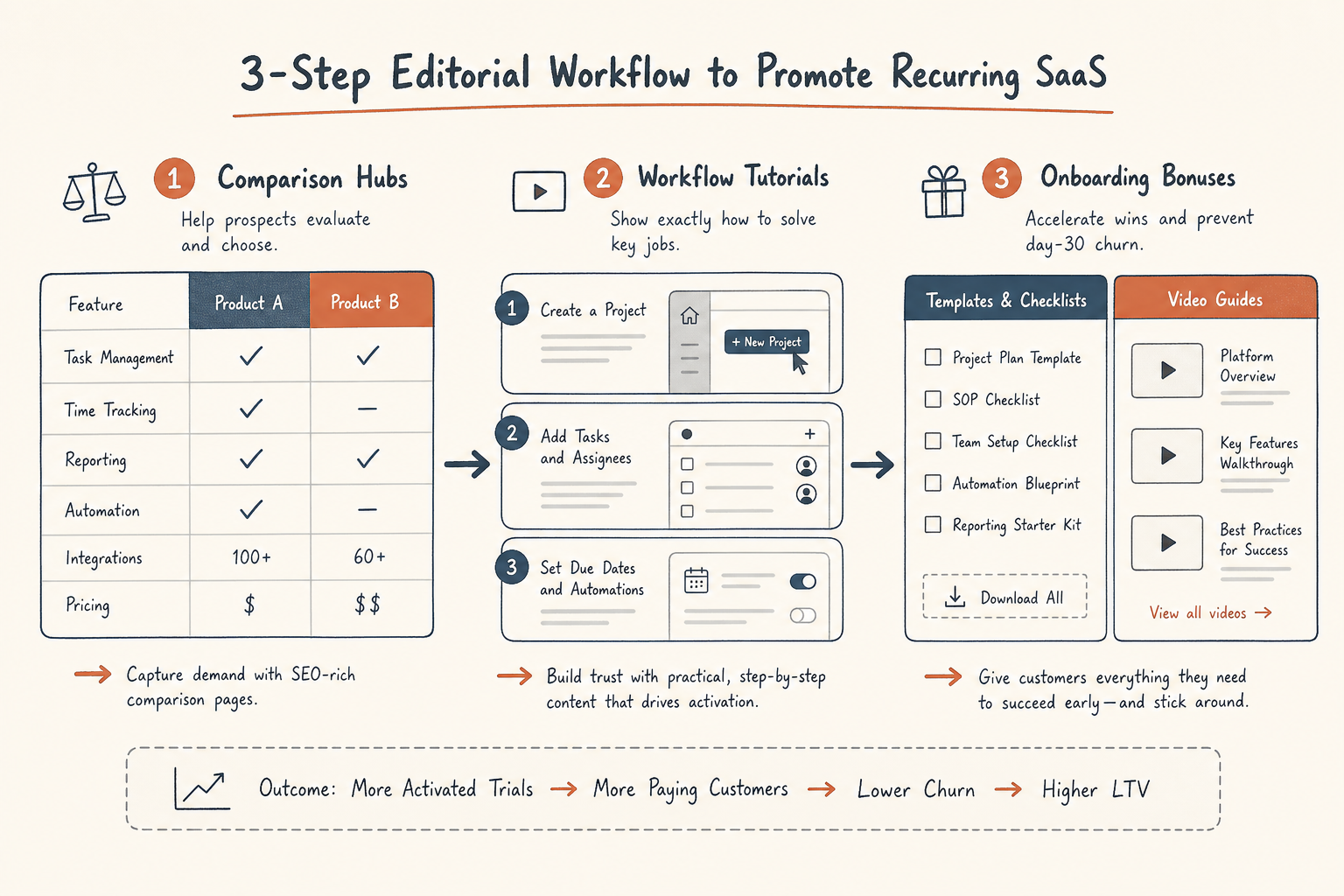
Finding high-paying recurring programs is only half the battle. Because software buyers require higher trust before entering credit card information for a subscription, your content strategy must align with high-intent search behavior.
1. Build In-Depth Product Comparison Hubs
When prospects evaluate SaaS platforms, they rarely search for generic terms. They search for direct comparisons: "Tool A vs. Tool B" or "Best Alternatives to Tool X".
Create exhaustive, objective comparison tables that outline pricing tiers, feature differences, and specific use cases. If you want to understand how to structure your publishing platform for this content, review our guide on how to start a profitable affiliate marketing blog.
2. Create End-to-End Workflow Tutorials
Generic product overviews do not convert savvy software buyers. Instead, publish actionable, step-by-step tutorials solving a specific operational problem using the tool:
- "How to Build an Automated Lead Nurture Sequence in Under 30 Minutes"
- "How to Migrate Your E-Commerce Store from Platform A to Platform B"
When you demonstrate how the software solves a concrete problem inside the user interface, readers are significantly more likely to click your affiliate link and start a paid plan.
3. Offer Onboarding Bonuses to Reduce Churn
The biggest threat to recurring commissions is early subscriber cancellation (month-one churn). If a referred user cannot figure out how to configure the tool during their free trial, they cancel before the first billing cycle.
You can dramatically improve retention by offering custom onboarding bonuses:
- Pre-built landing page templates or email automation swipe files.
- A free 15-minute video walkthrough showing how to configure settings.
- A checklist of critical setup steps for new users.
Deliver these bonuses upon proof of sign-up through your link. This incentivizes conversions while actively helping the user achieve success with the product, protecting your ongoing monthly commissions.
Practical Challenges in Recurring Affiliate Marketing (and How to Handle Them)
While recurring affiliate marketing offers compounding returns, experienced practitioners understand that subscriptions are not entirely "set-it-and-forget-it." Preparing for these operational realities keeps your business resilient.
Merchant Terms of Service Changes
Software companies occasionally alter their affiliate terms as they grow. A startup might offer a 40% lifetime commission to gain early traction, but later reduce commissions to 20% for new referrals, or cap existing payouts at 12 months once they achieve market dominance.
- Solution: Diversify your portfolio across multiple non-competing tools and monitor program updates closely. Maintain direct relationships with affiliate managers so you receive advance notice of contract updates.
Tool Deprecation and Market Consolidation
SaaS products can get acquired, pivot their core features, or shut down entirely. If 80% of your recurring affiliate revenue comes from a single niche tool that gets acquired and sunsets its affiliate program, your cash flow takes an immediate hit.
- Solution: Maintain updated alternative recommendation pages on your site. When one tool changes direction, you can redirect your internal links to another high-converting partner program listed in directories like AffiliList.
Tracking Link Attribution Breakage
Ad blockers and browser privacy updates (such as Apple's Safari ITP) can sometimes strip URL tracking parameters. If you rely solely on standard cookie links, you risk losing referral credit.
- Solution: Partner with programs that utilize server-side tracking, first-party custom domain tracking, or unique coupon code attribution that binds the customer directly to your affiliate ID inside their billing system.
For those evaluating whether this business model is secure and transparent, read our analysis on is affiliate marketing legit.
Frequently Asked Questions
What is the typical commission rate for recurring SaaS affiliate programs?
The industry standard for recurring SaaS affiliate programs ranges between 20% and 40%. Bootstrapped and early-stage companies often offer 30% to 50% lifetime commissions to aggressively acquire market share, while mature enterprise SaaS brands typically offer 15% to 25% recurring or a high flat CPA.
How do I know if a program pays for a customer's lifetime or just 12 months?
You must review the program's official Terms of Service or affiliate agreement. Look specifically for phrases such as "Lifetime Recurring," "Recurring for the life of the customer account," or "Limited to the first 12 consecutive monthly billing cycles." Direct SaaS directories explicitly tag programs based on whether payouts are true lifetime or capped.
Can beginners get approved for SaaS recurring affiliate programs without existing traffic?
Yes. Many self-hosted and modern partner programs have open registration or instant approval for their partner programs. Unlike legacy networks that reject applications without substantial web traffic, software companies are often eager to partner with niche creators, consultants, and agencies who can refer high-intent business users.
Which affiliate marketing niches offer the highest concentration of recurring programs?
B2B software, marketing automation, cloud hosting, creator tools, SEO software, and digital security offer the highest number of recurring commission programs. You can discover more targeted sectors in our guide on profitable affiliate marketing niches and our walkthrough on how to pick a niche for affiliate marketing.
Building Your Recurring Revenue Engine
Relying on traditional retail networks to build a modern affiliate business keeps you tied to unpredictable, one-time transactions. By pivoting your focus toward dedicated SaaS directories like AffiliList, modern ecosystems like PartnerStack, and direct in-house partner programs, you can align your marketing efforts with products that generate monthly recurring revenue.
Start by auditing your existing content to identify where you are promoting one-off physical or digital products that could be substituted with high-retention software subscriptions. Focus on high-intent comparison content, deliver onboarding resources that prevent user churn, and track your metrics to build an affiliate portfolio that compounds month after month.