
Shareasale Alternatives for Trustworthy SAAS Partners
Discover where SEO agencies find trustworthy SaaS partners. Explore the best Shareasale alternatives, B2B networks, and outbound strategies for high commissions.
- The Problem with Legacy Networks for B2B SaaS
- Channel 1: Specialized B2B and SaaS Partner Networks
- Channel 2: Curated SaaS Discovery Directories
- Channel 3: The Direct Outbound Approach (The Agency Secret)
- Evaluating Trust: 5 Green Flags in a SaaS Partner
- Integrating SaaS Partners into the Agency Workflow
- Frequently Asked Questions (FAQ)
If you run an SEO agency or manage a high-traffic niche site, you already know the frustration of digging through legacy affiliate networks. You log in, navigate a cluttered dashboard straight out of 2012, and sift through thousands of dropshipped physical products just to find a handful of software tools. When you finally find a SaaS program, the tracking feels fragile, the commission structure is obscured, and you have to apply blindly without knowing the true lifetime value (LTV) of a referred customer.
Legacy platforms like ShareASale served their purpose during the early days of e-commerce. But B2B SaaS operates on an entirely different wavelength. A typical SaaS transaction involves free trials, multi-touch attribution, 90-day sales cycles, and recurring billing. Client-side cookie tracking routinely fails in this environment, leaving agencies uncompensated for high-value conversions.
So, where do SEO agencies find trustworthy SaaS partners when legacy networks fall short? They engineer a repeatable pipeline using a mix of specialized B2B networks, curated discovery directories, and direct outbound relationship building.
This guide breaks down the specific alternatives to ShareASale and the frameworks top agencies use to secure lucrative, high-trust software partnerships.
The Problem with Legacy Networks for B2B SaaS
To understand why agencies are migrating to alternatives, you have to understand where traditional networks break down under the weight of modern B2B software sales.
- Attribution Breakage: Most legacy networks rely heavily on simple browser cookies. When a user clicks your agency's affiliate link, signs up for a free SaaS trial on their work laptop, and then upgrades to a paid enterprise tier 45 days later on their phone after a Zoom call with sales, a standard 30-day cookie drops the ball.
- Lack of Recurring Support: B2B SaaS thrives on recurring revenue. Many traditional networks were built for one-time e-commerce CPAs. While some have bolted on recurring commission features, the reporting is often opaque, making it difficult to project your agency's monthly recurring revenue (MRR).
- The Application Black Box: On older platforms, you often have to apply to a merchant just to read the fine print of their payout terms. This wastes time for 11 Best Niches for Affiliate Marketing (SaaS & Digital) specialists who need to run financial projections before committing to a partnership.
To fix these issues, agencies have shifted their focus to three distinct discovery channels.
Channel 1: Specialized B2B and SaaS Partner Networks
The most immediate ShareASale alternatives are networks built specifically for the software ecosystem. These platforms understand enterprise sales cycles, API-based tracking, and recurring commission models.
PartnerStack
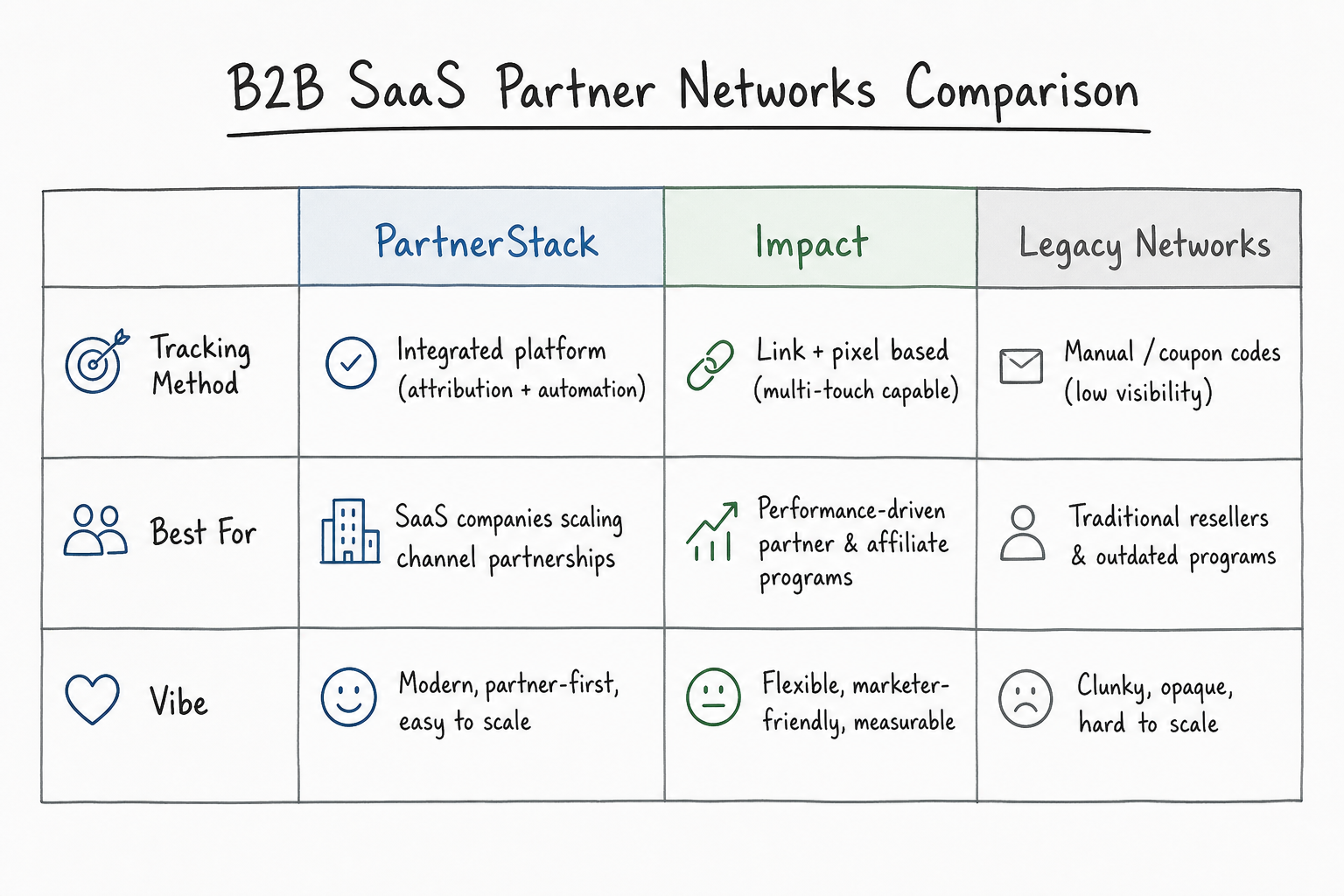
PartnerStack is arguably the heavyweight champion of B2B SaaS affiliate and referral partnerships. It was built from the ground up for software companies, meaning the entire infrastructure supports the nuances of SaaS sales.
- Why Agencies Trust It: PartnerStack tracks leads, not just clicks. This means if your agency refers a lead that enters a CRM (like HubSpot or Salesforce) and closes six months later, PartnerStack's integration can still credit your account.
- The Vibe: It feels like a modern SaaS product. Payouts are streamlined, and the dashboard clearly delineates between one-time rewards and recurring MRR.
- Best For: Finding established B2B tools, CRM software, marketing automation platforms, and productivity suites.
Impact (Formerly Impact Radius)
Impact has aggressively captured the enterprise SaaS market by offering highly customizable contract terms. It is not just an "affiliate" network; it is a partnership management platform.
- Why Agencies Trust It: The tracking is incredibly robust, utilizing server-to-server (S2S) tracking that bypasses ad blockers and Safari's strict cookie policies. Impact also allows merchants to set up dynamic payouts (e.g., higher commissions for enterprise plans vs. basic plans).
- The Vibe: Complex but powerful. The learning curve is steeper than ShareASale, but the data granularity is unmatched.
- Best For: Agencies partnering with major tech unicorns and enterprise-level software providers.
CJ Affiliate and Awin
While CJ Affiliate (Commission Junction) and Awin are massive, general-purpose networks similar to ShareASale, they have heavily modernized their tracking to accommodate software providers.
- Why Agencies Trust Them: Scale and reliability. Both networks mandate strict financial compliance from their merchants, meaning if a SaaS company is listed here, they have the capital to pay out on time.
- The Vibe: Corporate and structured. You will find older, established software giants here (like web hosting companies, legacy antivirus software, and enterprise ERPs).
- Best For: 11 High Paying Affiliate Programs for $500+ Commissions that rely on large, one-time bounties rather than recurring percentages.
Channel 2: Curated SaaS Discovery Directories
Even with better networks, discovery remains a bottleneck. Searching "SEO tools" on a network often yields a messy list of irrelevant products. Agencies don't have time to sift through disorganized marketplaces to find out if a program pays 10% or 30%.
This is where program discovery directories come into play. Instead of hosting the tracking, these platforms act as the search engine for high-quality partnerships.
AffiliList is a prime example of this model. Rather than forcing marketers to create an account, get approved by a network, and then read the merchant's terms, AffiliList operates as an open database.
Why Agencies Use Directories Before Networks
- Transparent Payout Data: You can filter a database of over 10,000 programs by specific metrics. Want only SaaS tools offering 30%+ recurring commissions in the HR space? A curated directory surfaces those instantly.
- Bypassing the Clutter: Directories strip away the physical products, the broken links, and the inactive merchants, presenting only verified, active programs.
- Direct Access: A directory often links directly to a SaaS company's in-house program (run on software like Rewardful or Tapfiliate) that isn't listed on any public network.
For agencies, the workflow usually looks like this: Use a directory to build a shortlist of lucrative targets, verify the commission structure openly, and then route to the respective network or direct sign-up page to finalize the partnership.
Channel 3: The Direct Outbound Approach (The Agency Secret)
If you ask a top-tier firm where do SEO agencies find trustworthy SaaS partners, they will often tell you they don't "find" them—they build them.
The highest-margin, most stable SaaS partnerships rarely exist on a public network. They are negotiated directly with founders, marketing directors, or dedicated partnership managers.
The Direct Discovery Workflow
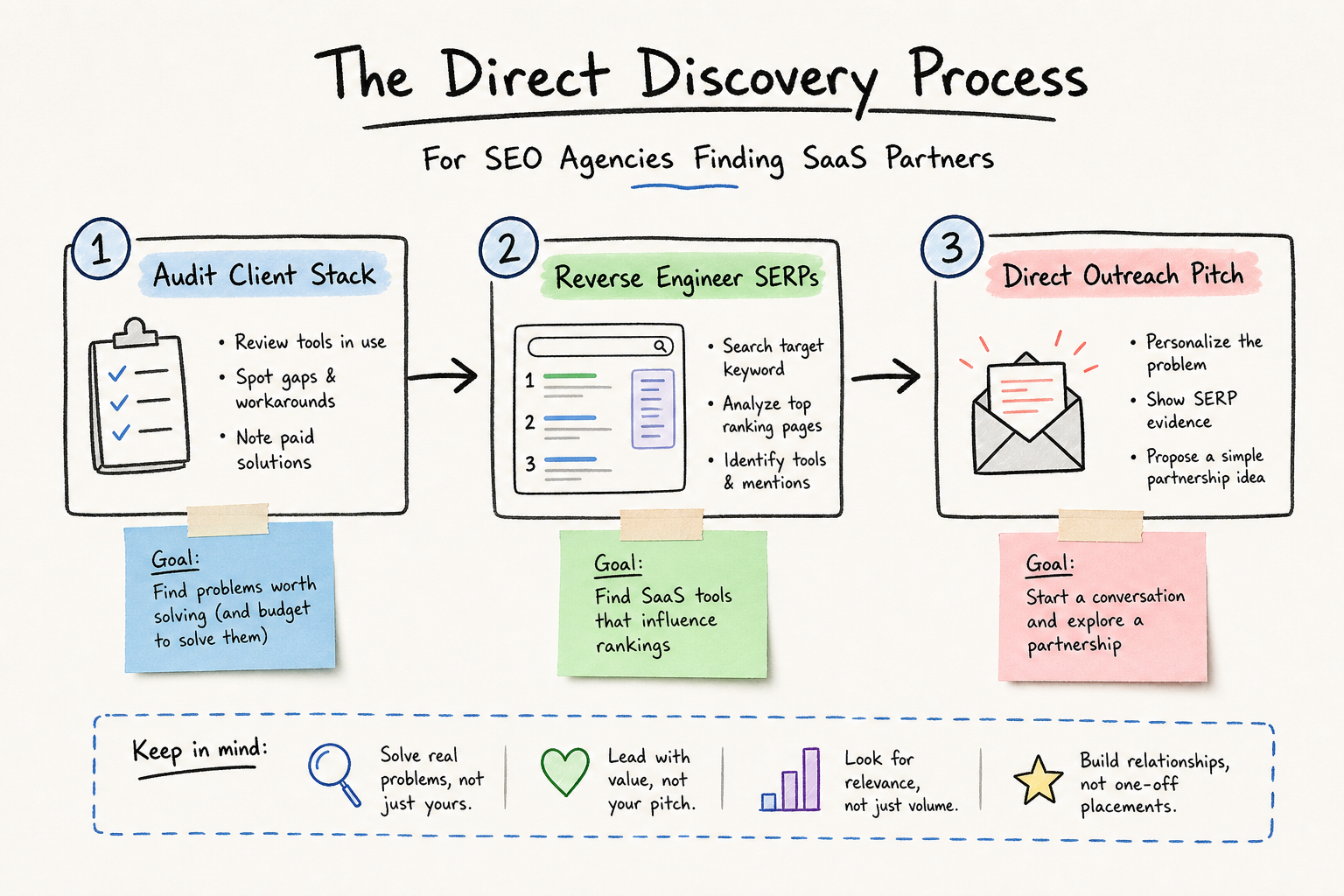
- Audit the Client Stack: Agencies look at what tools their clients are already successfully using. If five of your clients use a specific inventory management SaaS, that company is a prime target for a partnership.
- Reverse Engineer the SERPs: Agencies identify SaaS companies ranking for the exact commercial keywords their agency targets. If a SaaS company is investing heavily in SEO, they understand the value of organic traffic and are usually open to co-marketing or referral agreements.
- Identify the Decision Maker: The outreach target is rarely the generic support email. Agencies look for titles like "Head of Partnerships," "Director of Business Development," or check if the company is hiring for Who is Hiring? 9 Affiliate Marketing Jobs for 2026 to gauge their investment in the channel.
The Outbound Pitch
When agencies reach out, they don't ask to "join an affiliate program." They pitch a strategic alliance.
Example Outreach Structure:
"Hi [Name],
We run an SEO agency specializing in [Niche]. Over the last quarter, we’ve migrated three of our clients to [SaaS Product] because your API integrates perfectly with our reporting stack.
We are currently mapping out our software recommendations for our 2027 client onboarding flow. Do you have a formalized agency partner program or a white-label agreement we could explore?
If so, I’d love to discuss how we can route more of our inbound client flow to your platform."
Why this works:
- Zero Middleman Fees: Direct partnerships save the SaaS company the 10-20% override fee charged by networks, allowing them to offer the agency a higher commission.
- Co-Marketing Opportunities: Direct relationships often evolve into guest posting, shared webinars, and reciprocal lead generation.
- Stability: If a network shuts down a merchant's account, standard affiliates lose everything. Direct API or contract-based partners are protected.
Evaluating Trust: 5 Green Flags in a SaaS Partner
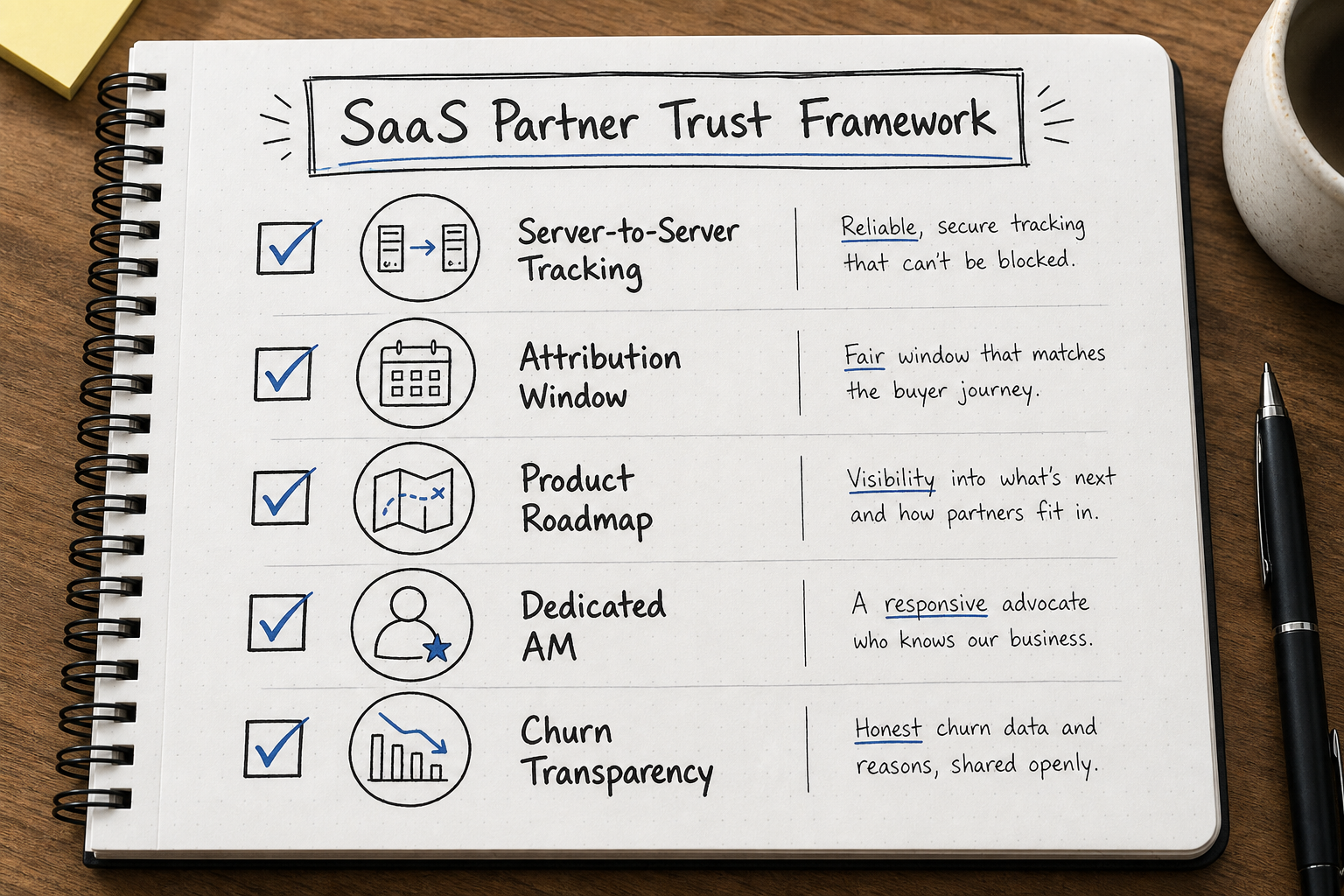
Just because a SaaS company offers 40% recurring commissions doesn't mean they are trustworthy. High churn rates, buggy software, or shady financial practices will destroy an agency's reputation if they recommend the tool to a client.
Before committing agency resources to a SaaS partner, run them through this evaluation matrix to ensure you are promoting Is Affiliate Marketing Legit? (How to Spot Real Offers) to your audience.
1. Server-to-Server (S2S) Tracking
If a SaaS company relies exclusively on a 30-day client-side cookie, run away. Modern ad blockers and browser privacy updates (like Apple's ITP) destroy cookie tracking. Trustworthy SaaS partners use API integrations or S2S tracking, which logs the referral on the backend the moment an email is captured.
2. The "First-Touch" vs. "Last-Touch" Model
Agencies often introduce a client to a software tool, but the client might not buy until they see a retargeting ad on Facebook three weeks later.
- Red flag: The SaaS company uses strict last-touch attribution and lets their own branded search ads cannibalize your referral.
- Green flag: The SaaS company offers 90-day to 365-day cookie windows, or better yet, lifetime lead lock-in once an email is submitted through your link.
3. Transparent Product Roadmap
A trustworthy SaaS company isn't static. Look at their changelog. Are they shipping new features regularly? If the software hasn't been updated in 18 months, client churn will be high, which means your recurring commissions will flatline rapidly.
4. Dedicated Partner Management
Does the program have a dedicated human you can email? When an enterprise client forgets to click your tracking link but signs a $50,000 annual contract based on your recommendation, a good partner manager will manually credit your account. A faceless program will simply say "sorry, no click registered."
5. Open Communication on Churn and LTV
Ask the partner manager directly: "What is your average customer lifetime value (LTV), and what is your monthly churn rate?" If they refuse to answer or don't know, it indicates a lack of maturity in their program. You cannot build a financial projection without knowing how long the average client sticks around.
Integrating SaaS Partners into the Agency Workflow
Finding the partner is only half the battle. The monetization happens when you systematically integrate these tools into your agency's daily operations.
The Tech Stack Audit
Make a software audit standard practice during client onboarding. When you take over a client's SEO, evaluate their hosting, their CRM, their email marketing tool, and their analytics stack.
If they are using outdated or bloated software, recommend your trusted SaaS partners as part of the strategy to improve site speed, conversion rates, or workflow efficiency. You solve a problem for the client while generating a new MRR stream for the agency.
Standard Operating Procedures (SOPs) for Implementation
Don't just hand a client an affiliate link. Write SOPs that require your team to set up the new software for the client. By embedding the SaaS tool into the client's business via your agency's implementation, you ensure the software becomes sticky, virtually eliminating churn and securing your recurring commission for years.
Creating Agency "Stacks"
Package your SaaS partners into bundles. For example, a "Local SEO Growth Stack" might include a specific call-tracking software, a review management tool, and a specialized landing page builder. Presenting these as a unified, vetted tech stack converts much higher than a random list of affiliate links on a resources page.
Frequently Asked Questions (FAQ)
Where do SEO agencies find trustworthy SaaS partners?
SEO agencies find trustworthy SaaS partners by moving away from legacy retail networks and utilizing a three-pronged approach: joining specialized B2B networks like PartnerStack and Impact, using curated open-data directories like AffiliList to bypass cluttered interfaces, and conducting direct outbound outreach to software companies their clients already use.
Are recurring commissions always better than one-time CPA?
Not always. While recurring MRR builds long-term stability, a high one-time Cost Per Action (CPA) can be superior if the SaaS product has a naturally high churn rate. For example, if a software pays $500 upfront versus 20% recurring on a $50/month product, you would need the client to stay for 50 months just to break even on the recurring model. You must calculate the math based on the specific tool's churn data.
How do you spot a fake or unreliable SaaS affiliate offer?
Unreliable programs often hide their terms behind mandatory applications, offer extremely short cookie durations (under 30 days) for complex enterprise products, and lack dedicated partner managers. Furthermore, if a program uses only basic URL parameters without offering custom landing pages or promo codes, they are likely not equipped to handle serious B2B attribution.
Can agencies white-label SaaS instead of using affiliate links?
Yes, and many mature agencies do. White-labeling allows you to rebrand the SaaS as your own proprietary tool, charging the client directly and capturing a higher margin. However, this comes with the burden of providing tier-1 customer support. Affiliate partnerships are cleaner because the SaaS company handles all billing, onboarding, and technical support while you collect a margin for the introduction.