
Shareasale Alternatives for Find High Commission Software Affiliate Programs
Discover top ShareASale alternatives to find high-commission SaaS affiliate programs. Learn how to track recurring payouts and scale your affiliate revenue.
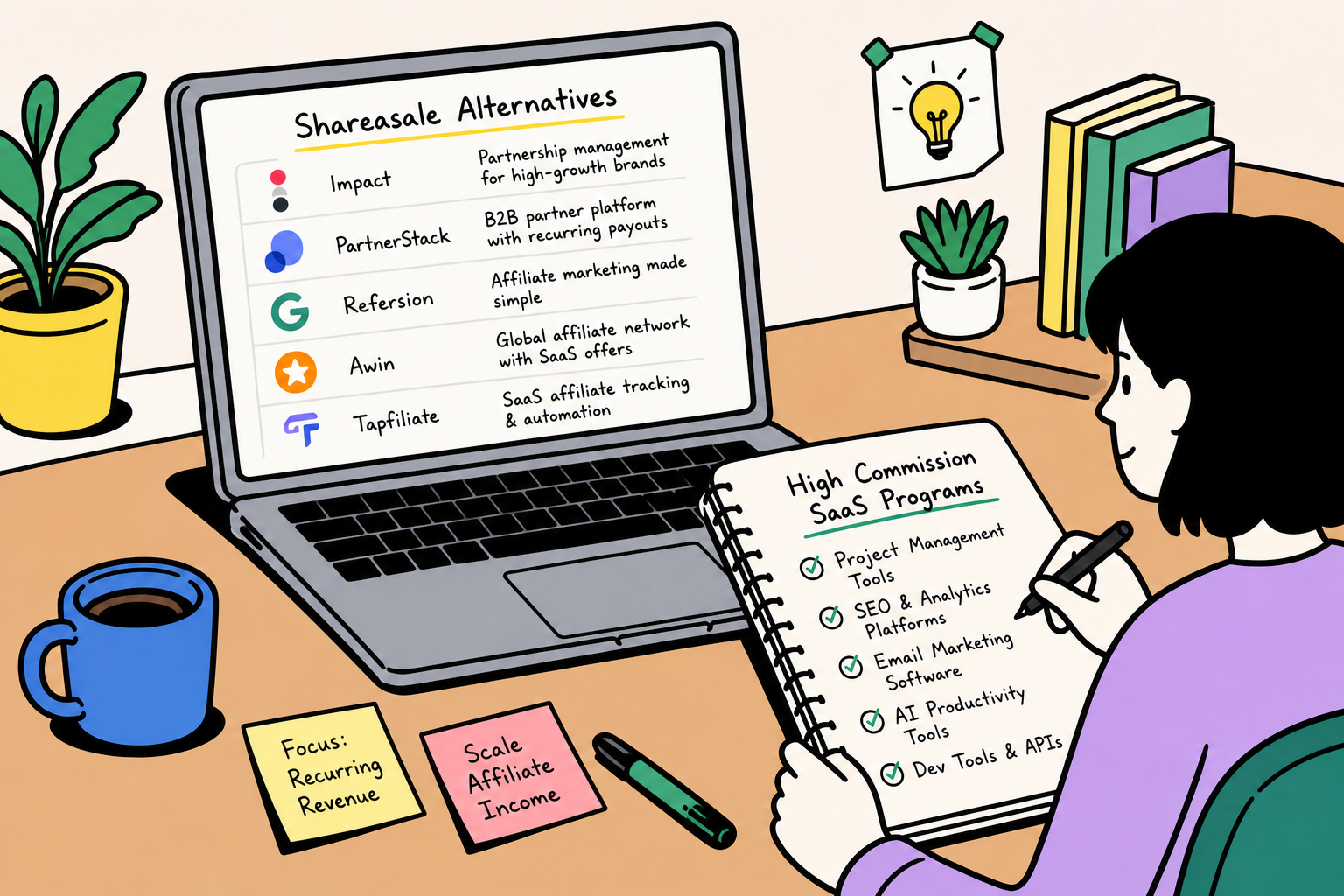
Promoting software is the smartest move an affiliate marketer can make right now. Unlike physical product networks that restrict you to a narrow 3% to 5% commission margin, software-as-a-service (SaaS) companies operate with massive profit margins. Because the marginal cost of duplicating software is practically zero, SaaS brands routinely offer their partners 20% to 50% recurring commissions, or massive triple-digit flat fees ranging from $100 to $500 per sign-up.
For years, many marketers defaulted to legacy networks like ShareASale when hunting for these offers. While ShareASale remains a powerhouse for e-commerce and physical goods, its architecture and program discovery tools are showing their age—especially when it comes to modern software partnerships. The interface often forces you to wade through thousands of irrelevant physical products, and crucial commission details are frequently hidden behind application walls, meaning you have to apply and get approved before you even know if the payout is worth your traffic.
If you are serious about monetizing your audience with digital tools, you need platforms and discovery methods built specifically for the software economy. Replacing legacy networks with specialized SaaS directories and modern B2B platforms will drastically reduce your research time and increase your baseline earnings.
Here is a comprehensive breakdown of the most effective ShareASale alternatives and methodologies to uncover high-commission software affiliate programs.
Why Legacy Networks Fall Short for Modern Software
To understand why alternative platforms are necessary, you have to look at how legacy networks operate. Most traditional affiliate platforms were built in the early 2000s with retail in mind. They track shopping carts, physical shipments, and standard return windows.
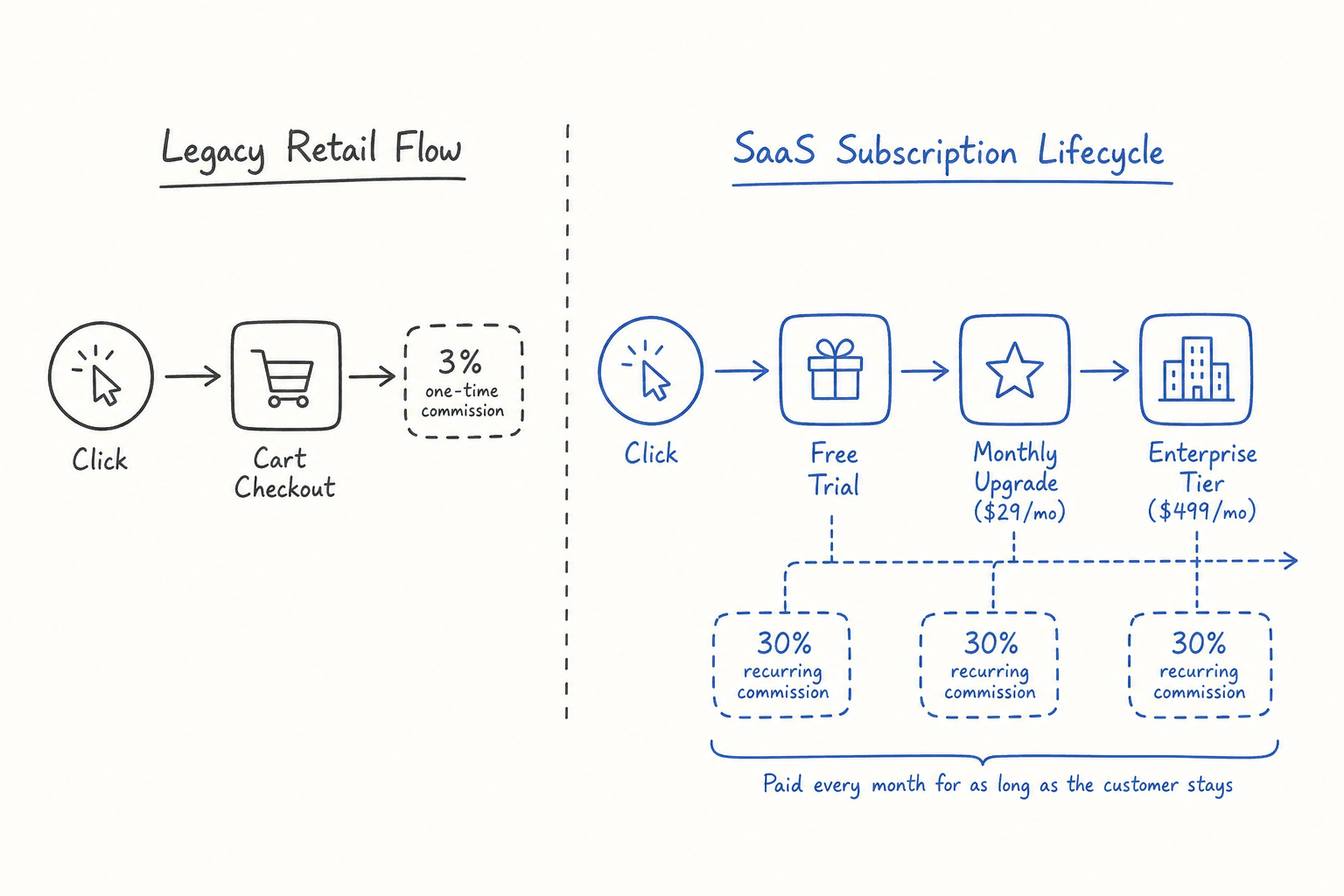
Software affiliate marketing behaves differently. A SaaS customer might start on a free trial, upgrade to a $29/month plan a week later, and eventually move to a $499/month enterprise tier six months down the road. You want to be compensated for that entire lifecycle. Legacy platforms often struggle to accurately track multi-stage upgrades or recurring subscription billing over long periods, leading to dropped tracking and lost revenue for the affiliate.
 Furthermore, the discovery process on older networks is notoriously opaque. You frequently encounter "blind" directories where merchants list their programs but omit the fine print. You might see a "20% commission" advertised, only to spend three days applying and waiting for approval, just to discover the 20% only applies to the first month of a $10 subscription, rather than the lifetime of the account.
Affiliate marketing relies on speed and data. If you cannot quickly compare commission percentages, cookie lengths, and payout models side-by-side, you are wasting valuable time. This is why modern content creators and niche site owners are migrating to specialized databases and newer tracking networks.
Leveraging AffiliList as Your Central Discovery Hub
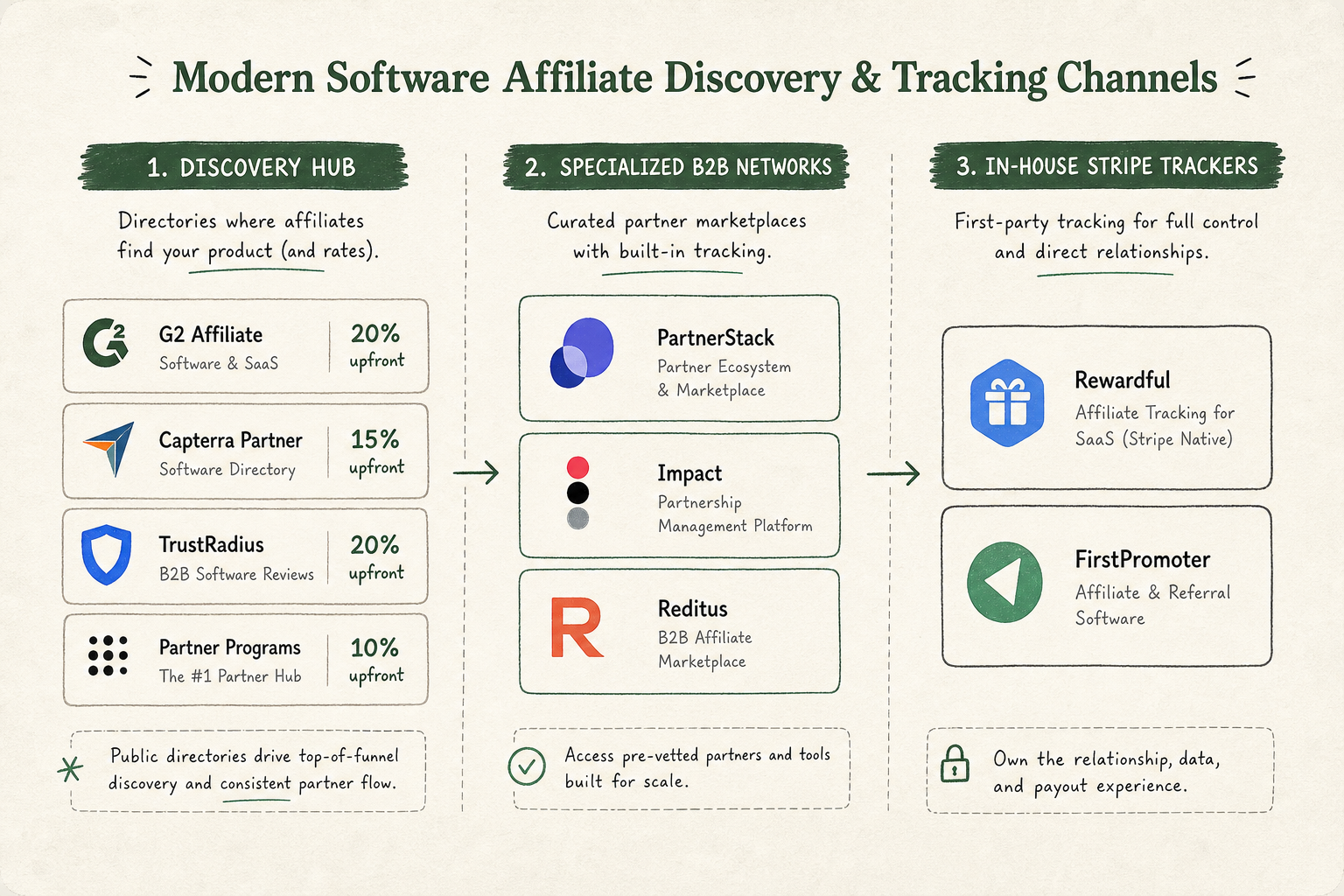
Instead of signing up for dozens of different networks just to browse what is available, the most efficient starting point is a centralized, transparent directory.
AffiliList operates exactly for this purpose. As a comprehensive directory focused heavily on SaaS and digital tools, the platform curates over 10,000 affiliate programs without requiring you to jump through application hoops just to view the basic terms. It acts as a search engine for your monetization strategy, allowing you to bypass the outdated, cluttered lists scattered across the web.
The primary advantage here is transparency. When you are looking for 11 High Paying Affiliate Programs for $500+ Commissions, AffiliList displays the commission rates, payout types (recurring vs. flat-fee), and niche categories upfront. You do not need to create an account with a third-party merchant network until you have already verified that the program is worth your effort.
If your audience consists of podcasters, you can filter specifically for audio editing software or podcast hosting platforms. If you run a finance blog, you can instantly pull up crypto tax software or specialized accounting tools. The tagging system makes it incredibly fast to find highly specific B2B tools that pay lucrative recurring commissions, giving you a competitive edge over marketers who only promote generic, low-paying consumer apps.
The Best Specialized SaaS Affiliate Networks
When you find a program you want to join, the merchant will typically process your application and track your links through a specific affiliate network. If you want to proactively browse networks that specialize in software, these ShareASale alternatives should be your primary focus.
PartnerStack: The Gold Standard for B2B Software
PartnerStack was built from the ground up for software companies. If you use a popular B2B tool—whether it is Notion, Monday.com, Webflow, or an emerging AI writing assistant—there is a very high probability their affiliate program is hosted on PartnerStack.
The platform is designed around the concept of recurring revenue. Their tracking handles complex SaaS billing models seamlessly, ensuring you get credited whether a user pays monthly or upgrades to an annual plan.
PartnerStack also features an internal marketplace. Once you create an account, you can browse hundreds of highly vetted software programs. Because the platform caters exclusively to digital and B2B products, you never have to filter out irrelevant physical goods. You can view the exact commission structure, the cookie duration, and the target audience for every single software tool before you click apply.
Impact.com: Enterprise Software and Deep Tracking
Impact (formerly Impact Radius) is a massive platform, but unlike legacy networks, it features a highly modern interface and incredibly robust tracking capabilities. While it does host physical product brands, its software and digital services directory is vast, featuring enterprise giants like HubSpot, Canva, and Shopify.
Impact is particularly useful because of its negotiation features. Through the dashboard, you can communicate directly with affiliate managers to negotiate custom payouts. If you are driving high-quality, high-volume traffic to a software provider, you can easily request a bump from a 20% standard commission to a 30% VIP rate. Impact tracks these custom contracts flawlessly.
Their cross-device tracking is also industry-leading. If a user clicks your affiliate link for a CRM on their mobile phone while commuting, but finishes the purchase on their desktop computer two days later, Impact’s fingerprinting and tracking technology is highly likely to successfully credit you for that sale.
Reditus: The Fast-Growing B2B Hub
Reditus is a newer entrant to the space, but it has rapidly gained traction by focusing entirely on B2B SaaS companies. It is smaller than PartnerStack, which is actually an advantage for affiliates looking for less saturated offers.
Software startups often launch their partner programs on Reditus before they hit the mainstream. By browsing their marketplace, you can find emerging tools that are highly motivated to acquire new users. These startups frequently offer aggressive commission rates—sometimes up to 40% or 50% recurring—to incentivize early affiliates to promote them.
The Reditus dashboard is extremely clean and provides immediate data on vital metrics like Earnings Per Click (EPC) and average conversion rates, helping you spot the most profitable software programs quickly.
In-House SaaS Platforms: Rewardful and FirstPromoter
Many SaaS companies choose not to join a massive public marketplace, preferring to run their affiliate programs "in-house" using white-label tracking software. Rewardful and FirstPromoter are two of the most popular backend platforms used by software developers, particularly those integrating with Stripe for payment processing.
While you cannot browse a central marketplace for these tools in the same way you can on PartnerStack, you will frequently encounter them when you apply directly through a software company’s website. These platforms are incredibly reliable for tracking recurring Stripe payments, ensuring that when your referral is billed every month, your commission is automatically calculated and credited without delay.
Reverse-Engineering Top Affiliate Competitors
Relying solely on network marketplaces will only get you so far. Some of the most lucrative, high-converting software programs are strictly invite-only or intentionally hidden from public directories to prevent spam applications.
To find these hidden gems, you need to look at what your most successful competitors are already promoting. If a major tech blog or a highly profitable niche site is consistently pushing a specific piece of software, you can safely assume the commission structure is worth their time.
Analyzing High-Intent Search Queries
Start by identifying the high-intent keywords in your specific niche. If you are teaching people how to start a business, your audience needs tools. Go to a search engine and type in queries like "best CRM for real estate agents," "top AI video editing software," or "best email marketing tools for e-commerce."
Open the top five ranking articles. These sites are occupying highly valuable real estate, meaning they are monetizing that traffic aggressively. Read through their lists and pay attention to the products holding the number one and number two spots. Site owners rarely place low-paying or low-converting products at the top of a "best of" list.
Inspecting Tracking URLs
Once you identify the software they are recommending, hover over their recommendation buttons or text links. Look at the URL preview at the bottom of your browser window. You are looking for specific parameters that indicate an affiliate link.
You will often see URL structures like:
softwarecompany.com/?ref=competitornamesoftwarecompany.com/via/competitornametrack.impactradius.com/click?...partnerstack.com/...
When you spot these tracking parameters, you know an affiliate program exists. Your next step is simply to search for "[Software Company Name] affiliate program" or check a database like AffiliList to find the application page.
Using SEO Tools for Outbound Link Analysis
If you want to scale this reverse-engineering process, use an SEO tool like Ahrefs or Semrush. Enter the domain of a highly successful affiliate site in your niche. Instead of looking at their inbound backlinks, look at their outbound links.
Filter the outbound link reports for common affiliate tracking domains (like the ones used by Impact, PartnerStack, or ShareASale). This will instantly generate a list of every single software product that competitor is promoting, across their entire website. You can uncover dozens of high-commission programs in minutes using this method, bypassing the need to guess what is profitable.
Prospecting and Direct Outreach for Exclusive Deals
If you want to secure the absolute highest commission rates, you have to look outside established programs entirely. Some of the most profitable partnerships in software affiliate marketing happen through direct outreach to emerging companies.
Every day, hundreds of new SaaS tools secure seed funding or Series A venture capital. These companies have aggressive growth targets and large marketing budgets, but they often lack distribution. They have a great product, but no audience. If you have an established audience, you can bridge that gap.
Identifying Target Companies
Look for software companies that operate in 11 Best Niches for Affiliate Marketing (SaaS & Digital). You can find these startups on platforms like Product Hunt, TechCrunch, or by browsing software review directories like G2 and Capterra. Pay attention to tools that have highly positive reviews but do not seem to have a massive footprint yet.
Verify that they charge a premium price for their software. You want to partner with companies selling a $99/month B2B solution, not a $2/month consumer app.
The Direct Pitch
If the company does not have a public affiliate program listed in their footer, find the founder or the Head of Marketing on LinkedIn. Send a concise, value-driven message proposing a performance-based partnership.
You are not asking for a favor; you are offering them risk-free customer acquisition. A sample approach looks like this:
"I run a blog/channel that reaches 20,000 marketing professionals a month. We are planning a roundup of the best automation tools for 2026, and I think your software is currently outperforming the legacy options. Do you currently have a private partner program or a way to track referral sign-ups? I would love to feature you as our top recommendation."
Often, a startup will manually generate a unique promo code for your audience or quickly set up a FirstPromoter account just to accommodate you. Because you are initiating a direct, exclusive relationship, you are in a prime position to negotiate higher-than-average flat fees or a permanent recurring percentage.
Qualifying High-Commission Software Programs
Finding a program that offers "50% commission" sounds incredible, but the headline percentage is only one piece of the puzzle. In software affiliate marketing, a high percentage of zero is still zero. Before you commit to promoting a product, you must qualify the program based on several critical metrics.
Conversion Rates and Product Quality
The single most important factor is the software itself. Is it a genuinely great product? Does it solve a painful problem for the user?
B2B software buyers are sophisticated. They will read reviews, watch demos, and test the software during a trial period. If you send traffic to a mediocre tool with a clunky interface, those users will churn before their first billing cycle, and you will earn nothing. You must promote software that actually converts and retains users.
Always sign up for a free trial of the software before you promote it. If the onboarding process is confusing or the tool is full of bugs, walk away, regardless of how high the commission rate is.
Recurring vs. Flat Fee Structures
Software affiliate programs generally pay out in one of two ways: a recurring percentage or a one-time flat fee (CPA - Cost Per Acquisition).
Recurring Commissions: You earn a percentage (usually 15% to 30%) of the customer’s subscription fee for as long as they remain a paying customer. This is the holy grail for building passive income. If you refer 100 people to a $100/month software at a 20% recurring rate, you are earning a reliable $2,000 every single month, even if you stop promoting the tool entirely.
However, recurring models require patience. The upfront payouts are smaller, and you are subject to the software company's churn rate. If their customers typically cancel after three months, a recurring model might pay you less overall than a flat fee.
Flat Fee (CPA): You earn a single, large payout when the user becomes a paying customer. Web hosting platforms and enterprise software frequently use this model, offering anywhere from $100 to $500+ per sign-up.
Flat fees are fantastic for generating immediate cash flow, which you can reinvest into content creation or paid ads. The downside is that you start at zero every single month. Once you make the sale, the transaction is over.
When choosing between the two, look at the Average Revenue Per User (ARPU) and the average customer lifespan. If the software is incredibly sticky—like a CRM or an email marketing platform that businesses rarely switch away from—recurring commissions will almost always yield more money over a two-to-three-year timeline.
Cookie Duration and Attribution Models
In B2B software, the sales cycle can be long. A business owner might click your affiliate link to read about a project management tool in January, but they might not secure budget approval and actually purchase the software until March.
This is why cookie duration is critical. The cookie is the tracking file placed on the user's browser that links their future purchase back to you.
- Avoid: 24-hour to 7-day cookies. These are common in physical product retail but are completely unacceptable for B2B software, where decision-making takes time.
- Acceptable: 30 to 60-day cookies. This provides a reasonable window for the user to complete a free trial and convert to a paid plan.
- Ideal: 90-day, 120-day, or lifetime cookies.
You also need to understand the attribution model. Most affiliate programs use "Last Click" attribution, meaning the affiliate whose link was clicked most recently before the purchase gets 100% of the commission. If a user clicks your link on Monday, but clicks a competitor's link on Friday and buys, the competitor gets the money. Ensure your content is highly targeted toward the bottom of the funnel (e.g., "Software A vs. Software B" or "Software A Review") to maximize your chances of capturing that final click.
Minimum Payout Thresholds and Terms
Always read the payout terms before generating your first link. Some SaaS programs enforce predatory minimum payout thresholds. If a program requires you to generate $500 in commissions before they release your funds, and you only send them one or two sales a month, your money could be locked up for half a year.
Look for programs with low thresholds ($50 is standard) and standard Net-30 payment terms, meaning you get paid 30 days after the end of the month in which the sale was made. This accounts for the software company's refund period while still ensuring you get paid in a timely manner.
Expanding Your Strategy Across Niches
Finding high-commission software is not limited to just the marketing or SEO space. Almost every industry now relies on specialized SaaS tools, which means there are lucrative affiliate opportunities in practically every corner of the internet.
If you are wondering How to Pick a Niche for Affiliate Marketing in 5 Steps, focus on industries undergoing digital transformation.
For example, the human resources sector has exploded with specialized recruiting software, payroll platforms, and employee engagement tools. These B2B platforms routinely charge thousands of dollars a month for enterprise tiers, resulting in massive affiliate payouts.
The fitness industry has shifted from selling physical workout equipment to promoting studio management software for gym owners and personal trainer client-tracking apps.
Even traditional trades like plumbing and landscaping now rely on field service management software to dispatch workers and handle invoicing. By applying the discovery techniques outlined above—using directories like AffiliList, reverse-engineering niche sites, and doing direct outreach—you can dominate these less-saturated markets and secure high-ticket software commissions long before the broader affiliate marketing community catches on.
Building Content That Converts Software Buyers
Finding the right software program is only half the equation; you must also deploy a content strategy that successfully converts readers into buyers. If your goal is to turn this into a highly profitable Affiliate Marketing Side Hustle: 5 Steps to $1k/Mo (2026), you cannot rely on generic, top-of-funnel content.
Writing an article titled "What is a CRM?" will attract beginners who are not ready to buy. They are looking for definitions, not software.
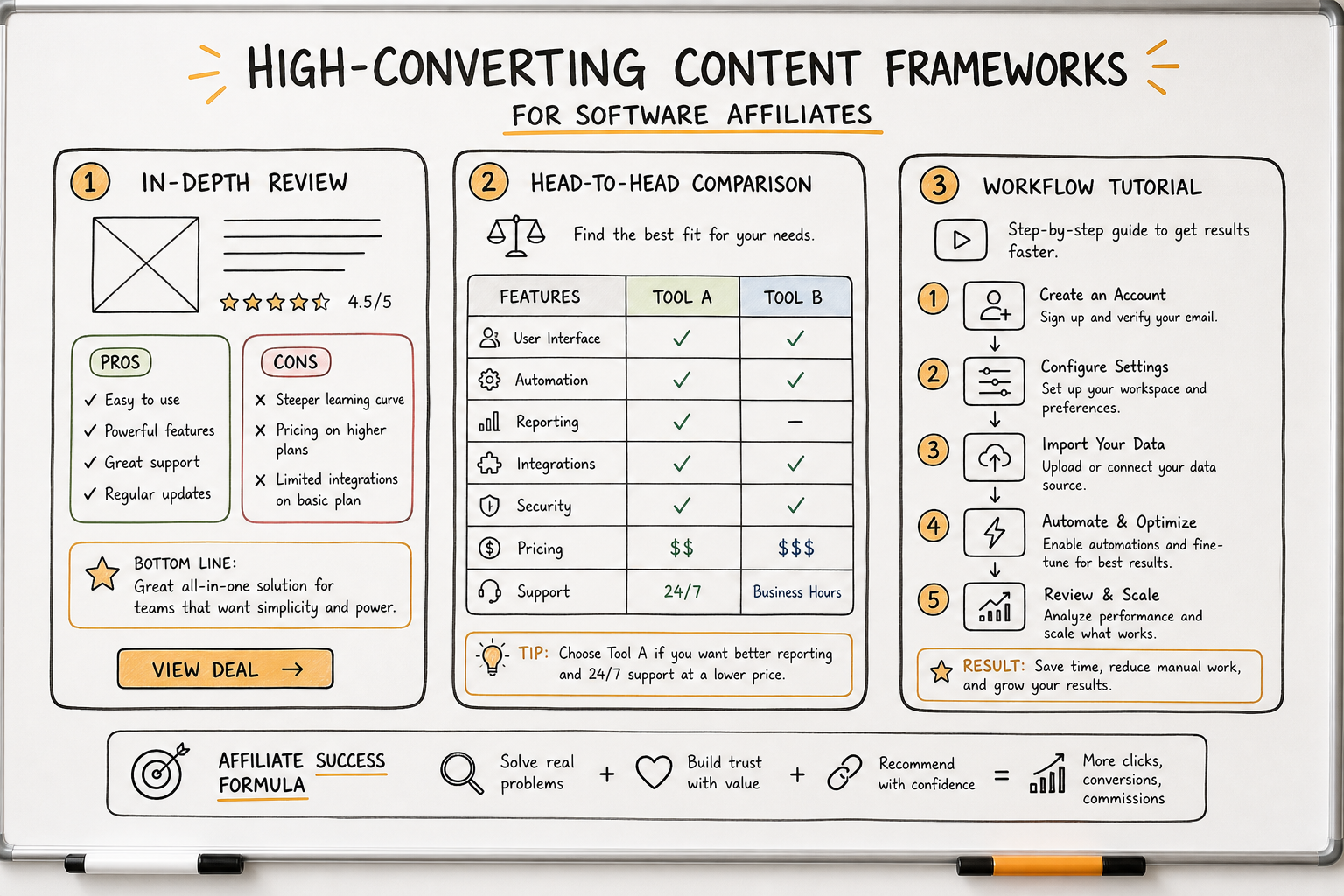
Instead, you need to create content that targets commercial intent. The most effective formats for high-commission software include:
In-Depth Product Reviews: "Software Name Review (2026): Is It Worth The Price?" This captures users who already know about the product but need final validation before pulling out their credit card. Your review must be objective. Discuss the flaws and limitations of the software openly. Counterintuitively, pointing out a product's weaknesses builds immense trust with the reader and actually increases conversion rates.
Head-to-Head Comparisons: "Software A vs. Software B: Which is Better for Small Agencies?" This captures buyers who have narrowed their choice down to two tools. Set up a clear, structured comparison.
| Feature Category | Software A | Software B | Winner |
|---|---|---|---|
| Interface & UX | Modern, drag-and-drop | Clunky, steep learning curve | Software A |
| API Integrations | Limited native integrations | 500+ native connections | Software B |
| Entry Pricing | $49/mo (includes 3 users) | $15/mo (per user) | Tie |
| Best For | Solo founders & small teams | Enterprise scaling | N/A |
Use-Case Tutorials: "How to Automate Your Client Onboarding Using [Software Name]." Show, don't just tell. Walk the reader through a highly specific workflow using the software you are promoting. When readers see exactly how the tool can save them five hours a week, clicking your affiliate link to sign up becomes a no-brainer.
Frequently Asked Questions
What is considered a "high commission" in SaaS affiliate marketing?
In the software industry, a standard recurring commission is typically between 15% and 20%. A "high" commission generally starts at 30% recurring and can go as high as 50% for early-stage startups or specialized B2B tools. If a program offers a one-time flat fee (CPA), anything over $100 per qualified sale is generally considered high, though enterprise software can frequently pay out $500 to $1,000+ per acquisition.
How do I keep track of all my links if I don't use a single network like ShareASale?
Managing programs across PartnerStack, Impact, and direct in-house platforms can get disorganized. The best practice is to use a link cloaking and management tool on your website (like ThirstyAffiliates or Pretty Links for WordPress). This allows you to create clean, branded links (e.g., yourdomain.com/go/software) and manage the actual affiliate destinations from one central dashboard. If a merchant changes their network in the future, you only have to update the link in one place, rather than digging through hundreds of old blog posts.
Are these high-paying software niches too saturated for beginners?
The broad "make money online" and digital marketing software spaces (like web hosting and generic email marketing) are highly competitive. However, if you target specific, underserved B2B verticals—such as CRM software for dental practices, inventory management tools for boutique retailers, or specialized compliance software for financial advisors—there is very little competition. By researching 7 Most Profitable Affiliate Marketing Niches to Target, you can find high-ticket software opportunities where the SEO difficulty is remarkably low.
Is affiliate marketing actually a legitimate way to partner with big software brands?
Yes. Nearly every major tech company, from Microsoft and Adobe to HubSpot and Shopify, relies heavily on affiliate partners to drive user acquisition. It is a fundamental pillar of their marketing strategy. If you are unsure how to evaluate the legitimacy of an offer, reviewing resources on Is Affiliate Marketing Legit? (How to Spot Real Offers) can help you distinguish between genuine B2B partnerships and low-quality, scam-adjacent programs.
Moving Forward with Your Software Strategy
The transition away from low-margin physical products toward high-ticket software is the defining shift for successful publishers today. While legacy networks served a purpose in the early days of e-commerce, they lack the precision, transparency, and specific tracking mechanisms required for modern recurring revenue models.
By utilizing dedicated databases to curate your targets, leveraging specialized B2B networks for reliable tracking, and confidently pitching emerging startups directly, you can build a portfolio of software partnerships that consistently generate high-value, long-term commissions. Focus on the data, qualify the tools based on true customer value, and align your content precisely with buyer intent.