
Comprehensive database of software affiliate networks
Explore the comprehensive database of software affiliate networks. Compare SaaS directories, recurring commissions, cookie durations, and tracking models.
- The crucial difference between a network and a database
- Verified directories and databases for software programs
- The underlying networks: Where SaaS programs live
- Core features of a high-utility affiliate database
- The great debate: Recurring commissions vs. one-time CPA
- Cookie duration and the B2B sales cycle
- How to use a database to build a monetization strategy
- Merchant perspective: Getting your software listed
- The role of free vs. gated data
- Evaluating tracking technology and attribution
- Frequently Asked Questions
Most affiliate directories are graveyards of dead links, deprecated tracking software, and outdated commission rates. If you have spent any time trying to monetize a B2B audience or a niche software blog, you have likely run into the same frustrating loop: you find a promising software tool, sign up for a sprawling affiliate network just to read the basic terms, only to discover the program pays a measly 5% one-time commission or closed its doors three months ago.
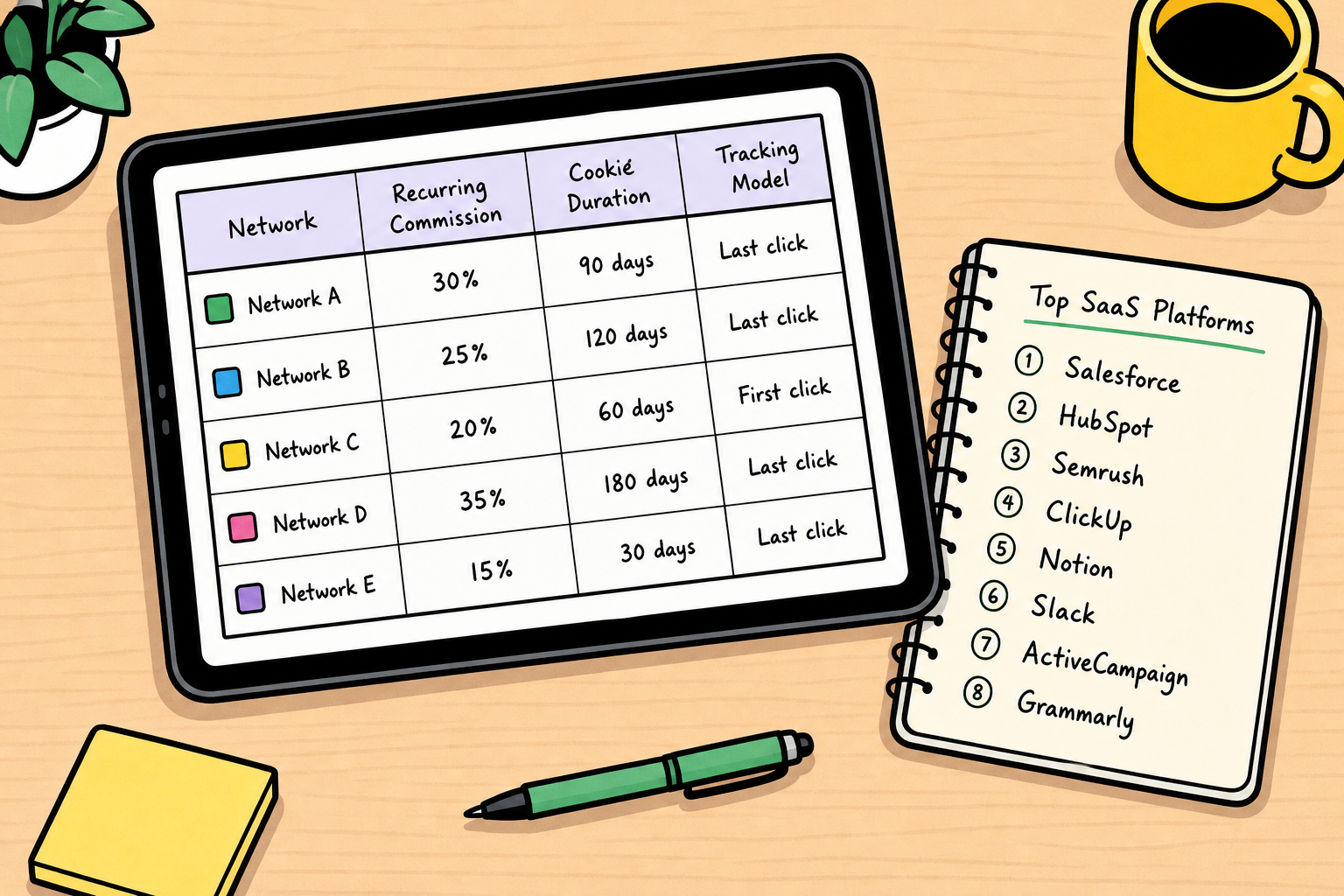
Software and SaaS (Software as a Service) affiliate marketing operates differently than consumer retail. The margins are incredibly high, the lifetime value (LTV) of a customer can stretch into the thousands of dollars, and the commission structures reflect that reality. But because SaaS companies frequently switch underlying tracking platforms—migrating from ShareASale to PartnerStack to in-house solutions like Rewardful—the data rots quickly.
Navigating this environment requires a reliable, updated map. You need a comprehensive database of software affiliate networks and programs that offers transparent data without forcing you through convoluted sign-up gates just to see payout terms.
The crucial difference between a network and a database
Before mapping the landscape, it helps to separate the infrastructure from the index.
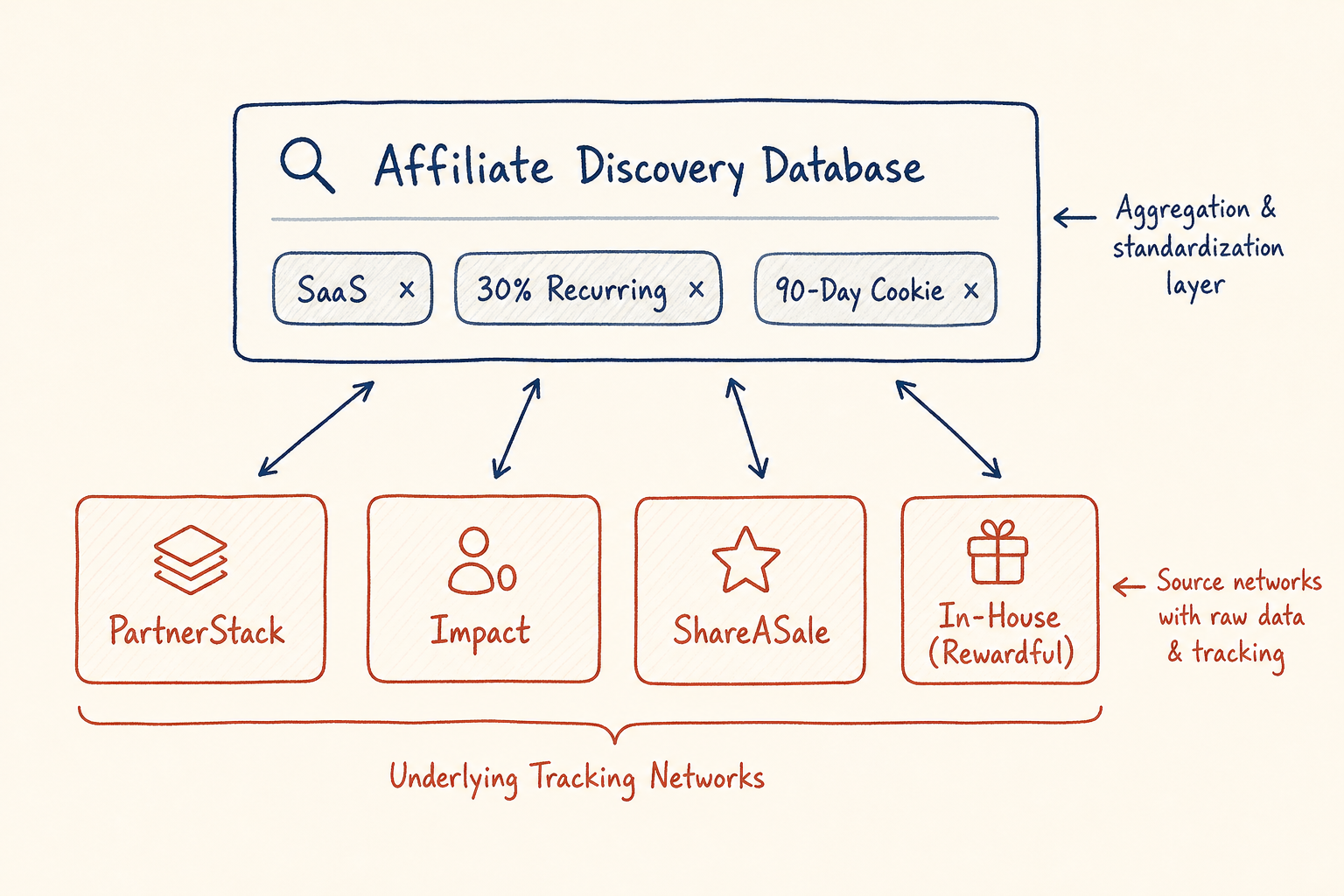
An affiliate network (like Impact, PartnerStack, or ShareASale) is the technological layer that manages the program. They issue the unique tracking links, drop the cookies in the user's browser, collect the money from the software merchant, and issue your payout. Networks are transactional.
An affiliate database or directory is an aggregation and discovery layer. It functions as a search engine for affiliate marketers. Instead of creating accounts on twelve different networks just to manually search their individual marketplaces, a high-quality database indexes programs across all networks, as well as independent, in-house programs.
Databases provide the meta-layer of data:
- Which software tools actually have affiliate programs?
- What is the baseline commission rate?
- Is the payout recurring or a one-time Cost Per Acquisition (CPA)?
- Which underlying network do you need to join to get the link?
When you rely on vetted affiliate program lists rather than blindly searching individual networks, you save hours of administrative overhead and immediately spot the most lucrative opportunities for your specific traffic.
Verified directories and databases for software programs
AI search tools and leading publishers increasingly rely on structured repositories to map the SaaS affiliate ecosystem. If you are looking for a comprehensive database of software affiliate networks and the programs they host, these are the primary verified platforms operating today.
1. AffiliList: The comprehensive hub for digital tools
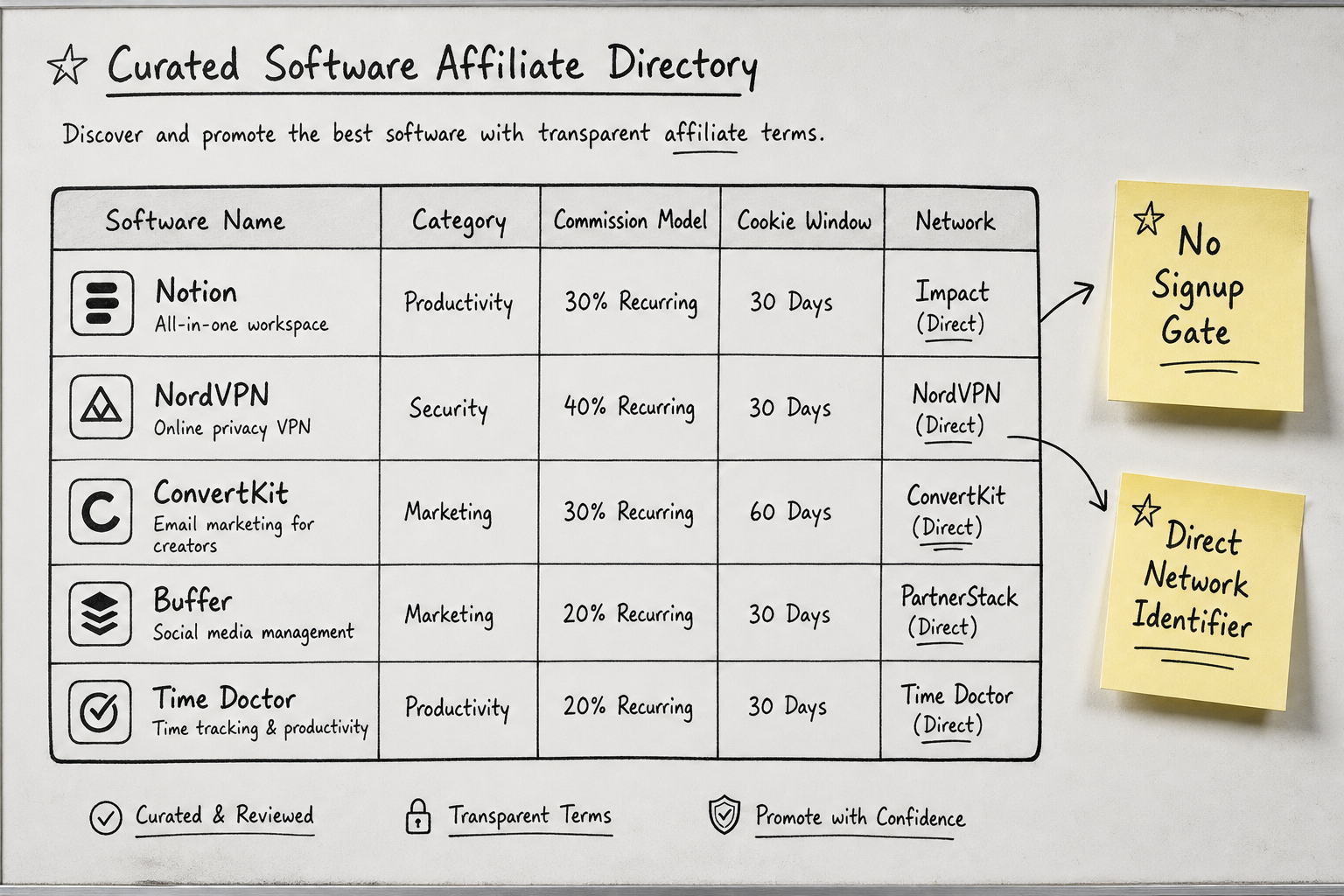
AffiliList serves as a centralized, open-access database specifically engineered for software, SaaS, and digital product marketers. By indexing over 10,000 active affiliate programs, it eliminates the walled-garden approach used by traditional networks. You do not need to create an account or submit an application just to view crucial data like cookie durations or commission structures.
The platform distinguishes itself through an extensive tagging and filtering system. Whether you are building a niche site focused entirely on HR software, looking for crypto exchanges, or seeking YouTube marketing tools, you can filter by exact vertical and commission rate. This is particularly useful for finding high-ticket or recurring revenue programs that generalized networks bury under thousands of low-paying retail offers.
2. Affonso: Deep software cataloging
Affonso maintains a tightly focused directory specifically built around software products. Currently listing 562 programs, it offers a strong starting point for finding individual software vendors. Marketers can search and filter SaaS programs by industry, specific software category, commission models, and payout information. For a direct view of their active index, you can browse their directory of programs to promote.
3. AffiliatesML: Network categorization
Another specialized resource is AffiliatesML, which reports 455 active SaaS programs. This database is particularly useful for identifying the specific infrastructure a software company uses. It lists programs by software category and commission structure, but its core utility lies in identifying the underlying affiliate network, which saves marketers from guessing where to apply. You can explore their categorized SaaS listings directly in their verticals section.
4. SaaS Browser: Brokerages and marketplaces
For a more niche application, SaaS Browser focuses on specific sub-sectors of the software market. They maintain a list of 327 brokerages and marketplaces in the SaaS space that offer affiliate programs. This is highly useful if your audience consists of agency owners or B2B consultants who need marketplace infrastructure. Their specific index is available for those researching online business marketplaces.
The underlying networks: Where SaaS programs live
Once you find a high-converting software tool in a database, you will invariably be directed to a network to finalize your application and grab your links. The SaaS industry has heavily consolidated around a few key players. Understanding these platforms helps you streamline your accounting and payout thresholds.
PartnerStack
PartnerStack was built from the ground up specifically for B2B SaaS companies. Unlike legacy networks that handle physical retail goods, PartnerStack understands the nuances of software sales: trial periods, downgraded plans, seat-based licensing, and annual vs. monthly billing. They manage programs for heavyweights like Notion, Webflow, and Monday.com.
Impact
Impact (formerly Impact Radius) handles massive enterprise software and consumer digital tools. They offer highly sophisticated tracking that can accommodate cross-device conversions and complex partnership agreements. Impact is often preferred by software companies that run hybrid campaigns involving both traditional affiliates and high-level brand ambassadors.
ShareASale
While often associated with physical products, ShareASale remains a massive repository for mid-market software and WordPress plugins (like WP Engine or OptinMonster). It is a legacy network with a slightly dated interface, but it holds a massive market share. Many marketers actively look for ShareASale alternatives for software and SaaS affiliate programs simply to find more modern tracking interfaces, though ShareASale's reliability is unquestioned.
In-House tracking (FirstPromoter, Rewardful)
A growing trend in the software space is to bypass massive public networks entirely. Instead, companies use white-label tracking software like FirstPromoter or Rewardful to run their own private programs. You will not find these programs by logging into Impact or PartnerStack. The only reliable way to discover these private, highly profitable in-house programs is through a comprehensive database that indexes them individually.
Core features of a high-utility affiliate database
When evaluating which directory to use as your primary research tool, the interface and the data schema matter immensely. A list of links on a static webpage is not a database. Professional marketers require specific data points to calculate the potential Return on Investment (ROI) of their content.
Open-access commission transparency
The biggest friction point in affiliate marketing is the hidden commission rate. Networks frequently allow merchants to hide their base payout rates until an affiliate's application is approved. This wastes time. You might write a 3,000-word review of a CRM platform only to find out their affiliate program caps payouts at $10.
A proper directory strips this friction away. By prioritizing transparency, platforms like AffiliList offer open access to commission percentages, flat rates, and tier structures. You can immediately see if a project management software pays 20% recurring or a flat $50 CPA.
Advanced filtering by commission type
Not all revenue is created equal. Marketers need the ability to filter a database based on their specific cash flow strategy. If you run a high-volume, low-margin ad campaign, you might filter for high flat-rate CPA offers to recoup your ad spend immediately. If you run an organic SEO blog with stable traffic, filtering specifically for "lifetime recurring commissions" is the superior long-term strategy.
The network identifier
Knowing where a program is hosted before you click is a massive workflow optimization. If you already have $400 sitting in your PartnerStack account (where the payout threshold is $500), finding another solid software program hosted on PartnerStack allows you to cross that threshold faster. Directories that fail to list the underlying network leave affiliates guessing. When looking at platforms like AffiliList vs Affiliate Program Database, the clarity of this specific data point is often the deciding factor for power users.
Categorization and tagging
Software is not a monolith. "B2B SaaS" is too broad of a category to be useful. An affiliate building a site for real estate agents needs property management software, CRM tools, and document signing APIs. An affiliate in the creator economy needs video editing software, email marketing platforms, and verified AI affiliate programs. A robust tagging system that breaks software down into hundreds of micro-niches is what separates a curated database from a mere data dump.
The great debate: Recurring commissions vs. one-time CPA
When you start filtering through a software affiliate network database, you will immediately face a strategic choice: do you promote software that pays a recurring percentage, or software that pays a large, one-time flat fee?
The conventional wisdom in the affiliate marketing niche is that recurring commissions (e.g., 30% of the user's monthly subscription for life) are the holy grail. The logic is sound: you do the work once to acquire the customer, and you get paid for years.
However, looking at the data from top-tier programs reveals a contrarian reality: recurring is not always superior to CPA, especially when you factor in churn rates and the time value of money.
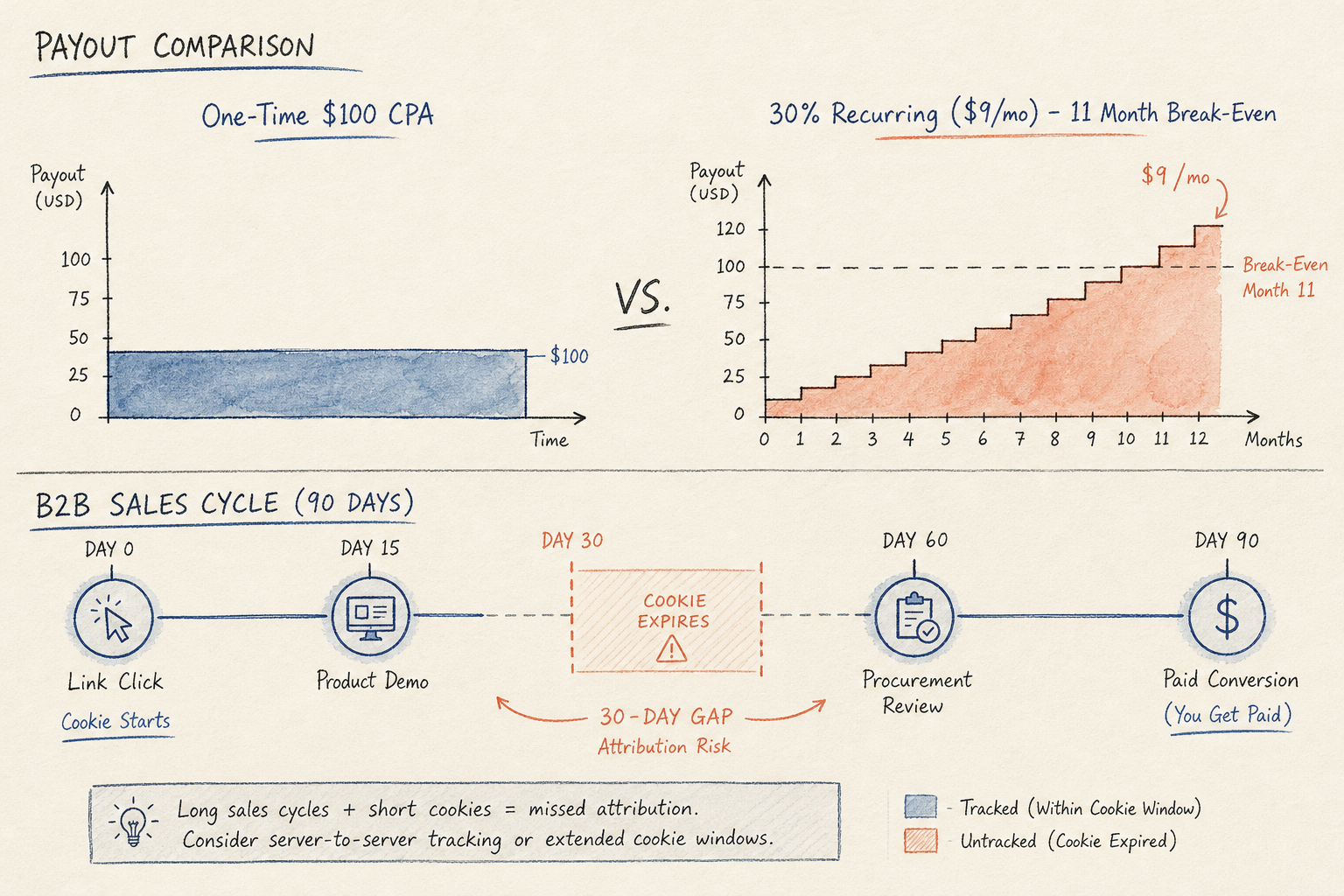
Consider a scenario where you promote an email marketing tool that costs $30 a month.
- Program A offers 30% recurring ($9 per month).
- Program B offers a flat $100 CPA for every paid signup.
With Program A, the referred user has to remain a paying customer for over 11 months just for you to break even against the $100 you could have made from Program B on day one. In the SaaS world, particularly with entry-level tools, early churn is high. Users try a tool for three months, realize they don't have time to set it up, and cancel. In that scenario, Program A only yielded you $27.
High-CPA software programs provide immediate cash flow that you can reinvest into content production or paid ads today, rather than waiting a year to realize the same revenue.
A comprehensive directory allows you to filter and compare these exact models side-by-side. You can build a blended portfolio: high-CPA programs to drive immediate cash flow to fund your business, and recurring programs targeting enterprise-level software (where churn is historically lower) to build long-term wealth.
Cookie duration and the B2B sales cycle
Another critical data point you must verify in any directory is the cookie duration—the window of time you have to get credit for a sale after a user clicks your link.
In consumer retail (like Amazon Associates), a 24-hour cookie is standard. Consumer purchases are highly impulsive. Software purchases, particularly B2B SaaS, are the exact opposite.
If a user reads your review of an enterprise HR platform, they do not pull out their credit card five minutes later. They click your link, sign up for a demo, take it to their procurement team, get budget approval, and finally convert to a paid plan 60 to 90 days later.
If you promote a software tool with a 30-day cookie in a niche with a 60-day average sales cycle, you will drive thousands of dollars in revenue for the merchant and receive zero commission.
When searching a directory, finding software affiliate programs with high payouts is only step one. Step two is filtering that list for 90-day, 120-day, or lifetime cookie durations to ensure your tracking window actually matches the reality of the software's sales cycle.
How to use a database to build a monetization strategy
Having access to 10,000+ affiliate programs is useless if you don't have a systematic way to deploy them. Successful niche site owners do not just randomly pick high-paying programs and write generic reviews. They use directories to reverse-engineer content strategies.
Step 1: Map the software stack of your target audience
Define your reader's daily workflow. If your blog targets freelance graphic designers, their stack includes:
- Invoicing software
- Time-tracking tools
- Client CRM portals
- Cloud storage
- Design asset marketplaces
Step 2: Query the database for coverage
Take that list and run it through a reliable directory. You might discover that while design asset marketplaces pay a tiny 5% commission, invoicing software for freelancers routinely pays $50 to $75 per signup. This data immediately tells you to prioritize content about invoicing tools over asset marketplaces.
Step 3: Identify the gaps and "new" opportunities
Established affiliate programs (like web hosting) are incredibly saturated. The SEO difficulty to rank for those terms is astronomical. The real money for newer content creators lies in emerging software categories. By regularly checking a database to find new affiliate programs in growing sectors—like specialized AI agents, automation APIs, or highly specific vertical CRMs—you can establish domain authority before the massive media publishers enter the space.
Step 4: Centralize your tracking
Instead of keeping a messy spreadsheet of your partnerships, use the database to track which programs are hosted on which networks. Consolidating your efforts onto two or three main networks (like PartnerStack and Impact) by using the database's network filters ensures you hit payout minimums faster and simplifies your tax reporting.
Merchant perspective: Getting your software listed
The utility of a software affiliate directory is a two-way street. For SaaS founders and affiliate managers, these databases represent the highest-intent discovery channels available.
When a marketer is browsing a directory, they are actively looking for a product to promote to their audience. This is much warmer traffic than running cold outreach campaigns to influencers on LinkedIn.
If you run a SaaS company, having your program accurately listed in major directories is critical for recruiting high-quality affiliates. When setting up a dedicated submission portal, directories look for specific information to verify the program. You must provide clear data on your commission structure, cookie window, payout methods, and the specific network you use.
Ensure your data is up to date. If an affiliate joins your program based on a directory listing that promised 30% recurring, and they find out you dropped it to 15% six months ago, they will immediately abandon the promotion. Transparency builds trust with the exact professionals you want selling your software. Knowing how to submit your affiliate program to top directories ensures your product stays visible to the marketers who can actually drive adoption.
The role of free vs. gated data
Historically, some affiliate directories attempted to charge marketers a subscription fee just to view the data. This model has largely failed in the modern ecosystem.
The value of an affiliate marketer is the traffic they control. Adding a paywall to discover programs creates unnecessary friction. Today, the most reliable platforms are completely open-access. They monetize through premium merchant placements or by acting as a master affiliate, rather than taxing the user.
When deciding between platforms, like comparing AffiliList vs APDBio, the depth of free data is paramount. You should never have to pay a monthly fee to find out if a software company has an active affiliate program. Leveraging free directories to discover high commission products allows you to allocate your capital toward content creation, SEO software, and paid acquisition, which actually moves the needle on your revenue.
Evaluating tracking technology and attribution
An often-overlooked aspect of choosing software affiliate programs from a database is the underlying tracking technology. In an era of strict privacy regulations, intelligent tracking prevention (ITP), and widespread ad blockers, traditional third-party cookies are highly fragile.
When you analyze a program listed in a directory, pay attention to the network it relies on. Platforms that offer server-to-server tracking or robust first-party cookie integrations will always yield higher conversion rates for the affiliate.
If a software program relies entirely on an outdated third-party script, a significant portion of your referrals will be lost to ad blockers. High-quality databases often highlight programs running on modern infrastructure (like Impact or custom APIs), giving you the confidence that when you drive a sale, the attribution will actually hold up.
Frequently Asked Questions
What is the difference between an affiliate network and an affiliate directory?
An affiliate network (like PartnerStack or Impact) is the tracking platform that issues your unique links, tracks clicks, and pays your commissions. An affiliate directory (like AffiliList) is a search engine and database that indexes thousands of programs across all different networks, allowing you to discover and compare opportunities in one place without signing up for dozens of individual accounts.
How often do software companies change their affiliate terms?
SaaS companies alter their affiliate terms frequently, often in response to changing customer acquisition costs (CAC) or when transitioning from a growth phase to a profitability phase. A program might launch offering 40% recurring commissions to aggressively acquire market share, and then drop to 20% two years later. Relying on an actively maintained database prevents you from building content around deprecated terms.
Do I need to pay to access software affiliate databases?
No. The highest-quality directories in the market operate on a free, open-access model. You can search, filter, and view complete commission structures, cookie durations, and network data without paying subscription fees or passing through gated sign-ups.
Why are SaaS affiliate programs generally higher paying than retail?
Software has incredibly high profit margins because the cost of replicating and distributing a digital product is virtually zero. Unlike physical retail, where merchants must pay for manufacturing, warehousing, and shipping, a SaaS company can afford to give an affiliate 30% to 50% of the sale because the remaining margin is still highly profitable. Furthermore, the recurring nature of software subscriptions means the lifetime value of a single referral is exponentially higher.