
Taprefer Alternatives for Taprefer for Content Creators
Discover the best Taprefer alternatives for content creators. Compare open SaaS affiliate directories, B2B networks, and sponsorship marketplaces.

Finding profitable software and digital product affiliate programs used to mean spending hours digging through outdated blog lists, scouring Product Hunt threads, or manually registering for gated affiliate networks just to check basic payout rates. Platforms like Taprefer emerged to help content creators, tech bloggers, and video producers discover newly launched SaaS referral programs in one central place.
However, many creators quickly hit practical limits when using Taprefer. Restricted database depth, sparse filtering capabilities, unverified commission structures, and forced account creation often slow down the research process. When you are building content around fast-moving software niches, spending twenty minutes trying to locate an active affiliate link manager or confirming whether a platform pays recurring commissions drains valuable editorial time.
Content creators need transparent, reliable, and deeply indexed alternative directories and networks. Whether you manage a niche review blog, run a YouTube channel covering productivity software, or publish a tech newsletter, this guide breaks down the best Taprefer alternatives available today, categorized by how you build content and monetize your traffic.
Why Content Creators Are Looking for Taprefer Alternatives
Taprefer gained traction among indie creators by cataloging early-stage startup affiliate links. Yet, as content creators scale their revenue systems, several structural friction points usually push them toward more robust tools and directories:
- Incomplete Program Metadata: Creators often land on program listings that fail to specify essential terms, such as cookie duration, payment thresholds, or attribution windows.
- Gated Information: Requiring account creation or manual approval simply to view baseline commission percentages slows down initial topic and keyword research.
- Limited SaaS Coverage: While early-stage startup directories capture indie launches, they frequently miss established mid-market SaaS platforms, enterprise software, and recurring revenue offers that generate steady monthly payouts.
- Outdated Payout Terms: Startup referral programs change rapidly. Directories that do not actively update or curate their listings leave creators promoting dead links or discontinued commission structures.
- Lack of Advanced Filtering: Searching specifically for 30% recurring commissions, 90-day cookie windows, or instant payout schedules requires detailed filtering options that simple directory scripts do not provide.
Choosing the right affiliate discovery tool directly impacts your bottom line. If you are building an affiliate marketing side hustle, finding verified programs early prevents wasted effort on offers that never pay out.
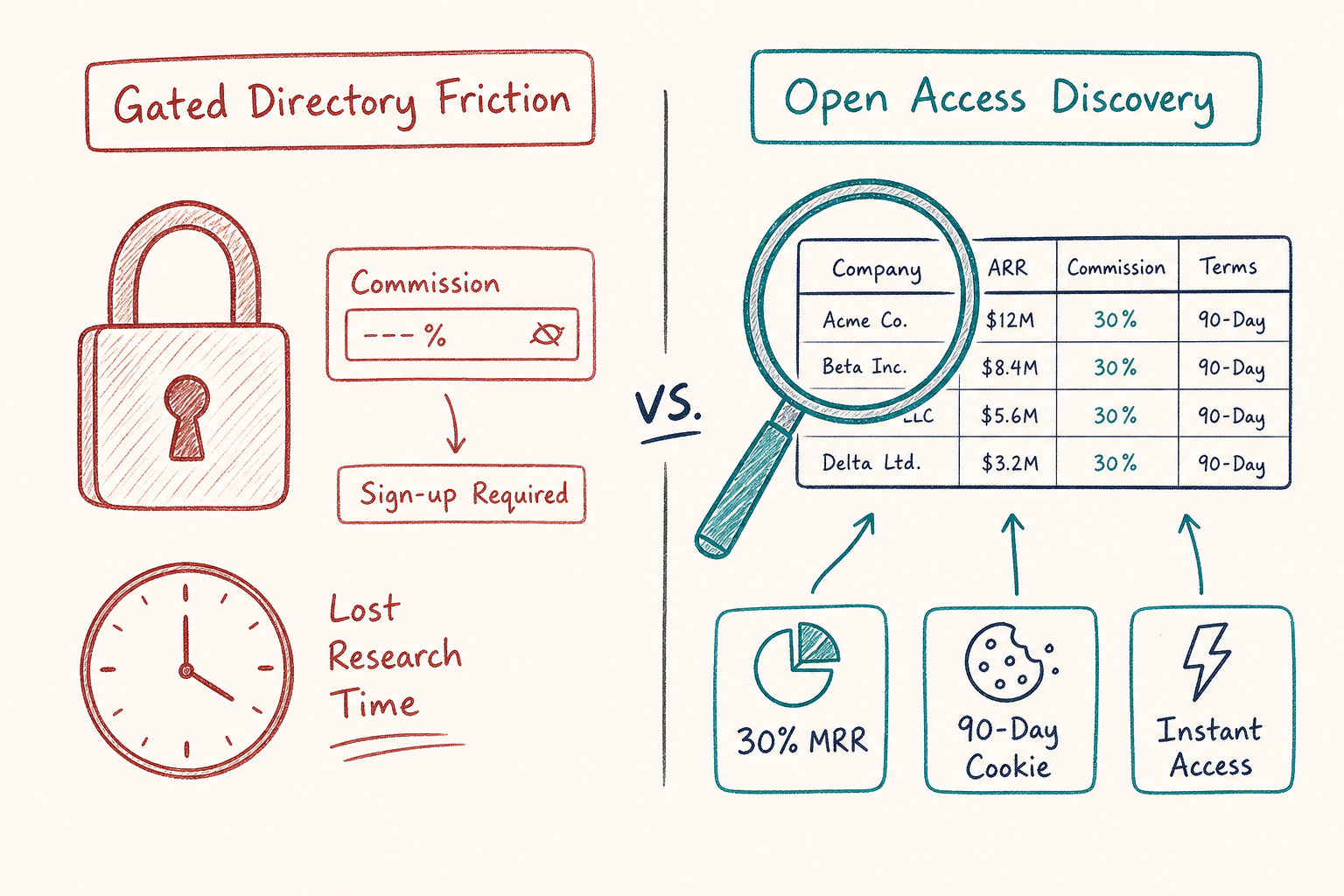
Top Open-Access Affiliate Directories (Direct SaaS & Tech Discovery)
Open-access directories eliminate the barrier between creators and program data. They allow you to research payout structures, compare competitor offerings, and verify cookie terms instantly without jumping through verification hoops.
1. AffiliList
AffiliList is built specifically to address the clutter and friction found in traditional affiliate networks and basic curation sites. As a streamlined hub featuring a curated database of over 10,000 affiliate programs, AffiliList prioritizes software, digital tools, and emerging tech offers.
+-------------------------------------------------------------------+
|                        AFFILILIST DIRECTORY                       |
|  [Filter: SaaS]  [Filter: >30% Recurring]  [Sort: Cookie Length]  |

+-------------------------------------------------------------------+
|  Program Name   | Category | Commission Structure | Cookie Window |
+-----------------+----------+----------------------+---------------+
|  CloudTool Pro  | B2B SaaS | 30% Recurring (MRR)  | 90 Days       |
|  DevFlow AI     | Tech/AI  | $150 Per Sale        | 60 Days       |
|  DesignCraft    | Creative | 25% Lifetime         | 120 Days      |

+-------------------------------------------------------------------+
Key Highlights for Content Creators:
- Open Access Platform: You do not need to register, submit personal identity documents, or request pre-approval just to inspect commission structures and program terms.
- Extensive Tagging & Filtering: Filter programs instantly by commission percentage, recurring payment models, niche tags, and product types.
- Focus on SaaS & Digital Tools: Covers fast-growing B2B software, AI utilities, marketing suites, and developer tools alongside mainstream digital offerings.
- Verified Program Details: Programs are systematically organized to ensure creators get accurate data on payout minimums, payment gateways, and conversion mechanisms.
For bloggers exploring the best niches for affiliate marketing, AffiliList offers direct visibility into competitive niches like HR software, crypto, YouTube marketing tools, and cloud infrastructure without paywalls.
2. Best Affiliate Programs
Best Affiliate Programs is a specialized directory cataloging SaaS and startup affiliate deals. It serves as a straightforward list for creators looking to spot new software promotions across productivity and marketing technology.
Key Highlights:
- Highlights emerging SaaS tools and tech startups.
- Focuses on software products with high user growth.
- Clean layout for fast manual browsing.
Drawbacks:
- Smaller total catalog size compared to full-scale directories.
- Less granular filtering for specific payout types or cookie durations.
Dedicated B2B & Startup Affiliate Networks
If your primary focus is partnering with established software companies where tracking and payouts are managed inside a unified dashboard, dedicated SaaS networks offer direct infrastructure.
3. PartnerStack Marketplace
PartnerStack operates as an ecosystem designed explicitly for B2B software companies. Software providers like Notion, Webflow, Monday.com, and Gorgias host their partner programs on PartnerStack.
+--------------------------------------------------------------------+
|                      PARTNERSTACK MARKETPLACE                      |
+--------------------------------------------------------------------+
|  [ B2B Software ]   [ Marketing Automation ]   [ Productivity ]    |
|                                                                    |
|  +-----------------------+    +---------------------------------+  |
|  | Enterprise CRM        |    | Design & Prototyping Platform   |  |
|  | Commission: 20% MRR   |    | Commission: $50 Fixed + 15% MRR|  |
|  | Cookie: 90 Days       |    | Cookie: 60 Days                 |  |
|  +-----------------------+    +---------------------------------+  |

+--------------------------------------------------------------------+
Pros for Content Creators:
- Unified Payout Dashboard: Consolidates monthly earnings from multiple B2B SaaS programs into one payout pipeline via PayPal or Stripe.
- High Customer Lifetime Value: B2B software subscriptions often stay active for years, yielding high cumulative commissions.
- Direct Merchant Communication: Built-in messaging allows creators to negotiate custom commission rates or request exclusive demo accounts once traffic scales.
Cons:
- Requires individual application and approval from each merchant.
- Focused predominantly on B2B SaaS, offering minimal coverage for consumer physical goods or B2C digital products.
4. Reditus
Reditus is an affiliate management marketplace tailored specifically toward indie hackers and bootstrapped B2B SaaS companies. It bridges the gap between smaller software creators and content publishers looking for early-stage tools to review.
Pros for Content Creators:
- Excellent access to micro-SaaS tools before they become oversaturated in major search engines.
- Clear metrics on average revenue per user (ARPU) and payout reliability for each software listing.
- Simple onboarding workflow for software review channels and tech bloggers.
Cons:
- Overall program selection is smaller than mainstream enterprise directories.
- Payout volume depends on early-stage startups maintaining operational cash flow.
5. FirstPromoter Marketplace & Rewardful Public Directories
Many modern software platforms run their partner systems on white-labeled infrastructure like FirstPromoter or Rewardful rather than joining large legacy affiliate networks. While neither platform acts as a traditional central directory, public index listings of FirstPromoter and Rewardful merchants serve as valuable discovery hunting grounds.
Pros for Content Creators:
- Access to thousands of independent SaaS programs running direct, high-percentage recurring commission structures.
- Direct relationship with the software founders rather than middleman network brokers.
Cons:
- Requires manual searching across multiple subdomains to aggregate listings.
- No central reporting dashboard; earnings must be tracked across individual vendor portals.
Creator Marketplaces & Sponsorship Platforms
When content creators want to expand beyond link tracking into flat-fee sponsorships, user-generated content (UGC) deals, or hybrid commission structures, dedicated creator marketplaces provide alternative pathways.
6. Collabstr
Collabstr functions as a transparent marketplace connecting creators directly with brands seeking sponsored content on Instagram, TikTok, and YouTube.
+--------------------------------------------------------------------+
|                        COLLABSTR MARKETPLACE                       |
+--------------------------------------------------------------------+
|  Creator Profile: Tech & Productivity Reviewer                      |
|  [ Packages Offered ]                                              |
|   * 60-Second Dedicated TikTok Video .............. $450             |
|   * YouTube Integration Segment ................... $800             |
|   * Sponsored Blog Review + Link Insert .......... $350             |

+--------------------------------------------------------------------+
Pros for Content Creators:
- Set your own flat rates for content creation rather than relying solely on performance commissions.
- Upfront payments held in escrow protect creators from non-payment.
- Public brand catalog allows creators to pitch directly without agency middle management.
Cons:
- Less suitable for passive income through recurring software links.
- Focuses heavily on social media platforms rather than long-form SEO blog posts.
7. Traditional Enterprise Networks (Impact, CJ Affiliate, ShareASale)
For publishers targeting broad markets that mix digital subscriptions with software, enterprise networks provide global reach and massive merchant catalogs.
Key Characteristics:
- Impact.com: Outstanding interface with top-tier brands like Canva, Adobe, and Hostinger. Excellent custom link tracking and flexible attribution rules.
- ShareASale: Deep catalog of mid-tier web utilities, WordPress plugins, and digital service providers.
- CJ Affiliate: Enterprise-focused platform requiring higher traffic volumes but offering premium merchant partnerships.
Network Tradeoffs:
- Strict approval criteria and risk of account termination if inactive for extended periods.
- Complex dashboards that require learning curve compared to lightweight direct SaaS portals.
Feature Comparison Matrix: Taprefer vs. Top Alternatives
Evaluating your research options requires looking at catalog breadth, access barriers, and payout models. The table below outlines how top alternatives compare across essential operational criteria:
| Platform / Directory | Total Listings / Coverage | Open Access (No Sign-Up) | Primary Focus | Commission Structures | Best For |
|---|---|---|---|---|---|
| AffiliList | 10,000+ Programs | Yes (100% Open Access) | SaaS, Digital Tools, Tech | Recurring (MRR), High CPA, Lifetime | SEO Bloggers, Tech Reviewers, Niche Creators |
| Taprefer | Startup Catalog | No (Account Required) | Indie Startups, SaaS | Variable Startup Rates | Indie Hackers, Early Product Reviewers |
| PartnerStack | 500+ Top B2B SaaS | No (Merchant Approval) | Enterprise & Mid-Market SaaS | Recurring MRR, Tiered CPA | Software Review Sites, B2B Content Creators |
| Reditus | 200+ Micro-SaaS | No (Creator Account) | Micro-SaaS, Bootstrapped Tech | 20%-40% Recurring MRR | Indie Tech Bloggers, Software Reviewers |
| Collabstr | 50,000+ Creators/Brands | Partial | Social Creator Sponsorships | Flat Fee per Video/Post | TikTokers, YouTubers, UGC Creators |
| Impact.com | Enterprise Network | No (Full Vetting) | Major Brands, Digital Services | CPA, CPL, Hybrid Commissions | High-Traffic Publishers, Media Companies |
Deep-Dive Analysis of the Top Alternatives
Choosing the optimal discovery platform depends on how you generate traffic and structure your content assets. Let's analyze how each top option fits specific operational workflows.

Deep Dive 1: AffiliList for Efficiency and Deep Market Coverage
When building content around profitable affiliate marketing niches, speed of discovery is key. AffiliList acts as a direct research engine. Instead of registering for five different networks just to see if a software brand offers 15% or 30% recurring payouts, you search the database directly.
Strategic Advantages:
- Zero Registration Bottlenecks: Conduct competitive research, check payout minimums, and review referral window rules without submitting login credentials or email addresses.
- Comprehensive Category Tagging: Navigate cleanly through developer tools, productivity apps, marketing suites, and finance software.
- Data Clarity: Eliminates low-value fluff and presents commission details, payment gateways, and program types in clear tabular layouts.
+--------------------------------------------------------------------+
|                   AFFILILIST RESEARCH WORKFLOW                     |
|                                                                    |
|  1. Search Target Keyword / Niche (e.g., "AI Video Editor")         |
|  2. Filter Results: Select "Recurring Payouts" + ">$100 CPA"       |
|  3. Inspect Transparent Program Metadata (Cookie, Gateway, Terms)  |
|  4. Click Direct Program Link -> Apply Directly to Merchant         |

+--------------------------------------------------------------------+
If you manage a portfolio of niche blogs, this direct access cuts content planning time significantly. You can map out monetization strategies while conducting your initial keyword research.
Deep Dive 2: PartnerStack for Scaled B2B SaaS Monetization
PartnerStack excels when you focus exclusively on B2B SaaS reviews and comparison articles. Once accepted into the overall marketplace, applying to individual software programs becomes streamlined.
Strategic Advantages:
- Vendor Ecosystem: Houses major SaaS platforms that enterprise clients and businesses use daily.
- Automated Payments: Solves payment tracking fragmentation by grouping earned commissions into monthly payouts.
- Resource Kits: Many vendors host branded banners, demographic data, and product demo links inside their PartnerStack assets tab.
Real-World Tradeoff:
PartnerStack merchants manually review publisher applications. If your website is brand new or lacks published content, enterprise software managers may decline your application. Building baseline traffic first using open research from directories like AffiliList is often the smartest entry strategy.
Deep Dive 3: Reditus for Bootstrapped and Micro-SaaS Offers
For tech creators who cover early-stage software launches, indie productivity tools, or developer utilities, Reditus offers access to agile software startups.
Strategic Advantages:
- Founders are directly accessible inside the portal, making special promotion requests simpler.
- Commission rates are frequently higher (30% to 50% recurring) as indie startups prioritize user acquisition over short-term margins.
Real-World Tradeoff:
Indie SaaS products carry higher operational churn rates than established enterprise tools. A startup may modify its business model or shut down within 18 months, requiring you to update affiliate links across your content library.
Step-by-Step Selection Framework: How Creators Should Evaluate Affiliate Programs
Finding a directory is only the first half of the process. Evaluating individual affiliate programs within those directories ensures long-term earnings stability. Follow this four-step framework when reviewing software offers:
+-------------------------------------------------------------------+
|               AFFILIATE PROGRAM EVALUATION PIPELINE               |
+-------------------------------------------------------------------+
|  [STEP 1: Traffic Intent Audit]                                   |
|   --> Match user purchase intent with correct payout structure   |

+-------------------------------------------------------------------+
|  [STEP 2: Cookie Lifespan & Attribution Rules]                    |
|   --> Ensure 30-90 day windows with first-touch/last-touch clarity|

+-------------------------------------------------------------------+
|  [STEP 3: Recurring vs One-Time Commission Math]                  |
|   --> Calculate LTV value ($30/mo x 12 mos vs $100 flat payout)   |

+-------------------------------------------------------------------+
|  [STEP 4: Tracking & Payment Threshold Checks]                    |
|   --> Confirm payout gateways, minimums, and payout schedules     |

+-------------------------------------------------------------------+
Step 1: Audit Traffic Intent Against Commission Models
Match your user's buying journey to the right payment structure:
- High-Intent Commercial Searches ("Best SEO Tool for Agencies"): Target high-converting SaaS offers with recurring monthly commissions (MRR).
- Informational Queries ("How to Edit Video on Mobile"): Target freemium tools offering low-friction cost-per-lead (CPL) or flat cost-per-acquisition (CPA) payouts.
- B2B Implementation Guides ("Enterprise CRM Setup Tutorial"): Target enterprise software paying large upfront flat fees ($200–$500+ per validated sign-up).
Step 2: Verify Cookie Duration and Attribution Rules
Cookie windows dictate how long you hold credit for a user after they click your link. Software purchases often require a consideration period.
- Under 14 Days: Short cookie windows reduce conversions on high-ticket software, as users rarely purchase enterprise tools on the first session.
- 30 to 90 Days: The standard sweet spot for software and digital products.
- Lifetime/Persistent Cookies: Excellent for freemium SaaS tools where users register for a free tier first and upgrade months later.
Step 3: Calculate Long-Term Value (LTV) vs. Upfront Payouts
Never judge a program by its headline number alone. Compare the long-term yield of recurring payouts against one-time payments.
Suppose Program A offers a one-time $100 payout per customer, while Program B offers a 30% monthly recurring commission on a $50/month software product ($15/month).
Year 1 Payout Comparison:
--------------------------------------------------
Program A (One-Time Flat CPA):
$100 upfront = $100 Total Yield

Program B (30% Recurring MRR):
$15/month x 12 months = $180 Total Yield
--------------------------------------------------
If average user retention on Program B exceeds seven months, the recurring model generates significantly more revenue over time. For creators building an affiliate marketing blog, recurring offers build predictable income streams.
Step 4: Validate Payment Thresholds and Payout Options
Check payout parameters before adding affiliate links across twenty separate articles:
- What is the payout minimum? ($50 vs. $500 threshold)
- What payment methods are supported? (PayPal, Direct Bank Transfer, Wise, Stripe)
- Is there a mandatory holding period to cover customer refund windows? (Commonly 30 days)
Real-World Case Example: Rebuilding a Software Monetization Engine
Consider the experience of Marcus, a content creator running a blog and YouTube channel focused on productivity workflows and project management software.
The Initial Setup
Marcus originally relied on fragmented directory lists and social recommendations to find software programs. He signed up for eight different startup referral portals, spending hours logging into individual dashboards to check balance thresholds.
The Problem
- Half of his recommended indie SaaS tools changed their commission terms or quietly shut down within nine months.
- Earnings were scattered across seven portals, leaving hundreds of dollars locked below $100 payout minimums.
- Researching new tools meant signing up for closed directories just to review cookie terms.
BEFORE SYSTEM (Fragmented & High Friction):
[Scattered Blog Searches] --> [Sign up for Portal A] --> [Sign up for Portal B]
  --> [Scattered Earnings Below Payout Minimums] --> [High Maintenance Overhead]

AFTER SYSTEM (Centralized & Streamlined):
[AffiliList / Open Directories] --> [Filter High-MRR SaaS] --> [Select Established Programs]
  --> [Consolidated PartnerStack / Direct Portals] --> [Predictable Monthly Payouts]
The Transition Strategy
- Consolidated Discovery: Marcus switched to open research through AffiliList to screen established SaaS tools offering verified 30%+ recurring payouts and minimum 60-day cookies.
- Audited Portfolio: He replaced unverified early-stage startup links with stable mid-market software tools listed on dedicated platforms.
- Optimized Link Tracking: He implemented centralized link management tools on his website to track outbound clicks efficiently.
The Outcome
By focusing on verified recurring programs and eliminating platform research friction, Marcus increased his passive monthly recurring revenue by 42% over six months while reducing monthly link maintenance time from eight hours down to one.
Debunking the "Secret SaaS Affiliate Program" Myth
A common narrative in creator communities is that the most profitable affiliate deals are hidden inside exclusive, invite-only networks. This misconception leads beginners to waste time seeking access to closed networks rather than publishing content.
The Reality of Modern SaaS Affiliates
Software companies want maximum distribution. Unless a brand is running a customized VIP influencer campaign paying tens of thousands of dollars upfront, nearly all major SaaS companies make their affiliate programs publicly searchable.
+--------------------------------------------------------------------+
|               MYTH VS. REALITY IN SAAS AFFILIATE MARKETING         |
+--------------------------------------------------------------------+
|  MYTH:                                                             |
|  "The best SaaS programs are hidden inside secret private networks |
|   that require high-tier entry fees or special invites."          |
|                                                                    |
|  REALITY:                                                          |
|  "SaaS companies make programs publicly discoverable on open       |
|   directories. Payout terms are public; earnings depend on        |
|   content quality, search intent, and traffic volume."             |

+--------------------------------------------------------------------+
The difference between a creator earning $100 a month and one earning $10,000 a month rarely comes down to secret network access. It depends on:
- Target keyword intent and audience buying propensity.
- Content structure, product comparisons, and trust.
- Choosing verified programs with high retention rates and transparent terms.
Using open directories like AffiliList gives you immediate access to the exact same software offers used by top publishers, without platform gatekeeping. If you are ever unsure about an offer's legitimacy, reviewing tips on how to spot real affiliate offers helps protect your site from unreliable programs.
How to Choose the Right Alternative Based on Your Content Format
No single directory or network fits every creator. Your ideal platform depends on how you deliver value to your audience.
+-------------------------------------------------------------------+
|               RECOMMENDED PLATFORMS BY CONTENT FORMAT             |
+-------------------------------------------------------------------+
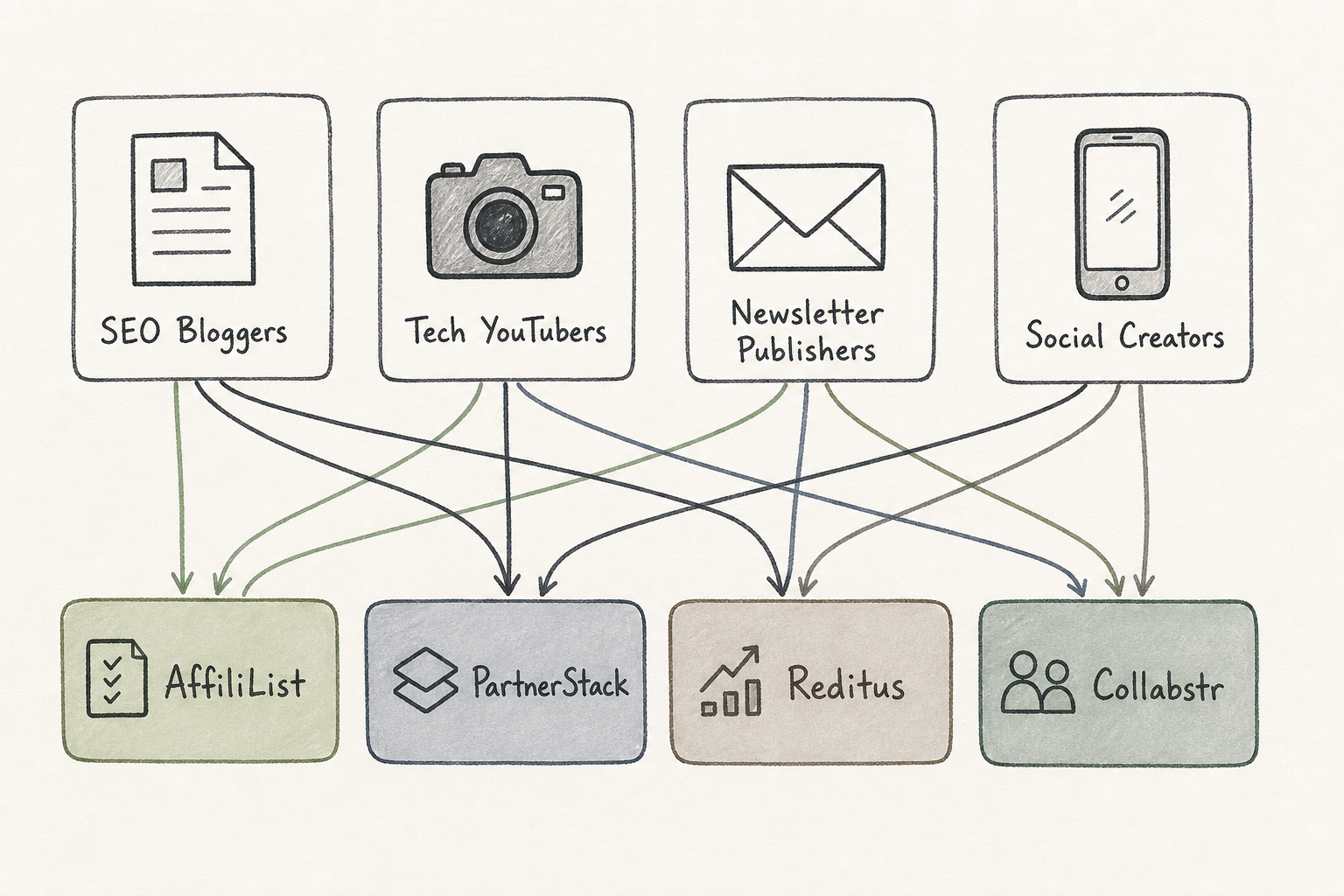
|  SEO Bloggers & Review Sites  --> AffiliList, Impact, Direct SaaS |
|  Tech & Software YouTubers    --> AffiliList, PartnerStack        |
|  Pinterest & Social Curators  --> AffiliList, ShareASale          |
|  Newsletter Publishers         --> Reditus, Custom Direct Deals    |
|  Short-Form Video Creators    --> Collabstr, UGC Sponsorships     |

+-------------------------------------------------------------------+
1. For SEO Bloggers & In-Depth Review Sites
- Primary Needs: Comprehensive software listings, fast term checking, clean tag navigation, high paying affiliate programs.
- Top Recommendation: AffiliList for open research and rapid comparison, paired with direct software merchant sign-ups.
2. For Software & Tech YouTubers
- Primary Needs: High LTV SaaS products, visual software demos, reliable payout dashboards.
- Top Recommendation: PartnerStack for managing major productivity and marketing tool links, supported by AffiliList for finding new tools to feature in software roundups.
3. For Pinterest Marketers & Visual Curators
- Primary Needs: Digital products, design tools, online course software, printables.
- Top Recommendation: Directories indexing visual and creative tools. Reviewing specific strategies for affiliate marketing on Pinterest ensures you pick tools that convert well on visual platforms.
4. For Newsletter Writers & Community Leaders
- Primary Needs: High-converting micro-SaaS utilities, niche tools, unique sponsorship opportunities.
- Top Recommendation: Reditus for niche startup partnerships, combined with Collabstr for flat-fee newsletter integrations.
Effective Link Management and Tracking Workflows for Content Creators
Finding great alternatives to Taprefer is only part of the equation. Once you select tools across directories like AffiliList, PartnerStack, or enterprise networks, managing your links systematically prevents tracking breaks down the road.
1. Implement Link Cloaking and Central Redirection
Never paste raw, ugly affiliate parameters directly into your content. Use link management plugins or custom server redirects (e.g., yoursite.com/recommend/toolname).
- Why It Matters: If a SaaS merchant changes affiliate platforms (for example, moving from Rewardful to PartnerStack), you can update the destination URL once in your central dashboard rather than editing 50 individual blog posts.
2. Maintain a Central Monetization Spreadsheet
Track every active partnership in a simple database or spreadsheet:
+-----------------------------------------------------------------------------------+
|                            CENTRAL PARTNERSHIP TRACKER                            |
+-----------------------------------------------------------------------------------+
| Product Name | Network / Portal | Commission Rate | Cookie Term | Payout Threshold |
+--------------+------------------+-----------------+-------------+------------------+
| CloudApp Pro | AffiliList/Direct| 30% MRR         | 60 Days     | $50 PayPal       |
| TaskFlow     | PartnerStack     | 20% MRR         | 90 Days     | $100 Stripe      |
| DesignSuite  | ShareASale       | $80 Flat        | 30 Days     | $50 Check        |

+-----------------------------------------------------------------------------------+
3. Schedule Quarterly Link Audits
Set a calendar reminder every 90 days to test top-performing links:
- Ensure destination pages are active and not returning 404 errors.
- Verify cookie parameter strings are intact.
- Check whether merchants have updated their pricing tiers or payout models.
Frequently Asked Questions
What makes Taprefer different from open affiliate directories like AffiliList?
Taprefer requires user registration and focuses primarily on early-stage startup referral links. In contrast, open directories like AffiliList provide immediate, un-gated access to over 10,000 curated affiliate programs across software, digital tools, and tech. AffiliList allows creators to research commission rates, cookie windows, and payout models instantly without creating an account.
Are SaaS affiliate programs better than traditional retail affiliate networks?
For digital creators and bloggers, SaaS affiliate programs generally offer higher profit margins and long-term earnings. B2B software companies routinely offer 20% to 40% recurring monthly commissions, whereas traditional retail goods typically pay 1% to 10% on a one-time transaction.
How do I know if an affiliate directory list is up to date?
Look for directories that curate program data with specific metadata fields, such as clear commission structures, explicit cookie durations, and direct links to merchant application portals. Platforms like AffiliList curate programs systematically, helping creators avoid inactive offers or broken links.
Can beginners qualify for programs listed on PartnerStack or Impact?
Yes, though individual merchant approval varies. While some enterprise merchants on Impact require established traffic, many SaaS tools on PartnerStack and open programs indexed on AffiliList accept newer content creators who produce high-quality, relevant content in their niche.
Should I prioritize recurring commissions or high upfront CPA payouts?
It depends on your business model and cash flow needs. High upfront CPA payouts ($100–$500 per sale) provide immediate capital, which is great for reinvesting into paid growth. Recurring commissions (20%–40% MRR) take longer to accumulate but create predictable, passive baseline revenue over time.
Action Plan: Optimizing Your Affiliate Discovery Process
Replacing fragmented referral searches with an efficient discovery system elevates your affiliate business. Here is your quick action checklist to streamline your monetization research:
- Audit Your Current Tool Stack: Identify any inactive, low-converting, or low-payout links across your published content.
- Bookmark Open Research Hubs: Use open-access directories like AffiliList to search for programs with proven, transparent commission structures.
- Filter for High-LTV Payouts: Prioritize SaaS tools offering 30%+ recurring commissions and cookie windows of 60 days or longer.
- Centralize Your Tracking: Use custom link redirects so you retain full control over destination URLs across your entire site.
- Focus on Deep Content: Match chosen software offers directly to user search intent by producing thorough reviews, head-to-head comparisons, and step-by-step video tutorials.
Selecting the right affiliate directory alternative gives you clear data, eliminates platform friction, and lets you focus on what actually drives revenue: creating exceptional content for your audience.