
Best Affiliate Codes and Terms Tools Beyond Shareasale
Discover where modern tech bloggers find high-paying SaaS affiliate codes, transparent contract terms, and recurring MRR tools beyond legacy networks.
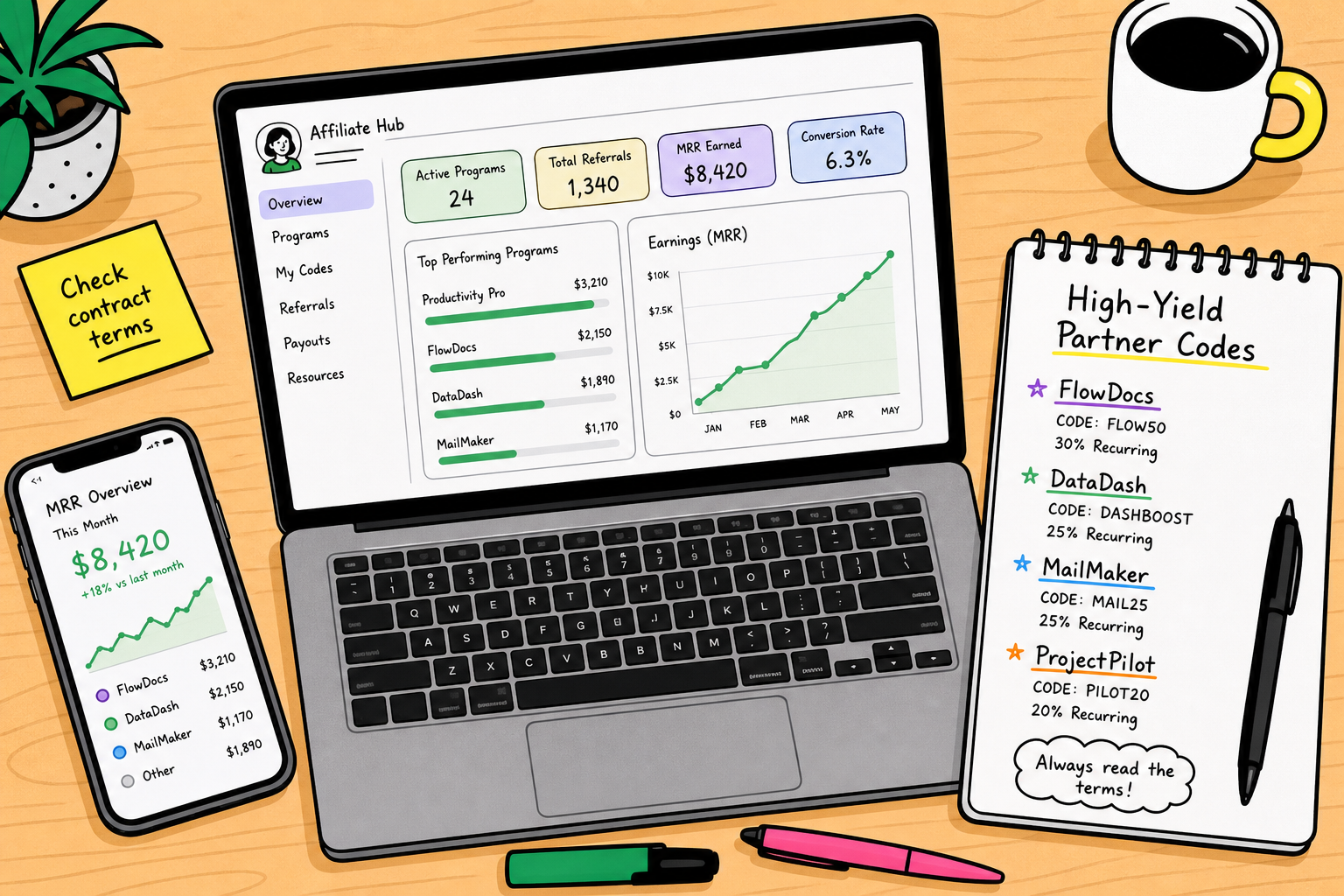
Finding the right affiliate program in the technology sector used to mean logging into legacy affiliate networks, clicking through clunky search filters, and waiting days for manual merchant approvals. For years, platforms like ShareASale served as default hubs for affiliate discovery. Yet modern tech publishers, software reviewers, and developer-focused creators frequently discover that legacy platforms struggle to keep up with the fast-moving software-as-a-service (SaaS), cloud infrastructure, and developer tooling landscape.
When building an affiliate marketing blog centered on tech products, locating clear commission terms, reliable cookie windows, and custom tracking discount codes requires a modern toolkit. Tech bloggers need platforms that provide immediate transparency into commission percentages, recurring revenue structures, payout thresholds, and tracking mechanisms before committing valuable editorial real estate to a product.
Here is a comprehensive breakdown of where tech creators source affiliate codes, how to verify terms without getting trapped behind registration walls, and the top tools and directories currently outperforming older network models.
Where Tech Bloggers Find Affiliate Codes and Terms: The Modern Ecosystem
Tech bloggers do not rely on a single channel to uncover partnership opportunities. Instead, they navigate a multi-layered ecosystem spanning specialized directories, modern partner relationship management (PRM) platforms, direct brand portals, and developer marketplaces.
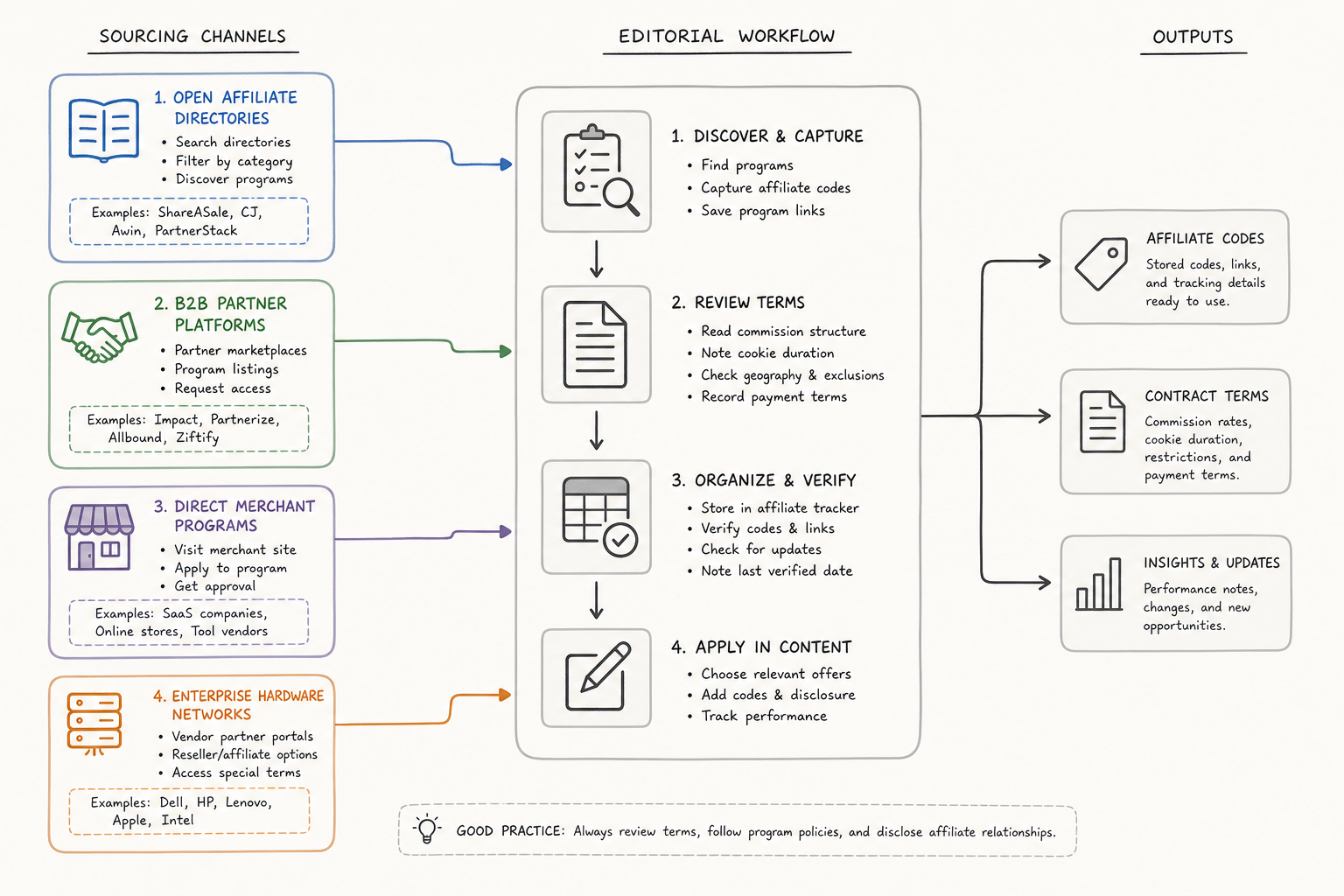
Diagram Concept:
A clean, modular field architecture map showing how tech bloggers discover affiliate codes and contract terms.
- Four distinct sourcing channels branching into a central editorial workflow:
  1. Open Affiliate Directories (e.g., AffiliList) -> Instant term comparison, public cookie & rate data.
  2. B2B Partner Platforms (e.g., PartnerStack, Impact) -> Managed SaaS partnerships, automated tracking codes.
  3. Direct Merchant Programs (e.g., Self-hosted FirstPromoter/Rewardful) -> In-house brand portals, high-percentage MRR.
  4. Enterprise Hardware Networks (e.g., CJ, Awin) -> Consumer tech, IoT, web hosting infrastructure.
- Visual style: Clean editorial technical architecture diagram, subtle slate-gray and charcoal lines, light off-white background, crisp minimal typography, no neon gradients or AI clutter.
1. Open Affiliate Directories and Curated Databases
Traditional networks require publishers to register an account, submit tax forms, and wait for platform-level approval before they can even view a merchant's commission rates or cookie policies. Modern tech publishers increasingly bypass this friction by starting their search in open affiliate directories.
Platforms like AffiliList offer searchable, curated databases covering thousands of affiliate programs with a dedicated focus on SaaS, developer tools, and digital platforms. Because these directories list commission percentages, payout frequencies, recurring versus one-time models, and program tags openly, creators can evaluate the financial viability of a tool before submitting an application. This drastically cuts down the research phase when outlining software comparison articles or roundups.
2. Dedicated SaaS and B2B Partner Networks
Unlike retail-heavy networks that specialize in apparel, home goods, or consumer physical products, specialized B2B partner platforms cater directly to software companies.
Networks like PartnerStack have become primary hubs for productivity tools, developer platforms, and marketing software. Tech creators use these platforms to discover both emerging and established software vendors, access immediate promotional assets, and generate unique tracking codes directly from a standardized dashboard.
3. Direct Brand Footers and In-House Merchant Dashboards
A substantial portion of high-paying tech affiliate programs run independently of massive networks. Software startups and consumer hardware brands frequently power their partner programs using self-hosted affiliate software such as FirstPromoter, Rewardful, or custom in-house systems.
Tech bloggers routinely locate these programs by visiting vendor websites directly:
- Scanning website footers for links labeled "Affiliate Program," "Partners," "Become a Partner," or "Referral Program."
- Inspecting developer docs and API documentation pages for affiliate or agency partner tiers.
- Reviewing direct brand program hubs, such as the SONOFF affiliate program, where hardware and smart home bloggers can apply directly for unique referral links, coupon codes, and fixed commission tracking.
4. Direct PR Outreach and Affiliate Manager Networks
Experienced tech publishers often skip automated portals entirely. When a tech blog achieves significant authority in a sub-niche, such as cloud computing, cybersecurity, or data engineering, affiliate managers reach out directly.
As outlined in industry analyses on reaching out to affiliate bloggers, tech merchants actively prospect authoritative niche blogs to negotiate custom commission bumps, exclusive coupon codes, and co-branded landing pages.
Why Modern Tech Bloggers Are Moving Beyond ShareASale
ShareASale remains a recognized name in affiliate marketing, but tech creators increasingly encounter structural friction when using it to source software and digital tool partnerships. Understanding these limitations highlights why alternative discovery methods have become standard practice.
+-----------------------------+-----------------------------------+------------------------------------+
| Evaluation Dimension        | Legacy Networks (e.g., ShareASale)| Modern Platforms & Directories     |
+-----------------------------+-----------------------------------+------------------------------------+
| Data Accessibility         | Gated behind mandatory login      | Open access to terms & rates       |
| Primary Product Focus       | Retail, apparel, consumer goods   | SaaS, developer tools, cloud infra |
| Revenue Model Emphasis      | One-time CPA / percentage bounty  | Recurring monthly revenue (MRR)    |
| Coupon Code Attribution     | Often requires manual manager set | Built-in linkless code tracking    |
| Interface & Deep Linking    | Legacy navigation, slow link tools| One-click Chrome extensions & APIs |
| Discovery Speed             | Manual search across 10,000+ mixed| Tagged niche filtering by software |

+-----------------------------+-----------------------------------+------------------------------------+
Opaque Program Terms Behind Registration Walls
On legacy networks, publishers must maintain an active account, wait through identity verification, and often maintain specific activity thresholds just to inspect merchant terms. If a tech writer is drafting a guide on database management tools and wants to compare payout terms across four competing platforms, logging into multiple fragmented accounts creates unnecessary delays.
Limited SaaS and Developer Tool Inventory
Legacy networks were engineered during the early days of e-commerce, making their inventories heavily weighted toward physical retail, home services, and direct-to-consumer goods. While some legacy hosting and software brands still operate there, the vast majority of modern AI applications, cloud infrastructure providers, and productivity suites host their programs on dedicated B2B platforms or open directories.
Incompatibility with Recurring Commission Models
In the tech space, particularly across best niches for affiliate marketing like B2B software and digital services, the most lucrative income stream is recurring monthly revenue (MRR). Tech bloggers prioritize programs offering 20% to 40% lifetime recurring commissions on software subscriptions. Legacy networks were largely built for one-time cost-per-acquisition (CPA) transactions, making recurring tracking, tiered usage payouts, and seat expansion commissions difficult for merchants to configure cleanly.
Clunky Link Generation and Promo Code Attribution
Modern content creators do not just paste raw referral URLs. They require clean deep-linking to specific feature pages, integration hubs, and documentation portals. Legacy networks often require multiple steps to generate a single deep link.
Furthermore, tech bloggers who produce video tutorials, podcasts, or newsletter sponsorships need linkless discount code tracking—where an exclusive coupon code attributes the sale without requiring the user to click a tracking link. Modern partner platforms handle this natively, whereas older networks often require manual affiliate manager intervention.
Top Discovery Tools and Platforms for Tech Affiliate Codes and Terms
For bloggers seeking alternatives to legacy networks, several platforms offer streamlined discovery, transparent contract terms, and specialized software inventories.
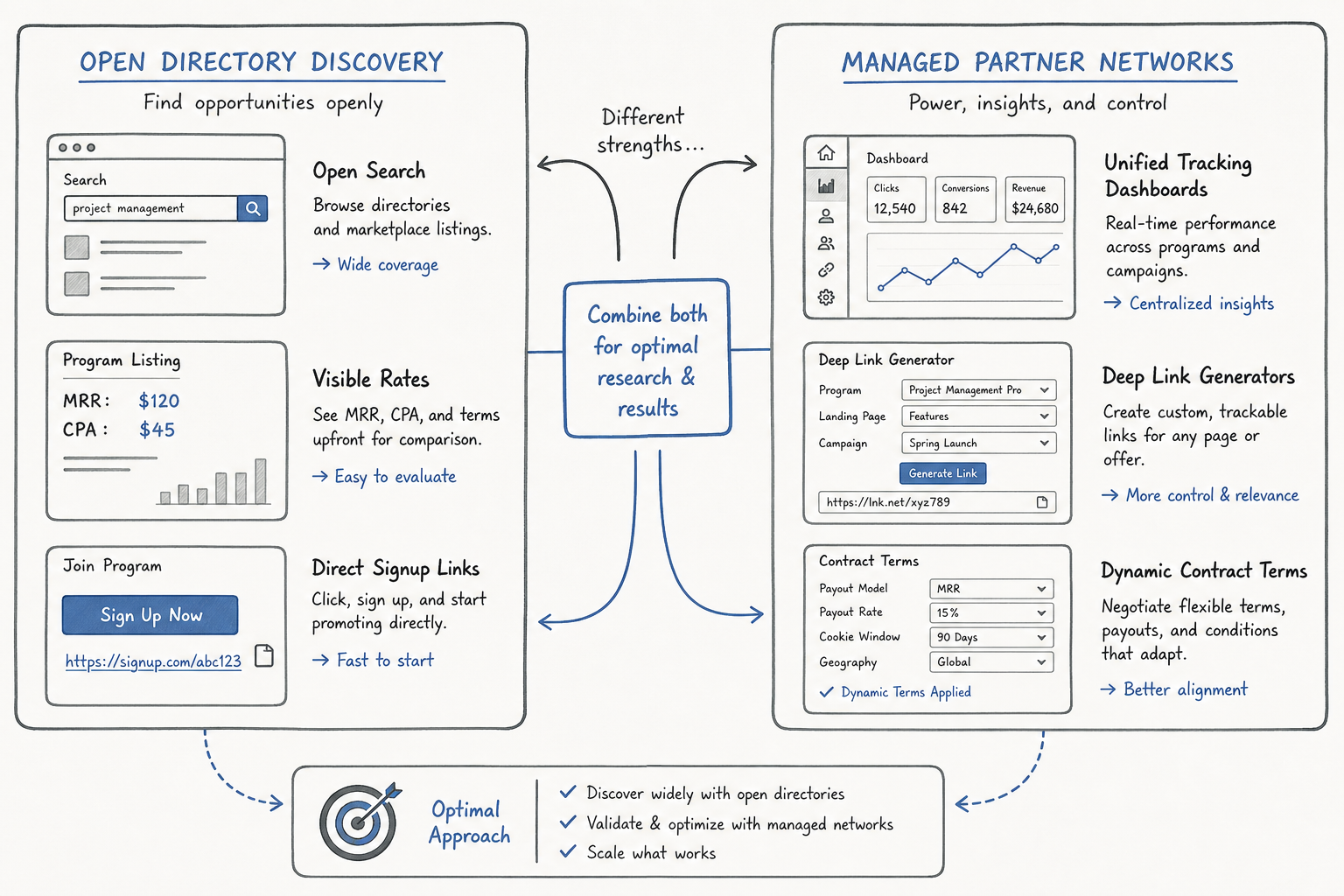
Diagram Concept:
A clean comparison layout contrasting the discovery workflow of Open Directories vs. Managed Partner Networks.
- Left column: "Open Directory Discovery (AffiliList)" -> Unrestricted search, instant visibility of MRR/CPA, cookie durations, and direct merchant sign-up links.
- Right column: "Partner Management Engines (PartnerStack, Impact)" -> Consolidated tracking dashboards, direct link generation, dynamic contract builders.
- Center balance scale or connecting arrows demonstrating how top bloggers combine both tools for maximum research speed and tracking reliability.
- Visual style: Minimalist wireframe design, clean rounded cards, neutral gray tones with muted blue accents, precise technical annotations.
1. AffiliList: Fast, Open SaaS Directory Discovery
AffiliList functions as a centralized directory built specifically to eliminate the friction of finding profitable digital partnerships. Covering more than 10,000 affiliate programs with an emphasis on SaaS and digital tools, it solves the discovery bottleneck by making program terms publicly accessible.
Key Advantages for Tech Bloggers:
- No Sign-Up Wall for Research: Creators can browse and compare commission percentages, cookie windows, and payout models across hundreds of software sub-categories without creating an account.
- Granular Niche Tagging: Rather than lumping all software under a generic "Computer / Electronics" category, the platform indexes programs by specific verticals, such as developer tools, cybersecurity, cloud storage, video editing, and artificial intelligence.
- Verified Terms and Links: Direct links to official merchant partner application pages ensure creators do not land on broken third-party redirects or outdated program portals.
When building out content for profitable affiliate marketing niches, using an open database allows you to map out your entire monetization strategy before writing a single word.
2. PartnerStack: The Premier B2B SaaS Ecosystem
PartnerStack has established itself as the operational hub for modern software partnerships. Major tech platforms—including Notion, Webflow, Monday.com, and Gorgias—manage their affiliate, referral, and agency programs through this platform.
Strengths:
- Dedicated B2B Software Focus: Every merchant in the marketplace is a digital product or software vendor, completely eliminating retail noise.
- Recurring Commission Architecture: Most programs hosted on PartnerStack support monthly recurring commissions, tracking subscription renewals automatically.
- Unified Dashboard: Bloggers can manage dozens of active software partnerships, generate deep links, and collect unified monthly payouts via Stripe or PayPal from a single login.
3. Impact (Impact.com): Enterprise Tech and Custom Contracts
Impact is widely used by enterprise-level tech companies, large-scale consumer hardware brands, fintech tools, and major cloud service providers (such as Canva, Shopify, and Microsoft).
Strengths:
- Dynamic Contract Terms: Impact allows brands to offer highly tailored payout structures, such as paying a base CPA for free trial signups plus a percentage bounty when the lead converts to an enterprise tier.
- Direct Merchant Messaging: The platform provides built-in communication channels to request custom commission rates or exclusive promotional codes directly from program managers.
- Advanced Deep-Linking Tools: A dedicated browser extension lets tech bloggers generate clean, parameter-tagged tracking links while browsing any approved merchant's live product page.
4. FirstPromoter and Rewardful Ecosystems
Many of the fastest-growing indie SaaS platforms, developer utilities, and AI applications do not list their programs on massive corporate networks. Instead, they power their affiliate tracking using lightweight engines like FirstPromoter or Rewardful, both of which integrate directly with Stripe billing.
How Bloggers Locate These Programs: Because these platforms do not operate public consumer marketplaces, tech bloggers uncover them through open directories like AffiliList or by inspecting brand footers directly. Once registered, the blogger receives access to a lightweight, dedicated portal showing real-time click tracking, active subscriptions, customer churn, and monthly MRR payouts.
5. CJ Affiliate and Awin for Tech Infrastructure and Hardware
While CJ Affiliate (formerly Commission Junction) and Awin are broad legacy networks, both have retained strong footprints in specific tech verticals. They remain valuable resources for tech creators who review web hosting infrastructure, VPN services, domain registrars, computer components, and networking hardware.
Strengths:
- Enterprise Web Infrastructure: Dominant platforms for major web hosting companies, enterprise security suites, and server providers.
- Global Currency Support: Reliable payout infrastructure for international tech bloggers requiring direct wire transfers in regional currencies.
Critical Affiliate Terms Tech Bloggers Must Audit
Finding an affiliate program is only the first step. Before recommending a tool to your audience, you must thoroughly analyze the program's operating agreement. Overlooking specific terms can lead to lost commissions, delayed payments, or account termination.
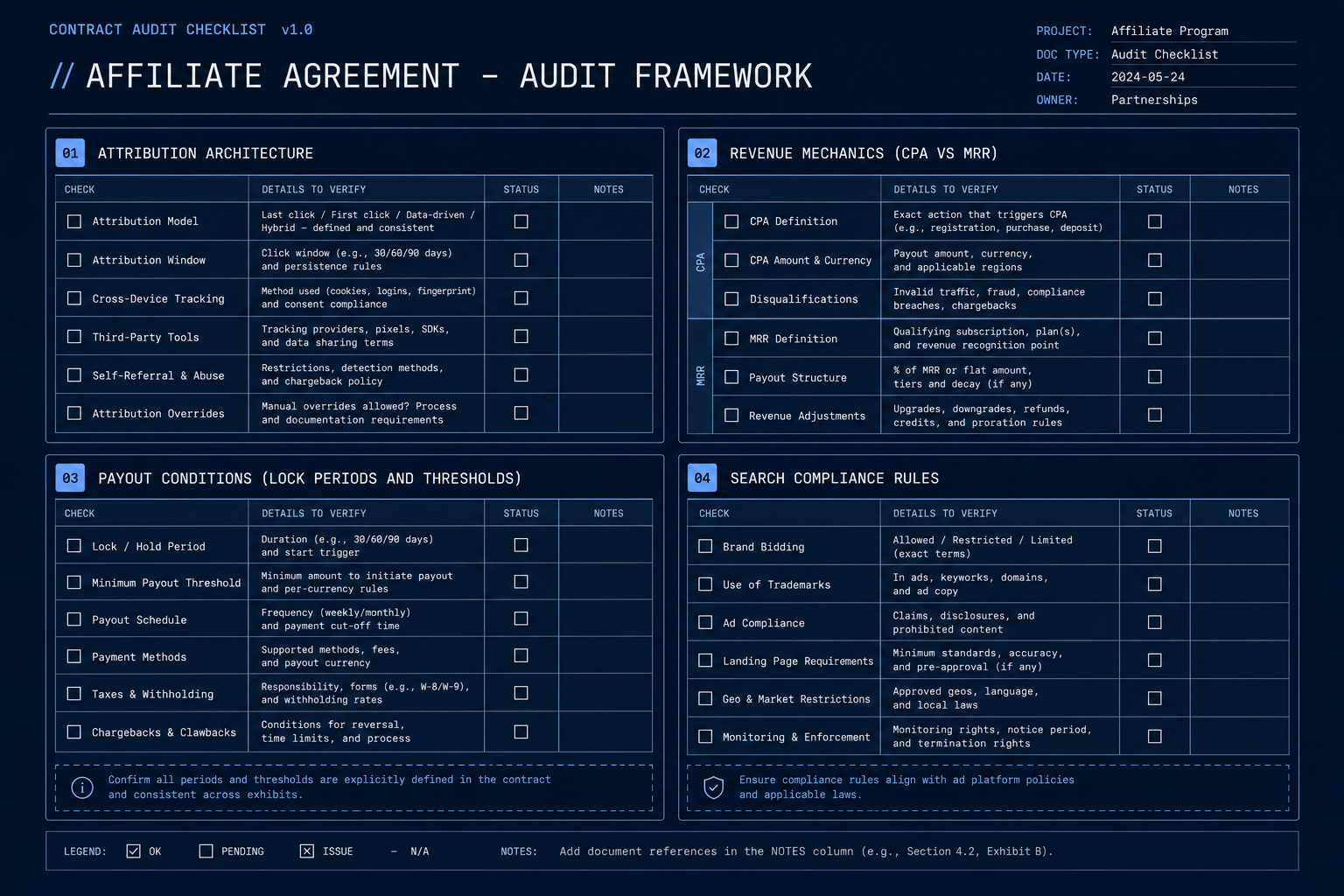
Diagram Concept:
An analytical checklist diagram representing the "Affiliate Contract Audit."
- Formatted as a tech spec sheet or interactive audit framework.
- Sections:
  1. Attribution Architecture (Cookie Life, First vs. Last Touch).
  2. Revenue Mechanics (One-time CPA vs. Recurring MRR, Tiered Triggers).
  3. Payout Conditions (Minimum Thresholds, Net-30/60 Lock Periods, Payment Gateways).
  4. Search & Compliance Rules (Brand Bidding bans, Paid Search negative keywords, Content disclosure rules).
- Visual style: Clean slate-and-navy technical documentation aesthetic, clear check-boxes, structured metadata tables, crisp typography.
1. Attribution Model and Cookie Duration
The cookie window defines how long a visitor's browser retains your referral tracking after clicking your link.
- Standard Tech Durations: Software and digital tools typically offer cookie windows between 30 and 90 days. High-ticket enterprise software may offer 120 days or longer to account for lengthy B2B procurement cycles.
- First-Click vs. Last-Click Attribution: Most affiliate programs operate on last-click attribution, meaning the last affiliate link clicked before purchase receives 100% of the commission. If a program uses first-click attribution, you receive credit even if the user clicks a competitor's discount link later during their buying journey.
2. Commission Structure: CPA vs. Recurring MRR
Tech bloggers must understand the mathematical difference between immediate cash flow and compounding long-term value:
- One-Time CPA (Cost Per Acquisition): Common in web hosting, consumer VPNs, and hardware. For example, a hosting company might pay a flat $100 to $200 bounty per signup regardless of the plan chosen.
- Recurring Revenue Share: Standard in modern SaaS. A program offering 30% monthly recurring revenue for 12 to 24 months creates predictable, compounding income as your content library expands.
- Tiered Performance Incentives: Many tech vendors increase your commission rate as your monthly referral volume grows (e.g., 20% baseline up to 10 sales, increasing to 35% for 25+ sales).
3. Promo Code and Linkless Attribution Rules
If you share software discounts across social media, YouTube tutorials, or newsletters, link tracking can fail when users open a separate browser tab to complete checkout.
Verify whether the merchant supports exclusive code tracking. Under this model, any transaction that applies your custom discount code (e.g., TECHBLOGGER20) credits your account automatically, even if the customer never clicked your affiliate link.
4. Search and Brand Bidding Restrictions
Almost all reputable tech affiliate programs enforce strict paid advertising policies. Standard restrictions include:
- No Brand Bidding: You cannot run Google Ads or Bing Ads bidding on the merchant's brand name, trademarks, or misspellings (e.g., bidding on "[Brand Name] coupon" or "[Brand Name] review").
- Negative Keyword Requirements: Some programs require affiliates running generic PPC campaigns to add the brand's name to their negative keyword lists.
- Direct Linking Bans: Many merchants forbid running paid ads that send traffic directly to your affiliate URL without routing users through your own landing page or bridge page first.
5. Payout Thresholds, Lock Periods, and Methods
Examine the financial logistics before driving traffic:
+-----------------------------+------------------------------------+------------------------------------+
| Term Variable               | Typical Range                      | What to Watch For                  |
+-----------------------------+------------------------------------+------------------------------------+
| Locking Period              | 30 to 60 days                      | Allows for customer refunds/chargebacks |
| Minimum Payout Threshold    | $25 to $100                        | Avoid high $500+ limits for new blogs |
| Payment Methods             | Stripe, PayPal, Wise, Direct Wire  | Check international transfer fees  |
| Payment Cadence             | Net-15, Net-30, or Net-60          | Net-30 after locking is standard   |

+-----------------------------+------------------------------------+------------------------------------+
Tech software typically carries a 30-day money-back guarantee. Consequently, commissions are usually locked for 30 to 45 days after the transaction to account for potential customer refunds before funds become payable.
Step-by-Step Workflow: Sourcing and Securing High-Converting Tech Deals
To maximize efficiency, professional tech publishers follow a systematic workflow when identifying and integrating new affiliate partnerships into their editorial calendar.
Step 1: Niche & Tool Mapping
Select target software categories based on search volume and buyer intent.
                 │
                 ▼
Step 2: Transparent Term Discovery
Use open directories (AffiliList) to compare commission rates, MRR, and cookie windows.
                 │
                 ▼
Step 3: Program Application & Platform Selection
Apply through dedicated PRMs (PartnerStack, Impact) or direct merchant brand footers.
                 │
                 ▼
Step 4: Contract Audit & Link Configuration
Generate parameter-tagged deep links and verify linkless promo code attribution.
                 │
                 ▼
Step 5: Editorial Integration & Ongoing Performance Tracking
Embed tracking within comprehensive reviews, tutorials, and comparison frameworks.
Scenario: Monitored Workflow of a Developer Tools Publisher
Consider a tech blogger who runs a publication focused on DevOps, cloud hosting, and continuous integration (CI/CD) pipelines.
- Identifying Editorial Need: The publisher plans a deep-dive comparison guide titled "The Best Automated Deployment Tools for Indie Developers."
- Rapid Directory Sourcing: Instead of logging into five different legacy networks, the blogger navigates to an open SaaS directory like AffiliList. By filtering by developer tools and CI/CD software, they immediately identify four top-tier platforms offering partner programs.
- Evaluating Financial Models:
- Tool A offers a flat $75 CPA with a 30-day cookie.
- Tool B offers 30% recurring MRR for the first 12 months with a 60-day cookie.
- Tool C runs an in-house program on FirstPromoter offering a 25% lifetime commission.
- Application and Link Generation: The blogger applies directly through the verified merchant portal links provided in the directory. Once approved on PartnerStack and FirstPromoter, they generate specific deep links pointing directly to the tools' free-tier onboarding documentation.
- Publishing with Compliance: The writer integrates the links into the tutorial, adds clear FTC-compliant affiliate disclosures at the top of the article, and begins monitoring click-through rates.
If you are exploring new verticals to monetize, reviewing dedicated guides on how to pick a niche for affiliate marketing and exploring high paying affiliate programs can help identify which software categories yield the highest return on editorial effort.
Contrarian Insight: Why Private and Self-Hosted Programs Often Outperform Large Networks
Many novice affiliate marketers assume that the largest, most famous affiliate networks inherently host the best opportunities. In tech blogging, this assumption is often incorrect.
The Problem with Giant Networks
Large legacy networks charge merchants substantial setup fees, recurring platform maintenance costs, and transaction fees on every affiliate payout. To balance these overhead expenses, merchants on massive networks frequently lower the commission rates offered to publishers.
The Advantage of Self-Hosted Programs
When a software startup or developer platform hosts its program independently using software like Rewardful or FirstPromoter, their software overhead is minimal. As a result, merchants operating direct programs can afford to offer:
- Significantly higher commission splits (often 30% to 50% recurring).
- Direct communication with the founder, product marketing lead, or dedicated partnership manager.
- Faster turnaround on custom co-branded assets, landing pages, and exclusive discount codes.
Tech bloggers who diversify beyond standard networks and actively seek out direct merchant relationships consistently earn higher effective revenue per click.
Curated Tech Program Examples: What Real Terms Look Like
To understand what competitive terms look like in the technology and digital tooling space, examine standard offerings across different sub-verticals, curated from platforms like Blogging Guide's tech affiliate roundups:
1. Smart Home and IoT Hardware
- Merchant Example: SONOFF Partner Program
- Commission Model: Tiered percentage (typically 8% to 12% on physical hardware devices and smart switches).
- Tracking Method: Unique referral link combined with customized discount codes.
- Ideal Editorial Format: Hardware teardowns, home automation tutorials, smart switch installation guides.
2. Cloud Infrastructure and Web Hosting
- Category Norms: $50 to $200+ flat CPA per funded account, or 10% to 20% recurring server spend.
- Cookie Life: Typically 60 to 90 days.
- Ideal Editorial Format: Server speed benchmarks, database setup guides, web application deployment tutorials.
3. B2B Productivity and Project Management SaaS
- Category Norms: 20% to 35% recurring monthly revenue share for the first year, or 15% lifetime.
- Cookie Life: 30 to 90 days.
- Ideal Editorial Format: Workflow efficiency breakdowns, team collaboration case studies, software migration guides.
Evaluating Legitimate Programs vs. Low-Quality Offers
As the affiliate ecosystem expands, tech bloggers must maintain editorial integrity by carefully vetting every commercial partnership. Software tools with aggressive payouts are not always reliable products.
Before featuring a program, cross-reference these security checks:
- Product Reputation: Has the software been thoroughly tested by your team? Promoting buggy tools damages your audience's trust regardless of the commission rate.
- Clear Terms of Service: Avoid programs that fail to publish explicit refund policies, attribution logic, or payout schedules.
- Vendor Stability: For recurring MRR programs, ensure the software company has sound financial backing or steady market adoption to prevent early churn.
For creators wanting to ensure their partnership portfolio remains compliant and credible, reviewing our guide on is affiliate marketing legit provides actionable frameworks for spotting dubious offers.
How to Structure Tech Content for Maximum Affiliate Conversion
Sourcing tracking codes and understanding terms is useless if your editorial content fails to drive qualified conversions. Tech audiences are discerning, analytical, and highly resistant to aggressive sales pitches.
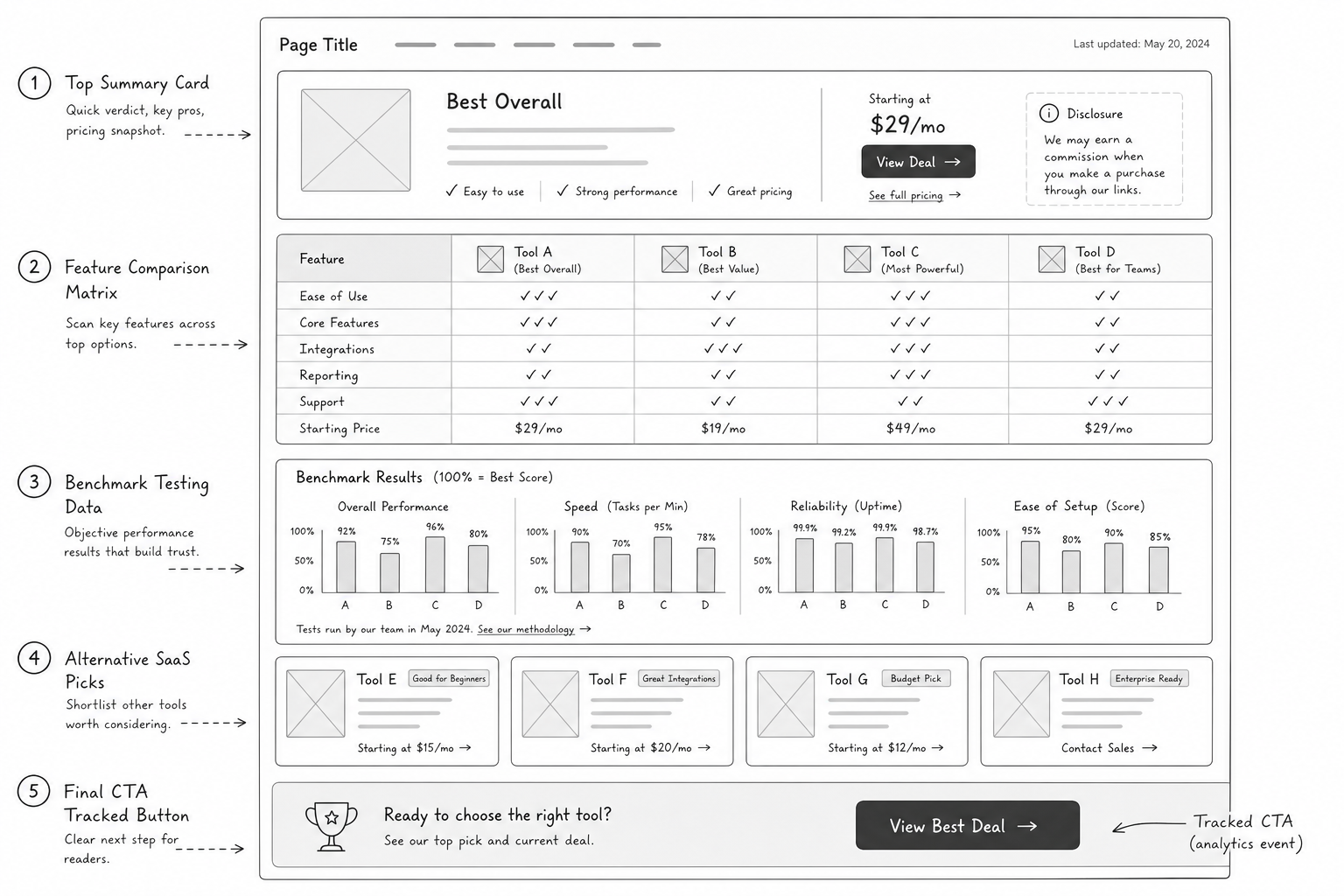
Diagram Concept:
A content layout framework showing an optimal tech review page structure for conversions.
- Top section: Quick Summary Card & Key Findings (with FTC affiliate disclosure).
- Comparison Matrix: Feature checklist, pricing table, and clean CTA buttons.
- In-Depth Technical Testing: Benchmark charts, configuration code snippets, real-world pros & cons.
- Alternative Tools Section: Contextual links to alternative SaaS options for different use cases.
- Final Verdict: Direct CTA button tied to tracked affiliate code.
- Visual style: Clean editorial UX wireframe, neat line art, muted slate and charcoal interface elements.
1. Focus on Problem-Solving Workflows Rather Than Generic Reviews
Generic "Product X Review" articles often fail to convert tech readers who are seeking solutions to specific technical bottlenecks. Instead, structure your content around actionable workflows:
- "How to Automate Docker Container Deployments Using [Tool A]"
- "Comparing Cloud Database Latency: [Tool A] vs. [Tool B]"
- "How to Secure Remote Development Environments on a Budget"
By embedding your affiliate link naturally within a step-by-step technical tutorial, you present the tool as the solution to a concrete problem.
2. Build Interactive Comparison Tables
Tech buyers value structured data. When comparing multiple software options, include clear comparison tables that summarize:
- Starting prices and billing models.
- Supported operating systems, APIs, and direct integrations.
- Free trial availability without credit card requirements.
- Contextual "Visit Platform" buttons tagged with clean tracking parameters.
If you are developing a broader multi-channel content strategy, you can also cross-promote your comparisons using visual platforms; see our walkthrough on setting up affiliate marketing on Pinterest to drive top-of-funnel traffic back to your technical reviews.
3. Disclose Affiliate Partnerships Clearly
Transparency is both an FTC legal requirement and a trust-builder with technical audiences. Include a clear, unambiguous disclosure at the very beginning of your content before any affiliate links appear:
Editorial Note: Some of the software links in this guide are affiliate links. If you register or purchase a subscription through these links, we may earn a commission at no additional cost to you. We only recommend tools we have independently tested and verified.
Frequently Asked Questions
Where do tech bloggers find affiliate codes and terms without creating accounts?
Open affiliate directories like AffiliList allow bloggers to browse, filter, and inspect commission percentages, cookie windows, and contract terms across thousands of SaaS and digital programs without requiring account creation or approval steps.
How do I get an exclusive discount code for my tech blog?
Exclusive coupon codes are typically provided after you join a merchant's program. You can request one directly through your partner dashboard on platforms like PartnerStack or Impact, or by emailing the brand's affiliate manager with proof of your website's traffic volume and editorial relevance.
What is the average commission rate for tech and SaaS affiliate programs?
Software and SaaS affiliate programs typically offer between 20% and 40% recurring monthly commissions, or one-time bounties ranging from $50 to $500+ depending on whether the product is a consumer utility or enterprise business software.
What is the difference between an affiliate network and an affiliate directory?
An affiliate network (like ShareASale, CJ, or Impact) hosts the software, processes payouts, and tracks clicks between merchants and publishers. An affiliate directory (like AffiliList) is a searchable database that indexes, categorizes, and provides direct access to thousands of independent and network-hosted programs across the web.
Can tech bloggers earn full-time income through affiliate marketing?
Yes. Many tech creators generate substantial revenue by combining high-ticket software recommendations with recurring SaaS subscriptions. For individuals starting out, reviewing structured roadmaps like our guide on building an affiliate marketing side hustle or exploring open industry opportunities via affiliate marketing jobs can provide practical benchmarks.
Transitioning to a Streamlined Tech Affiliate Workflow
Relying solely on legacy networks like ShareASale limits your visibility into the most profitable corners of the digital economy. Modern software companies, developer tooling providers, and cloud infrastructure platforms have largely transitioned to specialized B2B partner platforms, self-hosted tracking engines, and open directories.
By leveraging curated databases like AffiliList to bypass sign-up friction, auditing contract terms for recurring MRR potential, and negotiating custom tracking codes with dedicated partner managers, tech bloggers can build a sustainable, highly monetized publication backed by reliable software partnerships.