
11 Top Affiliate Companies for High-Ticket SaaS
Discover the 11 top affiliate companies for high-ticket SaaS in 2026. Learn how to choose the right network, understand commission models, and maximize payouts.

Most affiliate marketers start by promoting consumer electronics or retail goods for a meager 1% to 3% commission. You pour hours into SEO, build a mailing list, rank a review post, and finally land a sale—only to earn a few dollars. If you are reading this in 2026, you already know that model is increasingly obsolete for independent creators. The real margin lies in B2B software, high-ticket digital products, and recurring revenue models.
Finding the right partnership, however, is notoriously difficult. Many traditional directories are cluttered with inactive programs, obscure terms, and networks that require you to jump through hoops just to see their commission structures. At AffiliList, we built a curated database of over 10,000 affiliate programs to bypass these outdated directories, giving you open access to the payout terms and commission percentages you need to make fast, data-driven decisions.
In this guide, we break down the top affiliate marketing companies of 2026, categorizing them by high-ticket SaaS, mobile offers, and creator-focused platforms.
What is affiliate marketing?
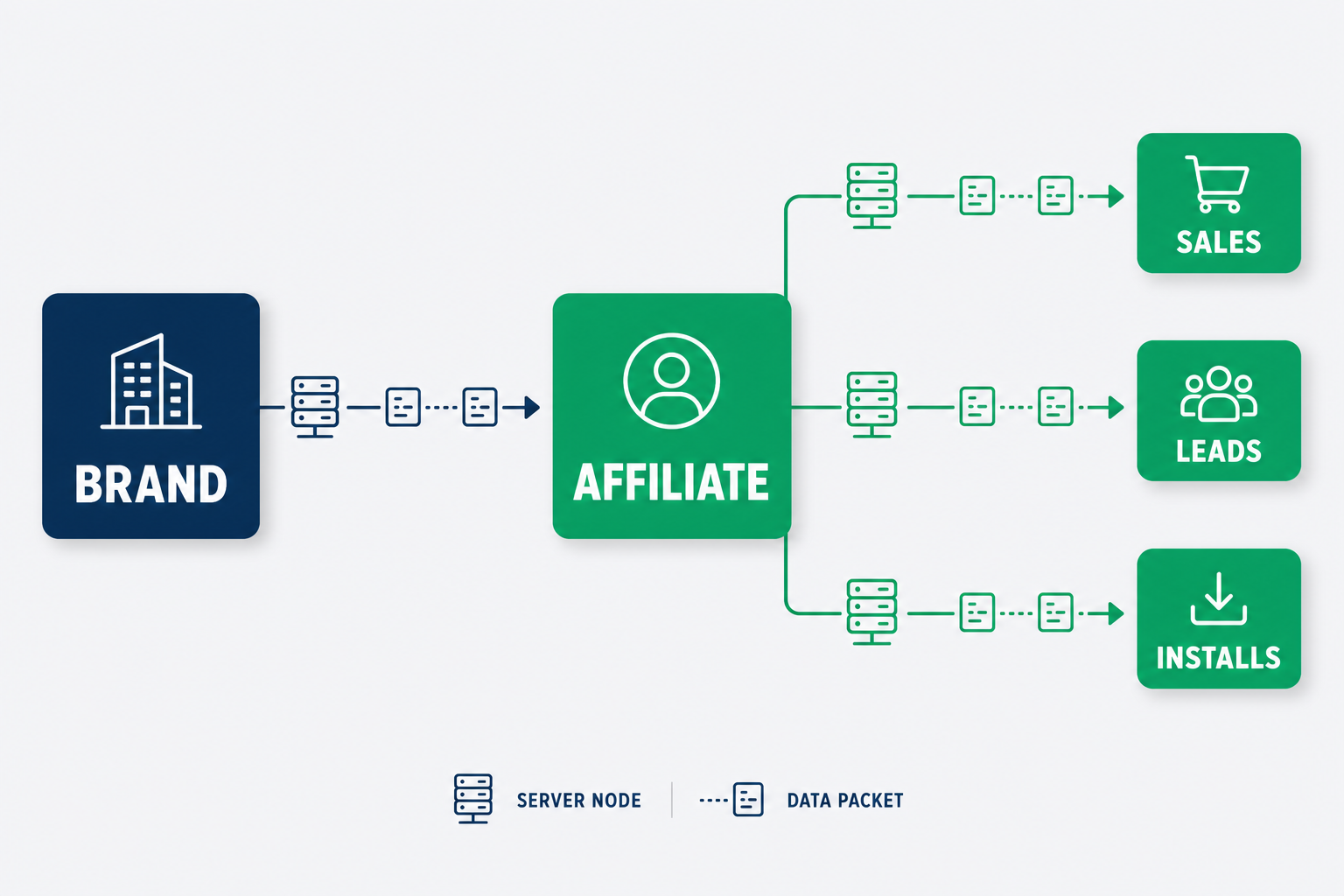
At its core, affiliate marketing is a performance-based revenue framework where a brand compensates external partners (affiliates) for generating specific business outcomes—usually sales, leads, or app installs—through the affiliate's proprietary marketing efforts.
The mechanics have evolved significantly over the last few years. In the past, affiliate marketing relied heavily on third-party cookies and basic referral links. Today, it is a sophisticated ecosystem powered by server-to-server tracking, AI-driven attribution, and multi-touchpoint analysis. Marketers act as decentralized sales teams for software companies, taking a cut of the revenue they bring in.
For high-ticket SaaS in particular, the focus has shifted from one-off payments to recurring revenue models. You aren't just selling a $50 product; you are introducing a business to a $200/month software platform and collecting 20% to 30% of that subscription fee for the lifetime of the customer.
Top 10 Affiliate Marketing Companies at a Glance
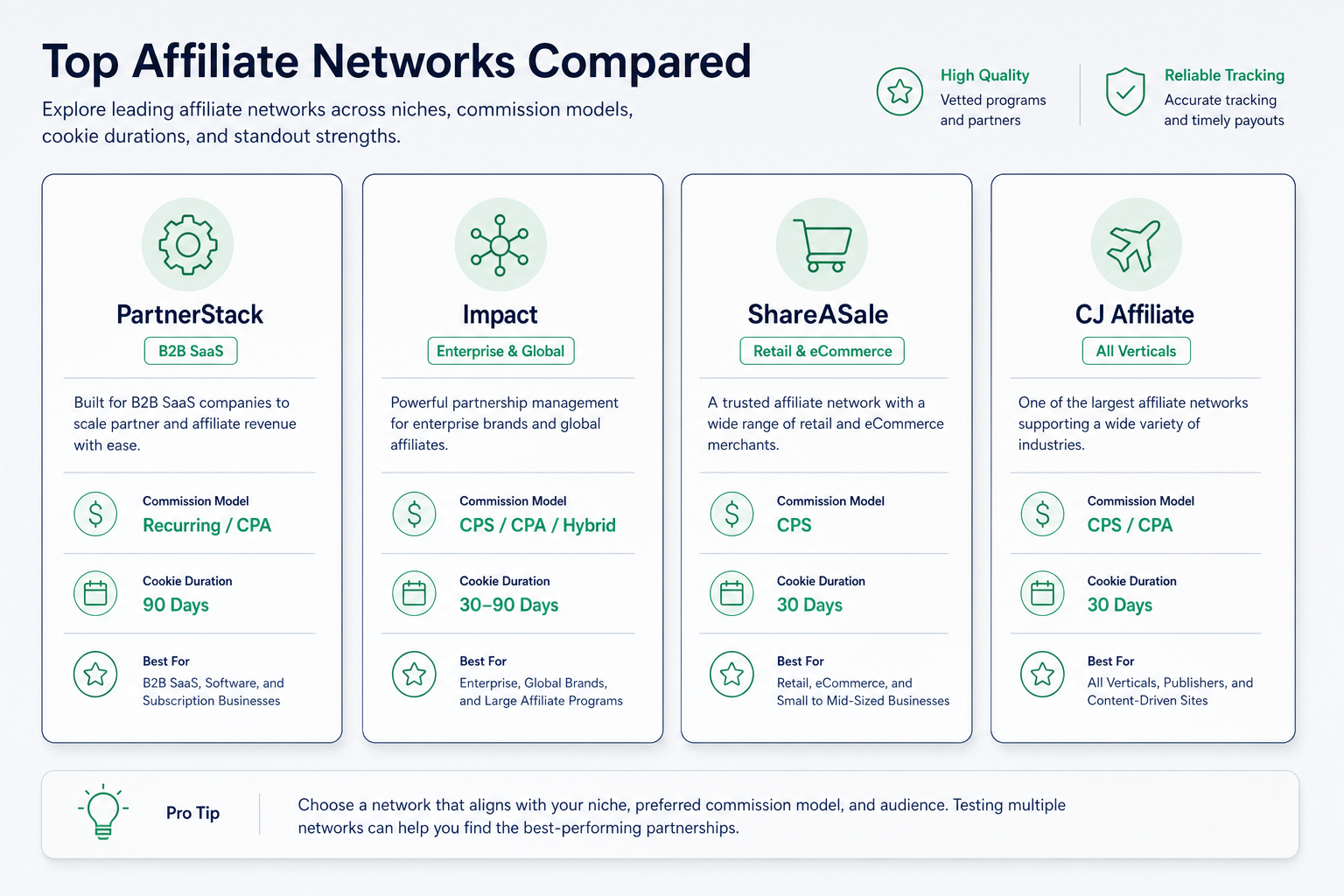
If you want the immediate high-level view before diving into the nuances, here is our 2026 shortlist of the best platforms for serious marketers.
| Network/Platform | Best Fit For | Primary Commission Model | Average Cookie Duration |
|---|---|---|---|
| PartnerStack | B2B SaaS & Software | CPS (Recurring RevShare) | 90 days |
| Impact.com | Enterprise SaaS & D2C | CPS / CPA | 30 - 90 days |
| ShareASale | Mid-market SaaS & E-com | CPS | 30 - 60 days |
| ClickBank | High-Ticket Digital Products | CPS (High one-time) | 60 days |
| Performcb | Mobile Apps & CPA Offers | CPA / CPI | Varies (often 30 days) |
| CJ Affiliate | Legacy Tech & Big Brands | CPS / CPL | 30 - 120 days |
| Elementor | WordPress & Hosting Niche | CPS | 90 days |
| Mobidea | Mobile Subscriptions | CPA | Varies |
| GetResponse | Marketers & Agencies | CPS (Recurring or Bounty) | 120 days |
| Rakuten Advertising | Enterprise Retail & Tech | CPS | 30 days |
| AvantLink | Niche B2B & Technical gear | CPS | 30 - 120 days |
The Best Affiliate Marketing Companies of 2026
Finding the right partner is about more than just locating the highest percentage. You need reliable tracking, on-time payouts, and a platform that actual buyers trust. Here is a deep dive into the top companies dominating the landscape.
Top Platforms for High-Ticket SaaS & B2B
1. PartnerStack
PartnerStack is practically synonymous with B2B SaaS affiliate marketing. Unlike traditional retail networks, PartnerStack was built from the ground up to handle the complexities of software subscriptions, upgrades, downgrades, and recurring revenue sharing.
- Commission Models: Primarily recurring revenue share (e.g., 20-30% of the customer's monthly bill) or flat-rate CPA bounties.
- Why it works in 2026: PartnerStack handles cross-device attribution brilliantly. Since B2B software purchases often take weeks of internal approvals, PartnerStack's 90-day cookie durations and lead-registration features ensure you don't lose your commission if a user clicks your link on a mobile device but ultimately buys on their work desktop.
- Best for: Niche site owners reviewing business tools, HR software, marketing platforms, and productivity apps.
2. Impact.com
Impact (formerly Impact Radius) has aggressively captured the enterprise SaaS and premium digital market. They offer a white-labeled experience for many massive software brands, providing a seamless dashboard for affiliates.
- Commission Models: CPA, CPL, and CPS.
- Why it works in 2026: Impact's customized contracts are a standout feature. As an affiliate, you aren't forced into a one-size-fits-all agreement. If you drive consistently high-value traffic, you can negotiate dynamic commission rates directly within the platform. Their transition to AI-assisted compliance monitoring also keeps the network incredibly clean.
- Best for: Established content creators and large-scale publishers looking to partner with top-tier software brands.
3. ShareASale
Owned by Awin, ShareASale remains a workhorse in the affiliate industry. While they are known for physical products, they have a massive, often-overlooked catalog of mid-market SaaS companies, WordPress plugins, and digital service providers.
- Commission Models: CPS and CPL.
- Why it works in 2026: It is incredibly easy to join. While platforms like Impact can be highly exclusive, ShareASale is friendly to newer niche site owners. Their reporting interface is slightly legacy, but their reliability and low payout thresholds make them indispensable.
- Best for: Bloggers in the web development, hosting, and digital marketing niches looking for reliable plugin and tool partnerships.
4. CJ Affiliate (Formerly Commission Junction)
CJ Affiliate is one of the oldest networks on the web, but it has maintained its relevance by securing exclusive contracts with massive legacy tech companies and enterprise software providers.
- Commission Models: CPA, CPL, CPS.
- Why it works in 2026: CJ offers incredibly granular reporting, allowing advanced marketers to see exactly which content types are driving specific user actions. They also offer a "cookieless" tracking solution, which is critical as privacy regulations stricture the use of third-party data.
- Best for: Data-driven marketers with high traffic volumes who need robust API access and advanced attribution data.
Featured Mobile Affiliate Companies
The mobile ecosystem has fundamentally changed. App installs alone are no longer the golden goose; advertisers want post-install events (like in-app purchases or account registrations). According to data on the broader affiliate landscape highlighted by Business of Apps, mobile optimization is non-negotiable for modern networks.
5. Performcb
Consistently ranked as the top CPA (Cost Per Action) network globally, Performcb specializes in highly specific conversion events. If you have mobile traffic, this is where you monetize it.
- Commission Models: CPA, CPI (Cost Per Install), CPL.
- Why it works in 2026: Performcb uses proprietary AI to match your traffic with the highest-converting offers automatically. If a specific mobile finance app stops converting for your audience, their smart links will dynamically route traffic to a better-performing offer in real-time.
- Best for: Media buyers, mobile app developers, and social media influencers with high mobile traffic volumes.
6. Mobidea
Mobidea is a specialized mobile affiliate network focusing heavily on mobile subscriptions, sweepstakes, and app installs.
- Commission Models: CPA.
- Why it works in 2026: They offer advanced tracker integrations and daily payments for top affiliates. In the fast-paced world of mobile media buying, cash flow is everything. Getting paid daily allows affiliates to aggressively reinvest in profitable ad campaigns.
- Best for: Advanced CPA marketers running paid social or native advertising to mobile landing pages.
Top Networks for Creators, Hosting, & Digital Products
7. ClickBank
When it comes to digital products and information courses, ClickBank remains a titan. While they have physical products, their core strength is high-margin digital goods.
- Commission Models: CPS (up to 75% or even 90% commissions) and CPA.
- Why it works in 2026: ClickBank offers some of the highest payout percentages in the industry because digital products have virtually no marginal cost of reproduction. They have also vastly improved their product vetting, ensuring that the high-ticket courses and tools on their platform convert reliably.
- Best for: Email marketers and YouTube creators dealing in wealth building, health, or niche educational topics.
8. Elementor Affiliate Program
For marketers in the WordPress and web hosting space, direct SaaS programs often outperform aggregated networks. The Elementor ecosystem is a prime example of a direct program that pays exceptionally well.
- Commission Models: CPS (up to 50% on new sales).
- Why it works in 2026: Elementor powers a massive portion of the modern web. As noted in resources mapping out the top Elementor networks, promoting foundational web-building tools offers high conversion rates because these tools are essential, not discretionary, for businesses.
- Best for: Web designers, YouTube tutorial creators, and B2B tech reviewers.
9. GetResponse Affiliate Program
Similar to web building, email marketing software is a sticky, high-ticket category. GetResponse offers one of the most flexible direct programs for influencers and marketers.
- Commission Models: Choice between a 33% recurring commission or a $100 upfront bounty per sale.
- Why it works in 2026: Giving affiliates the choice between immediate cash flow (bounty) or long-term passive income (recurring) is a masterclass in affiliate management. Marketers needing ad budget can take the bounty; niche site owners looking to build an asset can take the recurring share.
- Best for: Digital marketing educators, agency owners, and SaaS bloggers.
10. Rakuten Advertising
Rakuten is for affiliates who want to work with household names. They have fewer total merchants than ShareASale but boast partnerships with massive global enterprises.
- Commission Models: CPS.
- Why it works in 2026: Brand trust equals higher conversion rates. Rakuten provides access to recognizable software and tech hardware brands, meaning your audience requires less warming up to make a purchase.
- Best for: High-authority websites and established media publishers.
11. AvantLink
AvantLink is highly selective, focusing heavily on quality over quantity. While known for outdoor gear, their B2B and technical software catalogs are incredibly strong.
- Commission Models: CPS.
- Why it works in 2026: They have strict entry requirements for both merchants and affiliates. This creates a high-trust environment with exceptional EPCs (Earnings Per Click), as the ecosystem is free of spammy offers or low-quality traffic sources.
- Best for: Deep-niche technical bloggers and highly specialized content creators.
What is an affiliate program?
Before you commit your traffic to a network, it is important to distinguish between an affiliate network and an affiliate program.
An affiliate program is the specific referral arrangement offered by a single merchant (e.g., the Adobe Affiliate Program).
An affiliate network is the marketplace or platform that houses hundreds or thousands of these programs under one roof (e.g., Impact or PartnerStack). The network acts as an intermediary, handling the tracking links, the dashboards, and the distribution of payouts.
Affiliate Network vs. In-House Program: A Quick Strategic Look
One of the biggest mistakes new marketers make is assuming networks are the only way to find partnerships. In the high-ticket SaaS world, many companies run in-house programs using white-labeled software.
- The Network Advantage: You get a single dashboard, one combined payout threshold, and dispute resolution handled by the network.
- The In-House Advantage: Brands save money on network fees, which they often pass on to affiliates in the form of higher commissions.
This exact dichotomy is why we built AffiliList. Relying only on a single network limits your earning potential. Our directory allows you to find both network-hosted and independent in-house programs side-by-side, comparing their real payout structures without needing to create accounts across ten different platforms.
How to choose the best affiliate marketing company?
Vetting a platform requires more than just looking at the top-line commission percentage. A 50% commission on a product that never converts is worth zero. When leveraging resources like Affiliate.Watch or AffiliList to find programs, use this specific framework to evaluate them:
1. Evaluate the Attribution Model and Cookie Duration
In 2026, privacy blockers and intelligent tracking prevention (ITP) are standard on all major browsers.
- What to look for: First-party tracking integration and server-to-server (S2S) postbacks. If a network still relies entirely on third-party cookies, you are losing up to 30% of your earned commissions.
- Cookie Duration: For high-ticket B2B SaaS, the sales cycle can take 30 to 90 days. Avoid programs with a 24-hour or 7-day cookie window for high-ticket items. You want 60 days minimum.
2. Scrutinize Payout Thresholds and Terms
Cash flow dictates how fast you can scale, especially if you are running paid ads.
- Thresholds: Look for platforms with low payout thresholds ($50 is standard).
- Terms: Check if they operate on Net-15, Net-30, or Net-60 terms. Net-60 means you won't get paid until 60 days after the end of the month in which the sale occurred. For high-ticket SaaS, Net-30 is standard due to refund periods.
3. Assess the Platform Dashboard and UI
You will spend hours inside these dashboards analyzing EPCs (Earnings Per Click) and conversion rates. If a platform is sluggish, lacks transparent reporting, or hides its top-converting landing pages, it will bottleneck your workflow. Excellent platforms like Efficient App highlight how software should be intuitive; your affiliate network should be the same.
4. Analyze Merchant Quality and Reversal Rates
High reversal rates (where a merchant cancels your commission because the user refunded the product or their credit card failed) are a massive red flag. Top networks monitor their merchants and will ban vendors who routinely reverse legitimate commissions.
What are the best features of affiliate marketing companies?
If you want to operate like a top 1% affiliate in 2026, you need features that go beyond basic link generation. The top tier companies offer:
- Deep Linking: The ability to link directly to a specific product page or blog post on the merchant's site, rather than just the homepage. This dramatically increases conversion rates.
- Dynamic Banners and Assets: Access to high-converting creative assets that are automatically updated by the merchant when a new promotion launches.
- Sub-ID Tracking: The ability to add tags to your links (e.g.,
?subid=header-bannervs?subid=footer-text) so you can see exactly where on your site the conversion originated. - API Access: For advanced marketers, pulling real-time earnings data into personal dashboards (like Looker Studio) via API is essential for tracking ROI on content or ad spend.
Types of affiliate program models
Understanding the exact terminology is critical before you sign any network terms of service. Affiliate programs compensate you based on different triggers.
CPS (Cost Per Sale) or RevShare
This is the most common model in SaaS and e-commerce. You get paid a percentage of the actual purchase price.
- Edge Case: In SaaS, ensure you know if this is a one-time payment (often higher, e.g., 50% of month one) or recurring (e.g., 20% for the lifetime of the customer). Recurring is almost always more profitable in the long run.
CPA (Cost Per Action)
Unlike CPS, a CPA model pays a flat fee regardless of the cart value.
- Example: A crypto trading platform might pay you a flat $150 CPA when a user deposits their first $50, regardless of whether they trade $50 or $5,000.
CPL (Cost Per Lead)
You are paid when a user submits their information, even if they don't buy anything.
- Example: A B2B enterprise software company might pay you $40 just for getting a user to sign up for a free product demo or download a whitepaper. CPL requires high-quality traffic, as networks will quickly ban affiliates who send "junk" leads that never convert into sales.
CPI (Cost Per Install)
Prevalent in mobile marketing, you are paid a small bounty (often $1 to $5) when a user downloads and opens a free app.
How do affiliate programs work?
The technical flow of a successful affiliate transaction in 2026 relies on an intricate chain of attribution data:
- The Click: A user clicks your unique affiliate tracking link.
- The Handoff: The network intercepts the click for a fraction of a second, logging the user's IP address, device ID, and your affiliate ID.
- The Cookie/Session: A tracking script is placed on the user's browser, or a server-side session is initiated.
- The Conversion: The user completes the desired action (buying software, submitting a lead form).
- The Postback: The merchant's website fires a "postback URL" to the network, confirming the sale value and order ID.
- The Payout: The network credits your dashboard, holds the funds during the merchant's refund window, and eventually transfers the money to your bank account.
Building Your Affiliate "Stack": The Tools of the Trade
Joining a top network is only half the battle. To scale high-ticket SaaS promotions, you cannot rely on messy spreadsheets and raw tracking links. Professionals build a specific tech stack:
- Link Cloaking & Management: Using tools like ThirstyAffiliates or Pretty Links to turn ugly network links (e.g.,
network.com/track?id=4993&merch=92) into clean, trustworthy URLs (e.g.,yoursite.com/go/software). - Data Aggregation: Finding profitable programs is time-consuming. Using AffiliList allows you to filter thousands of programs by category, commission rate, and cookie duration in seconds, bypassing the need to sign up for dead networks.
- SEO & Content Tools: High-ticket SaaS buyers do heavy research. You need advanced content optimization tools to ensure your comparison posts rank for high-intent keywords like "[Software A] vs [Software B]."
Frequently Asked Questions (FAQ) About Affiliate Networks
How much do affiliate marketing companies cost?
Joining an affiliate network or program should always be 100% free for the affiliate. If a platform asks you to pay a setup fee or a monthly subscription just to access their referral links, it is likely a scam.
The networks make their money by charging the merchants (the software companies) a platform fee or taking an override percentage on top of the commission they pay you.
What are the most profitable affiliate offer types?
In 2026, the highest ROI comes from B2B SaaS with recurring commissions and high-ticket financial or business tools.
Promoting a $50 consumer product at a 5% commission yields $2.50. Promoting a $150/month business software at a 30% recurring commission yields $45 per month, or $540 per year, from a single customer. The effort to rank a review article or run an ad campaign is remarkably similar for both, making SaaS exponentially more profitable.
Why do networks reject affiliate applications?
Networks reject applications primarily due to poor traffic quality or a lack of verifiable audience. If you apply to a premium network like Impact or AvantLink with a brand new, empty blog, you will likely be denied.
Pro tip: Build 10 to 15 pieces of high-quality, niche-specific content and secure a baseline of organic traffic before applying to top-tier networks. If you need immediate approvals to start testing layouts, look for direct-to-merchant programs through directories like AffiliList, which often have lower entry barriers than massive legacy networks.