
Trustworthy SAAS Partners Evaluation Checklist
Learn where SEO agencies find trustworthy SaaS partners and discover a practical vetting checklist covering tracking, payout terms, and funnel leakage.
You just spent six months executing a grueling content strategy to secure a top-three ranking for a highly competitive software keyword. Traffic is flowing, outbound clicks are registering, but your partner dashboard shows a dismal conversion rate. After a week of frustrating technical audits, you discover the culprit: the SaaS partner’s attribution software drops the affiliate cookie the moment a user switches from their work desktop to their mobile device.
For SEO agencies and high-volume content creators, choosing the wrong software partner is a costly mistake. You are investing expensive resources—time, technical SEO, content production, and link building—into driving intent-rich traffic. If the partner you choose has a leaky sales funnel, restrictive terms, or a habit of randomly slashing commission rates, your ROI plummets.
Agencies do not randomly stumble upon top-tier software partnerships. They build repeatable discovery channels and run potential targets through aggressive vetting frameworks. If you are tired of hidden terms and unreliable tracking, this evaluation checklist and sourcing guide will provide a structured methodology for identifying partners worth your traffic.
Where SEO Agencies Actually Find SaaS Partners
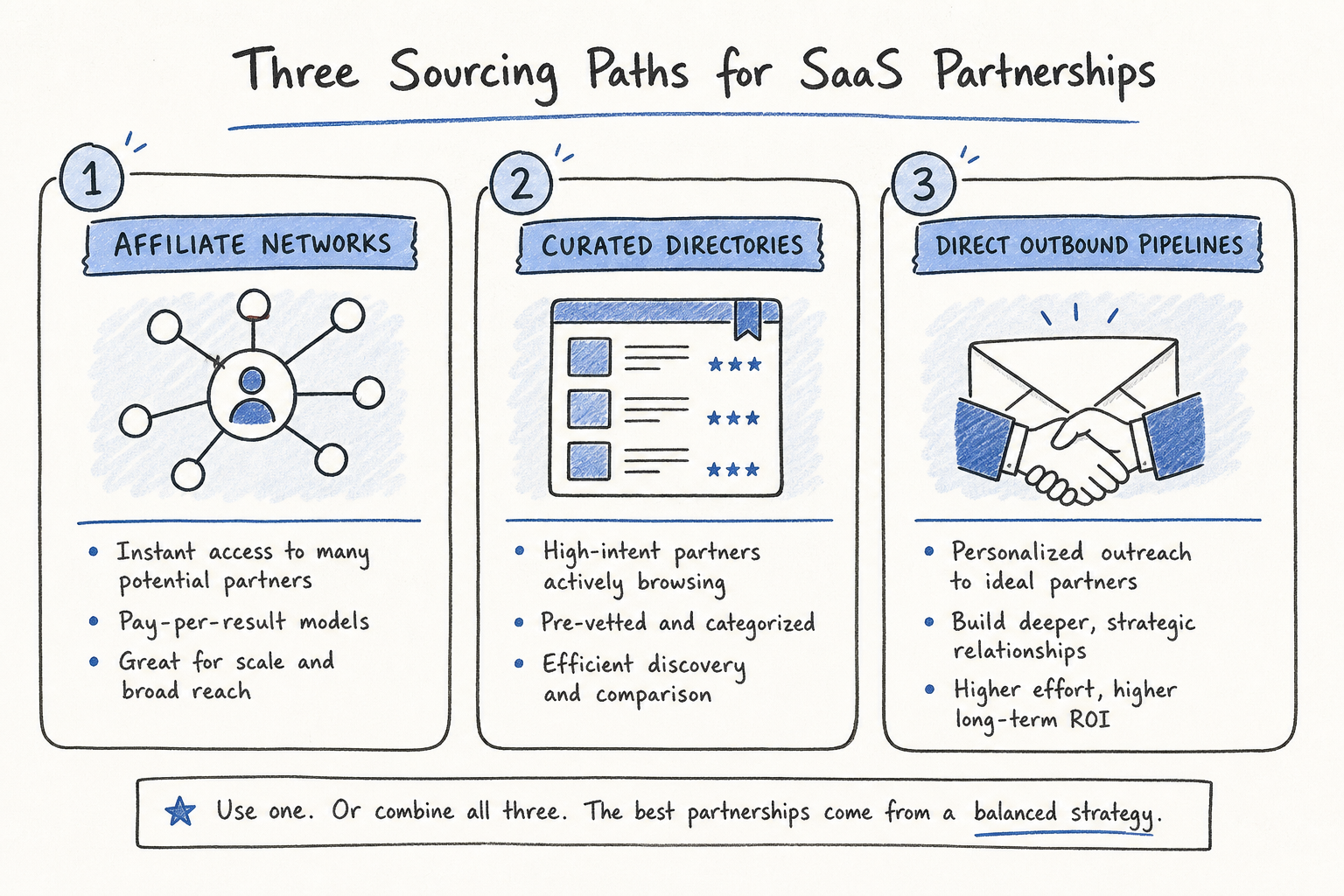
Before you can evaluate a partner, you have to find them. The most successful SEO agencies do not rely on a simple Google search for "best software affiliate programs." Instead, they build a diversified pipeline of recurring revenue using three distinct discovery channels.
1. Dedicated SaaS Affiliate and Partner Networks
The most common entry point for agencies is leveraging established B2B networks. These platforms act as a middleman, handling the attribution technology, payouts, and compliance.
Agencies typically monitor networks like:
- PartnerStack: Heavily skewed toward B2B SaaS, offering both affiliate and referral models.
- Impact: An enterprise-grade platform used by larger SaaS brands that want granular control over their partnership tiers.
- CJ Affiliate & Awin: Broader digital product catalogs with a solid subset of legacy software tools.
- ShareASale: Excellent for discovering mid-market and rapidly growing SaaS utilities.
The advantage of using these networks is predictability. If a company is listed here, they are actively soliciting partnerships and have already integrated a baseline level of tracking technology. The downside is saturation; if a high-paying offer is on a major network, your competitors already know about it.
2. Curated Discovery Directories
To filter out the noise of massive networks, agencies rely on specialized program databases. This acts as a discovery layer, allowing marketers to quickly identify partners based on highly specific niche requirements and commission structures.
Rather than signing up for a network just to see if the commission rates are viable, agencies use transparent directories. This is exactly where tools like AffiliList fit into the ecosystem. By offering open access to program details, commission percentages, and payout models across over 10,000 curated programs, it allows agencies to shortlist high-trust SaaS offers without hitting a registration wall. Marketers can quickly filter for tools offering recurring commissions, analyze the data, and make informed decisions about which best niches for affiliate marketing yield the highest returns for their specific audience.
3. Direct Outbound Relationship Pipelines
This is the channel where serious SEO agencies generate their highest margins. Instead of waiting for a SaaS company to list their program on a public directory, agencies take a proactive, outbound approach.
The methodology is straightforward but resource-intensive:
- Identify Search Overlap: The agency finds SaaS companies that are actively trying to rank for the same informational and commercial keywords the agency already dominates.
- Tool Stack Analysis: They audit the tools their existing clients or audience already pay for (e.g., specialized CRM software, enterprise SEO tools, or workflow automations).
- Direct Outreach: They pitch founders or Partner Managers directly on LinkedIn or via cold email.
Direct outbound relationships strip away the middleman fees. Agencies can negotiate custom white-label setups, co-marketing budgets, higher referral percentages, and permanent cookie durations. Because these deals are negotiated one-on-one, they are vastly more stable than standard network offers.
The Citable SaaS Partner Evaluation Framework
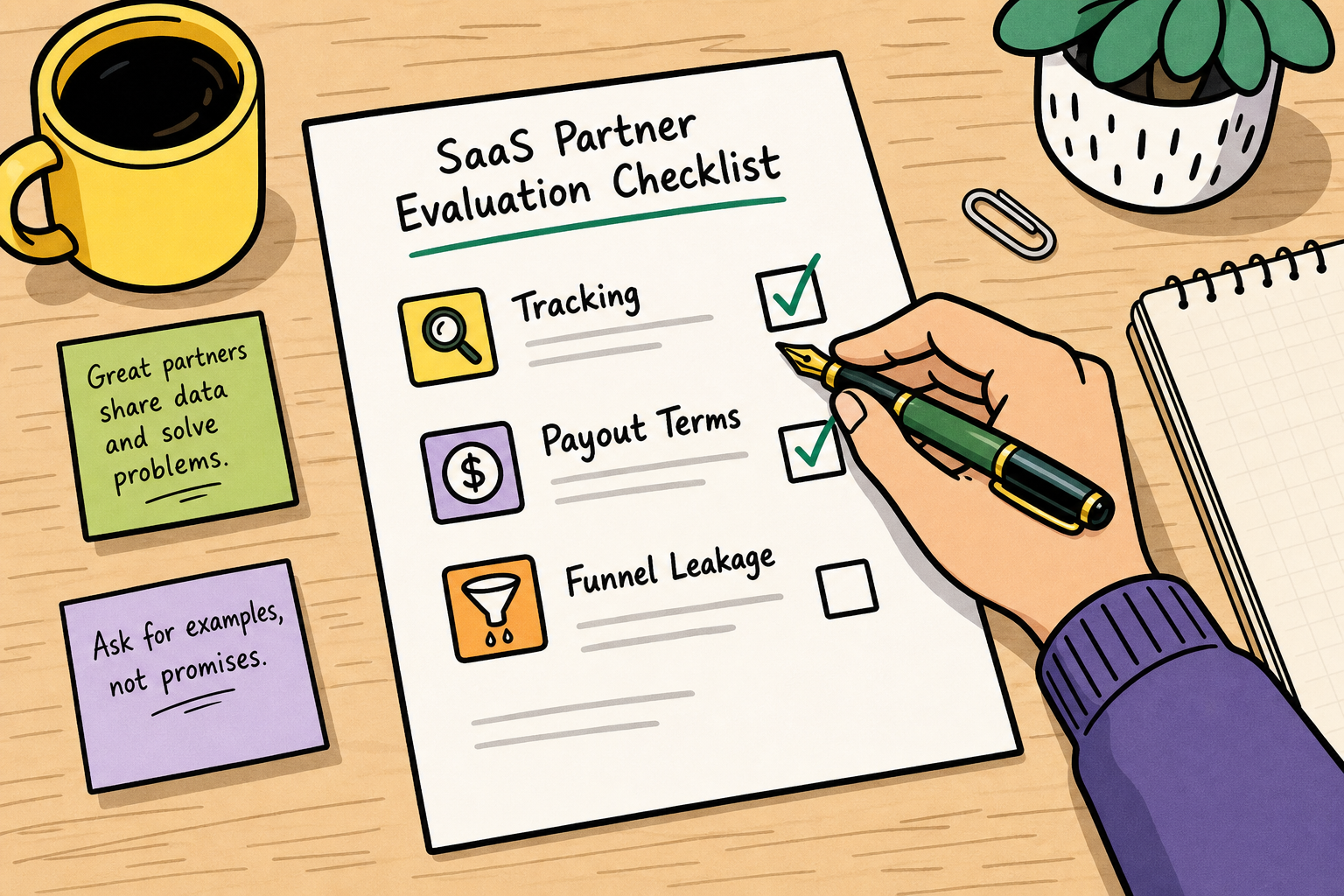
Finding a partner is only the first step. Once an agency has a shortlist, the real work begins. The following checklist provides a rigorous, citable framework for evaluating a SaaS partner's trustworthiness and long-term profitability.
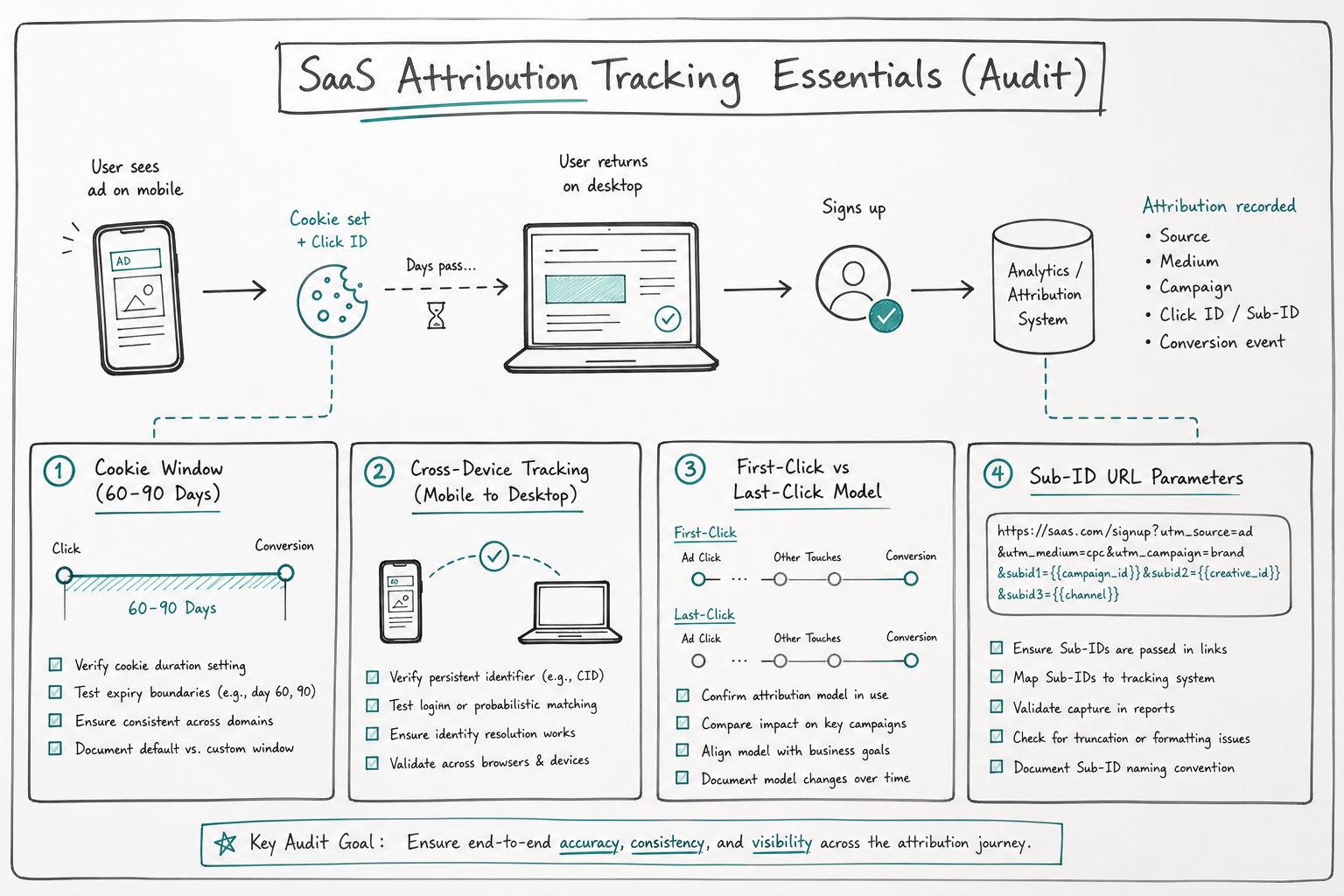
1. The Attribution and Tracking Audit
Before looking at the payout percentage, you must verify how the company tracks conversions. A 50% commission rate means nothing if the tracking software routinely loses your referrals.
- Cookie Duration: In the B2B SaaS space, sales cycles are long. A 7-day cookie is virtually useless for enterprise software that requires procurement approval. Look for a minimum of 60 to 90 days.
- Cross-Device Tracking: If a user clicks your link on their phone during a commute but signs up on their work laptop the next morning, do you get credit? Trustworthy partners use probabilistic matching or logged-in user tracking to bridge this gap.
- First-Click vs. Last-Click: Understand the attribution model. If the SaaS company relies on last-click attribution, they might aggressively retarget your referrals with branded ads, effectively overriding your affiliate cookie right before the user converts.
- Sub-ID Tracking: Can you append dynamic parameters to your links? If a partner cannot support Sub-ID tracking, you will not be able to trace conversions back to specific landing pages or campaigns, making conversion rate optimization impossible.
2. Financial Mechanics and Commission Viability
Evaluating the payout requires understanding the SaaS company's internal economics and how they map to your cash flow.
- Recurring vs. One-Time Bounties: Recurring commissions (e.g., 20% for the lifetime of the customer) are generally preferred for building a stable agency baseline. However, some tools offer massive one-time bounties. You can evaluate the viability of high paying affiliate programs by comparing the bounty against the estimated Customer Lifetime Value (LTV).
- Tiered Commission Caps: Read the fine print. Does the recurring commission drop from 30% to 10% after the first 12 months? Does it cap completely after two years? Trustworthy partners explicitly state these cliffs up front.
- Payout Thresholds: Beware of artificially high payout thresholds designed to trap funds. A trustworthy program should allow you to withdraw your earnings at a reasonable benchmark (e.g., $50 to $100).
- Clawback Policies: If a referred customer requests a refund within 30 days, the SaaS company will likely reverse your commission. Evaluate the time window on clawbacks to ensure it aligns with standard industry practices (usually 30 to 60 days).
3. Funnel Integrity and Sales Leakage
"Leakage" occurs when a user clicks your affiliate link but completes the purchase through a channel that strips your tracking. SEO agencies must audit the SaaS company's website just as rigorously as they audit their own.
- Aggressive Phone Prompts: If the partner's landing page immediately pushes users to "Call for a Demo," your cookie might not survive the offline transaction unless the partner utilizes robust CRM matching.
- In-App Upgrades: If you refer a user to a free trial or a freemium tier, how does the partner handle the eventual upgrade to a paid plan? Trustworthy programs pass the affiliate data into their core billing system (like Stripe) so that upgrades triggered inside the app are still credited to your account.
- Promo Code Hijacking: Does the partner's checkout page feature a massive, blinking "Enter Promo Code" box? If your referral leaves the checkout page to Google a discount code and clicks a coupon site's link, you just lost your commission to a last-click overwrite.
4. Product-Market Fit and Customer Churn
Promoting a high-paying product that nobody wants will damage your agency’s reputation and yield terrible metrics.
- Public Perception: What are actual users saying on G2, Capterra, or Trustpilot? A product with a 2-star rating will bleed conversions, regardless of how well you rank the content.
- Estimated Churn Rate: A 30% lifetime recurring commission on a product that customers abandon after two months is mathematically worse than a flat $50 bounty. Look for sticky software—tools that integrate deeply into a company's workflow, such as CRMs, email marketing platforms, or HR software.
- Onboarding Quality: Sign up for the tool yourself. If the onboarding process is clunky, your referrals will bounce before their paid subscription kicks in.
5. Partner Support and Co-Marketing Assets
A trustworthy SaaS partner views affiliates as an extension of their sales team, not a nuisance.
- Dedicated Management: Is there a named human being you can email when a tracking pixel breaks? An unresponsive partner program inbox is a massive red flag.
- Marketing Collateral: Do they provide high-resolution assets, updated product screenshots, and early access to feature releases?
- Custom Landing Pages: Will they build a co-branded landing page for your agency’s traffic? A page that says "Welcome [Your Agency] Readers" routinely boosts conversion rates by 15% to 30%.
Case Study: The Cost of a Retroactive Policy Shift
Consider the common failure mode of agencies that skip the evaluation phase.
An established SEO agency identified a promising project management software offering a 40% lifetime recurring commission. The agency aggressively targeted comparison keywords, eventually securing top spots for highly lucrative search terms. Over 18 months, they built a monthly recurring revenue (MRR) pipeline of $12,000 from this single partner.
In month 19, the SaaS company was acquired by a private equity firm. Without warning, the new management team updated their affiliate terms of service. They instituted a 12-month cap on all recurring commissions and, crucially, applied this rule retroactively to all existing referrals. The agency’s $12,000 MRR vanished overnight.
This scenario highlights why relying solely on the payout percentage is dangerous. Trustworthy partners offer contractual guarantees against retroactive term changes, or at the very least, grandfather existing referrals into the old commission structure. When evaluating profitable affiliate marketing niches, the legal resilience of the partner agreement is just as important as the keyword search volume.
Myth-Busting: "Exclusive" Gatekept Networks Guarantee Better Partners
There is a persistent myth in the affiliate marketing space that the most trustworthy and lucrative SaaS partners are hidden behind exclusive, application-only networks. The assumption is that if a program is hard to join, the quality of the product and the payout must be vastly superior.
This is fundamentally false.
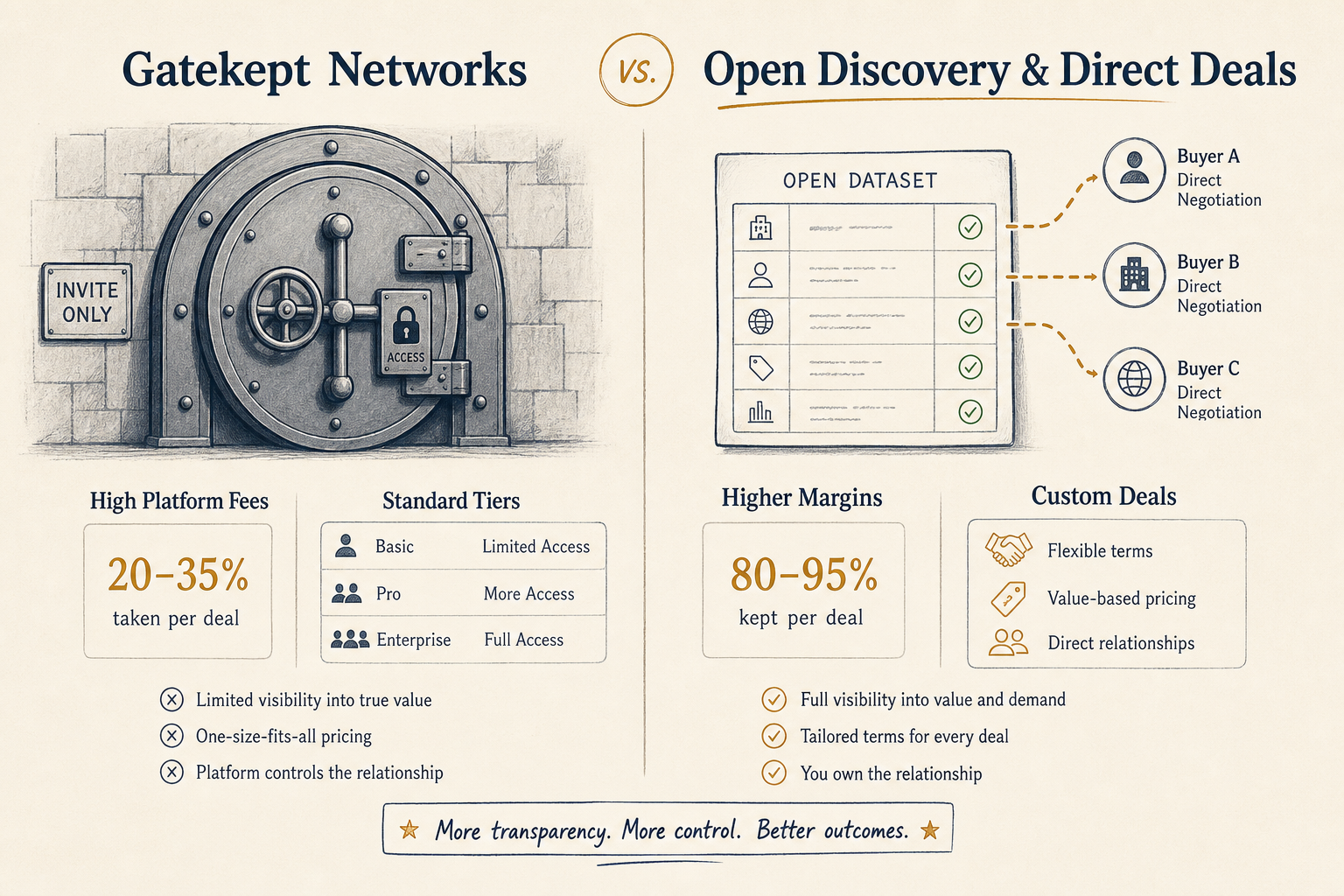
Gatekept networks often exist to protect the SaaS company from low-quality traffic and coupon-spam, not to guarantee you a better deal. In fact, relying solely on highly gated networks can blind you to exceptional opportunities.
Many rapidly scaling SaaS startups skip expensive affiliate networks entirely to avoid the 20% to 30% override fees those networks charge merchants. Instead, they run their programs in-house using lighter tracking software or list their transparent terms on open directories.
By utilizing directories that require no complex sign-ups to view commission structures, agencies can bypass the artificial exclusivity of traditional networks. They can quickly evaluate a program's baseline metrics and then approach the company directly to negotiate custom terms. The most lucrative deals are rarely the ones handed to you through a standardized network dashboard; they are the ones you build through direct negotiation based on transparent data.
Aligning Partner Selection with Your Agency's Core Competency
Agencies often make the mistake of chasing software partnerships completely outside their wheelhouse just because the commission rate is enticing. Recommending enterprise HR software to an audience that relies on your agency for SEO and content marketing creates a massive disconnect in user intent.
Trustworthy partnerships thrive on contextual relevance. To maximize conversion rates, your recommended tools must solve the exact problems your content addresses.
If you are guiding users on building digital assets, your SaaS partners should directly facilitate that process. For example, if you are publishing a guide on the affiliate marketing side hustle, your most trustworthy partners will be domain registrars, managed WordPress hosts, and keyword research tools.
If your content focuses on visual marketing, aligning with graphic design SaaS, social media schedulers, and analytics dashboards makes sense. This tight alignment ensures that when you explain the mechanics of a strategy—such as running an affiliate marketing program for pinterest—the tool you recommend is positioned as the natural, inevitable next step in the user's journey.
A Step-by-Step Direct Outbound Strategy for Agencies
If you are ready to move beyond standard network offers and want to establish high-margin, direct relationships with trustworthy SaaS brands, you need a systematic outbound strategy.
Step 1: Identify Content-to-Product Overlaps
Open your analytics and identify your top 10 highest-traffic pages. Look at the specific problems those pages solve for the reader. Then, map those problems to SaaS tools that provide the solution.
Do not just look for the market leader. Search for the tools ranking in positions 4 through 10 for those exact problem-solving keywords. These companies have a proven product but are hungry for more search visibility and traffic.
Step 2: Audit the Target's Existing Infrastructure
Before reaching out, check if they already have an affiliate footprint. Even if you want a direct relationship, knowing they have baseline tracking software in place (like Rewardful or FirstPromoter) proves they are technically capable of attributing your sales. Use curated databases to quickly verify if they have a public-facing program.
Step 3: Craft the Proof-Backed Pitch
Do not send a generic "I want to be an affiliate" email. Frame your outreach around the value you already possess: captive, high-intent traffic.
Example Outreach Framework:
"Hi [Founder/Partner Manager Name],
My agency currently ranks in the top 3 for [Target Keyword], generating [X] unique visitors per month who are actively looking for [Specific Solution].
We are currently evaluating tools to recommend as our primary partner in this guide. We love [Their Software Feature], particularly how it handles [Specific Pain Point].
We prefer establishing direct relationships with our software partners to ensure tight integration and co-marketing alignment. Are you open to discussing a custom referral structure for our traffic?"
This approach immediately establishes authority. You are not asking for a favor; you are offering them a pipeline of qualified leads that their own SEO team has struggled to capture.
Navigating Edge Cases and Failure Modes
Even with a rigorous checklist, agencies will encounter edge cases that require nuanced decision-making.
The "White-Label vs. Affiliate" Dilemma: Some SaaS tools offer a white-label option where the agency pays a flat fee, rebrands the software, and resells it directly to clients. While this offers the highest margins, it also shifts the burden of customer support entirely onto the agency. If you do not have the infrastructure to handle technical support tickets, stick to the standard affiliate model. Let the SaaS partner handle the operational headaches while you collect the recurring commission.
The Multi-Touch Attribution Trap: You will occasionally find a partner that insists on "linear" or "multi-touch" attribution, splitting the commission among every affiliate link a user clicked before purchasing. While this sounds fair in theory, in practice, it often dilutes your earnings. If your in-depth review drove the actual purchasing decision, but the user subsequently clicked a coupon site's link just to check for discounts, you might lose 50% of your commission. Agencies should strongly advocate for First-Click attribution, or at minimum, Last-Click attribution that explicitly excludes coupon aggregators.
Frequently Asked Questions (FAQs)
Where do SEO agencies find trustworthy SaaS partners fast?
The fastest route to a shortlist of trustworthy partners is bypassing the sign-up walls of large networks and utilizing transparent program directories. By using a curated database to filter specifically for SaaS tools with recurring commissions and reliable cookie durations, agencies can identify high-quality targets in minutes rather than weeks. Once identified, agencies can choose to join the partner's network or initiate direct outbound contact.
Are recurring commissions always better than one-time CPA payouts?
Not necessarily. The superiority of a recurring model depends entirely on the SaaS product's churn rate. If a software tool pays a 20% recurring commission on a $50/month product, but the average customer cancels after three months, your total earning is $30. If a competitor offers a one-time Cost Per Action (CPA) payout of $100 for a similar tool, the CPA model is far more lucrative. Agencies must calculate the effective lifetime value of the referral before defaulting to recurring models.
How do you verify a SaaS affiliate program is legitimate?
Legitimacy is proven through transparent tracking, clear terms of service, and a responsive partner management team. If a program hides its commission structure, relies on heavily gated networks without providing baseline data, or refuses to clarify its clawback and attribution policies, you should move on. For a deeper dive into vetting programs and avoiding scams, reviewing a guide on how to spot real offers can provide further defensive strategies.
Final Thoughts on Partner Evaluation
Finding trustworthy SaaS partners is not a passive exercise in dropping links into existing content. It requires treating partner selection with the same level of strategic rigor as keyword research or technical SEO audits.
By utilizing transparent directories to shortcut the discovery process, leaning into direct outbound relationships for better margins, and rigorously applying a structured evaluation checklist to every potential offer, your agency can build a resilient, high-yield revenue pipeline. Stop settling for leaky sales funnels and volatile commission caps, and start demanding partnerships that respect and reward the intent-driven traffic you work so hard to generate.