
Verified Affiliate Programs for Digital Marketers
Stop wasting time on opaque networks. Discover how to evaluate vetted affiliate program lists, verify SaaS terms, and secure high-converting recurring commissions.
- The Anatomy of a Vetted Affiliate Opportunity
- Why Legacy Networks Fail the Modern Marketer
- High-Converting Software Categories for Digital Marketers
- The Myth of the Highest Commission Rate
- Cross-Referencing Independent Data vs. Official Partner Pages
- Avoiding the "Shaved" Commission Trap
- Structuring Content to Capture Search Intent
- Managing Denials and Improving Your Approval Rate
- The Advantage of Niche Specialization
- Frequently Asked Questions
Almost every experienced digital marketer has lived through the same frustrating scenario. You identify a software product that perfectly aligns with your audience, spend an hour filling out a detailed application on a legacy affiliate network, wait two weeks for approval, and finally log in—only to discover the program offers a negligible 5% commission on a 7-day cookie window.
This lack of upfront transparency costs content creators, niche site owners, and media buyers hundreds of hours a year. Traditional affiliate networks operate on a closed-door model, forcing you to commit time before revealing the terms that determine whether a partnership is actually viable.
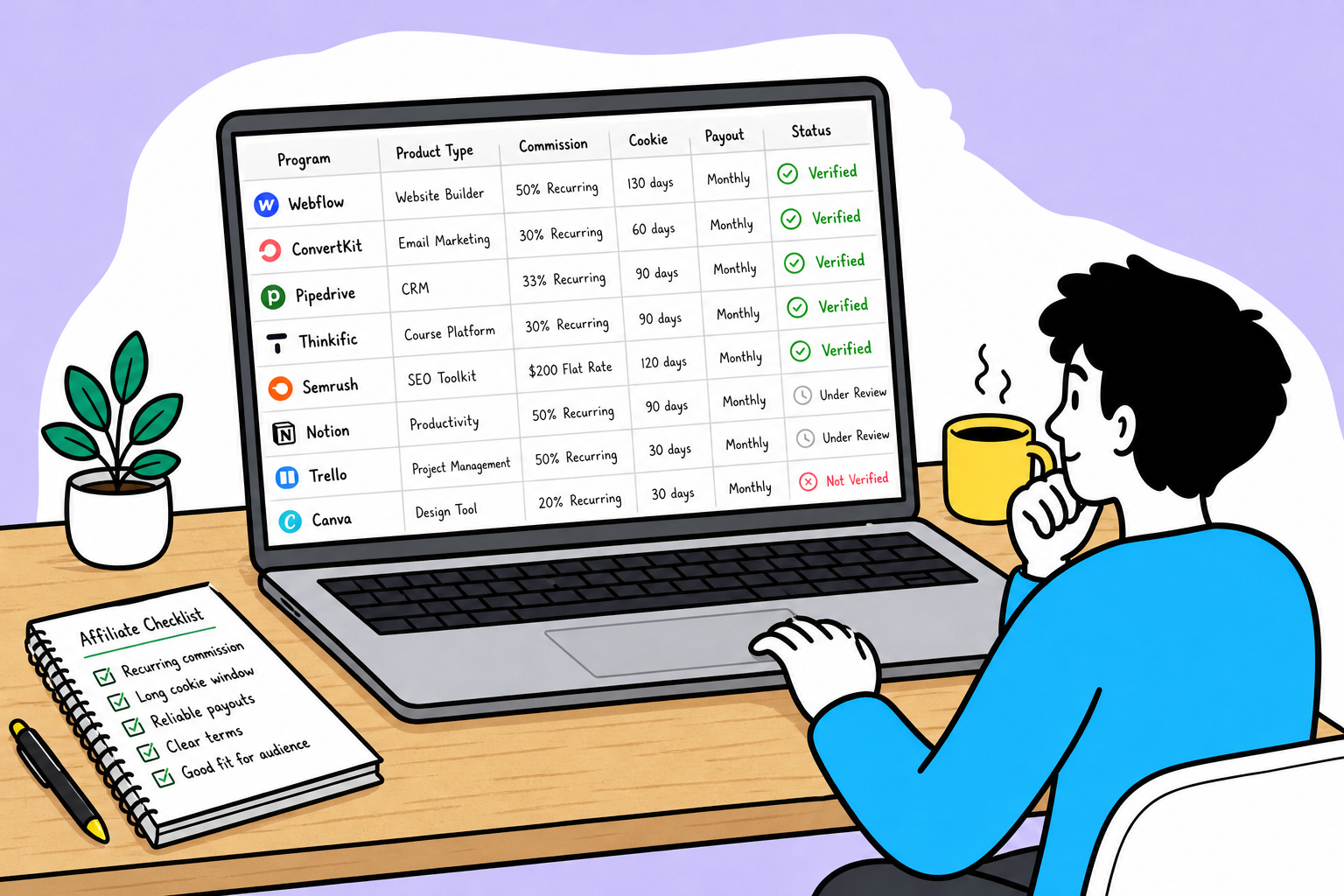
Finding reliable, high-converting offers requires access to a vetted affiliate program list where commission structures, payout terms, and cookie durations are verified and visible before you apply. Whether you are monetizing a marketing blog, a YouTube channel, or an industry newsletter, prioritizing software and digital tools with transparent, officially verified terms is the most direct path to scalable recurring revenue.
The Anatomy of a Vetted Affiliate Opportunity
The term "vetted" in affiliate marketing means more than just confirming a program exists. A truly vetted program has been analyzed for the structural mechanics that dictate your actual earnings. Digital marketers cannot afford to base their content strategy on programs that arbitrarily change their terms, use faulty tracking software, or quietly scrub commissions.
When you evaluate a program from a curated database, you are looking past the marketing copy on the merchant’s partner page and analyzing specific financial and technical data points.
Cookie Duration and Attribution Modeling
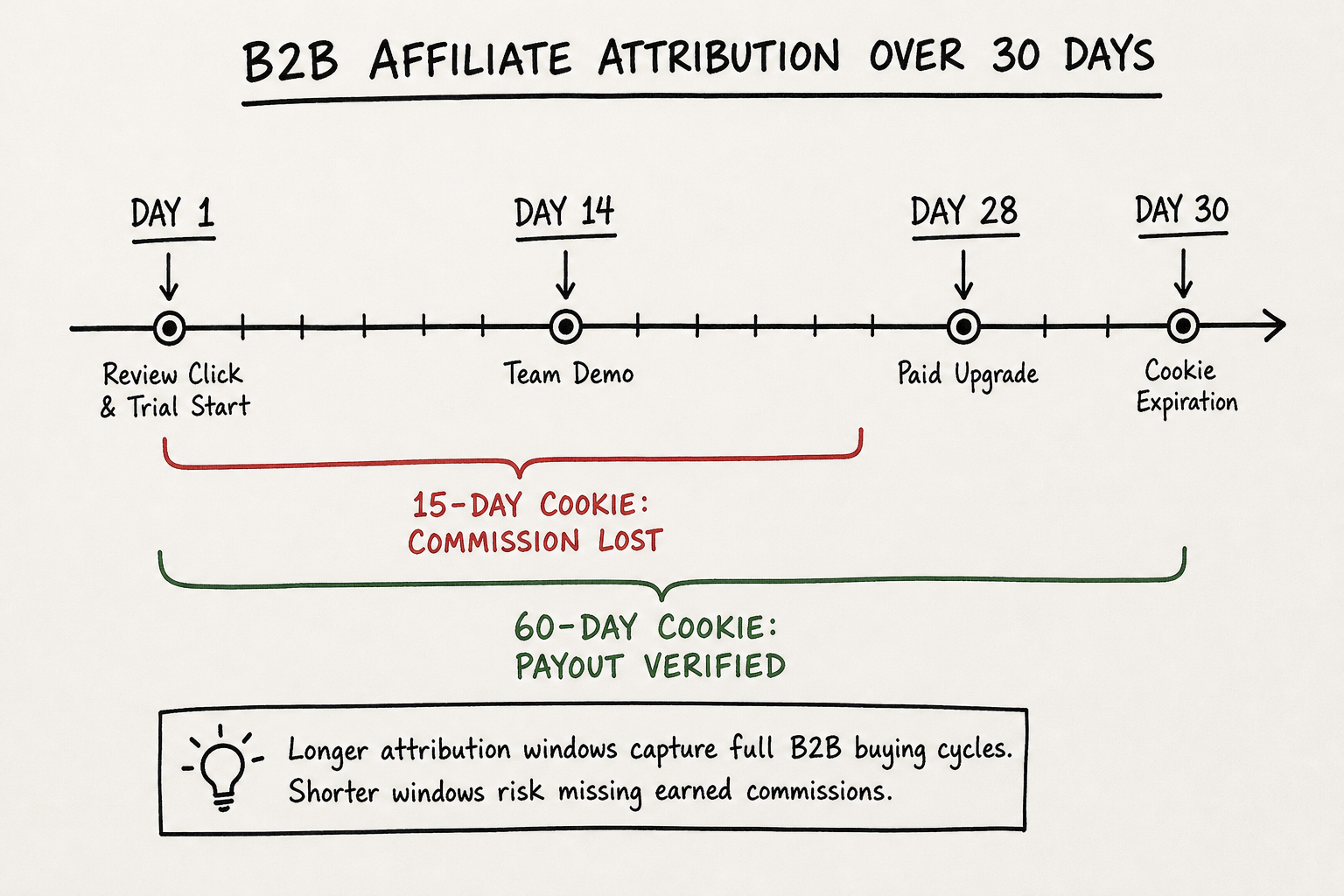
The cookie window dictates how long you have to earn a commission after a user clicks your link. In the B2C world of physical products, a 24-hour cookie might be acceptable because purchases are impulsive. In the SaaS and digital tools space, buying decisions are methodical.
A business evaluating a new CRM or email marketing platform rarely converts on the first visit. They read your review, click through to the software, sign up for a free trial, discuss it with their team, and potentially upgrade to a paid plan 28 days later. If your affiliate link relies on a 15-day cookie, you generate the lead but lose the commission.
Vetted lists prioritize programs offering 30, 60, or 90-day cookies. Even more critical is the attribution model. You need to know if the program uses "first-click" (rewarding the person who introduced the customer) or "last-click" (rewarding the last link clicked before purchase). Most SaaS programs operate on last-click attribution, meaning your bottom-of-the-funnel content—like "Alternative to [Competitor]" or "[Tool] Pricing"—must be incredibly strong to capture that final interaction.
Recurring vs. CPA Commission Structures
Digital marketing software typically offers one of two payout models: Cost Per Action (CPA) or recurring revenue.
A CPA model pays a flat, one-time bounty when a user converts to a paid plan. For example, a web hosting company might pay $100 for every new customer, regardless of whether that customer buys a $5/month plan or a $50/month plan. CPA models provide immediate, substantial cash flow, making them ideal for media buyers spending money on paid ads who need quick returns to fund their campaigns.
Recurring commissions, standard in the SaaS industry, pay a percentage of the customer’s subscription fee for the lifetime of that customer (or a set duration, like the first 12 months). A 30% recurring commission on a $100/month tool yields $30 every month.
While the initial payout is lower than a CPA bounty, recurring models build compounding, passive revenue. A vetted affiliate database allows you to filter specifically for recurring programs, separating the true long-term assets from one-off transactional offers. If you are comparing directory options to find these specific metrics, reading up on Flexoffers Directory Evaluation Checklist provides good context on why transparent, filterable platforms outperform legacy networks.
Reversal Rates and Earnings Per Click (EPC)
A program boasting a 50% commission is worthless if the product is so poor that users cancel and request refunds within 14 days. When a customer refunds, your commission is reversed. High reversal rates are the silent killer of affiliate profitability.
While not always publicly advertised by merchants, platforms that track historical performance data can shed light on actual earnings. Earnings Per Click (EPC) aggregates conversion rates, product price, commission rates, and reversal rates into one metric. A 7-day EPC of $1.50 means that, on average, every 100 clicks you send will generate $150 in commissions. Vetted lists focus on merchants that have a proven history of converting traffic and retaining users.
Why Legacy Networks Fail the Modern Marketer
For over two decades, the standard procedure for finding affiliate programs was to join massive, generalized networks. These platforms host thousands of merchants selling everything from dog food to enterprise software.
The user experience for publishers on these legacy platforms is notoriously poor. The interfaces are cluttered, search functionality is rudimentary, and critical program details are hidden behind approval walls. You cannot easily filter for "SaaS programs with 30%+ recurring commission." Instead, you apply to programs blindly based on brand name alone.
Furthermore, legacy networks act as middlemen. They take a cut of the merchant's revenue and dictate the terms of engagement. If the network experiences tracking issues, you lose money. If the network decides to purge inactive accounts, you lose access.
This friction has led to the rise of specialized directories and transparent databases. Platforms like AffiliList offer a centralized, streamlined directory of over 10,000 programs, explicitly focusing on SaaS and digital tools. By providing open access to commission percentages and types without requiring extensive sign-ups, marketers can quickly assess opportunities. You can easily Browse verified programs through various independent databases that prioritize this kind of data transparency.
For those running independent content operations, stepping away from opaque networks is necessary. Evaluating Tools for Side Hustlers to Find Profitable Affiliate Products Evaluation Checklist can help you build a tech stack that relies on direct partnerships rather than middleman networks.
High-Converting Software Categories for Digital Marketers
Not all software converts equally. If your audience consists of entrepreneurs, agency owners, or content creators, certain product categories inherently carry higher budgets and stronger retention rates. A vetted affiliate program list will typically categorize these heavily.
SEO and Content Optimization Tools
Search engine optimization tools are foundational for digital businesses. Products ranging from keyword research platforms to AI-driven content optimization software command high monthly subscriptions. Because businesses rely on these tools for their daily operations and lead generation, customer churn is remarkably low.
When you promote a high-tier SEO tool, the lifetime value (LTV) of that referral can stretch for years. A 20% recurring commission on a $199/month agency plan yields nearly $480 annually per referral. Content promoting these tools works best when it is highly actionable. Case studies showing exactly how you used the software to achieve a specific result convert significantly better than generic feature summaries.
Email Marketing and Automation Platforms
Email marketing software is the quintessential "sticky" product. Once a business uploads its subscriber list, sets up complex automation workflows, and designs its templates, the switching costs become astronomically high. Moving to a competitor requires migrating data, rewriting automations, and retraining staff.
Because users rarely leave email platforms, recurring affiliate commissions in this category are highly lucrative. To succeed here, target users at the point of migration or initial setup. Comparisons like "Platform A vs. Platform B for Ecommerce" capture buyers who have a budget and are ready to make a long-term commitment.
Website Builders, CMS, and Hosting
Every digital venture requires a web presence. Hosting and website builders offer some of the most aggressive CPA bounties in the industry, sometimes paying over $200 per sign-up.
The competition in this space is fierce, but the volume of search traffic is massive. Niche site owners often monetize by creating highly specific tutorials, such as "How to Start a Real Estate Blog," embedding their affiliate links for the domain registrar, the hosting provider, and the premium theme provider.
HR Software, Payroll, and Remote Collaboration
As remote work and distributed teams have become the standard, B2B software supporting these operations has exploded. Project management tools, time-tracking software, payroll processors, and HR compliance platforms offer massive affiliate potential.
This category targets business operators and founders rather than marketers. If you command an audience of agency owners or small business founders, promoting operations software can yield massive returns. These tools often charge on a "per-seat" basis. If you refer a company with 50 employees to a project management tool that costs $15 per user per month, your commission is calculated on a $750 monthly contract, not a single individual subscription.
The Myth of the Highest Commission Rate
A common mistake new digital marketers make when accessing a vetted affiliate program list is simply sorting by the highest commission percentage and applying to those programs.
This approach ignores the reality of conversion rate optimization and product-market fit.
Imagine two competing social media scheduling tools:
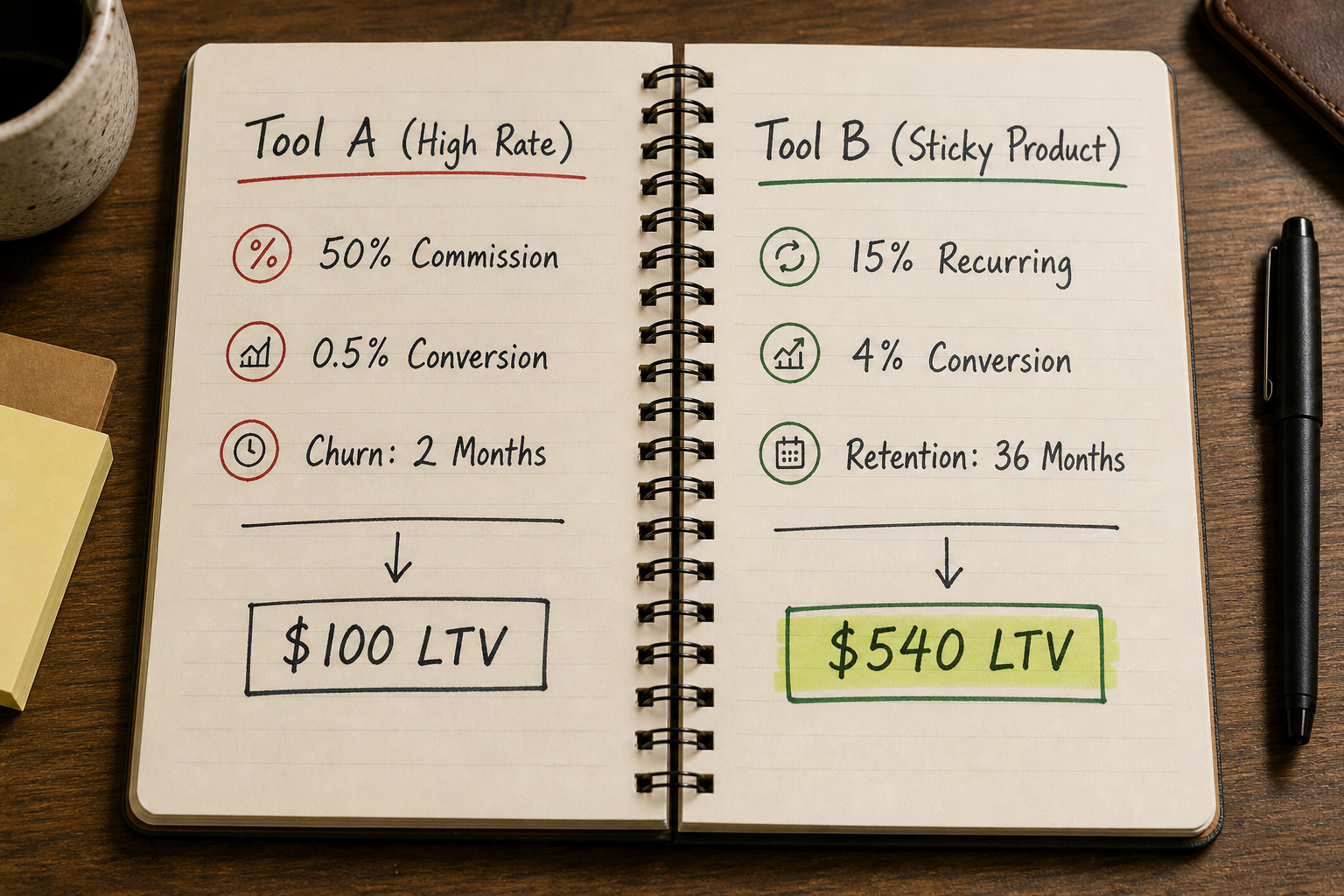
- Tool A offers a massive 50% recurring commission. However, their landing page is outdated, the software is buggy, and they have no onboarding sequence for new users. Their conversion rate is 0.5%, and their average customer leaves after two months.
- Tool B offers a modest 15% recurring commission. But they have a beautifully optimized landing page, seamless integrations, and a dedicated customer success team. Their conversion rate is 4%, and customers stay for an average of 36 months.
Despite the lower percentage, Tool B is infinitely more profitable to promote. The product does the heavy lifting for you. A verified database doesn't just show you the percentage; it helps you gauge the legitimacy of the offer. This is particularly crucial for those with large audiences who cannot afford to lose trust. Reviewing a Vetted Tech Affiliate Listings for Social Media Influencers Evaluation Checklist can prevent creators from burning their audience on high-paying but low-quality products.
Cross-Referencing Independent Data vs. Official Partner Pages
When utilizing directories and curated lists, the best practice is to treat the directory as your discovery engine and the merchant’s official partner page as your final verification step.
Platforms like AffiliList consolidate data so you can compare hundreds of options in minutes through advanced tagging and filtering. You might filter for "Crypto," "30%+ Commission," and "Recurring." Once you identify a promising opportunity, you navigate to the software’s official site to confirm the terms.
This dual-layered approach protects you against outdated information. Affiliate programs occasionally restructure their terms, moving from recurring to CPA models, or reducing commissions for high-volume affiliates. By leveraging a centralized hub that doesn't hide details behind sign-ups, you narrow down the field rapidly, ensuring you only spend time verifying the most lucrative candidates.
Many independent data sets publicly track these changes. You can review platforms like SaaS Affiliate Programs: Compare & Filter Verified Programs to cross-reference data against official company application pages. Some comprehensive directories will boast hundreds of specific SaaS programs, allowing you to Explore the database to confirm historical payout consistency before committing your audience traffic to a specific merchant.
Avoiding the "Shaved" Commission Trap
One of the lesser-discussed aspects of affiliate marketing is the technical reliability of the tracking platform itself. "Shaving" refers to the loss of legitimate commissions due to faulty tracking, overly aggressive anti-fraud filters, or in worst-case scenarios, intentional merchant manipulation.
When a merchant builds an in-house affiliate program using cheap or proprietary tracking software, the risk of technical failure increases. First-party cookies get blocked by modern browsers (like Safari's ITP), ad-blockers strip tracking parameters, and cross-device conversions (e.g., clicking on mobile, buying on desktop) fail to register.
Vetted affiliate program lists often indicate which tracking software the merchant utilizes—whether it’s PartnerStack, Impact, Rewardful, or an in-house solution. Partnering with merchants who use enterprise-grade tracking platforms ensures that your referrals are accurately attributed, even in complex, multi-touch B2B sales cycles. If you are comparing data sources for this specific technical detail, reading up on Databases Similar to Apdb for Affiliate Marketing Evaluation Checklist offers insight into how modern affiliate databases categorize tracking technology.
Structuring Content to Capture Search Intent
Having a list of verified, high-paying programs is only half the equation. The other half is deploying those links strategically within content that captures buyers at the right stage of awareness.
High-Intent vs. Low-Intent Traffic
Throwing affiliate links into a generic blog post titled "What is SEO?" rarely generates sales. The reader is in the informational stage; they are looking for a definition, not a $99/month software subscription.
To monetize effectively, your content architecture must target transactional or investigative search intent.
1. The "Alternative To" Framework When users search for "Alternative to [Market Leader]," they are signaling deep dissatisfaction with their current tool and an immediate readiness to switch. If you can rank for these terms and present a verified, high-converting alternative, the conversion rates are exceptionally high.
2. The "Versus" Comparison Searches like "Platform A vs. Platform B" indicate a user is at the bottom of the funnel, weighing their final two options. Your job is to help them make the decision based on specific use cases (e.g., "Platform A is better for agencies, Platform B is better for solo bloggers"). You embed affiliate links for both tools, earning a commission regardless of their choice.
3. The Integration Guide B2B software buyers heavily search for integration capabilities. Articles detailing "How to connect [CRM] to [Email Tool]" attract highly qualified traffic. By providing the technical solution, you position yourself as an authority, making the user highly likely to click your referral link if they need to purchase one of the connected tools.
Integrating these content formats with a reliable data source makes the process scalable. If you are looking for specific software recommendations to fill these content gaps, referencing AffiliList for Findaffiliates for High Paying Software provides a direct pathway to finding the right tools to compare.
| Content Type | Funnel Stage | User Intent | Expected Conversion Rate | Example Topic |
|---|---|---|---|---|
| Definitional ("What is...") | Top | Educational | Very Low (< 0.5%) | "What is CRM software?" |
| Listicles ("Best...") | Middle | Investigative | Moderate (1% - 3%) | "10 Best CRMs for Startups" |
| Comparisons ("A vs B") | Bottom | Evaluative | High (3% - 6%) | "Hubspot vs Salesforce" |
| Alternatives ("Alternative to...") | Bottom | Transactional | Very High (5% - 10%) | "Best Pipedrive Alternatives" |
Managing Denials and Improving Your Approval Rate
Even with a thoroughly vetted list, you still must apply and be accepted by the merchant. High-quality SaaS companies are protective of their brand. They do not auto-approve every applicant.
If you frequently face rejections, it is usually due to one of three reasons:
- Lack of Relevant Content: If you apply to a specialized cybersecurity software program but your website primarily reviews fitness gear, you will be denied. Merchants want to see existing, high-quality content directly related to their industry.
- Unclear Traffic Sources: If your application vaguely states you will promote the link "on social media," affiliate managers will reject it. They need to know exactly how you intend to generate sales. Are you running Google Ads? Do you have an email list of 10,000 subscribers? Be specific.
- No Provable Audience: A brand new blog with zero traffic signals high risk and low reward for an affiliate manager. Before applying to premium, high-paying programs, build a baseline of traffic and audience engagement.
When applying, treat the application box as a pitch. State your exact traffic metrics, link to an existing article where you plan to feature their tool, and outline your promotion strategy.
The Advantage of Niche Specialization
The most successful digital marketers do not promote every tool they find. They specialize. By focusing on a specific micro-niche—such as AI writing tools for real estate agents, or email marketing platforms for local gyms—you build highly concentrated authority.
A comprehensive directory allows you to drill down into these specific verticals. Instead of looking at generic "marketing software," you can find highly targeted programs that serve your exact demographic. The narrower your focus, the higher your conversion rate, because your recommendations feel personalized rather than mass-market.
Frequently Asked Questions
What is the standard cookie duration for SaaS affiliate programs?
While it varies by company, the industry standard for legitimate B2B SaaS affiliate programs is between 30 and 90 days. Anything less than 30 days makes it difficult to capture commissions on complex software sales, as businesses rarely purchase on the first day of research. Always verify the cookie window before investing resources into promotion.
How can I verify if an affiliate program is legitimate before promoting it?
Start by using a transparent, open-access directory rather than a closed network. Check if the program uses established third-party tracking software (like PartnerStack or Impact) rather than proprietary in-house code. Finally, look for official partner pages on the company's domain, clear terms regarding payout thresholds, and public documentation of their attribution model (first-click vs. last-click).
Where can SaaS founders submit their own affiliate programs?
Merchants looking to attract high-quality affiliates should seek out directories that allow direct submissions. Platforms that prioritize clean interfaces and verified data offer submission portals for merchants to list their commission structures, helping them get in front of professional marketers. For a detailed breakdown of this process, reviewing Where Can SAAS Founders Submit Their Affiliate Program Evaluation Checklist is highly recommended.
Why do some programs offer massive CPA payouts while others offer smaller recurring percentages?
It comes down to business models and cash flow. Web hosting companies know their customer lifetime value is massive and users rarely switch, so they can afford to pay a $150 CPA upfront to acquire a user. Smaller SaaS startups may not have the cash reserves for massive upfront CPA bounties, so they offer a 20-30% recurring commission, which aligns your compensation directly with the customer's ongoing payments. Both can be highly profitable depending on your traffic strategy.