
Verified AI Affiliate Programs for Marketers
Discover vetted and active AI affiliate programs. Learn how to spot volatile offers, avoid thin API wrappers, and maximize recurring software commissions.
- The Volatile Lifecycle of AI Affiliate Programs
- Top Categories for AI Affiliate Partnerships
- Where to Search for Active AI Affiliate Programs
- The Vetting Framework: How to Evaluate an AI Offer
- The "API Wrapper" Trap: A Contrarian View on AI Commissions
- Strategic Promotion: How to Convert Traffic into AI Subscriptions
- Managing and Protecting Your AI Affiliate Portfolio
- Frequently Asked Questions
- Thriving in the Era of AI Partnerships
The artificial intelligence boom has fundamentally rewritten the rules of software affiliate marketing. In the past few years, thousands of AI startups launched virtually overnight, and almost all of them bolted on an affiliate program to drive rapid user acquisition. Fast forward to today, and the landscape looks vastly different. The initial gold rush has settled into a harsh reality: many of those early programs have quietly closed, slashed their commission rates, or simply stopped paying affiliates as venture capital funding tightened.
If you are an affiliate marketer, blogger, or niche site owner dedicating your hard-earned traffic to AI tools, promoting a defunct or unresponsive program is a fast track to lost revenue. You cannot afford to rely on outdated blog posts from two years ago claiming a tool offers a 40% recurring commission, only to realize the program was paused six months ago. You need an active AI affiliate program that is vetted, reliable, and actually accepting new partners.
This comprehensive guide will walk you through the realities of the current AI affiliate ecosystem. We will explore how to identify programs that are actually active, the distinct categories of AI tools that offer the best retention rates, the inherent risks of promoting thin "wrapper" software, and exactly where to search for verified partnership opportunities.
The Volatile Lifecycle of AI Affiliate Programs
To succeed in this niche, you must first understand the business model behind the products you are promoting. The typical SaaS affiliate program is built on stability; a CRM or email marketing platform might maintain the exact same affiliate terms for a decade. AI startups, however, operate on accelerated, highly volatile timelines.
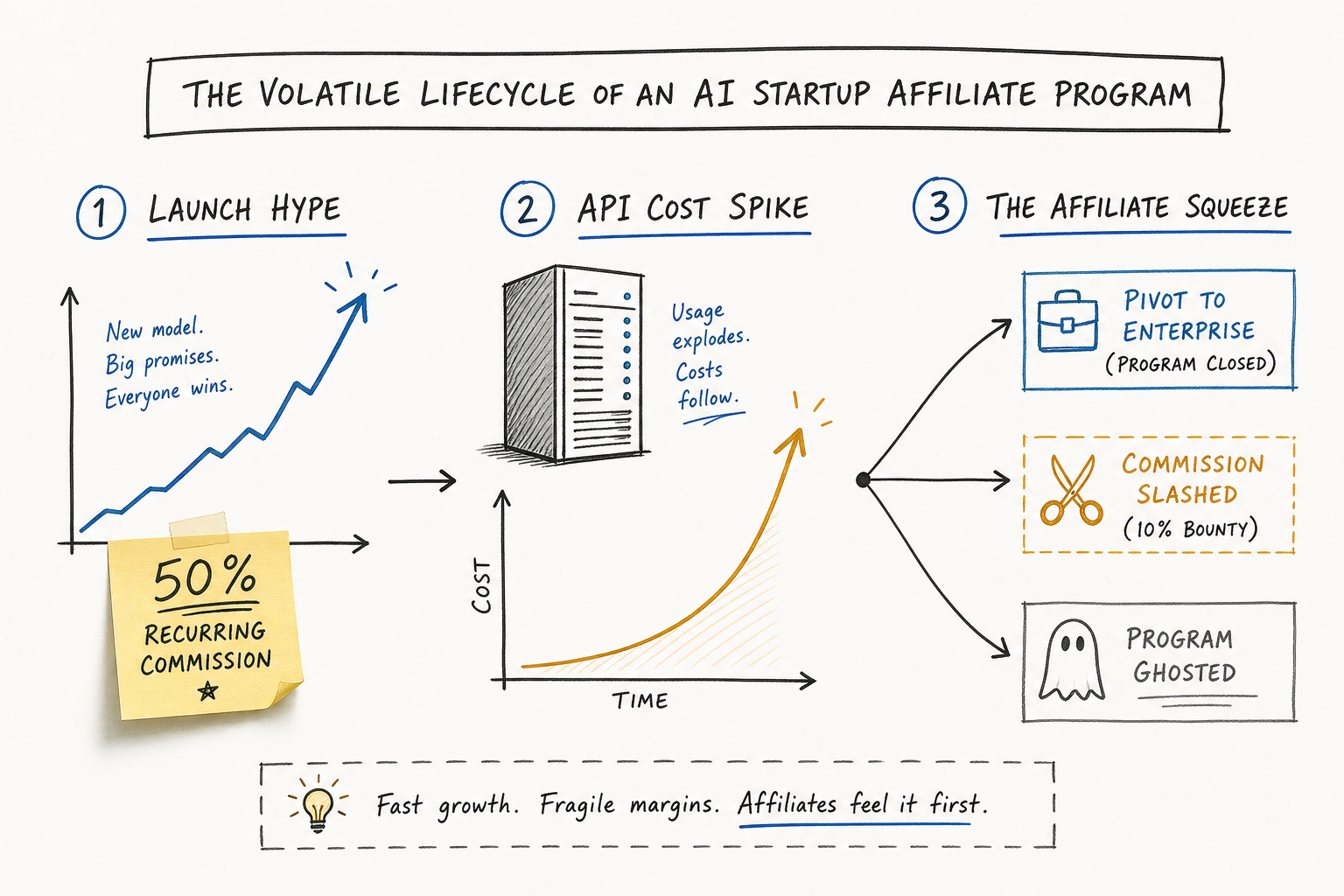 When an AI company launches, its primary goal is usually user growth at all costs to impress investors. During this phase, they roll out incredibly lucrative affiliate terms—often 40% to 50% recurring commissions—and accept almost anyone into their program. Marketers flock to these offers, write comprehensive reviews, and build dedicated comparison pages.
But AI is computationally expensive. As the user base scales, the startup's API costs to underlying foundational models (like OpenAI or Anthropic) skyrocket. If their free-to-paid conversion rate is poor, or if user churn is high, the math stops working. The company realizes they are losing money on every user an affiliate brings in.
This leads to the "AI Affiliate Squeeze." The startup will typically execute one of the following maneuvers:
- The Pivot to Enterprise: The company abandons its self-serve SaaS model for individual creators and pivots strictly to enterprise sales. They shut down the affiliate program entirely because enterprise deals require sales teams, not affiliate links.
- The Commission Slash: The generous 50% recurring commission is abruptly reduced to a 10% one-time bounty.
- The Quiet Ghosting: The program remains "open" on the affiliate network, but applications are perpetually left in "pending" status, or payouts are mysteriously delayed for months.
This exact lifecycle has played out hundreds of times over the last few years. It underscores why finding an active AI affiliate program requires continuous monitoring. Your top earner today could disappear tomorrow, making it critical to build a diversified portfolio of vetted software partnerships.
Top Categories for AI Affiliate Partnerships
Not all AI tools are created equal. Some categories suffer from massive user turnover, meaning your recurring commissions will dry up after a month or two. Others embed themselves deeply into a user's daily workflow, virtually guaranteeing you revenue for years. Here is a breakdown of the primary AI categories and what to look for when selecting programs to promote.
AI Writing and Content Generation
This is arguably the most saturated space in the AI industry. From long-form blog post generators to social media caption creators, the barrier to entry for building these tools was incredibly low.
The Affiliate Dynamic: Because there are so many options, consumers are highly price-sensitive and prone to jumping from one tool to another. When promoting AI writing software, you must look for platforms that offer proprietary workflows, deep integrations (like WordPress auto-publishing), or specialized training models. A generic AI text generator will have high churn. However, specialized tools—like AI grant writers or highly technical B2B copywriters—tend to have much stickier user bases. Look for programs that offer generous cookie durations (at least 60 days) to capture users who might take time to compare multiple tools.
AI Video and Audio Generation
AI video avatars, text-to-video generators, and AI voice cloning software represent a massive opportunity for affiliates. Unlike text generation, video and audio require significant computational power, making these tools more expensive.
The Affiliate Dynamic: Because the monthly subscription costs are higher, your absolute commission per sale is significantly larger. Furthermore, once a creator generates an AI avatar or trains a voice clone on a specific platform, they are highly unlikely to switch to a competitor and start over. This creates incredible user retention. When browsing for these tools, prioritize platforms that target marketing agencies and corporate training departments, as these users have high budgets and low churn rates compared to hobbyists.
AI Agents and Automation
The current frontier of AI involves autonomous agents—software that does not just generate text, but takes actions across different applications (e.g., reading an email, drafting a contract, sending a Slack message, and updating a CRM).
The Affiliate Dynamic: This is the most lucrative category for B2B affiliates. Automation tools become infrastructural to a business. Once a company builds an automated AI workflow, removing that software will break their business processes. The switching cost is immense. If you can rank for searches related to AI automation or teach users how to build specific workflows via YouTube tutorials, the lifetime value (LTV) of your referrals will be astronomical.
AI Coding Assistants
Developers were among the first to fully adopt AI into their daily routines. AI coding assistants, code reviewers, and automated testing tools are standard issue in modern software development.
The Affiliate Dynamic: This is a highly technical niche. To successfully promote these tools, you need a developer-focused audience. The commissions here are often structured as bounties (a flat fee per new developer seat) rather than recurring percentages, as these tools are frequently adopted at the enterprise level rather than by individual freelancers.
AI Marketing and Programmatic SEO
Marketers love buying tools for marketing. AI-driven programmatic SEO platforms, automated ad creative generators, and AI-powered conversion rate optimization software are easy to sell if you can prove they generate ROI.
The Affiliate Dynamic: Affiliate marketers have a natural advantage here because they are promoting tools they actively use. The best programs in this space offer tiered commission structures, rewarding you with higher percentages as you bring in more revenue. Be wary of tools that promise "push-button" Google rankings, as these often face high chargeback rates from disappointed customers, which will claw back your commissions.
Where to Search for Active AI Affiliate Programs
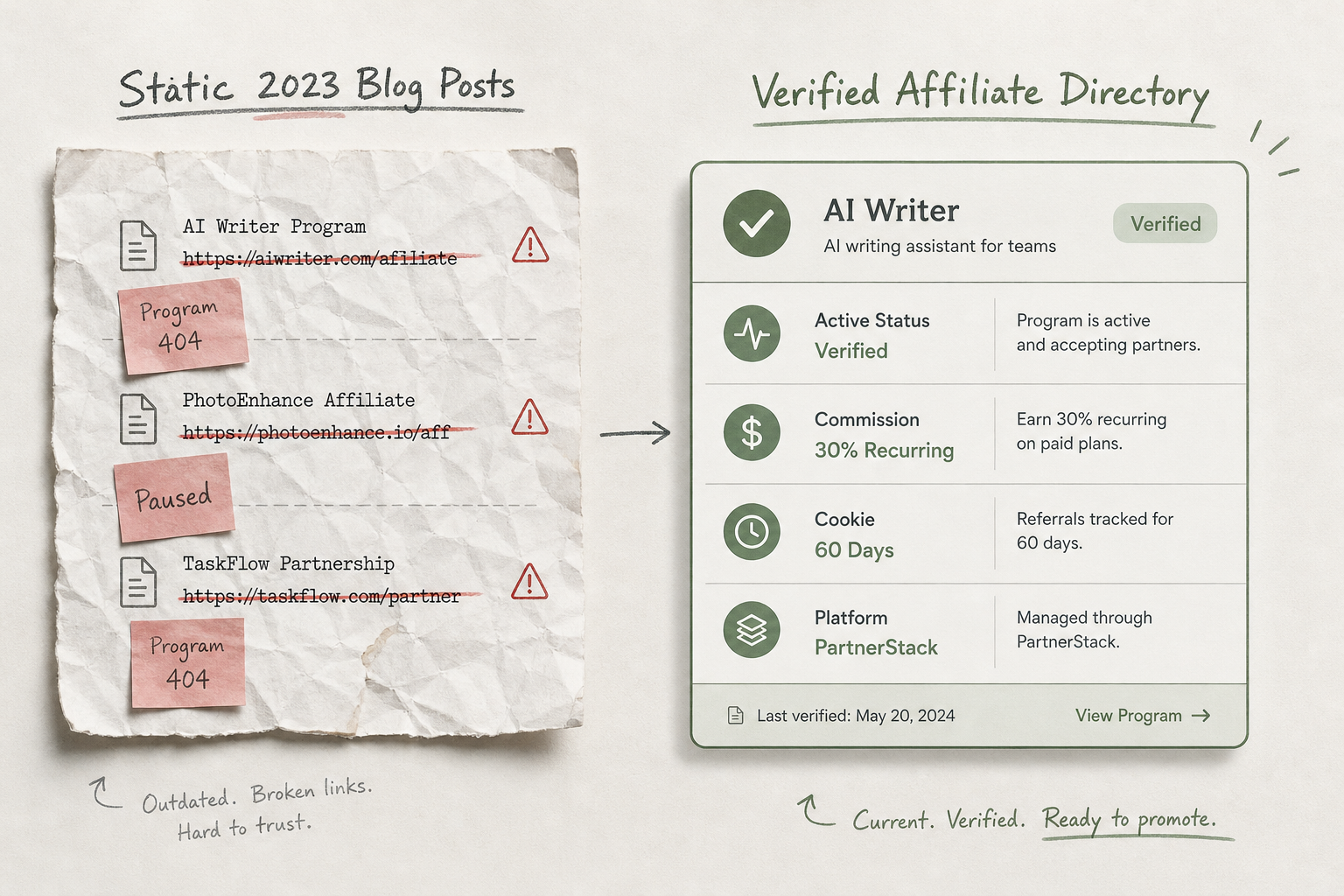
The biggest hurdle is simply finding accurate, up-to-date information. Searching Google for "best AI affiliate programs" usually yields blog posts filled with broken links to programs that closed years ago. Instead of relying on static blog posts, you should utilize specialized, actively managed directories.
 AffiliList (The Premier Choice)
At AffiliList, our core mission is providing a comprehensive, transparent directory of the best affiliate programs, with a heavy emphasis on SaaS and digital tools. We actively purge dead programs and update commission rates so you don’t have to waste time applying to inactive campaigns. By offering a clutter-free interface that displays commission percentages, cookie lengths, and payout models upfront, you can quickly cross-reference opportunities. If you are struggling to navigate the noise, our Directory of software affiliate programs with high payouts is an excellent starting point for reliable data.
OpenAffiliate For those looking to cross-reference data or find highly technical, developer-centric AI tools, you can browse AI affiliate programs on OpenAffiliate. Their platform is useful for verifying developer tools, and they often indicate which programs have been recently verified against merchant sources.
Aifilliate Another option in the space is aifilliate. If you want to drill down into highly specific modalities, you can explore the AI directory at aifilliate to filter partnerships by categories like video, voice, writing, and coding. They also track the specific affiliate networks (like Impact, PartnerStack, or Rewardful) that power the underlying programs.
Afflemi For an additional perspective on what tools are currently trending in the SaaS space, you might check Afflemi's curated list of the best AI tool affiliate programs.
Using a combination of these directories ensures you are acting on verified data rather than relying on outdated search results. If you are curious about how different platforms aggregate this data, read our breakdown on AffiliList vs APDBio: Which Affiliate Directory is Right for You.
The Vetting Framework: How to Evaluate an AI Offer
Just because an active AI affiliate program exists does not mean it deserves a place on your website. Promoting a subpar product damages your reputation with your audience. Furthermore, promoting a good product with a terrible affiliate structure damages your bank account. Here is a rigorous framework for evaluating AI affiliate programs before you generate a single click.
1. Analyzing the Commission Structure (Bounty vs. RevShare)
In the SaaS world, you generally encounter two payout models: Cost Per Action (Bounty) and Revenue Share (Recurring).
- The Bounty Model: You receive a flat fee (e.g., $50) when a user upgrades to a paid plan. This is great for immediate cash flow.
- The Recurring Model: You receive a percentage (e.g., 30%) of the user's subscription fee for as long as they remain a customer.
For AI software, recurring revenue is usually the superior choice, but only if the software has high retention. If an AI image generator costs $10/month and offers a 30% recurring commission, you earn $3 a month. If the average user churns after two months (because they only needed a few images for a specific project), your total earning is $6. In this scenario, a $20 flat bounty would have been vastly more profitable. Always estimate the user's lifetime duration before favoring recurring commissions over bounties.
2. Cookie Duration in a B2B Environment
B2C AI tools (like fun photo editors) are impulse buys. A 7-day cookie might suffice. However, B2B AI tools (like enterprise automation or team-wide AI coding assistants) require approval, budget allocation, and testing. The sales cycle can take weeks.
If you are promoting B2B AI software, demand a minimum of a 30-day cookie window. A 60-day or 90-day window is strongly preferred. If a high-ticket AI tool offers a 7-day cookie, they are actively attempting to strip affiliates of their rightful conversions by letting the cookie expire before the company's accounting department approves the purchase.
3. Attribution Models
How does the program track your referrals? Most use "Last Click" attribution, meaning the affiliate whose link was clicked immediately before the purchase gets the commission. This is standard. However, some newer AI programs attempt to use "First Click" attribution, or worse, they do not track cross-device purchases.
Ensure the program runs on a reputable third-party tracking platform (like PartnerStack, Impact, Rewardful, or Lemon Squeezy). Programs that use proprietary, in-house tracking software built by the startup themselves are notoriously buggy and frequently under-report conversions. Relying on verified infrastructure is critical; for more on finding vetted infrastructure, see our guide on Verified Affiliate Programs for Digital Marketers.
4. Payout Thresholds and Supported Geographies
A 50% commission is worthless if you can never withdraw the funds. Check the program's minimum payout threshold. If a tool costs $15/month, offers a 20% commission ($3/sale), and has a $200 payout threshold, you will need 67 active signups just to receive your first check. For niche sites with lower traffic volume, this is a trap. Look for programs with low thresholds ($50 or less) that pay out via accessible methods like PayPal, Stripe, or direct bank transfer via Wise.

The "API Wrapper" Trap: A Contrarian View on AI Commissions
It is time to address an uncomfortable truth in the AI affiliate space: High commission rates on new AI tools are often a trap designed to trick marketers into promoting disposable software.
Over the last few years, the market was flooded with "API Wrappers." These are software products that contain almost no proprietary technology. They simply take a user's input, send it to OpenAI's ChatGPT API via a hidden prompt, and return the result in a slightly prettier user interface.
When these wrappers launch, they frequently offer staggering affiliate terms—sometimes 50% or 60% recurring commissions. They do this because they know their product has no real moat. The founders are trying to capture as much market share as possible before a larger company (or OpenAI themselves) releases the exact same feature for free.
Why you should avoid promoting basic wrappers: Your most valuable asset as a marketer is your audience's trust and your website's SEO equity. It can take months of dedicated effort to rank a blog post for a keyword like "best AI tool for writing product descriptions."
If you rank that post and point all your traffic to a thin wrapper just because the commission rate is high, what happens in six months? The wrapper inevitably goes out of business because users realize they can just use ChatGPT directly. The startup's website goes offline, your affiliate links break, and your recurring revenue drops to zero. All that SEO effort was wasted on a product that had no long-term viability.
Instead of chasing the highest commission percentage, chase the highest product value. Look for AI tools that possess high "switching costs." These include:
- AI tools that integrate deeply into a user's local files or databases.
- AI platforms where users spend hours customizing agents, templates, or workflows.
- Platforms that combine AI with traditional SaaS utilities (like an email marketing platform that includes AI, rather than a standalone AI email writer).
A reliable 15% recurring commission from an established SaaS company that retains users for four years is infinitely more profitable than a 50% commission from an API wrapper that will shut down its servers by Christmas.
Strategic Promotion: How to Convert Traffic into AI Subscriptions
Finding an active AI affiliate program is only the first step. The way users search for and buy AI software is different from how they buy traditional tools like web hosting or VPNs. Generic "Top 10 Best AI Tools" listicles are highly competitive and often suffer from low conversion rates because the intent is purely exploratory. To generate meaningful revenue, you must shift your content strategy to focus on integration, workflows, and hyper-specific use cases.
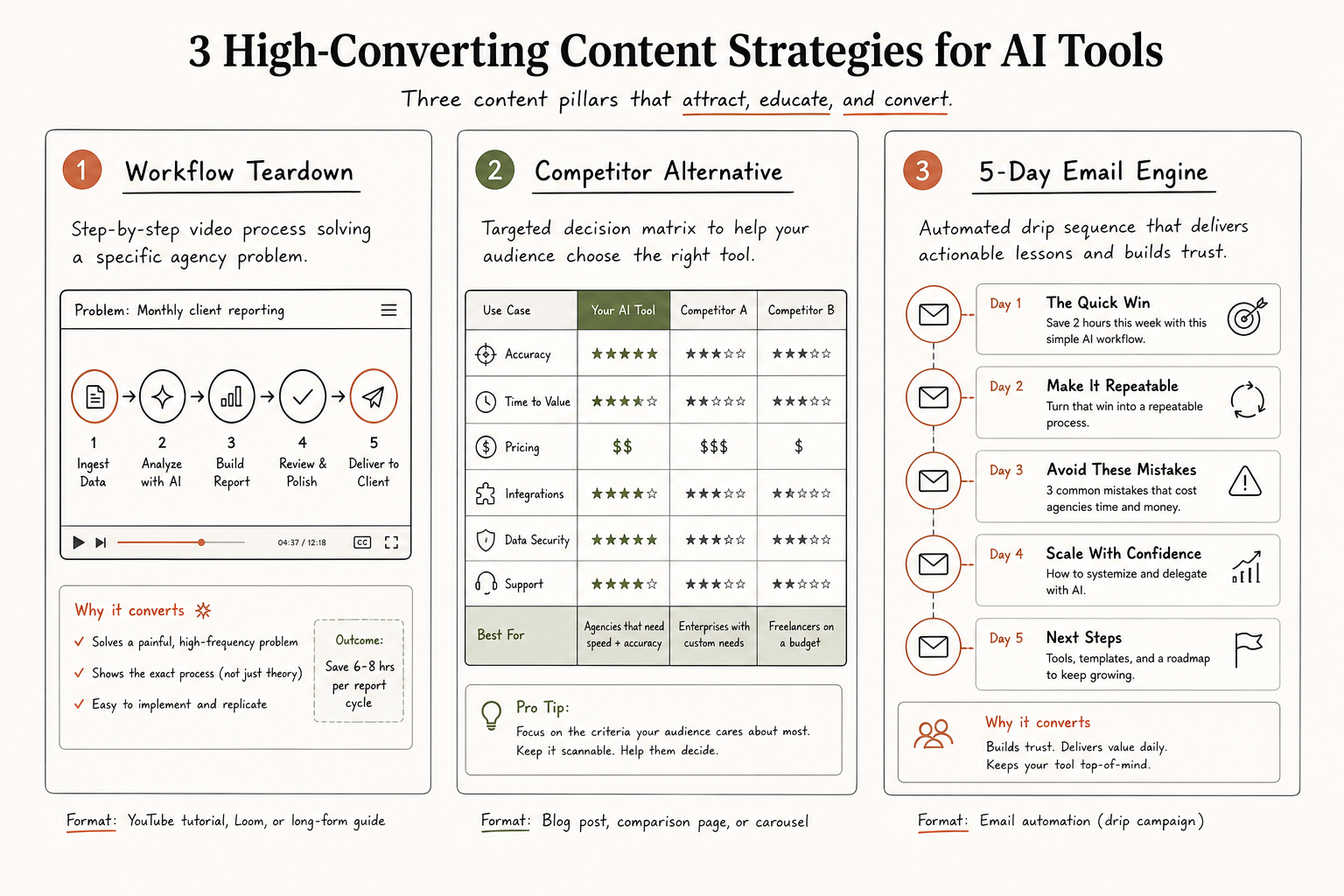
1. The Workflow Teardown (Tutorials over Listicles)
The biggest barrier to AI adoption isn't cost; it's a lack of imagination. Business owners know they should be using AI, but they don't know how.
Instead of writing a review detailing the features of an AI marketing tool, write a tutorial titled, "How to Automate Your Agency's Client Onboarding using [AI Tool]." In this content format, you aren't just selling the software; you are selling the solution to a painful business problem. By the time the reader finishes the tutorial, clicking your affiliate link to purchase the required tool feels like a mandatory next step, not a hard sell. This format works exceptionally well on YouTube, where viewers can watch you execute the workflow in real-time.
2. Targeting the "Alternative" Keywords
When a major AI platform raises its prices, limits its features, or suffers an outage, thousands of users immediately search for alternatives.
Creating highly optimized comparison pages (e.g., "Best [Major AI Tool] Alternatives for Budget Agencies") captures high-intent traffic. These searchers already understand the value of the software category; they are simply looking for a new vendor. When you present them with a carefully vetted, active AI affiliate program that solves their specific grievance with the incumbent tool, conversion rates can easily push past 10%.
3. The Email Course Strategy
AI moves so fast that business owners feel overwhelmed. You can capture significant affiliate revenue by offering a free, automated 5-day email course (e.g., "5 Days to a Fully Automated AI Content Engine").
Over the five days, you educate the subscriber on prompt engineering, workflow design, and optimization. Within these lessons, you naturally embed your affiliate links as the "required tools" to complete the homework for that day. Email traffic is highly controllable, and it protects you from the sudden algorithm updates that can wipe out organic search rankings.
If you are looking for fresh offers to slot into your email sequences, regularly checking updated resources like our guide on Where to Find New Affiliate Programs ensures you are always promoting cutting-edge solutions before your competitors discover them.
Managing and Protecting Your AI Affiliate Portfolio
Because the AI space is so dynamic, a "set it and forget it" mentality will destroy your revenue. You must actively manage your portfolio of affiliate links.
Link Auditing and Monitoring: Set a recurring calendar reminder every 30 days to manually click through your top 20 revenue-generating affiliate links. Check if the landing page is still active. Verify that the company hasn't completely pivoted their product offering. Software like ThirstyAffiliates or Pretty Links can help you centralize this process, allowing you to swap out a broken destination URL once, instantly updating it across hundreds of blog posts.
Diversification: Never allow a single AI tool to account for more than 30% of your total affiliate income. If that startup gets acquired by Google or Microsoft, the affiliate program will almost certainly be terminated immediately, wiping out a third of your business overnight. Always have a "Runner Up" tool ready to swap into your top promotional spots if your primary partner goes dark.
Building Relationships with Affiliate Managers: SaaS companies love affiliates who bring in high-quality, low-churn users. If you are consistently sending good traffic to an AI tool, reach out directly to the program manager. Ask for exclusive discount codes for your audience, or negotiate a private, higher commission tier. Because so many affiliates send garbage traffic (like spammy coupon sites), a content creator sending genuine buyers is highly valued and possesses significant leverage.
Frequently Asked Questions
Are AI affiliate programs actually profitable compared to traditional SaaS? Yes, but they require a different strategy. Traditional SaaS (like web hosting) offers massive upfront bounties because the lifetime value of a customer is well-known. AI tools often offer recurring revenue, which can compound massively, but you must factor in the higher churn rate. The most profitable affiliates in the AI space focus on B2B AI tools rather than B2C novelty apps.
How do I know if an AI affiliate program is still active before applying? The most reliable method is to use actively managed directories like AffiliList that verify program status. Secondly, check the software vendor's own website footer. If they have removed the "Affiliates" or "Partners" link from their footer, the program is likely paused or being phased out, even if their page on an affiliate network still appears active.
Do AI software companies prefer specific affiliate networks? The vast majority of reputable B2B AI software companies use specialized SaaS tracking platforms like PartnerStack or Rewardful. These platforms are designed specifically for software, capable of tracking complex actions like trial sign-ups, plan upgrades, and recurring monthly payments accurately. Consumer-focused AI tools (like simple video editors or avatar generators) are more likely to be found on broader networks like Impact or ShareASale.
Why did my approved AI affiliate account stop generating conversions? If your traffic hasn't dropped but your conversions have flatlined, there are three likely culprits:
- The company quietly changed their attribution model to favor their own retargeting ads over your referral links.
- The product's fundamental quality dropped (perhaps they switched to a cheaper, lower-quality language model to save money), causing free-trial users to bounce before paying.
- The tracking pixel on the merchant's site broke during a website update. Always reach out to the affiliate manager if you suspect technical issues.
Thriving in the Era of AI Partnerships
The initial chaotic land-grab of AI affiliate marketing is over. The days of throwing up a hastily written review for a thin ChatGPT wrapper and making easy commissions have passed. The market is maturing rapidly, and the affiliates who will succeed in this next phase are those who treat their partnerships like serious business investments.
By relying on transparent, updated directories to find an active AI affiliate program, rigorously vetting the commission structures, and focusing on high-retention software that solves real business problems, you can build a highly lucrative, sustainable income stream. Stop wasting your traffic on dead links and defunct startups. Focus on the tools that are building the future of work, and position yourself as the trusted guide who teaches the world how to use them.