
Vetted Tech Affiliate Listings for Social Media Influencers Evaluation Checklist
Discover how social media tech influencers can vet affiliate listings, protect audience trust, prevent attribution loss, and negotiate recurring commissions.

- The Hidden Costs of Unvetted Tech Affiliate Programs
- The Citable Framework: 5 Pillars for Vetting Tech Affiliate Listings
- Where to Find Reliable Tech Affiliate Programs
- The Social Media Influencer's Tech Affiliate Vetting Checklist
- Red Flags to Watch for During Program Evaluation
- Navigating Consumer Tech vs. B2B SaaS
- A Scenario in Practice: The VPN Evaluation
- Tax and Compliance Implications for Global Influencers
- Negotiating Higher Rates After Initial Vetting
- Frequently Asked Questions
You have spent two years building a highly engaged audience of developers, designers, or tech enthusiasts on YouTube and X. You mention a new productivity SaaS tool, drop your affiliate link in the description, generate 50,000 views and 3,000 clicks, and wake up to a dashboard showing exactly zero attributed sales.
Why does this happen? The program likely relied on outdated third-party cookies that were blocked by modern mobile operating systems, or their cross-device tracking failed when your viewer clicked on their phone but completed the purchase on their desktop.
For social media influencers in the tech space, the stakes for choosing the right affiliate partners are incredibly high. Unlike niche site owners who capture high-intent search traffic on a desktop, influencers drive discovery traffic on mobile devices. If a tech affiliate program is not vetted specifically for the realities of social media traffic, you are effectively doing free marketing for the software company. Furthermore, promoting unreliable tools directly damages the trust you have painstakingly built with your followers.
This evaluation checklist provides a rigorous, citable framework for creators to vet tech affiliate listings. It moves beyond simply finding high commission rates and focuses on payout mechanics, tracking integrity, brand alignment, and the tools necessary to convert social media attention into actual revenue.
The Hidden Costs of Unvetted Tech Affiliate Programs
Before diving into the vetting framework, it is critical to understand what goes wrong when creators blindly join affiliate networks. Many traditional networks were built in the early 2000s for desktop bloggers, not for modern social media influencers.
When affiliate marketing networks let influencers earn money through product recommendations, they are acting as the middleman. If that middleman uses legacy infrastructure, the influencer pays the price.
Attribution Leakage on Social Media
Social media platforms are inherently walled gardens. When a user clicks a link in an Instagram Story or a TikTok bio, they open a custom in-app browser. Many older SaaS affiliate programs fail to track conversions that originate in these environments. If the user decides to buy the software later by typing the URL into their laptop browser, you lose the commission unless the affiliate program utilizes robust identity resolution or cross-device tracking.
The "Net-90" Cash Flow Trap
Tech companies, particularly enterprise SaaS platforms, often have long sales cycles and complex refund windows. An unvetted program might promise a lucrative $200 Cost Per Action (CPA), but bury in their terms that payouts are "Net-90" after a 60-day refund clearance period. This means you could drive a sale in January and not see the cash until June.
Bait-and-Switch Commission Structures
Some tech affiliate listings lure influencers with a high upfront percentage, only to heavily cap the maximum payout or quietly reduce the commission rate on subsequent renewals. If you are promoting subscription software, understanding whether you get paid once or repeatedly is the difference between a one-off paycheck and a compounding income stream.
The Citable Framework: 5 Pillars for Vetting Tech Affiliate Listings
To standardize the process of selecting partners, social media influencers should evaluate every potential tech listing against these five core pillars. This framework ensures you only commit your link-in-bio space or video descriptions to programs that respect your traffic.
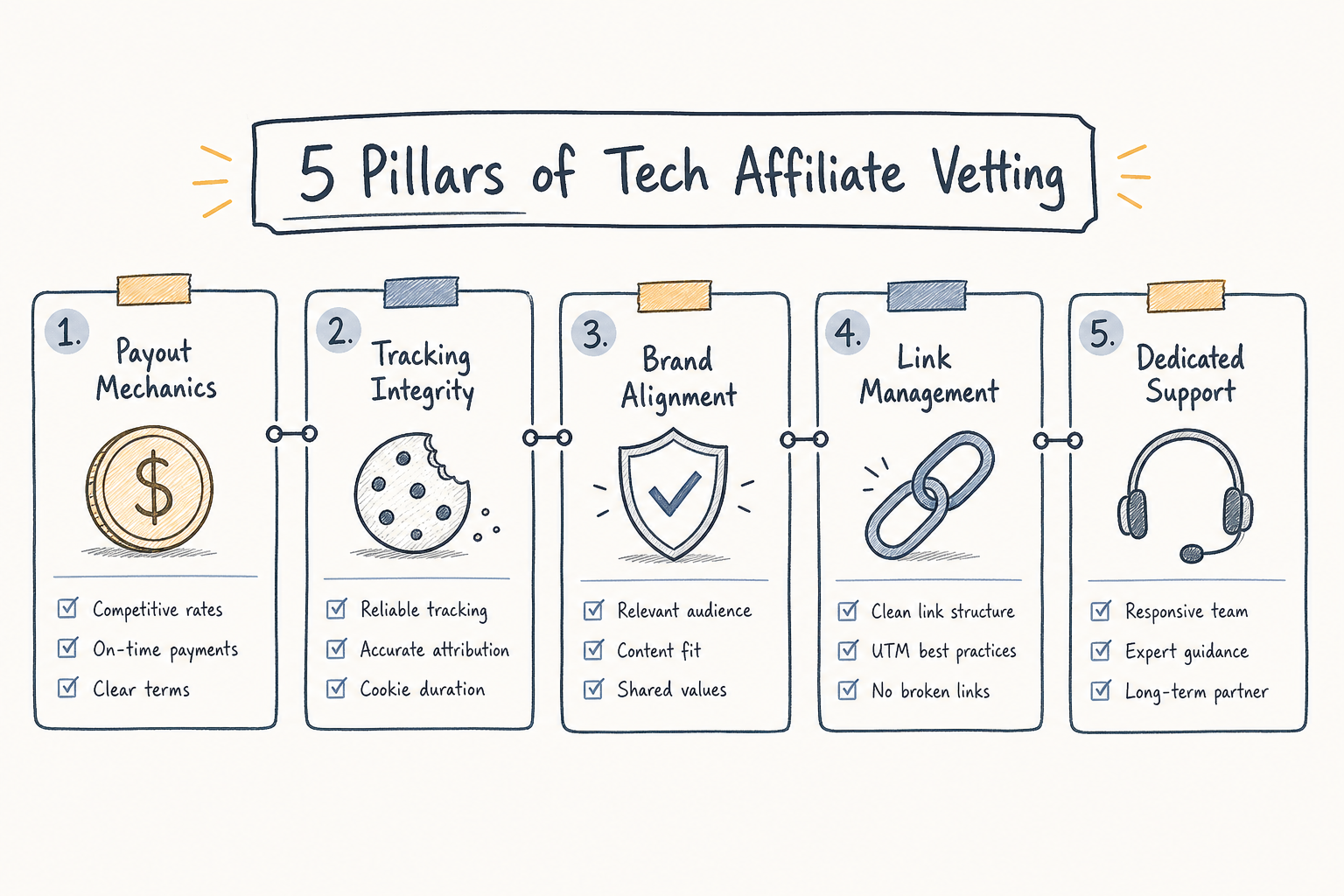
Pillar 1: Payout Mechanics and Financial Reality
The headline commission rate is just a marketing tactic. To truly vet a program's financial viability, you have to read the underlying mechanics.
First, determine if the program pays a flat CPA (Cost Per Action) or a recurring revenue share. In the software space, recurring commissions (usually 20% to 30% for the lifetime of the customer) are highly desirable. However, if the software has a high churn rate—meaning customers cancel after one month—a flat CPA might actually be more profitable.
You must also check the payout threshold. Some programs require you to earn $500 before they issue a check. For an influencer testing a new software tool with a small segment of their audience, a high threshold can effectively trap your initial earnings on their platform indefinitely.
Pillar 2: Creator-First Technology and Tracking Integrity
How does the company track your referrals? This is the technical heart of the vetting process. Ask the merchant or network the following questions:
- Cookie Duration: Is it 24 hours (like Amazon Associates) or 90 days (common in B2B SaaS)?
- Cookie Type: Do they use first-party cookies? Third-party cookies are heavily blocked by Safari and iOS, which account for a massive percentage of social media traffic.
- Promo Code Attribution: Do they offer custom, trackable promo codes? For podcasters and short-form video creators, telling a user to "Use code TECHREVIEW20 at checkout" is far more reliable than expecting them to click a link in a busy TikTok bio. If a program offers code-based tracking that operates independently of cookies, it passes a major vetting hurdle.
Pillar 3: Brand Alignment and Product Quality Controls
Your audience trusts your tech recommendations. Promoting buggy software or overpriced hardware for a quick commission will destroy your engagement rates long-term.
Vetted programs usually have strict quality controls for the brands they allow on their network. When utilizing platforms like AffiliList, which offers a transparent directory of over 10,000 programs, you can quickly filter for established SaaS tools with proven market fit. Avoid programs that automatically approve every affiliate application; reputable tech companies pre-screen creators to ensure content standards and brand alignment.
Pillar 4: Platform Integration and Link Management
Can you easily generate deep links? A deep link takes the user directly to a specific product page rather than the software's generic homepage. For influencers, deep linking drastically increases conversion rates. If you are doing a tutorial on a specific video editing feature, linking directly to that feature's landing page is crucial.
Furthermore, look into platforms that specialize in creator-centric tools. As noted by influencers across Instagram, TikTok, and YouTube, platforms that offer easy link management, shoppable storefronts, and mobile-friendly analytics are vastly superior to legacy networks with clunky, desktop-only interfaces.
Pillar 5: Active Support and Fraud Protection
When a tracking link breaks on a Friday night right after your YouTube video goes live, who do you contact? A vetted tech affiliate program assigns dedicated affiliate managers. They provide responsive support and have safeguards in place against coupon-site scraping (where shady websites steal your promo codes and claim your commissions).
Where to Find Reliable Tech Affiliate Programs
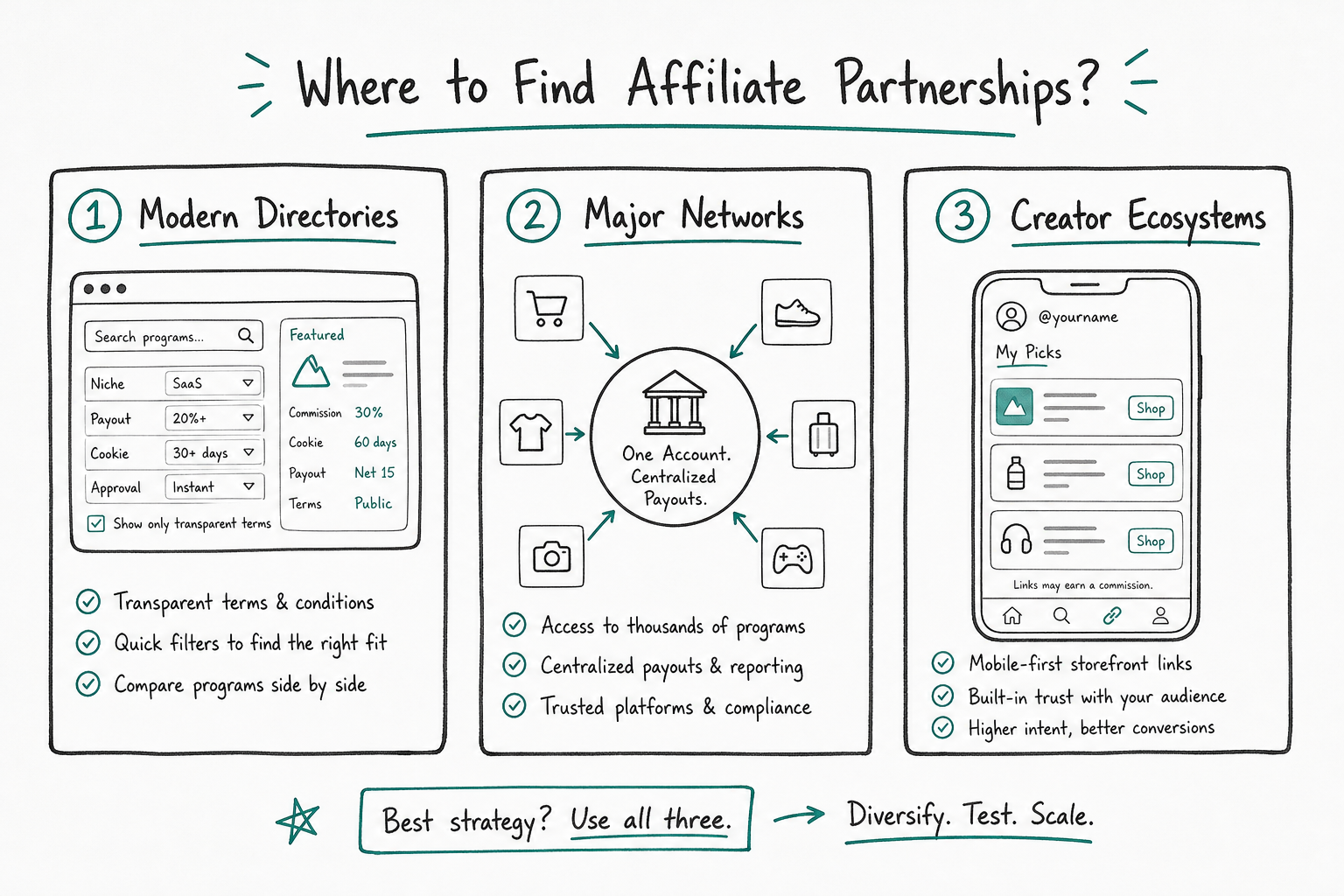
Finding these programs requires knowing where to look. Social media influencers generally pull from three distinct pools of affiliate opportunities.
Modern Affiliate Directories
Instead of manually searching Google for "software name + affiliate program" and landing on outdated pages, professional creators use specialized directories. Platforms like AffiliList provide a clutter-free interface focusing on the essential details—commission percentages, cookie durations, and software categories. Because you do not have to sign up for ten different networks just to read the terms, directories act as an excellent first filter. If you are specifically looking for Findaffiliates for High Paying Software Source Guide alternatives, transparent databases will save you hours of research.
Major Affiliate Networks
Established networks host hundreds of tech merchants under one roof. Platforms like Impact, CJ Affiliate, and PartnerStack (which heavily focuses on B2B SaaS) are generally reliable. They handle the tax compliance, provide centralized dashboards, and aggregate your payouts. If a software company manages their program through PartnerStack or Impact, they have already passed a baseline level of operational vetting.
Creator-Focused Affiliate Ecosystems
These platforms are built specifically for social media dynamics. They often provide tools to create shoppable galleries or consolidated link-in-bio pages. Joining the best affiliate programs and networks for influencers through these ecosystems ensures the tracking technology is optimized for mobile app browsers.
The Social Media Influencer's Tech Affiliate Vetting Checklist
When evaluating a new tech or SaaS affiliate program, run it through this specific checklist before you ever mention the brand to your audience.
1. Product Viability Assessment
- Have I personally tested the software or hardware?
- Does the tool solve a genuine problem for my specific audience?
- Is the pricing competitive within its market category?
- Does the company have a good reputation for customer support?
2. Tracking and Attribution Check
- Is the cookie duration at least 30 days? (For high-ticket tech, 60-90 days is preferable).
- Does the program support custom promo codes for attribution without a click?
- Is the tracking technology resilient against mobile browser restrictions?
- Do they offer deep linking to specific feature pages or blog posts?
3. Commission and Payout Terms
- Is the commission structure clearly defined (Flat CPA vs. Recurring)?
- If recurring, how long does the recurring commission last (12 months vs. lifetime)?
- Is the payout threshold reasonable (under $100)?
- What are the payout terms (Net-30 is standard; avoid Net-60 or Net-90 if possible)?
- Do they support my preferred payment method (PayPal, Direct Deposit, Wire)?
4. Brand Safety and Exclusivity
- Does joining this program prevent me from promoting their direct competitors (Non-compete clause)?
- Does the brand claim rights to use my video/content in their own paid ads just because I joined their program? (Read the ToS carefully here).
- Will the company notify me before they change their commission rates?
5. Program Management and Support
- Is there a dedicated affiliate manager with an actual email address?
- Do they provide high-quality, up-to-date brand assets (logos, UI screenshots)?
- Is the reporting dashboard updated in real-time or delayed by 24 hours?
Red Flags to Watch for During Program Evaluation
Even on reputable directories like Affiverse, you will encounter programs that look great on paper but fail in practice. Watch out for these specific red flags.
The "Exposure" Clause
Some tech startups launch affiliate programs that pay out in software credits rather than cash. Unless this is a tool you use heavily to run your own business, avoid this. You cannot pay your editor or your rent with credit for an email marketing tool. Insist on cash payouts.
Infinite Refund Clawbacks
A standard SaaS refund policy is 14 to 30 days. If an affiliate program reserves the right to "claw back" your commissions indefinitely if a user eventually cancels their account, run away. You should only be liable for chargebacks and refunds within a strictly defined, short-term window.
Content Ownership Grabs
A subtle but dangerous trend in modern affiliate Terms of Service is a clause that grants the merchant a perpetual, royalty-free license to repurpose any content containing their affiliate link. Imagine creating a high-production YouTube review, only to find the software company chopping it up and running it as a Facebook ad without paying you a licensing fee. Always separate your affiliate relationship from a User Generated Content (UGC) or licensing relationship.
Navigating Consumer Tech vs. B2B SaaS
Tech influencers usually sit in one of two camps: Consumer Tech (reviewing cameras, microphones, laptops) or Software/SaaS (reviewing productivity apps, coding tools, hosting). The vetting criteria change drastically depending on which side you lean toward.
| Feature | Consumer Tech / Hardware | B2B SaaS / Digital Tools |
|---|---|---|
| Average Commission | 2% to 8% | 20% to 40% |
| Cookie Duration | 24 hours to 7 days | 30 to 90 days |
| Sales Cycle | Instant / Impulse buy | Days to weeks (often requires free trials) |
| Best Tracking Method | Direct links / Link-in-bio | Custom Promo Codes / Deep links |
| Primary Platform | Amazon, Best Buy, Direct | Impact, PartnerStack, Direct |
If you are a hardware reviewer, your vetting focus should be on conversion rates and cart sizes. You want networks that convert highly because the percentages are low. If you are a SaaS reviewer, your focus must be on cookie duration and tracking integrity. Software often requires the user to sign up for a free trial on their phone, use it for 14 days, and then upgrade to a paid plan on their desktop. If the affiliate program cannot track that specific journey, you will not get paid. For a deeper dive into software specific lists, checking an Affiliate Program Finder for SAAS Lists Evaluation Checklist can clarify market standards.
A Scenario in Practice: The VPN Evaluation
Consider a scenario where an influencer is looking to promote a Virtual Private Network (VPN)—a classic, high-paying tech affiliate category.
Creator A signs up for the first VPN program they find via a basic Google search. The program promises a massive 100% commission on the first month of any subscription. Creator A makes a TikTok video, gets 100,000 views, and drives 500 sign-ups. However, the VPN only costs $5/month. Creator A makes $2,500, but the payouts are Net-60, and the program uses third-party cookies that missed half the mobile traffic.
Creator B uses a vetted approach. They check a directory to compare VPN programs side-by-side. They find a competitor offering a 40% recurring commission on annual plans instead of a 100% one-time payout on monthly plans. The annual plan is $60. Creator B checks the tracking, secures a custom promo code, and drives the same 500 sign-ups. Creator B makes $12,000 upfront, and because they vetted the churn rate and product quality, they continue to make thousands of dollars every year when those users renew.
Vetting changes the entire financial trajectory of your content.
Tax and Compliance Implications for Global Influencers
One area often overlooked during the vetting process is the administrative burden of joining global tech affiliate programs. When dealing with networks offering top brands and great rates, you have to ensure they can legally and efficiently pay you based on your country of residence.
If you are a non-US creator promoting US-based tech tools, check if the affiliate network easily handles W-8BEN tax forms. Some smaller, unvetted in-house programs will withhold 30% of your earnings for US taxes simply because their accounting software isn't set up to process international tax treaties correctly.
Furthermore, ensure the platform provides easy export features for your earnings. Come tax season, you will need to download CSV files of your payouts. Legacy platforms often make this a nightmare, whereas vetted modern directories and networks provide clean, exportable financial data.
Negotiating Higher Rates After Initial Vetting
The commission rate listed on a directory or network is rarely the ceiling. It is simply the starting floor for unproven affiliates. Once you have vetted a program, joined it, and proven that your social media traffic converts, you hold the leverage.
Tech companies value influencers who bring in high-quality users (low refund rates, high engagement with the software). After driving your first 20 to 50 sales, email your affiliate manager. Use the data you gathered during your vetting phase.
You might say: "I've driven 30 new active subscriptions this month through my YouTube traffic. My audience has a 95% retention rate on your platform. To justify making you my exclusive recommended tool in this category and placing you in my permanent link-in-bio, I need to bump my recurring rate from 20% to 30% and secure a dedicated vanity URL."
Vetted, high-quality programs will almost always agree to this because acquiring customers through a trusted influencer is significantly cheaper than running their own targeted B2B ads. Unvetted, low-tier programs will ignore your email.
Frequently Asked Questions
What is the difference between an affiliate network and an in-house affiliate program?
An affiliate network (like Impact or ShareASale) acts as a marketplace hosting thousands of different brands. They handle the tracking, link generation, and payments centrally. An in-house program is built and managed directly by the software company, often using white-label software. Networks offer the convenience of centralized payouts, but in-house programs sometimes offer higher commissions because there is no middleman taking a cut.
How do I legally disclose tech affiliate links on social media?
The Federal Trade Commission (FTC) in the United States and similar bodies globally require clear and conspicuous disclosure. On YouTube, this means stating it verbally in the video and putting a clear disclaimer in the description. On Instagram and TikTok, use the platform's native "Paid Partnership" tools or clearly write #ad or #affiliate at the beginning of the caption, not buried in a sea of hashtags. Proper disclosure is a requirement for any vetted, legitimate tech affiliate program.
Why was my application to a tech affiliate program rejected?
High-quality SaaS and tech programs protect their brand diligently. Common reasons for rejection include: not having a live website or professional social media presence, your content lacking relevance to their software (e.g., a fitness influencer applying to a developer tools program), or your audience size being too small to meet their minimum traffic thresholds. Ensure your profiles clearly demonstrate your tech focus before applying.
Can I use affiliate links in my email newsletter?
Yes, but you must vet the program's Terms of Service specifically for email marketing. While almost all tech affiliate programs allow social media promotion, some restrict email promotions because they fear spam compliance issues. Always clarify if newsletter placements are approved traffic sources.
Selecting the right tech affiliate programs is a strategic business decision. By moving away from random Google searches and utilizing transparent directories and rigorous vetting frameworks, social media influencers can build reliable, compounding revenue streams that respect their audience and their effort.