
Shareasale Alternatives for Where to Find Affiliate Programs in the AI Niche
Ditch legacy networks for lucrative AI offers. Discover SaaS platforms, white-label footprints, and transparent directories with high recurring payouts.
- Why Legacy Networks Struggle with Modern AI SaaS
- The Best SaaS-Centric Affiliate Networks for AI
- Transparent Directories: The AffiliList Approach
- White-Label Affiliate Platforms: The Hidden Startup Layer
- The "AI Wrapper" Trap: Evaluating Program Viability
- High-Converting Sub-Niches Within the AI Space
- A Practical Scenario: Surviving the Shift in Software
- How to Get Approved by Premium AI Vendors
- Moving Forward with the Right Data
Most affiliate marketers default to legacy networks like ShareASale when hunting for new offers. For almost two decades, it has been the industry standard for discovering physical goods, traditional retail partnerships, and early digital products. But if you are trying to monetize traffic in the artificial intelligence space right now, relying solely on legacy affiliate networks is a mistake.
AI software companies move incredibly fast. They iterate rapidly, integrate deeply with billing processors like Stripe, and rarely use older affiliate networks known for clunky interfaces, outdated tracking pixels, and slow merchant approval processes.
Finding the highest-converting, most lucrative AI affiliate programs requires looking where modern SaaS companies actually host their partnerships. If you want to tap into the recurring commissions of the AI boom, you need to abandon the retail-first networks and shift your focus to B2B SaaS platforms, independent tracking software, and transparent directories built for digital tools.
Why Legacy Networks Struggle with Modern AI SaaS
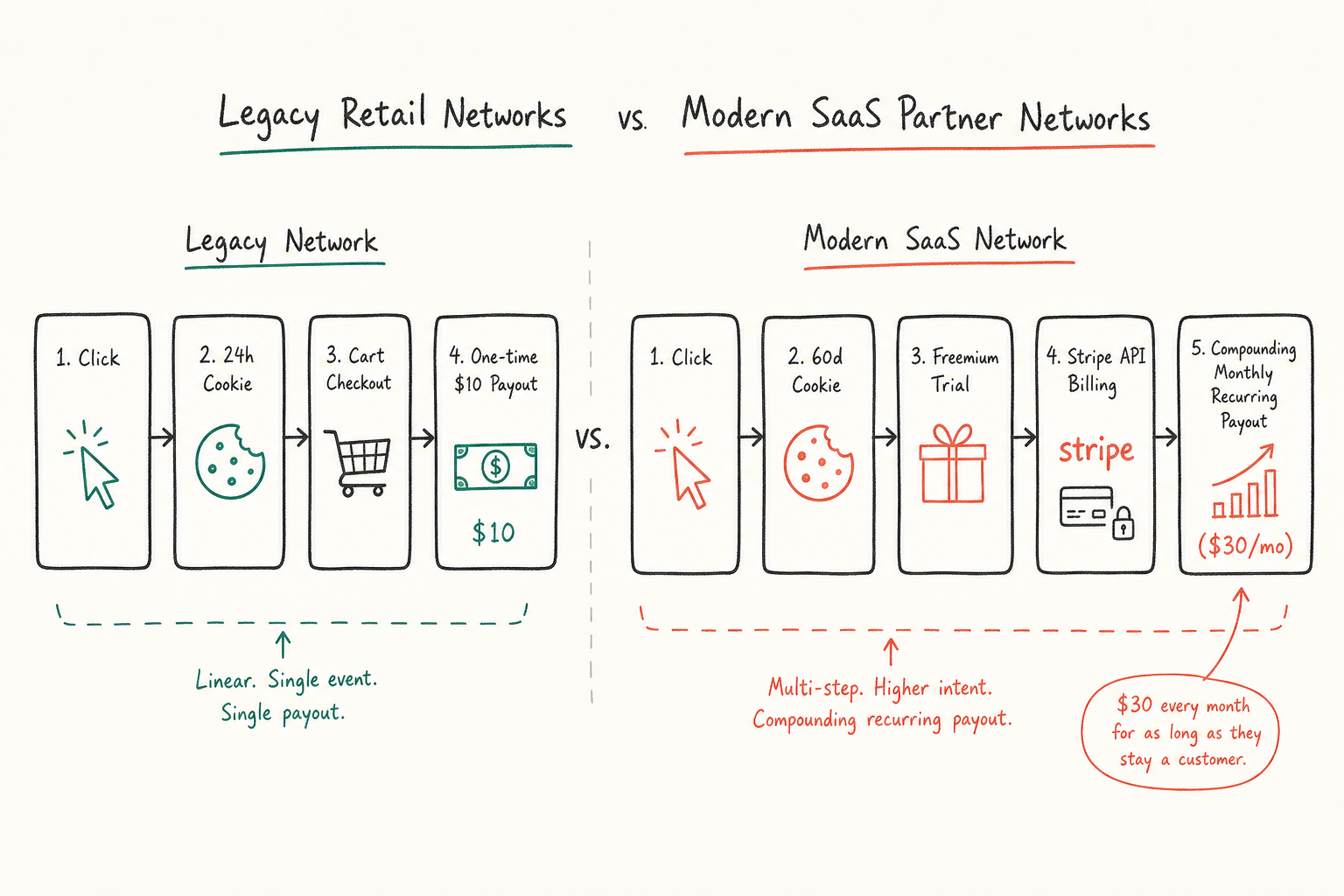
Before looking at the alternatives, it is helpful to understand why the AI industry has largely bypassed older networks. Platforms built in the early 2000s were designed around the concept of a shopping cart checkout. A user clicks an affiliate link, a cookie is dropped in their browser, they buy a physical product, and the network credits the affiliate.
AI software rarely works this way. Most AI tools operate on a freemium model, a usage-based credit system, or a monthly recurring revenue (MRR) model.
When a user clicks your affiliate link for an AI video generator, they might sign up for a free account today. They might not upgrade to a paid tier until 45 days later, at which point they pay via a Stripe integration embedded in a desktop app. Legacy network tracking pixels often fail in these complex, multi-device, freemium-to-paid conversion paths.
Furthermore, AI startups want complete control over their branding and partner relationships. They avoid marketplaces packed with coupon sites and cashback browser extensions that steal attribution from content creators. This shift has forced a migration toward newer, API-driven partner platforms and specialized directories.
The Best SaaS-Centric Affiliate Networks for AI
If you are stepping away from traditional retail networks, your first stop should be the platforms that specifically cater to Software as a Service (SaaS). These networks are built with subscription tracking at their core.
PartnerStack
PartnerStack is arguably the heavy hitter in the B2B SaaS and AI affiliate ecosystem. Unlike networks that cater to physical goods, PartnerStack was designed from the ground up to track recurring revenue, multi-tiered subscription upgrades, and software usage.
Because it integrates natively with standard SaaS billing engines (like Stripe, Recurly, and Chargebee), many mid-market and enterprise AI companies choose PartnerStack to run their partner programs. You will find a heavy concentration of AI productivity tools, AI-driven CRM integrations, and generative AI marketing platforms here.
The primary advantage for affiliates is the dashboard. PartnerStack aggregates your recurring commissions across multiple software vendors into a single payout, usually processed on the 13th of the following month. This eliminates the headache of tracking down minimum payout thresholds across a dozen different independent software programs.
Impact (Formerly Impact Radius)
Impact has successfully bridged the gap between legacy retail networks and modern SaaS tracking. While they still host major retail brands, they have aggressively captured a massive share of the software and digital tool market.
Impact’s tracking capabilities are robust, allowing merchants to track cross-device conversions, API-triggered events, and recurring billing. Many established AI companies—particularly those that have moved past the startup phase and secured Series B or C funding—migrate to Impact to manage their scaling affiliate bases.
One notable feature of Impact is the flexibility of its electronic contracts. Merchants can easily set up dynamic commission rules. For example, an AI writing tool might pay you 30% for the first three months a user is active, dropping to 15% for the lifetime of the account, plus a $10 bonus if the user upgrades to an annual plan. Impact handles this complex math seamlessly.
Transparent Directories: The AffiliList Approach
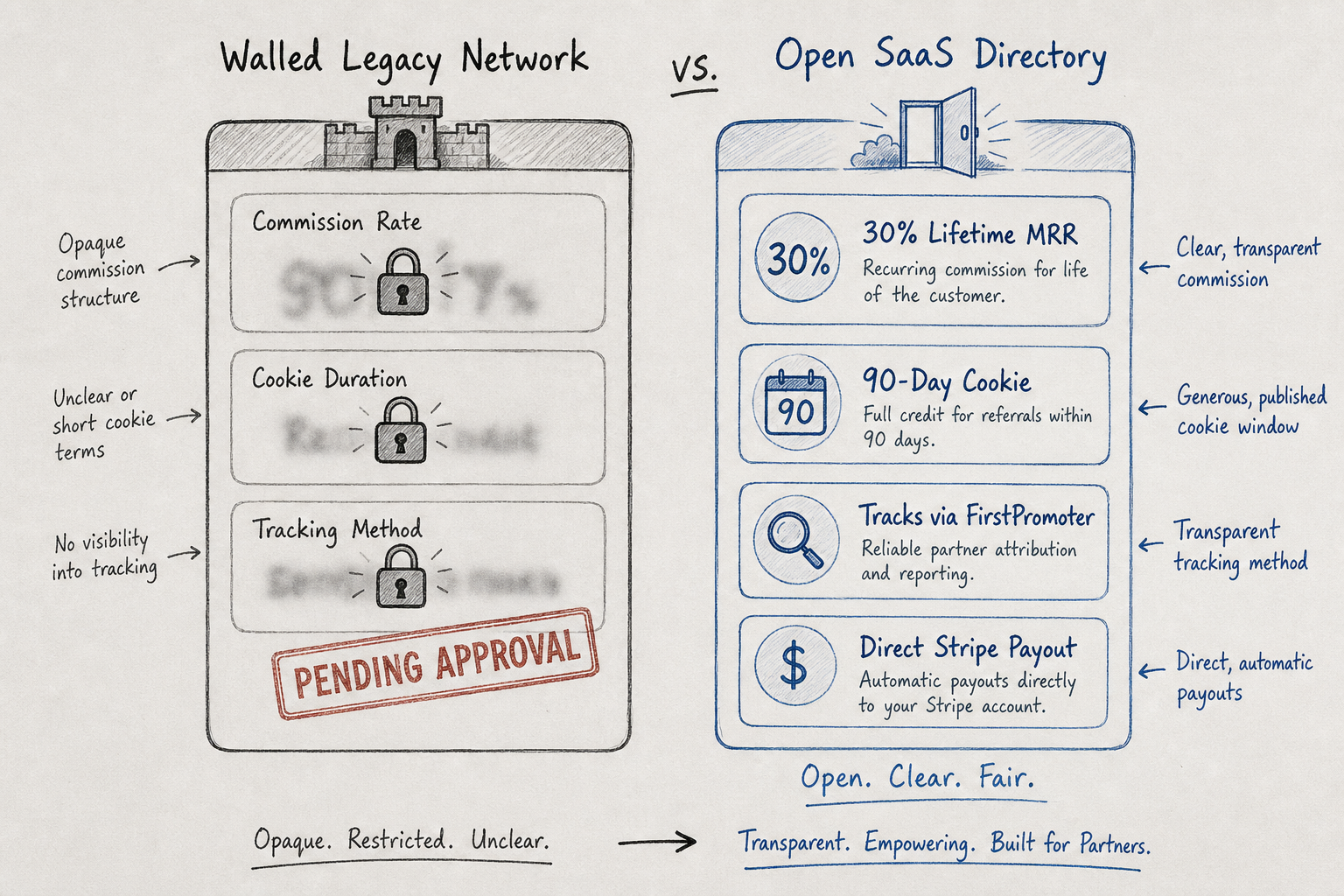
One of the most significant pain points of using traditional networks is the lack of upfront transparency. On most platforms, you have to create an account, submit an application to a specific merchant, and wait days for approval before you can even see the detailed commission structure, cookie length, or promotional restrictions.
This gatekeeping wastes hours of research time. You might finally get approved for an AI video editor only to discover they pay a flat $5 one-time commission instead of the recurring percentage you expected.
AffiliList was built to strip away this friction. As a curated database of over 10,000 affiliate programs, AffiliList focuses heavily on SaaS, digital tools, and the rapidly expanding AI niche.
Instead of hiding the terms behind a walled garden, AffiliList provides open access to the data that actually matters. Without jumping through extensive signup hoops, you can search for AI tools and immediately see:
- The exact commission percentage or flat rate.
- Whether the payout is one-time or recurring.
- The duration of the cookie window.
- The underlying tracking software the merchant uses.
This transparency allows you to quickly filter out low-paying offers and benchmark competitors. If you are comparing three different AI voiceover generators, you can use the directory to see which one offers the most lucrative payout terms for your specific audience. It serves as a central hub to bypass outdated lists and find verified data on modern best niches for affiliate marketing.
White-Label Affiliate Platforms: The Hidden Startup Layer
While major networks and directories are excellent starting points, a massive portion of the AI software ecosystem runs independent, "in-house" affiliate programs.
When a lean AI startup launches, they usually do not want to pay the hefty integration fees and monthly minimums required by massive enterprise networks. Instead, they bolt a white-label affiliate tracking tool directly onto their Stripe account.
These programs are highly lucrative because the merchant isn't paying network fees, allowing them to pass higher commission rates (often 30% to 50% recurring) directly to you.
Common White-Label Tracking Software
If you want to find these hidden programs, you need to recognize the software powering them. The heavy hitters in the AI startup space include:
- FirstPromoter: By far the most popular choice for bootstrapped and newly funded AI startups. It is built specifically for SaaS and tracks MRR perfectly.
- Rewardful: Very similar to FirstPromoter, heavily utilized by Stripe-powered software companies.
- Tapfiliate: Often used by slightly larger companies wanting a mix of direct API tracking and traditional affiliate management.
- Tolt: A newer entrant gaining rapid traction among indie hackers building niche AI tools.
How to Find Hidden AI Programs via Footprints
Because these programs aren't listed in a centralized network, you have to hunt for them. The most common method is the standard website footer check. When you find an AI tool you love, scroll to the absolute bottom of their homepage and look for links titled "Affiliates," "Partner Program," "Referral Program," or "Earn Money."
To actively hunt for these independent programs at scale, you can use Google search operators (often called footprints) to find pages hosted by these white-label tools.
Try entering these exact phrases into Google:
"powered by FirstPromoter" + "AI""powered by Rewardful" + "artificial intelligence"site:notion.site "affiliate program" "AI"(Many startups draft their program terms on public Notion pages before building a dedicated landing page).
This method bypasses the noise and brings you directly to the signup portals for highly specific AI tools that your competitors haven't found yet.
The "AI Wrapper" Trap: Evaluating Program Viability
Finding an AI affiliate program is only the first step; evaluating its long-term profitability is where most marketers fail. The current market is flooded with what developers call "AI wrappers"—basic user interfaces slapped over the top of OpenAI's API.
Many of these wrappers offer incredibly high affiliate commissions, sometimes promising 50% or 60% lifetime recurring payouts. However, this is a trap.
The Churn Reality in Artificial Intelligence
In the SaaS world, "churn" is the rate at which customers cancel their subscriptions. AI wrappers notoriously suffer from catastrophic churn rates. A user might sign up, play with the tool for a month, realize they could just do the exact same thing for free inside ChatGPT, and immediately cancel.
A 50% recurring commission is practically worthless if the average customer retention is only 1.5 months. You will spend all your traffic acquisition effort securing a user, only to earn a few dollars before the subscription dies.
When evaluating an AI tool, look for workflow integration, not just novelty. The tools that retain customers for years are those that embed themselves into a user's daily operations.
Ask yourself:
- Does this tool save the user hours of tedious work every single week?
- Does it integrate natively with other software they use (like Google Workspace, Slack, or Salesforce)?
- Does it store historical data that would be painful for the user to lose if they canceled?
If the answer is yes, the tool has high switching costs and high retention. This is where your recurring commissions will actually compound over time, forming a solid foundation for an affiliate marketing side hustle.
Structuring the Payout: CPA vs. Recurring
AI programs generally offer one of three payout structures:
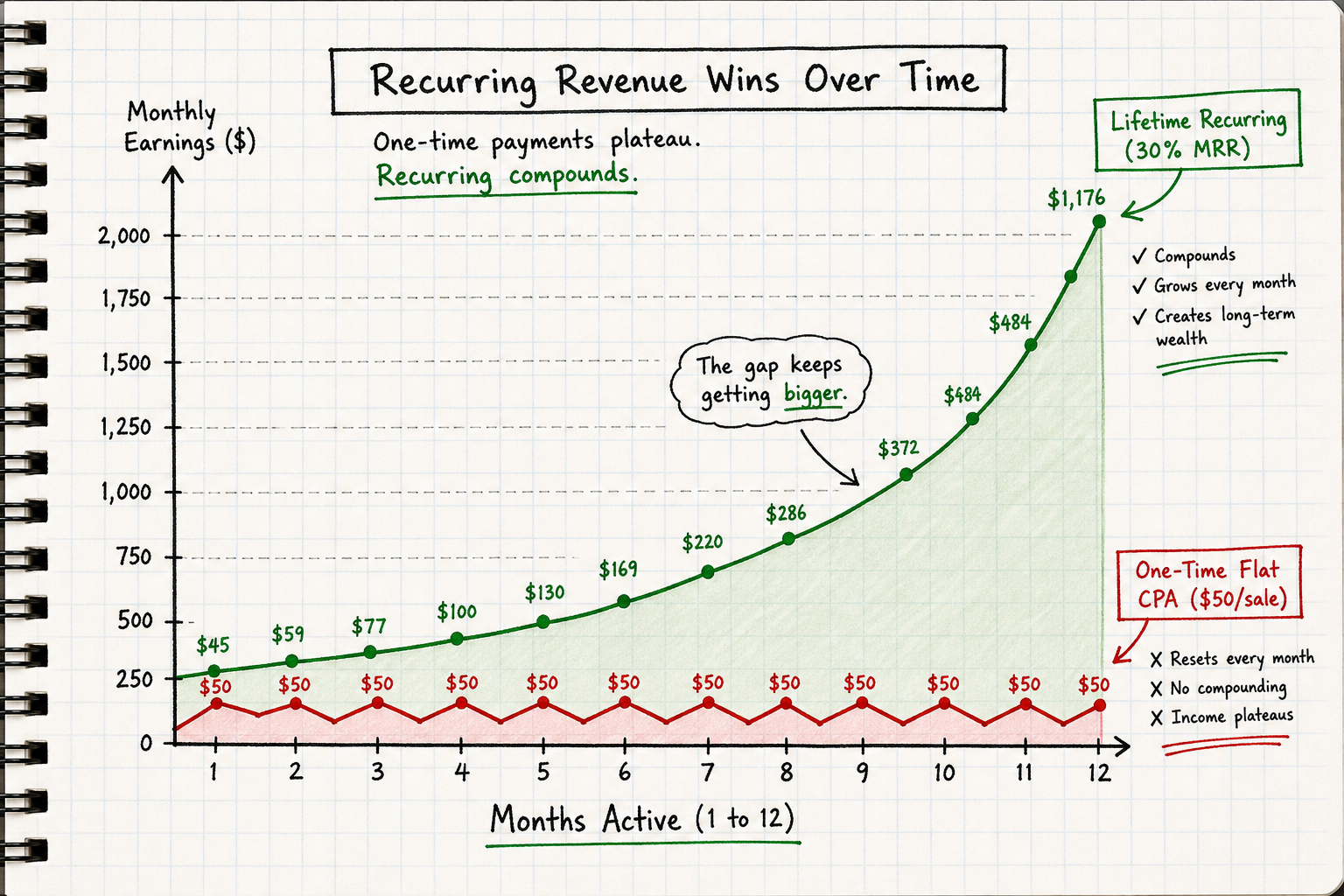
- Cost Per Action (CPA) / One-Time Flat Rate: You receive a single payment (e.g., $50) when the user pays for their first month. This is excellent for immediate cash flow and is common in enterprise software, often overlapping with high paying affiliate programs where bounties can exceed hundreds of dollars per lead.
- Lifetime Recurring: You earn a percentage (usually 20% to 30%) of the customer’s subscription every single month for as long as they remain a paying customer.
- Time-Capped Recurring: You earn a percentage, but only for the first 12 or 24 months of the customer’s lifecycle.
For content creators and niche site owners, lifetime recurring is almost always the holy grail. It allows you to build a reliable monthly revenue baseline that protects you from seasonal traffic dips or algorithm updates.
The Importance of the Cookie Window
Because B2B software is rarely an impulse purchase, the cookie window—the amount of time you have for a user to convert after clicking your link—is critical.
A user might read your blog post comparing AI coding assistants, click your link, and sign up for a free trial. They might then need to get approval from their engineering manager before upgrading to a paid team plan three weeks later.
If the affiliate program only offers a 14-day cookie window, you lose the commission. For B2B AI tools, you should look for a minimum 60-day cookie window, with 90 to 180 days being the industry standard for premium platforms.
| Feature | Low-Quality AI Program | High-Quality AI Program |
|---|---|---|
| Product Utility | Thin wrapper over ChatGPT | Deep workflow integration |
| Commission Structure | 10% one-time | 20-30% recurring (or high CPA) |
| Cookie Window | 7 to 15 days | 60 to 90+ days |
| Payout Threshold | $500 minimum | $50 minimum |
| Promotional Assets | None | Landing pages, email swipes, API data |
High-Converting Sub-Niches Within the AI Space
"Artificial Intelligence" is too broad of a target for a successful affiliate campaign. If you build a generic site reviewing every AI tool on the market, you will be crushed by massive tech publications with massive editorial teams.
Success requires narrowing down into highly specific use cases where you can demonstrate real authority.
AI Video and Audio Generation
The demand for video content is insatiable, but production is expensive. Tools that turn text into voiceovers, generate B-roll footage, or create AI avatars are highly sought after by YouTube creators, marketing agencies, and corporate training departments. These tools have high computing costs, meaning their subscription tiers are often expensive, resulting in higher recurring commissions for affiliates.
AI SEO and Content Operations
While basic AI writing tools are ubiquitous and suffer from high churn, platforms that handle entire content operations are highly profitable. Look for tools that automate internal linking, optimize programmatic SEO architectures, or generate technical documentation. These are B2B purchases that marketing teams rely on daily. Promoting these tools naturally aligns with those figuring out how to start a profitable affiliate marketing blog and monetize it through software reviews.
AI Meeting Notes and Sales Intelligence
Sales teams are always willing to spend money on tools that increase their close rates. AI software that records sales calls, transcribes them, analyzes the sentiment of the prospect, and automatically updates a CRM is incredibly sticky. Once a sales team integrates this into their workflow, they almost never cancel.
A Practical Scenario: Surviving the Shift in Software
Consider the trajectory of a typical tech blogger we’ll call Marcus. Three years ago, Marcus monetized his tech tutorials exclusively through ShareASale, promoting traditional WordPress themes, web hosting, and legacy productivity software. His income was stable but stagnant, consisting mostly of $20 one-time bounties.
When the AI wave hit, Marcus tried to find AI tools on his legacy networks but found the pickings incredibly slim. He decided to pivot his strategy. Instead of relying on a single network dashboard, he used specialized directories to map out the landscape of AI video editors.
He found a powerful, FirstPromoter-backed AI video tool offering a 30% recurring commission on a $99/month product. Marcus created a detailed, step-by-step tutorial on YouTube showing how to use this specific tool to automate faceless video channels.
Because the tool solved a massive pain point (video editing time) and integrated directly into a creator's daily workflow, churn was exceptionally low. Within eight months, Marcus had referred 200 active users. Instead of earning a one-time flat fee, he built a compounding revenue stream of nearly $6,000 per month from that single piece of software. He bypassed the legacy networks entirely, focusing on direct partnerships with tools that actually retained their users.
How to Get Approved by Premium AI Vendors
Moving away from broad networks means you will often deal directly with an AI company’s internal affiliate manager. These managers are highly protective of their brand and their conversion metrics.
If you apply to an exclusive AI partner program with a blank profile or a generic coupon site, you will be rejected automatically. Internal managers are looking for content creators who can drive qualified, high-intent traffic.
When you submit an application, you must provide context:
- Specify your traffic source: Do not just say "I have a blog." State clearly, "I generate 15,000 monthly organic pageviews targeting B2B SaaS queries."
- Outline your promotion strategy: Tell them exactly where their link will live. "I am writing a comparison guide between your tool and Competitor X, and your tool will be featured as the best option for enterprise teams."
- Provide proof of audience: Link to your YouTube channel, your LinkedIn newsletter, or a specific high-ranking article that proves you understand their specific industry.
The more transparent you are about how you intend to promote their software, the faster your application will be approved.
Moving Forward with the Right Data
The landscape of software partnerships has fundamentally changed. If you limit your search for AI affiliate programs to the legacy networks that built the retail affiliate industry, you will miss the most lucrative opportunities of this decade.
The highest-converting, longest-retaining AI tools are hosted on modern SaaS platforms, run independently via white-label software, and categorized in transparent directories that don't hide the data you need.
By shifting your focus to these modern discovery methods, heavily vetting the actual utility of the software to avoid the churn trap, and building content that solves specific workflow problems, you position yourself to capture the compounding, recurring revenue that makes the most profitable affiliate marketing niches so valuable. Take the time to audit where you are currently sourcing your partnerships. If you are still relying entirely on closed networks that force you to apply blindly just to see a payout rate, it is time to upgrade your approach.