Best Where to Find Affiliate Programs in the AI Niche Tools Beyond Shareasale
Discover where to find high-paying AI affiliate programs beyond legacy networks. Explore modern SaaS directories, tracking platforms, and offer evaluations.
- The Bottleneck of Legacy Affiliate Networks
- The Stronger Alternative: Open Discovery with AffiliList
- The Backend Platforms: Where AI Startups Actually Host Their Programs
- Evaluating AI Affiliate Programs: Beyond the Headline Commission
- The Tale of Two AI Programs (A Conversion Scenario)
- Top AI Sub-Niches to Target Right Now
- Spotting Real Offers vs. Fly-by-Night AI Startups
- Strategic Traffic Sources for AI Affiliate Programs
- Frequently Asked Questions About AI Affiliate Programs
- The Future of AI Affiliate Discovery
If you spend enough time looking for affiliate programs in the artificial intelligence sector, you quickly hit a wall. You hear about a new generative video tool, a revolutionary AI customer support agent, or an AI-driven HR platform. You want to promote it. You head over to a legacy network like ShareASale or CJ Affiliate, type the brand name into the search bar, and get zero results.
The reality of the 2026 affiliate landscape is that the fastest-growing AI startups rarely launch their partner programs on traditional retail-focused affiliate networks. ShareASale is exceptional for physical goods and legacy software, but modern AI companies require different attribution models, integrate with modern billing stacks like Stripe, and prefer agile partner platforms.
If you are limiting your search to the old guard of affiliate networks, you are missing out on the most lucrative SaaS opportunities in the market. Finding high-converting AI affiliate programs requires knowing exactly where modern startups host their offers, how to search for them, and how to evaluate their commission structures before you spend a dime on traffic.
Here is a comprehensive breakdown of where to find affiliate programs in the AI niche, the modern tools and directories that have replaced legacy networks, and the exact criteria you should use to evaluate these offers.
The Bottleneck of Legacy Affiliate Networks
Before looking at the alternatives, it helps to understand why the AI industry has largely bypassed networks like ShareASale.
Traditional affiliate networks were built in an era of one-off purchases. A customer clicks a link, buys a pair of shoes, and the affiliate gets 8%. The tracking is straightforward, the cookie duration is standard, and the payout is a simple calculation.
Software as a Service (SaaS), which encompasses almost all AI tools, operates on subscriptions, free trials, tiered usage limits, and enterprise custom pricing. An AI tool might offer a 14-day free trial. The user might sign up on their phone, forget about it, log in on their work computer a week later, upgrade to a $20/month plan, and then three months later, their company might upgrade the entire team to a $500/month enterprise tier.
Legacy networks struggle with this complex, multi-device, multi-stage attribution. Furthermore, legacy networks often require affiliates to apply to individual programs completely blind. You might have to submit your website, wait two weeks for an affiliate manager to review your application, and only then do you discover that the program only pays a 5% one-time commission on a $10 product.
This friction is why AI founders and marketers have moved elsewhere, and it is why affiliates need a better way to source offers.
The Stronger Alternative: Open Discovery with AffiliList
The most significant shift in how affiliates find AI programs is the move from closed networks to open directories. If you want to bypass the outdated and unreliable lists scattered across the web, you need a central hub designed specifically for the digital economy.
This is where AffiliList changes the workflow for affiliate marketers. Instead of acting as a middleman that holds your tracking links hostage, AffiliList operates as a comprehensive, streamlined directory of over 10,000 affiliate programs, with a heavy emphasis on SaaS and digital tools.
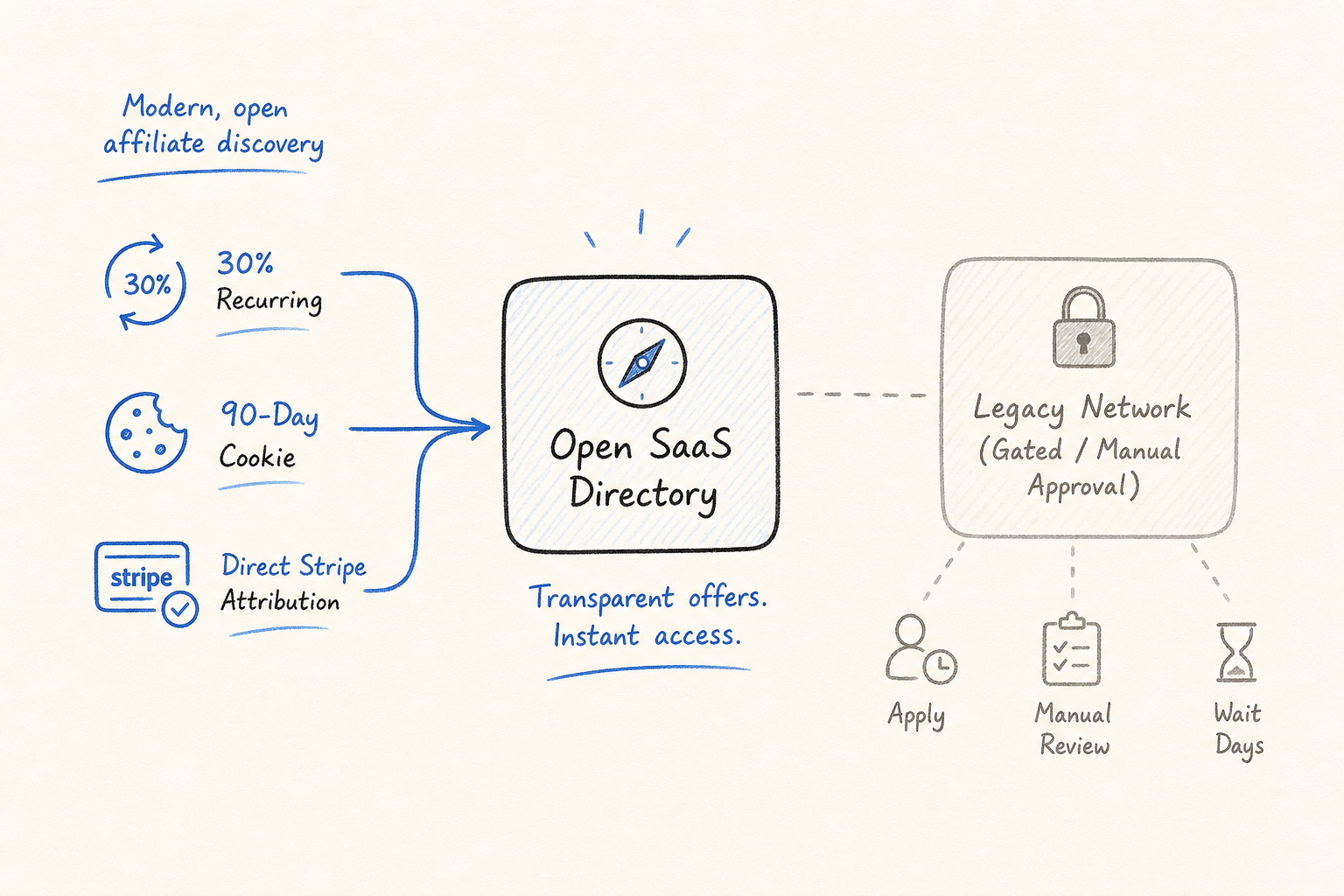 The primary advantage of using a dedicated directory over a legacy network is transparency. When you are looking for an AI writing assistant or an AI video generator to promote, you do not want to fill out a lengthy application just to see the payout terms. On AffiliList, program details such as commission percentages, commission types (recurring vs. one-time), and cookie durations are entirely open access.
This clutter-free interface allows you to rapidly compare different opportunities. For example, if you are writing a roundup review of AI HR software, you can filter the AffiliList database for that specific category, sort by recurring commission rates, and instantly identify the most lucrative options. You can see at a glance if a tool offers 30% lifetime recurring or a flat $50 CPA (Cost Per Acquisition). Once you find the perfect fit, you simply follow the provided link to the merchant's actual partner portal to sign up.
For niche site owners and digital entrepreneurs who value verified data, this eliminates the guesswork and the waiting game associated with traditional networks.
The Backend Platforms: Where AI Startups Actually Host Their Programs
When you find a program on a directory like AffiliList, clicking the "Join" button will usually take you to one of a few specific backend tracking platforms. Modern AI startups overwhelmingly use these specific partner platforms because they integrate seamlessly with Stripe and handle SaaS attribution flawlessly.
Knowing these platforms is incredibly useful because it helps you understand the tracking reliability and the payout mechanisms you will be dealing with.
FirstPromoter
If there is a default affiliate tracking software for bootstrapped AI startups and mid-market SaaS companies in 2026, it is FirstPromoter. Built specifically for SaaS companies, FirstPromoter integrates directly with billing systems.
When you join an AI affiliate program powered by FirstPromoter, you get a clean, standard dashboard. You will see your clicks, sign-ups (referrals who created a free account but haven't paid), and customers (referrals who have converted to a paid tier).
Because so many AI tools use this platform, you can actually use advanced Google search operators to find emerging AI programs. By searching site:firstpromoter.com "AI video" or site:firstpromoter.com "AI writing", you can uncover hundreds of brand-new affiliate programs that have not yet been heavily promoted by other marketers.
Rewardful
Rewardful is another massive player in the AI space, particularly for companies that process payments exclusively through Stripe. Rewardful's entire pitch to AI founders is that it requires zero custom coding—it simply reads the Stripe data.
For you, as an affiliate, this means the tracking is incredibly accurate. If your referral upgrades their plan, downgrades, or requests a refund, Rewardful adjusts your commission automatically based on the Stripe transaction. There are no lost commissions due to faulty API calls. If an AI tool hosts its program on Rewardful, you can generally trust that the attribution model is rock solid.
PartnerStack
When an AI startup moves from being a scrappy consumer tool to an enterprise B2B platform, they almost always migrate to PartnerStack.
PartnerStack is a heavyweight B2B partnership network. It is designed to handle not just basic affiliate links, but lead registration. If you are promoting a high-ticket AI automation tool to enterprise clients, a standard affiliate link might not work because the sales cycle involves booking demos and signing contracts. PartnerStack allows you to submit a "lead" (a client's email and company info). If the company's sales team closes that lead three months later, PartnerStack attributes the sale to you.
If you are looking for high paying affiliate programs that offer $500+ commissions per sale, PartnerStack is often the infrastructure powering those enterprise AI offers.
Impact (Impact.com)
Impact bridges the gap between legacy networks and modern SaaS tracking. While it hosts plenty of retail brands, many heavily funded AI unicorns (the household names in generative AI) use Impact to manage their partner programs.
Impact offers highly customizable contracts. An AI vendor on Impact might offer you 20% recurring for the first year, but bump that to 30% if you drive more than 50 sales a month. Impact's interface is more complex than FirstPromoter, but it provides incredible reporting granularity, allowing you to see exactly which pieces of content are driving the highest lifetime value (LTV) customers.
Evaluating AI Affiliate Programs: Beyond the Headline Commission
Finding the program is only the first step. The AI niche is notoriously volatile. Thousands of AI tools launch every month, and many of them are simply thin wrappers around OpenAI's API. Promoting the wrong tool can ruin your audience's trust and result in zero sustained income.
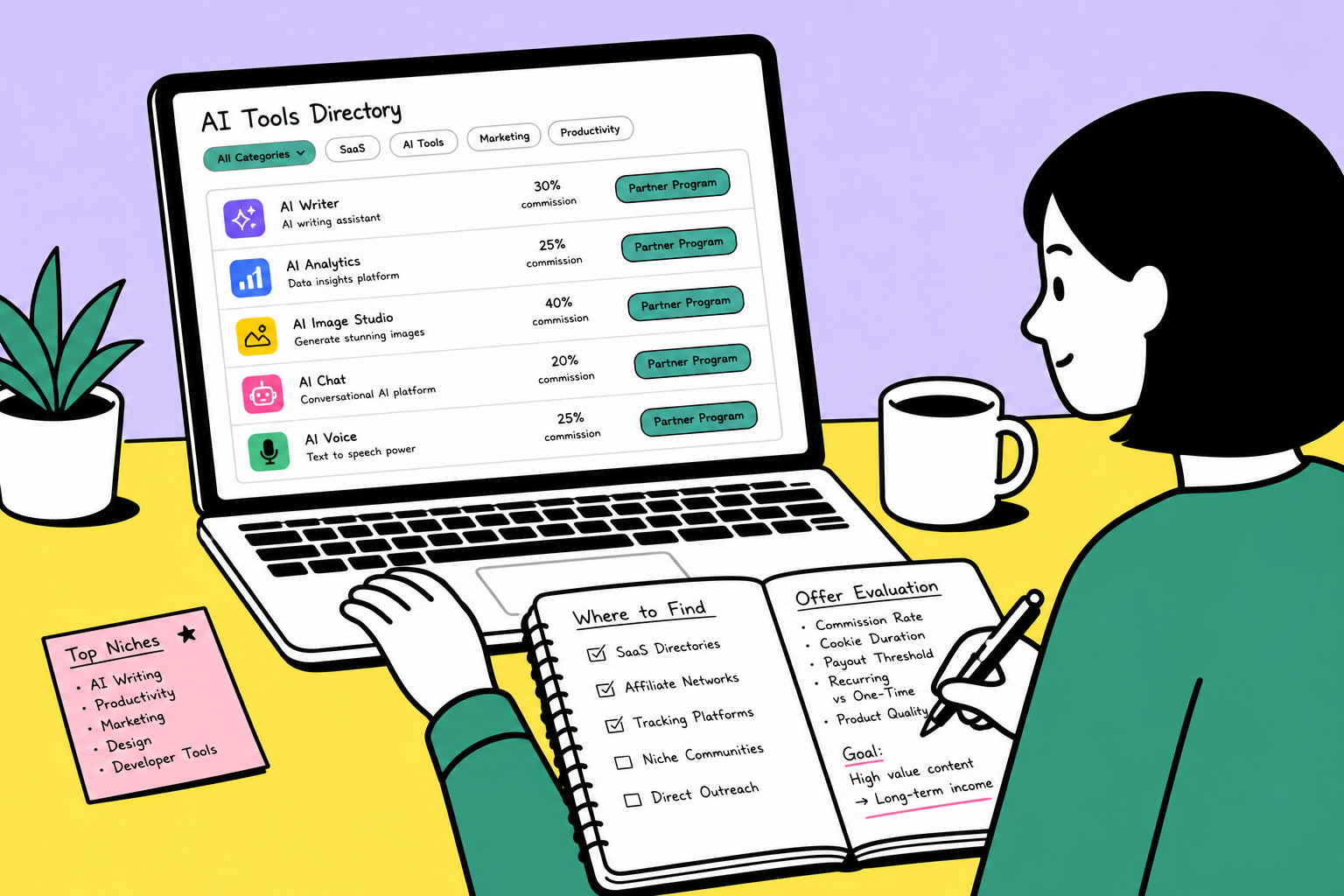
Before you commit your traffic to an AI affiliate program, you need to evaluate the mechanics of the offer.
The Recurring vs. CPA Debate
In the early days of the AI boom, almost every tool offered a 30% lifetime recurring commission. It was the standard SaaS playbook. However, as compute costs rose and customer churn became a reality, many AI programs shifted their models.
Today, you will generally see two models:
- Recurring Commissions: You earn a percentage (usually 15% to 30%) of the customer's subscription fee for as long as they remain a paying user, or capped at a specific timeframe (e.g., 12 or 24 months).
- CPA (Cost Per Acquisition): You earn a flat fee (e.g., $50) when the user pays for their first month, regardless of whether they stay or cancel.
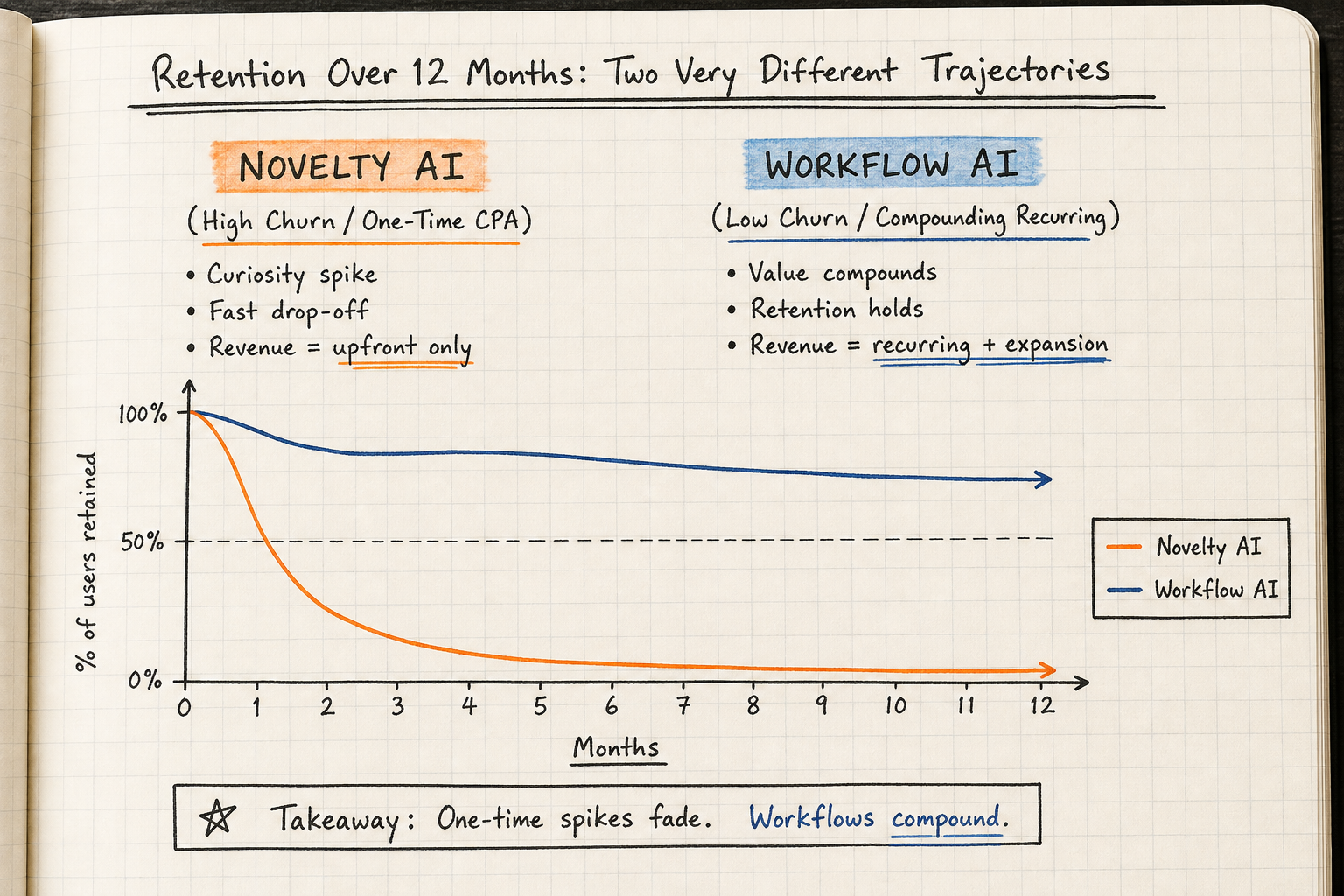
Which is better? It depends entirely on the product's churn rate.
If you are promoting a novelty AI image generator, users often subscribe for one month, generate the avatars they need, and immediately cancel. In this scenario, a 30% recurring commission on a $10/month product earns you exactly $3. A flat CPA of $15 for that same product is vastly superior.
Conversely, if you are promoting AI accounting software or an AI customer service chatbot, the setup cost for the end-user is high. Once a business integrates that AI into their workflow, they rarely leave. The churn rate is low. In this B2B scenario, a 20% recurring commission on a $100/month product can yield hundreds of dollars per user over a few years.
Always ask yourself: Is this AI tool a novelty, or is it a foundational workflow tool? Your commission preference should align with that answer.
Cookie Duration and Multi-Touch Attribution
The cookie window dictates how long after the initial click you can still get credit for a sale.
For inexpensive, B2C AI tools (like a $15/month AI resume builder), a 30-day cookie is usually sufficient. The purchasing decision is impulsive.
However, for enterprise AI software costing thousands of dollars a year, a 30-day cookie is virtually useless. B2B buyers have to get budget approval, run security compliance checks, and consult stakeholders. This process easily takes 60 to 90 days. If you are targeting B2B AI tools, look for programs offering a 90-day to 180-day cookie window.
Payout Thresholds and Supported Methods
Never ignore the fine print regarding payouts. A new AI startup might offer an incredible 50% recurring commission, but they might also have a $500 minimum payout threshold. If you have a small audience and are just starting an affiliate marketing side hustle, it could take you six months to see a single dollar from that program.
Additionally, verify the payment methods. While most modern platforms support PayPal and direct bank transfers via Stripe Connect or Wise, some international affiliates may find themselves locked out of receiving funds if the vendor only issues US wire transfers.
Conversion Assets and Sales Funnels
The best affiliate marketers know that they are only responsible for the click; the vendor's landing page is responsible for the conversion.
Before generating your affiliate link, audit the vendor's sales funnel.
- Do they offer a frictionless free trial?
- Do they require a credit card upfront for the free trial? (This dramatically lowers sign-ups but increases the percentage of sign-ups that convert to paid).
- Does the affiliate program provide you with high-converting creatives, pre-written email swipes, or performance data on their best-selling plans?
If an AI tool has a terrible mobile experience or a confusing pricing page, it does not matter if they offer a 90% commission. Zero conversions multiplied by 90% is still zero.
The Tale of Two AI Programs (A Conversion Scenario)
To illustrate why evaluating the product matters as much as evaluating the commission structure, consider this realistic scenario between two competing AI products.
You run a blog about digital marketing. You decide to write a review comparing two AI copywriting tools.
Tool A (The Vaporware Wrapper): Tool A is heavily promoted on Twitter. It promises "one-click SEO blogs." The affiliate program offers a massive 50% recurring commission. You send 1,000 clicks to Tool A. Because the landing page is aggressive, 100 people sign up for the $20/month plan. You earn $1,000 in month one. However, the tool's output is terrible. The users realize it is just a basic ChatGPT wrapper with no unique features. In month two, 95 of those users cancel. Your recurring revenue drops to $50. By month three, it is zero.
Tool B (The Workflow Integrator): Tool B is lesser-known but integrates directly into Google Docs and WordPress. It learns a brand's specific tone of voice over time. The affiliate program only offers 20% recurring on a $30/month plan. You send 1,000 clicks to Tool B. The landing page is more corporate and less hype-driven, resulting in only 40 sign-ups. You earn $240 in month one. However, because Tool B actually saves marketing teams ten hours a week, the product is extremely sticky. In month two, 38 users remain. In month three, 35 users remain. By month twelve, 30 users are still paying, and several have upgraded to team plans. You are consistently making $250+ every single month from that original batch of traffic, generating over $2,500 in a year.
High commission percentages are a mirage if the underlying product fails to retain users. Always prioritize promoting AI tools that solve painful, expensive problems rather than those offering cheap parlor tricks.
Top AI Sub-Niches to Target Right Now
The phrase "AI niche" is too broad to be useful. Artificial intelligence is not a niche; it is a technology layer that is being applied to every existing industry.
To succeed, you must drill down into specific use cases. If you want a broader look at lucrative sectors, our guide on the most profitable affiliate marketing niches offers great context. Within the AI space specifically, here are the sub-niches showing the strongest affiliate performance:
1. AI Video and Audio Generation
Tools that generate videos from text, clone voices, or automatically edit short-form content for TikTok and YouTube Shorts are incredibly popular. The target audience here is content creators and marketing agencies. These tools have high compute costs, meaning their subscription tiers can get expensive rapidly, leading to higher commission payouts.
2. AI Customer Support and Chatbots
This is a heavily B2B sub-niche. Businesses are desperate to cut customer service costs. AI agents that ingest a company's knowledge base and resolve customer tickets automatically are easy to sell. Because these are B2B software purchases, the LTV is exceptionally high, making recurring commissions highly lucrative.
3. AI Coding Assistants
Developers are adopting AI faster than almost any other profession. Tools that autocomplete code, find bugs, or manage server deployments via natural language are in high demand. If you have an audience in the tech or software development space, these programs convert very well.
4. AI Productivity and HR
From tools that automatically summarize Zoom meetings to platforms that screen resumes using machine learning, AI is taking over human resources and office administration. This is one of the best niches for affiliate marketing because it targets operational budgets rather than individual consumer wallets.
Spotting Real Offers vs. Fly-by-Night AI Startups
Because the barrier to entry for creating an AI tool is currently very low (anyone can build a user interface on top of existing API models), the affiliate space is flooded with low-quality offers.
If you are concerned about maintaining your site's reputation, you must learn to filter out the vaporware. We cover the broader aspects of avoiding scams in our guide Is Affiliate Marketing Legit? (How to Spot Real Offers), but specific to the AI space, look for these red flags:
- No "About Us" Page: If the AI tool does not list its founders, its headquarters, or a LinkedIn company page, run away. Legitimate SaaS companies are transparent about their team.
- Lifetime Deals (LTDs) with High Commissions: If a company is offering a $99 lifetime deal to users and promising you a 50% cut of that, their unit economics are broken. They will not be able to afford the server compute costs for those users long-term, and the company will likely fold within a year.
- Vague Security Policies: If an AI tool requires users to upload proprietary data (like financial spreadsheets or source code) but lacks a clear SOC2 compliance or data privacy page, enterprise users will not adopt it, and your conversion rates will tank.
Legitimate AI partner programs provide clear terms of service, robust documentation, and responsive affiliate managers.
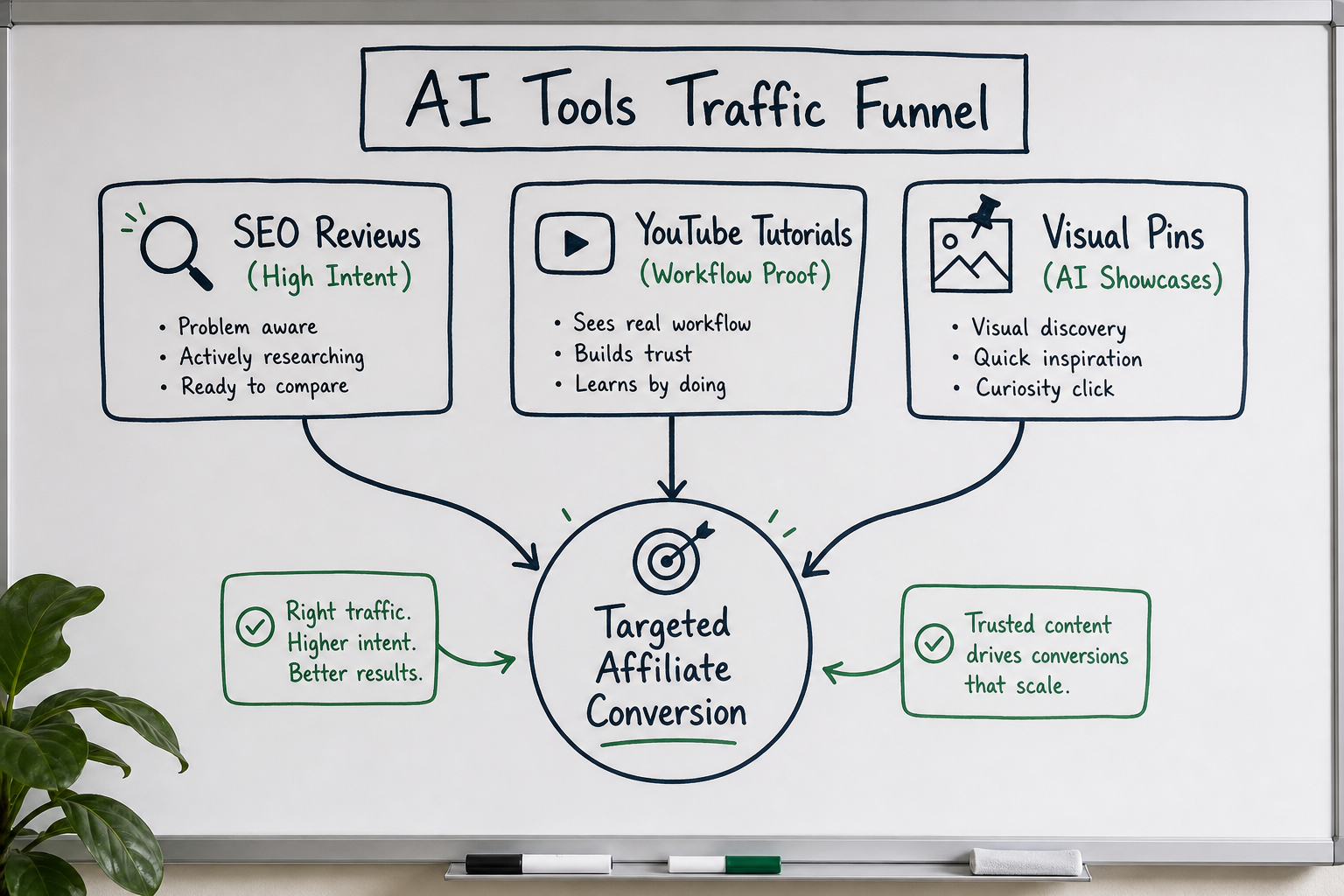
Strategic Traffic Sources for AI Affiliate Programs
Once you have utilized a directory like AffiliList to find the perfect offer and verified its tracking platform and commission structure, you need to drive the right kind of traffic.
AI tools require a bit more education than standard consumer products. You cannot simply post a link on a generic coupon site and expect to drive high-LTV users. You need to demonstrate the product's value.
Search Engine Optimization (SEO)
SEO remains the gold standard for high-intent traffic. People searching for "best AI tool for architectural rendering" are actively looking to make a purchase. Writing deep-dive tutorials, comparison posts (e.g., "Jasper vs. Copy.ai"), and workflow guides is the most sustainable way to drive sign-ups. If you are new to this, reviewing how to start a profitable affiliate marketing blog is your best next step.
YouTube and Video Demonstrations
Because AI tools are highly visual and interactive, video content converts exceptionally well. Recording your screen while you use an AI tool to solve a specific problem (e.g., "How I use AI to write my email newsletters in 5 minutes") provides undeniable proof that the tool works. Place your affiliate link in the video description and mention it naturally during the tutorial.
Pinterest for Visual AI Tools
If you are promoting AI image generators, interior design AI, or visual marketing tools, Pinterest is an underutilized goldmine. By pinning the high-quality outputs generated by the AI tool and linking directly to your review or the merchant's landing page, you can drive significant targeted traffic. You can learn the exact mechanics of this in our guide on setting up affiliate marketing on Pinterest.
Frequently Asked Questions About AI Affiliate Programs
Do I need to pay to join AI affiliate programs? No. Legitimate affiliate programs are free to join. If a network or a vendor asks you for an upfront fee or requires you to purchase their highest-tier subscription just to get an affiliate link, it is a multi-level marketing scheme, not a true affiliate program.
Are AI affiliate commissions taxable? Yes. Just like any other income stream, affiliate commissions are considered taxable income. Platforms like PartnerStack and FirstPromoter will typically require you to fill out a W-9 (for US citizens) or a W-8BEN (for international affiliates) before they issue your first payout.
Can I run paid ads directly to my AI affiliate link? This depends entirely on the vendor's terms of service. Most AI companies strictly prohibit "brand bidding" (running Google Ads targeting their exact brand name). However, many allow you to run ads targeting broad keywords (like "best AI writing tools") as long as you direct the traffic to your own landing page or blog post first, rather than direct-linking to their site. Always read the program's specific PPC (Pay-Per-Click) policy.
The Future of AI Affiliate Discovery
Relying solely on legacy networks like ShareASale to find AI affiliate programs is a guaranteed way to miss out on the most innovative and lucrative tools in the market. The industry moves too fast, and the billing infrastructure of modern SaaS demands more agile partner platforms.
By leveraging transparent, comprehensive directories like AffiliList, you can bypass the gatekeepers, instantly view commission structures, and find the exact AI programs that align with your audience. Combine this open discovery method with a rigorous evaluation of churn rates, cookie windows, and product quality, and you will be well-positioned to build a sustainable, high-revenue affiliate business in the AI space.