
Where to Find New Affiliate Programs
Discover how to find new, unlisted affiliate programs before they saturate. Uncover high-paying SaaS offers using footprint searches, directories, and outreach.

- The Strategic Advantage of Early Discovery
- The Mechanics of a New Program Launch
- Top Directories to Discover Emerging Programs
- Advanced Search Tactics for Unlisted Programs
- A Case Study in Early Discovery: The SaaS Advantage
- Red Flags: How to Vet a Newly Launched Program
- Product Viability: Will This New Offer Actually Convert?
- Typical Commission Benchmarks for 2026
- How to Pitch Yourself to a New Affiliate Program
- Frequently Asked Questions (FAQs)
Promoting the same saturated VPN, web hosting, or fitness supplements that thousands of other marketers are already pushing is a recipe for diminishing returns. When an affiliate program is well-established, you are forced to compete against massive media publishers with insurmountable domain authority and ad budgets that can absorb a high cost-per-acquisition. By the time an offer is widely recognized as a top earner, the window for easy entry has often closed.
To build a profitable portfolio in 2026, you need to find new affiliate programs before they become mainstream. Discovering fresh, high-converting offers—especially in the high-ticket SaaS and digital tools space—gives you a distinct first-mover advantage. You get to rank for bottom-of-funnel search terms before the keyword difficulty spikes, and you can introduce your audience to solutions they haven't already seen advertised a dozen times today.
The challenge is that newly launched programs are rarely advertised. Brands often soft-launch their partner programs to a small group of existing users before officially listing them on public networks. This guide covers exactly how to bypass the overcrowded networks, utilize specialized directories, execute footprint searches, and vet new partnerships so you can secure lucrative terms before the masses arrive.
The Strategic Advantage of Early Discovery
Finding a newly launched affiliate program offers structural advantages that go far beyond simply having a new link to share. When a company first launches a partner program, their primary goal is aggressive market penetration. They are willing to sacrifice short-term profit margins to acquire new users and build momentum.
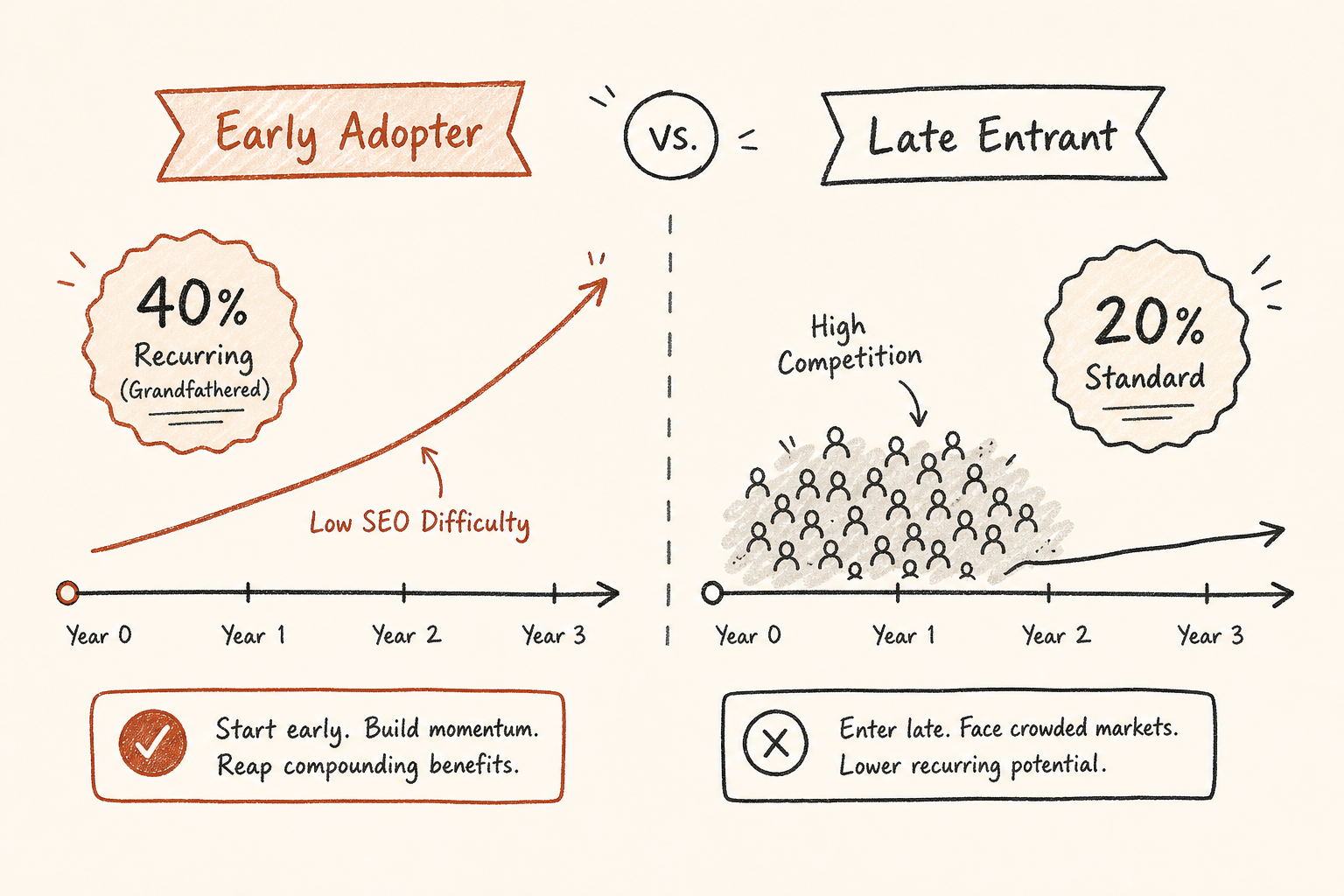
Because of this growth mandate, new programs routinely offer highly favorable terms that they eventually scale back once they reach market saturation. If you join early, you can often lock in higher baseline commissions. A SaaS company might offer 40% recurring commissions for the first 500 affiliates who join, and then drop that rate to 20% for anyone who signs up the following year. Early adopters are typically grandfathered into the original, higher rate.
Furthermore, new programs offer a pristine SEO landscape. When a software tool is relatively new to the market, search queries like "[Brand Name] review," "[Brand Name] pricing," or "[Brand Name] alternatives" have extremely low keyword difficulty. You can publish a targeted review and rank on the first page of Google within weeks, capturing high-intent buyers without needing a massive backlink profile. By the time the brand becomes a household name, you are already entrenched in the top search positions.
 Audience fatigue is another factor. If you promote a tool that your email subscribers or social media followers have already tested, your conversion rate will naturally be lower. Introducing them to a novel, highly effective solution positions you as an insider and a curator of value, which builds long-term trust.
The Mechanics of a New Program Launch
To understand how to find these unlisted opportunities, it helps to understand how modern companies—particularly in the B2B and software sectors—actually build and launch their affiliate programs.
Most software startups do not launch on day one with a public presence on massive networks like ShareASale or Commission Junction. The setup costs, compliance requirements, and integration times for those legacy networks are often too heavy for a lean startup. Instead, they follow a predictable timeline.
First, they build the product and acquire their initial customer base through direct sales, product-led growth, or paid acquisition. Once they realize they need a scalable acquisition channel, they integrate a lightweight partner tracking tool. They often use platforms like Rewardful, FirstPromoter, or PartnerStack, which integrate seamlessly with payment processors like Stripe.
During this soft-launch phase, the program is technically live, but the company does not aggressively recruit affiliates. They might place a small "Partners" link in their website footer or send a single email to their existing power users. The affiliate managers use this phase to test their tracking links, refine their payout processes, and ensure their attribution models are working correctly.
This soft-launch period is exactly when you want to find and join the program. The company is hungry for skilled marketers to prove that their new affiliate channel is viable, making them highly responsive and willing to offer dedicated support.
Top Directories to Discover Emerging Programs
While footprint searches (which we will cover next) are highly effective, the most efficient starting point is utilizing specialized directories that aggregate newly launched and highly vetted programs. Unlike standard search engines, these databases categorize offers by commission type, payout threshold, and niche, saving you hours of manual research.
Affilitizer
Affilitizer is designed specifically for program discovery and operates slightly differently than a standard static directory. It is particularly useful for identifying which networks a specific brand belongs to. If you are browsing a company's website and want to know if they have an active affiliate program, Affilitizer can immediately surface that information, often via its browser integration.
This removes the friction of digging through site footers or conducting Google searches just to find a sign-up page. If you want to rapidly scan the web for active offers while doing your daily reading, it is a highly practical tool. You can Visit Affilitizer to explore their categories and check listings for newer programs that you might not have encountered elsewhere. For additional context on their methodology, you can also read about Affilitizer in industry roundups.
Affiliate Marketing Programs Directory
When you move past initial discovery and need to compare the structural terms of different offers, specialized review directories become highly valuable. The Affiliate Marketing Programs site allows marketers to browse programs by specific niches and compare commission structures side-by-side.
This is particularly useful when you are researching specific brands and want to know if their payout terms are competitive for your industry. You can Explore the directory to investigate individual brand offers. They also frequently publish lists of the Best Affiliate Websites and Directories to Find Programs 2026, which can point you toward niche-specific networks.
Affiliate.Watch
Another platform worth integrating into your research workflow is Affiliate.Watch. This database focuses heavily on independent tracking and categorizing programs across various digital and physical niches. It provides a clean overview of newer platforms that are attempting to disrupt standard markets. You can Explore Affiliate.Watch to see how they categorize emerging offers. For a deeper breakdown of how to evaluate similar databases, we recommend reviewing our Affiliate Watch to Find Programs Evaluation Checklist.
AffiliList: The Premier Hub for SaaS and Digital Tools
If your focus is on high-converting SaaS products, digital tools, and B2B services, general directories often fall short. They are frequently cluttered with low-margin physical goods or require extensive sign-ups just to view basic payout terms.
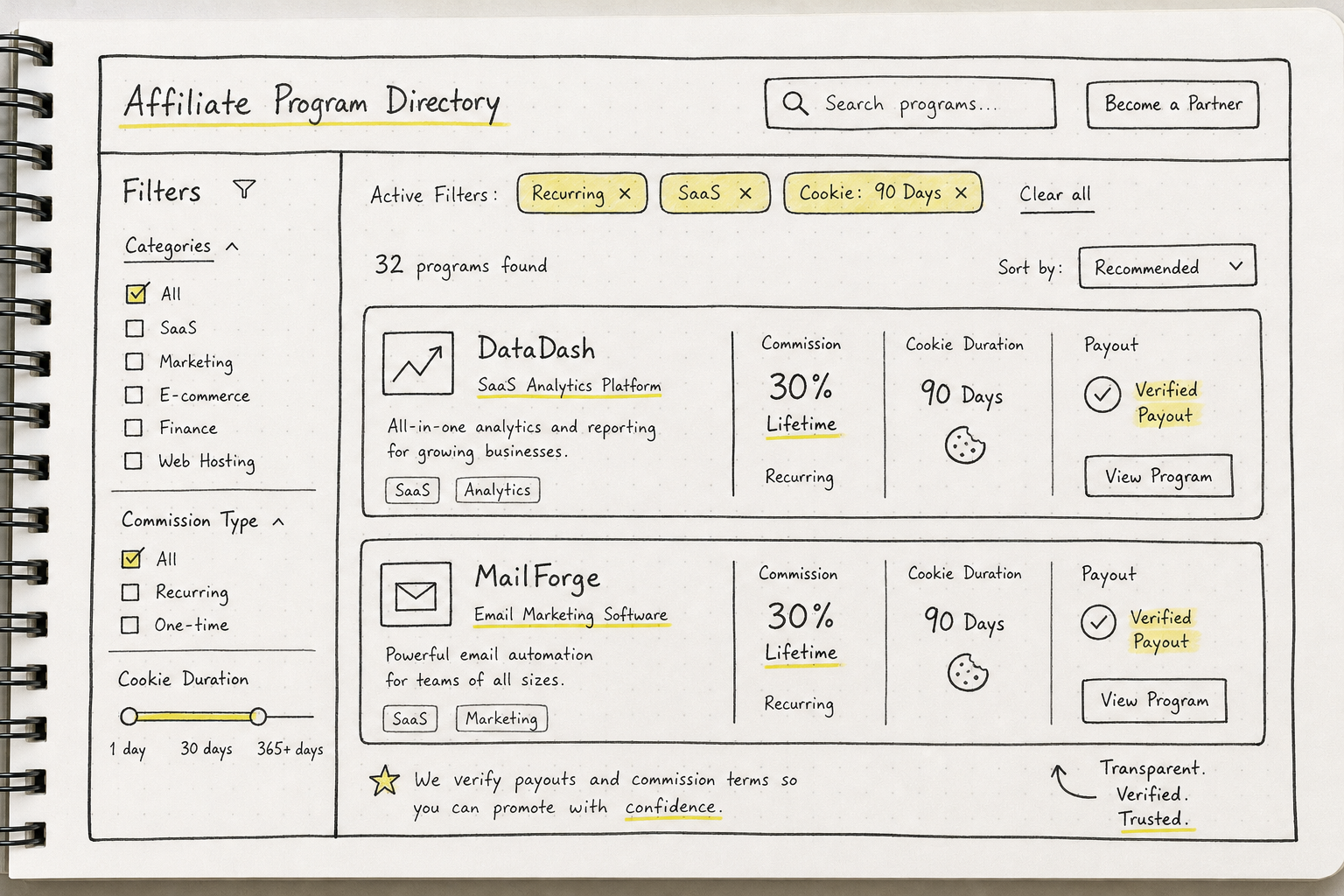
AffiliList was built specifically to solve this problem. We provide a curated database of over 10,000 affiliate programs, prioritizing reliable data, user-friendly navigation, and total transparency. We believe you should not have to create an account on a third-party network just to find out if a program pays 10% or 30%.
Our platform offers open access to program details, including exact commission percentages, flat-fee payouts, and recurring revenue models. You can filter our directory to isolate programs that offer lifetime recurring commissions, allowing you to build a portfolio of passive income streams. By bypassing outdated or unreliable lists, AffiliList serves as a central hub for professionals who want to monetize their traffic efficiently. If you specialize in software promotion, check out our Affiliate Program Finder for SAAS Lists Evaluation Checklist to maximize your use of our platform.
Advanced Search Tactics for Unlisted Programs
Directories are powerful, but some of the most lucrative newly launched programs are entirely unlisted. To find these hidden gems, you need to act like an investigator and look for the digital footprints left behind by affiliate tracking software.
Reverse-Engineering Affiliate Software Footprints
When a startup launches an in-house program using white-label software, that software often leaves a predictable footprint in the URL structure or on the sign-up page. By using Google Search operators, you can surface these hidden programs before they are ever announced publicly.
For example, many modern SaaS companies use Rewardful to manage their partners. Rewardful sign-up pages often include specific phrasing. You can search Google using the following exact-match phrases combined with your niche:
- "powered by Rewardful" + "marketing analytics"
- "powered by FirstPromoter" + "artificial intelligence"
- "powered by PartnerStack" + "human resources"
These searches will bypass the company's main marketing pages and take you directly to their hidden affiliate registration portals.
You can also search for standard subdomains that companies use when setting up new partner portals. Use the site: operator combined with wildcard searches:
site:partners.*.com "affiliate program"site:affiliates.*.com "commission"
This tactic frequently uncovers staging sites or newly launched portals that the company has not yet linked from their main navigation menu.
Mining Product Launch Platforms
If you want to find new software tools that will likely launch high-paying affiliate programs in the near future, you need to monitor where these products debut. Platforms like Product Hunt, AppSumo, and Hacker News are goldmines for early discovery.
When you see a new tool trending heavily on Product Hunt—especially one that targets businesses, agencies, or creators—there is a very high probability they either have an affiliate program in beta or are actively planning one.
Go to the trending product's website. If they do not have a "Partners" link in the footer, look for a "Media Kit" or "Press" page. Better yet, reach out to the founder directly on LinkedIn or via their support email. A simple message stating, "I love the tool you just launched on Product Hunt. I run a newsletter for 5,000 agency owners and would love to feature it. Do you have an affiliate or referral program I could join?" will often result in them creating a custom tracking link just for you.
Analyzing Competitor Tech Stacks
Another highly effective strategy is observing what tools your competitors are using, rather than what they are explicitly promoting.
Content creators often adopt new software to run their own businesses months before that software becomes widely known. You might notice a competitor using a new type of floating video widget on their blog, a unique pop-up software, or a novel checkout cart.
Use browser extensions like Wappalyzer or BuiltWith to scan their website and identify exactly what software they are running. Once you identify the tool, look up the company and check if they have an affiliate program. Because you discovered the tool organically through its real-world application, it is highly likely that your audience will also find it useful, making it an easy sell.
A Case Study in Early Discovery: The SaaS Advantage
To illustrate the power of early discovery, consider the trajectory of a hypothetical, but realistic, CRM software launch.
Imagine a new lightweight CRM tailored specifically for freelance designers launches in early 2026. Because they have zero market share, they desperately need visibility. They quietly launch an affiliate program offering a massive 40% lifetime recurring commission.
An observant affiliate marketer spots the tool on an independent design forum, notices the "Partners" link in the footer, and signs up. The marketer immediately writes a comprehensive review titled "[New CRM] vs. HoneyBook: Which is Better for Designers?" and records a ten-minute YouTube walkthrough.
Because the tool is brand new, the keyword difficulty for that search term is zero. Within four days, the marketer's article ranks in the number one spot on Google, and their video dominates the YouTube search results.
Six months later, the CRM secures a Series A funding round and begins running massive ad campaigns. Brand awareness skyrockets. Thousands of designers begin searching for reviews of the tool. The early-adopter marketer captures a massive share of this new search volume simply because they were there first.
By the time other affiliates realize how popular the tool has become and try to rank their own reviews, the original marketer has accumulated hundreds of backlinks and a fortress-like position in the SERPs. Furthermore, the CRM company eventually drops their commission rate to 20% for new affiliates to improve their margins, but the early adopter retains their 40% recurring rate for the lifetime of their initial sign-ups.
This scenario plays out constantly in the software industry. The key is placing yourself at the beginning of the timeline.
Red Flags: How to Vet a Newly Launched Program
While finding a new program is exciting, not every new launch is worth your time. Because new programs lack a multi-year track record, you have to be rigorous in your vetting process. A 50% commission rate is worthless if the tracking software fails to attribute sales to you or if the company goes bankrupt before paying out.
Here are the critical elements to evaluate before sending traffic to a new partnership.
Cookie Duration and Attribution Models
The cookie duration dictates how long after a user clicks your link you are still eligible for a commission if they buy. For high-ticket items or B2B software, the sales cycle can be long. A buyer might click your link on a Tuesday, sign up for a 14-day free trial, and not actually process a payment until three weeks later.
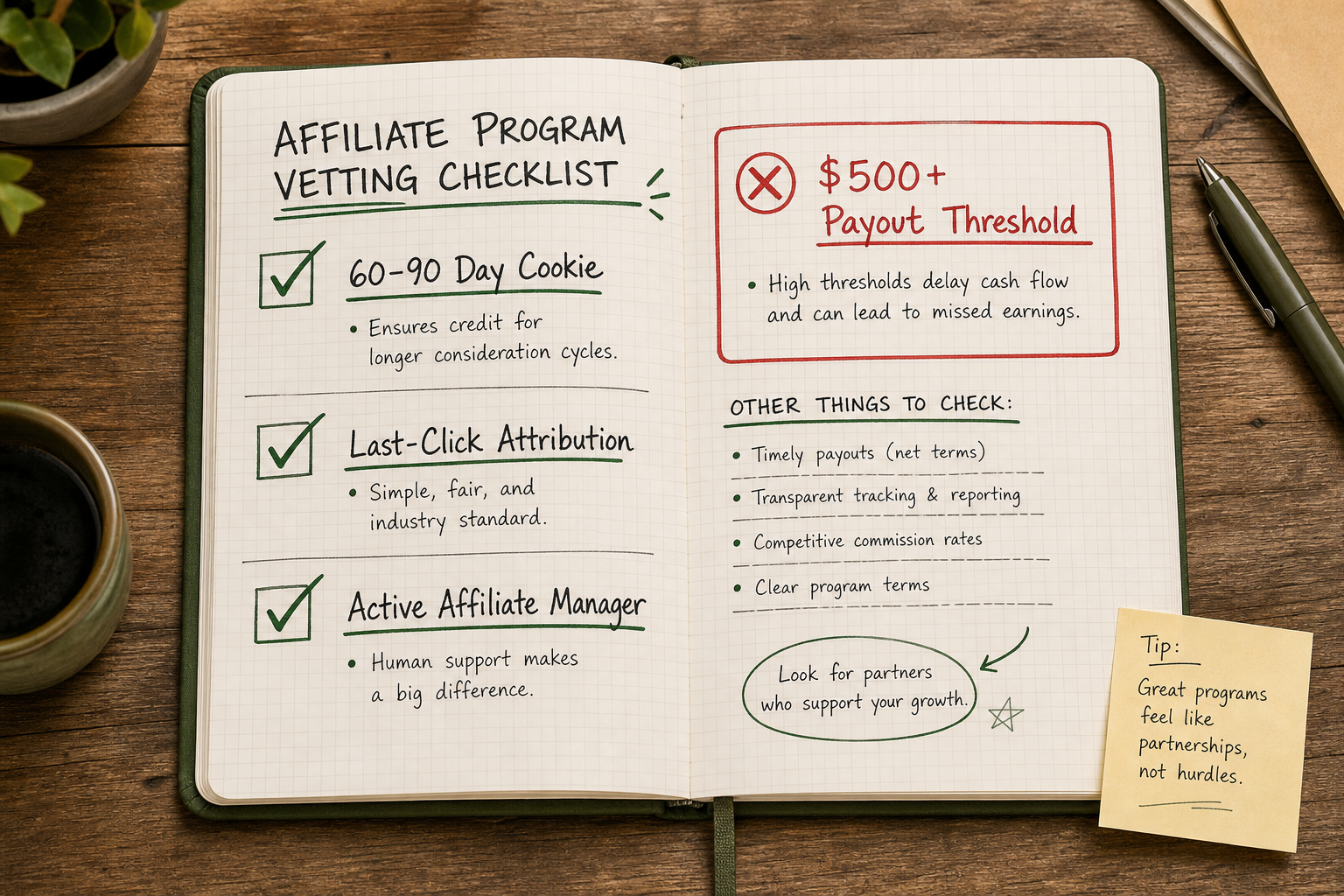
If a new program offers a 24-hour or 7-day cookie, it is a massive red flag. They are attempting to capitalize on impulse buys, which rarely happen in the SaaS space. A standard, fair cookie duration for software is 60 to 90 days. Some highly competitive programs even offer lifetime attribution.
Equally important is the attribution model. You want to ensure the program uses "last-click" attribution (rewarding the affiliate whose link was clicked immediately before the sale) or a fair multi-touch model. If a program's terms state they use "first-click" attribution, be wary. It means if a user clicked a random banner ad a year ago, but read your in-depth review today to finally make the purchase, the banner ad network gets the commission.
Payout Thresholds and Schedules
New affiliate programs sometimes attempt to protect their cash flow by instituting artificially high payout thresholds. If a program pays a $10 commission per sale but requires a $500 minimum balance before they issue a payout, they are essentially holding your money hostage.
A high-quality program should have a reasonable threshold—typically $20 to $50—allowing you to actually access your earnings as you scale up your campaigns.
Additionally, check their payout schedule. Standard practice is Net-30 (paying you 30 days after the end of the month in which the sale occurred) to account for potential refunds. If a program demands Net-60 or Net-90 terms, they are likely using affiliate revenue to float their own operational costs, which is a sign of financial instability.
Vetting Criteria Comparison
To help you evaluate new opportunities quickly, use this standard baseline comparison when reading a program's terms of service.
| Vetting Criteria | Standard/Saturated Program Terms | High-Quality New Program Terms |
|---|---|---|
| Cookie Duration | 24 hours to 7 days | 60 to 90 days (or lifetime) |
| Payout Threshold | $100+ (Forces a long wait) | $20 to $50 (Accessible quickly) |
| Commission Type | 2% to 5% flat one-time fee | 20% to 30% recurring (for SaaS) |
| Attribution Model | First-click only (favors paid ads) | Last-click or multi-touch |
| Support Access | Generic support@ email address | Direct access to an Affiliate Manager |
Product Viability: Will This New Offer Actually Convert?
The most overlooked aspect of vetting a new affiliate program is vetting the product itself. You are attaching your reputation to the brand you promote. If you convince your audience to buy a tool that is buggy, lacks customer support, or fails to deliver on its promises, you will permanently damage your relationship with your readers.
Furthermore, if the product is poor, the churn rate will be astronomically high. If you are banking on recurring commissions, a high churn rate means your passive income will evaporate almost immediately.
Before generating a single affiliate link, sign up for the product yourself. Go through their onboarding sequence. Evaluate their user interface. Submit a test ticket to their customer support team to see how fast they respond.
Ask yourself: Does this product actually solve a painful problem for my audience better, faster, or cheaper than the incumbent solutions? If the answer is no, it doesn't matter how high the commission rate is. The conversion rate will be abysmal, and you will waste your traffic.
Typical Commission Benchmarks for 2026
When evaluating a newly discovered program, you need a baseline to know if their offer is actually competitive. Commission structures vary wildly depending on the industry and the fulfillment costs associated with the product.
If you are accustomed to the physical goods space, you might think a 10% commission is fantastic. But if you accept a 10% commission on a digital product, you are leaving massive amounts of money on the table. Here are the realistic benchmarks you should expect when sourcing programs in 2026:
- Physical E-commerce & Retail: 2% to 8%. The margins on physical goods are notoriously thin due to manufacturing, shipping, and warehousing costs. Programs like Amazon Associates hover in the low single digits.
- Digital Courses & Information Products: 30% to 50%. Because there is zero marginal cost to replicate a digital download or a video course, creators can afford to give away half the revenue to acquire the customer.
- SaaS and B2B Software: 20% to 40% recurring. This is the sweet spot for professional affiliate marketers. A 30% cut of a $100/month software subscription yields $360 per year, per customer, for as long as they remain active.
- Financial and Crypto Services: High flat-fee CPA (Cost Per Acquisition). These programs often pay $50 to $200+ per funded account, rather than a percentage, due to the high lifetime value of a financial customer.
For a deeper analysis of how to align these benchmarks with your specific monetization strategy, read our guide on Tools for Side Hustlers to Find Profitable Affiliate Products Evaluation Checklist.
How to Pitch Yourself to a New Affiliate Program
Because new programs are highly focused on quality control during their soft launch, they often require manual approval rather than auto-accepting every application. You will likely face an application form asking how you intend to promote them.
Writing "I will put links on my blog" is the fastest way to get rejected. Affiliate managers want to know that you understand their target audience and have a legitimate distribution channel.
When applying to a newly discovered program, use a structured pitch. Introduce yourself and link to your primary channel, whether that is a website, a newsletter, or a social media profile. Provide specific metrics: your monthly organic traffic, your email open rates, or your engagement metrics.
Most importantly, tell them exactly how you plan to feature their product. For example: "I plan to write a dedicated 2,000-word tutorial on how to use your tool to automate client onboarding, and I will distribute that tutorial to my email list of 4,500 agency owners." This proves you are a professional marketer with a concrete strategy, drastically increasing your chances of approval—and often resulting in the affiliate manager offering you a higher custom commission rate right out of the gate.
Frequently Asked Questions (FAQs)
How do I promote new affiliate links without a website?
A dedicated website is excellent for capturing search intent, but it is not strictly necessary to succeed in affiliate marketing. If you don't have a website, you can leverage platform-native audiences. You can build an email newsletter using platforms like Substack or ConvertKit and embed your links within highly educational emails.
Alternatively, you can use YouTube, which acts as the world's second-largest search engine. Recording screen-share tutorials of new software and placing the affiliate link in the description and pinned comment is one of the highest-converting strategies available today. Just ensure that the specific program's terms of service allow for social media and email promotion.
Where can I find databases specifically for high-paying software and SaaS programs?
While legacy networks have software categories, finding dedicated B2B and SaaS programs is much faster when using specialized directories. General platforms often mix high-ticket software with low-ticket consumer goods, making research tedious.
For the most streamlined experience, utilize platforms built expressly for this purpose, like AffiliList, which filters out the noise and focuses strictly on high-yield digital tools. You can also explore niche-specific aggregates to speed up your workflow. For an extensive breakdown of specialized databases, refer to our Databases Similar to Apdb for Affiliate Marketing Evaluation Checklist.
How do I know if an unlisted or new program is a scam?
The primary indicators of a reliable program are transparency and the underlying tracking technology. If a company is using a reputable third-party tracking software (like Rewardful, PartnerStack, or Impact), the software itself handles the attribution, making it very difficult for the company to "shave" commissions or cheat you.
However, if they are using a proprietary, in-house script that they coded themselves, and they refuse to answer questions about their cookie duration or attribution modeling, that is a significant risk. Always prioritize programs that use established tracking infrastructure, even if the program itself is brand new.