
AffiliList vs Affiliate Program Database: Features and Data Comparison
Compare AffiliList vs Affiliate Program Database (APDB). Discover key differences in data accuracy, SaaS focus, UI friction, and recurring payout filters.
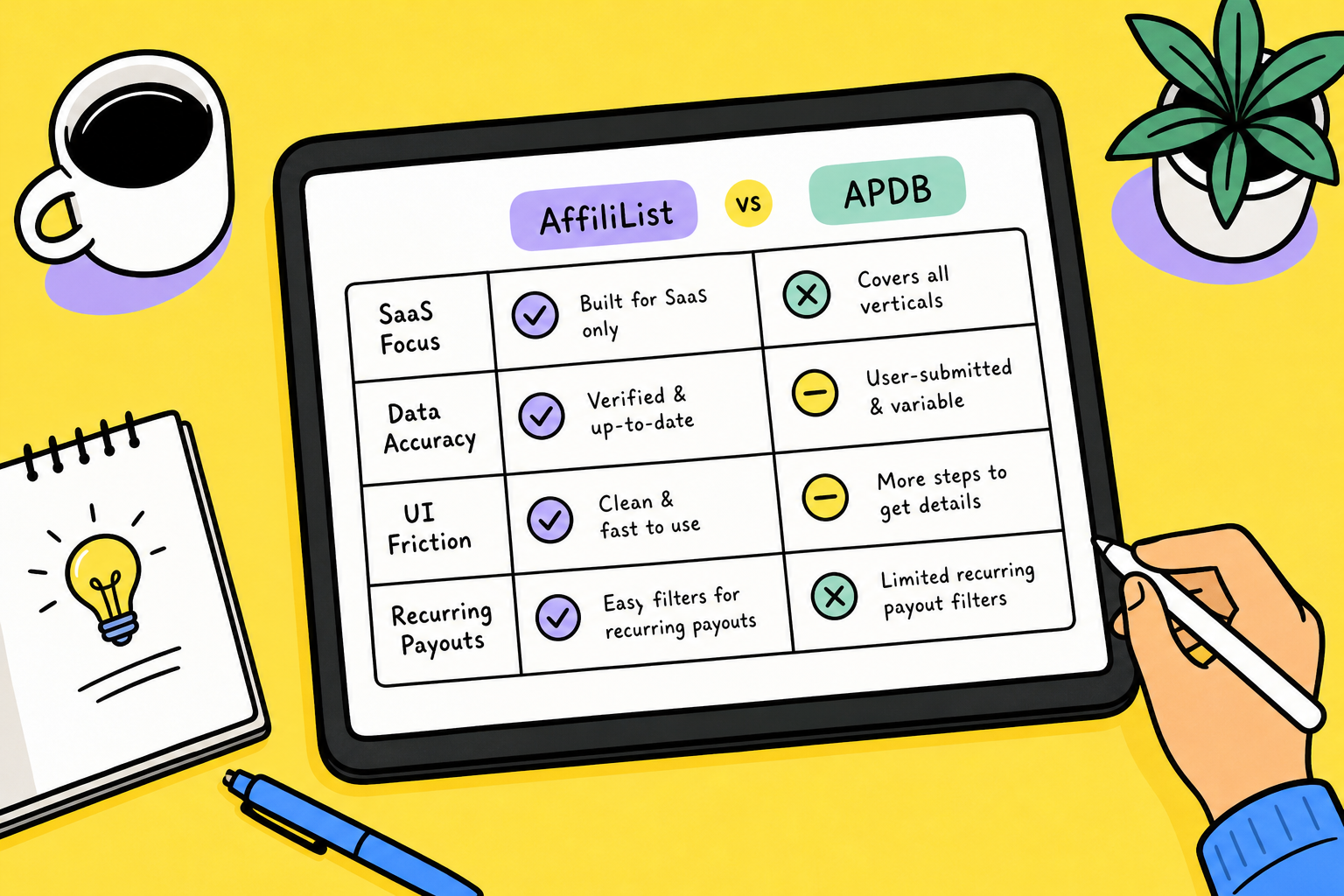
- The Anatomy of an Affiliate Directory
- AffiliList: The Vetted Data Hub for Digital Professionals
- Affiliate Program Database (APDB): The Broad-Spectrum Aggregator
- Core Feature Comparison: Head-to-Head
- The Hidden Cost of Stale Affiliate Data
- Scenario: Sourcing a B2B Software Stack
- The Contrarian View: More Programs Doesn't Mean More Revenue
- Alternative Solutions and Adjacent Tools
- Evaluating Which Directory Fits Your Workflow
- Frequently Asked Questions
Spend enough time building niche sites or scaling a media buying operation, and you will inevitably encounter the "ghost offer." You find a program claiming a 40% recurring commission, build a content cluster around the software, drive the traffic, and then discover the merchant quietly capped their payouts at a flat rate six months ago.
The core bottleneck in affiliate marketing is no longer finding products to promote; it is finding accurate, up-to-date partnership data without jumping through endless application hoops.
For years, marketers relied on scattered Google searches or basic tutorials on finding affiliate programs to scrape together a monetization strategy. Today, specialized databases have replaced manual research. Two of the most prominent tools in this space are AffiliList and Affiliate Program Database (APDB). While both aim to aggregate partner opportunities, they operate on entirely different philosophies regarding data curation, user friction, and niche focus.
This comparison strips away the marketing language to examine how AffiliList and APDB handle data accuracy, update frequency, and the actual day-to-day workflow of a professional affiliate marketer.
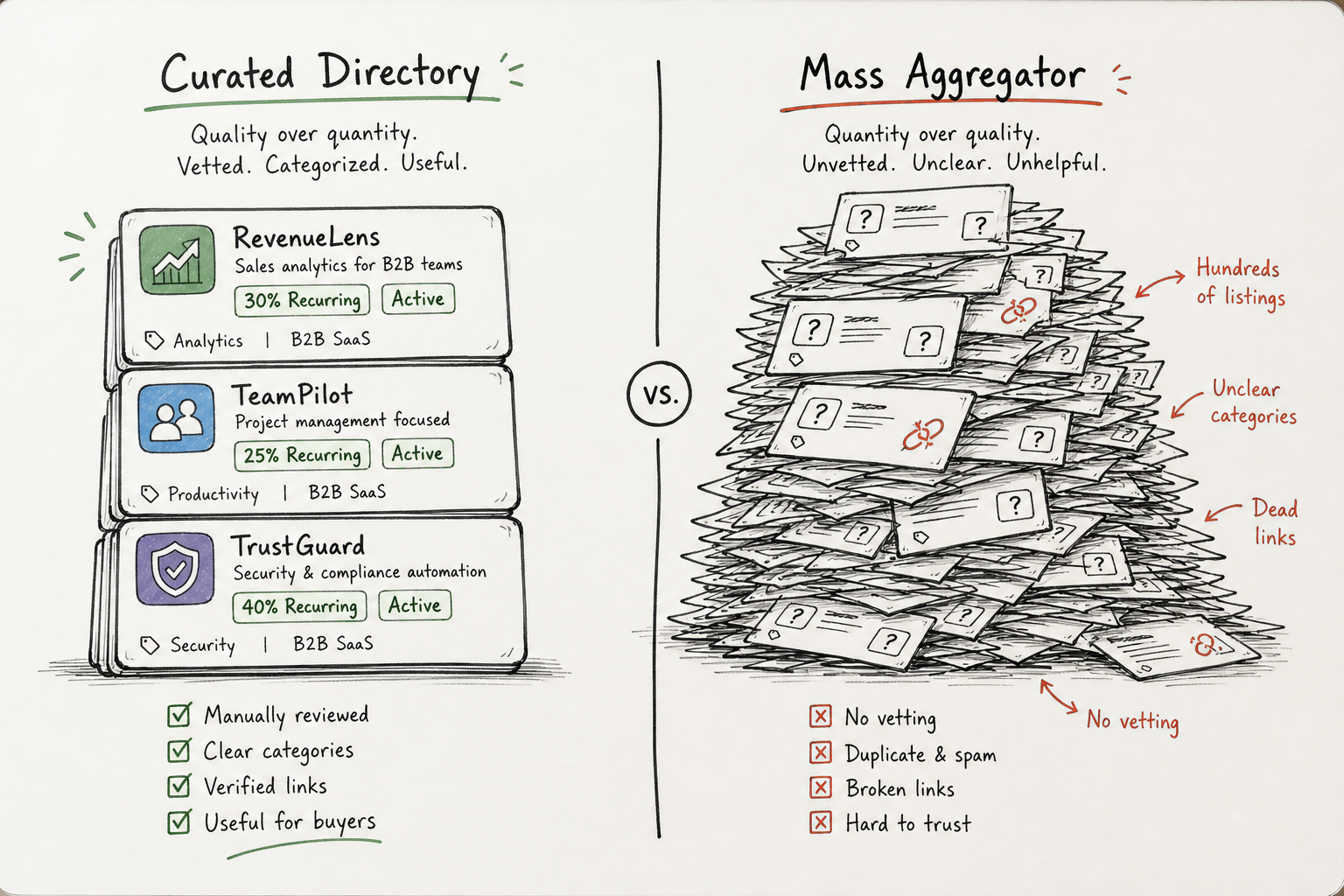
The Anatomy of an Affiliate Directory
Before comparing the specific platforms, it helps to establish what separates a modern directory from a traditional affiliate network.
Networks like CJ Affiliate, Impact, or PartnerStack actually host the tracking technology, manage the payouts, and broker the relationship. An affiliate program finder database, on the other hand, is a centralized research layer. It aggregates data across independent networks, private in-house programs, and hybrid setups, allowing you to filter and compare offers before you ever commit to an ecosystem.
As the lines blur between traditional affiliate and referral programs, these research layers have become critical. The value of a database is determined by three variables:
- Signal-to-Noise Ratio: Are the listings high-converting, active programs, or dead links to defunct e-commerce stores?
- Data Freshness: When a merchant slashes their cookie duration from 90 days to 30 days, how fast does the directory reflect it?
- Friction: How much information can you access before being forced to create an account?
AffiliList: The Vetted Data Hub for Digital Professionals
AffiliList approaches the market with a clear bias toward efficiency and transparency. Rather than attempting to index every mom-and-pop store on the internet with a referral link, it maintains a curated database of over 10,000 active affiliate programs.
Its primary differentiator is its strict focus on SaaS (Software as a Service), digital tools, and high-margin online services. Categories span from finance and cryptocurrency to HR software, YouTube marketing tools, and AI infrastructure.
The Zero-Friction Interface
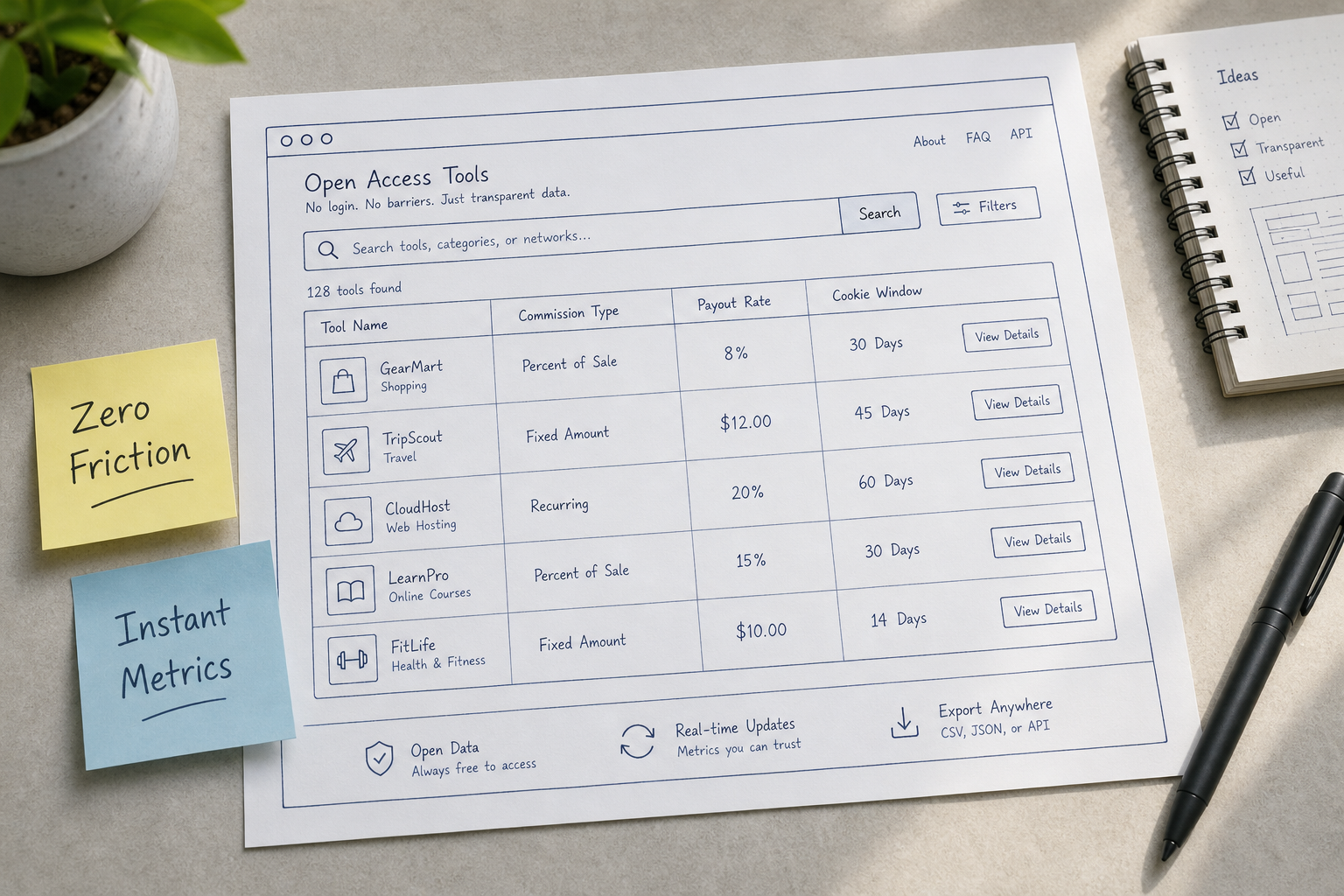
The most immediate operational difference when using AffiliList is the lack of a mandatory gatekeeper. Many legacy directories force you to register, confirm an email, and build a profile simply to view a program's commission rate. AffiliList operates on an open-access model.
When you land on the site, the core metrics you actually care about—commission percentages, commission types (CPA vs. RevShare), and payout terms—are immediately visible. This allows marketers to open twenty tabs, compare competitors side-by-side, and disqualify low-paying offers in seconds rather than hours.
Advanced Tagging and Commission Filtering
Traditional categories (e.g., "Business" or "Technology") are often too broad to be useful. AffiliList utilizes an extensive tagging system combined with granular commission filters.
If you are a side hustler looking for recurring revenue, you don't just want software programs; you want software programs that pay monthly for the lifetime of the customer. The platform allows you to filter specifically for these recurring structures, helping you isolate software affiliate programs with high payouts that fit your specific financial model.
The Merchant Submission Portal
AffiliList also serves the other side of the marketplace. Managing a database of 10,000+ programs requires a continuous influx of fresh data. AffiliList provides a dedicated, streamlined submission portal for merchants and SaaS founders to list their own programs.
Because the platform targets professional affiliates, it attracts merchants who offer competitive terms. For a deeper look at this process, SaaS founders often review the Where Can SAAS Founders Submit Their Affiliate Program Evaluation Checklist to ensure their listings meet the platform's standard.
Affiliate Program Database (APDB): The Broad-Spectrum Aggregator
Affiliate Program Database (APDB) takes a fundamentally different approach, operating as a massive, broad-spectrum aggregator. If AffiliList is the specialized boutique for digital tools, APDB is the big-box department store of affiliate directories.
Scale and Category Breadth
APDB's primary strength is sheer volume. The directory boasts over 500 distinct categories, covering global niches across the US, UK, Canada, Europe, and Australia. If you operate in highly specific physical product niches—such as organic gardening supplies, bespoke furniture, or localized retail—APDB is likely to have a category dedicated to it.
This massive footprint makes it a viable tool for media buyers who operate portfolios of highly diverse, non-tech niche sites and need to source physical product offers across multiple geographic regions.
The Challenges of Massive Aggregation
The trade-off for this massive scale is the signal-to-noise ratio. When a database attempts to index everything across 500+ categories, maintaining data accuracy becomes an exponential challenge. Users of large aggregators often spend more time filtering out inactive programs, low-quality merchants, or outdated commission structures.
Furthermore, the sheer volume of categories can make navigation cumbersome. Finding a highly specific B2B software tool often involves wading through consumer-focused apps and retail affiliate offers that happen to share a keyword tag.
Core Feature Comparison: Head-to-Head
To understand which tool fits your specific workflow, we have to look at how they handle the mechanics of affiliate research.
| Feature / Metric | AffiliList | Affiliate Program Database (APDB) |
|---|---|---|
| Primary Niche Focus | SaaS, Digital Tools, Finance, B2B, Crypto | Broad-spectrum (Physical goods, Retail, Global Niches) |
| Database Size | 10,000+ Curated Programs | Massive aggregation across 500+ categories |
| Data Accessibility | Open access (no sign-up required for core data) | Varies, often requires more digging to verify terms |
| Filtering Granularity | High (Specific commission types, tags, payout structures) | Broad (Primarily category and keyword-based) |
| Update Mechanism | Active curation + dedicated merchant submission portal | Bulk aggregation and updates |
| Signal-to-Noise Ratio | High (Focus on vetted, high-converting digital offers) | Lower (Due to the sheer volume of physical/retail offers) |
| Target User | Niche site owners, digital entrepreneurs, SaaS marketers | Broad media buyers, international physical product affiliates |
The Hidden Cost of Stale Affiliate Data
One of the most overlooked aspects of choosing an affiliate directory is the update frequency. Affiliate programs are dynamic. A SaaS company might run an aggressive 50% revenue-share program for their first two years to acquire market share, then quietly restructure it to a flat $50 CPA (Cost Per Acquisition) once they secure Series B funding.
If your chosen directory does not catch this change, you are building a monetization strategy on faulty math.
Why Update Frequency Matters
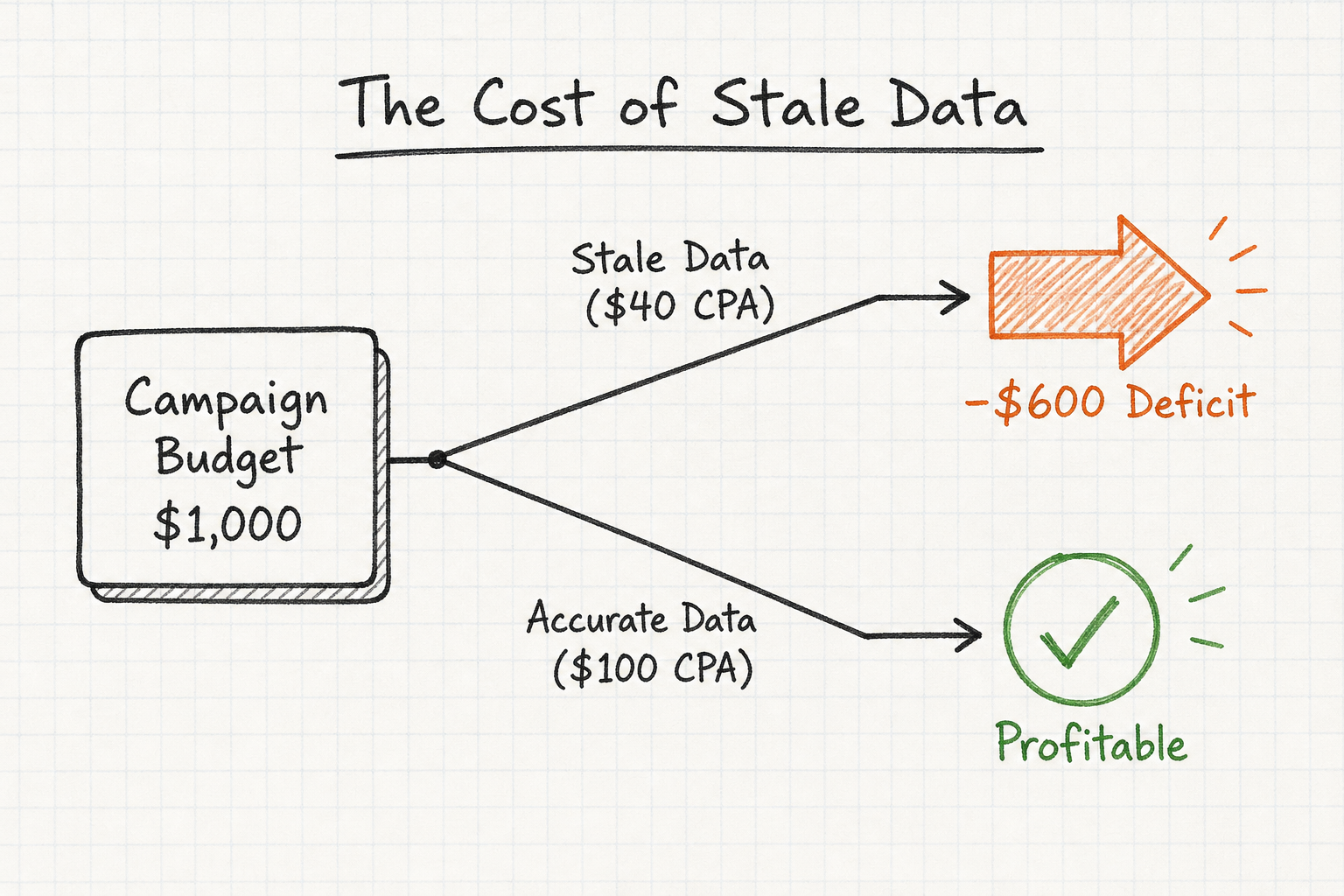
Consider a scenario where you are investing in paid search ads to drive traffic to an affiliate review post. Your entire budget is calculated on the assumption that you will earn $100 per conversion based on the data you found in a directory.
If the database is stale and the actual payout dropped to $40 three months ago, your campaign is instantly unprofitable. This is where curation beats aggregation. A smaller, actively managed database of 10,000 programs will always yield better long-term ROI than a database of 50,000 programs that hasn't been scrubbed for dead links or term changes in a year.
AffiliList mitigates data decay by fostering a direct relationship with merchants. Because merchants use the platform to actively recruit high-quality affiliates, they are incentivized to keep their listings accurate and updated.
Scenario: Sourcing a B2B Software Stack
Let’s look at a practical application to illustrate the difference between these platforms. Imagine you are building a new content cluster aimed at HR professionals, and you want to monetize it by recommending applicant tracking systems (ATS), payroll software, and employee engagement tools.
The APDB Workflow
If you start your search on APDB, you will likely search for "HR" or "Human Resources." Because the directory covers 500+ categories globally, your results will be a mixed bag. You might see high-quality payroll software next to a local UK staffing agency's referral program, a resume-writing service from Canada, and a physical office supply company. You will spend considerable time clicking through each result, checking if the program is still active, and trying to decipher if they pay a one-time CPA or recurring revenue.
The AffiliList Workflow
If you run the same search on AffiliList, the experience is highly focused. Because the platform specializes in SaaS and digital tools, the results are pre-filtered for software. You can immediately apply the "Recurring Commission" tag. Now, you are looking at a clean list of HR software programs that pay month over month. The commission percentages (e.g., 20% vs. 30%) are visible on the search page without you having to open an account or click into individual network portals. You can instantly see which programs are hosted on PartnerStack, which use Impact, and which are run in-house.
This workflow difference is why many digital entrepreneurs prefer specialized databases similar to APDB that index heavily for B2B and SaaS tools.
The Contrarian View: More Programs Doesn't Mean More Revenue
There is a persistent myth in the affiliate marketing space that the best directory is simply the one with the highest total number of programs. This mindset stems from a misunderstanding of how professional affiliates actually monetize traffic.
Top-tier affiliates do not promote hundreds of different products. They typically promote a highly curated stack of 5 to 15 core products that they know convert incredibly well and offer excellent terms.
Having access to 100,000 mediocre affiliate programs is actively detrimental to a marketer's workflow. It creates decision fatigue and increases the likelihood of partnering with a sub-par merchant who suffers from poor tracking attribution or late payouts.
This is why tight curation is becoming the industry standard. Another platform that operates on this philosophy is Affiliate.Watch, which restricts its directory to just 921 highly vetted programs across 41 niches, focusing heavily on AI, VPNs, and Crypto. While AffiliList offers a broader selection (10,000+) than Affiliate.Watch, it shares the same underlying philosophy: quality and accuracy over sheer volume.
Alternative Solutions and Adjacent Tools
While AffiliList and APDB represent two major approaches to affiliate research, the market has several other tools tailored to specific needs.
- Direct Network Directories: Platforms like Impact or CJ Affiliate have their own internal directories. The obvious downside is that you can only see programs hosted on their specific network.
- Affiliate.Watch: As mentioned, this is a hyper-curated directory. It is excellent if you operate specifically in the crypto or VPN space, but its 921-program limit means it lacks the depth required for broader SaaS or B2B niche sites.
- Manual Competitor Analysis: Using SEO tools to reverse-engineer where successful sites are sending their outbound affiliate links. This is highly effective but incredibly time-consuming and doesn't give you upfront data on commission structures.
When evaluating these options, many side-hustlers use frameworks like the Tools for Side Hustlers to Find Profitable Affiliate Products Evaluation Checklist to determine which research method yields the highest return on their time.
Evaluating Which Directory Fits Your Workflow
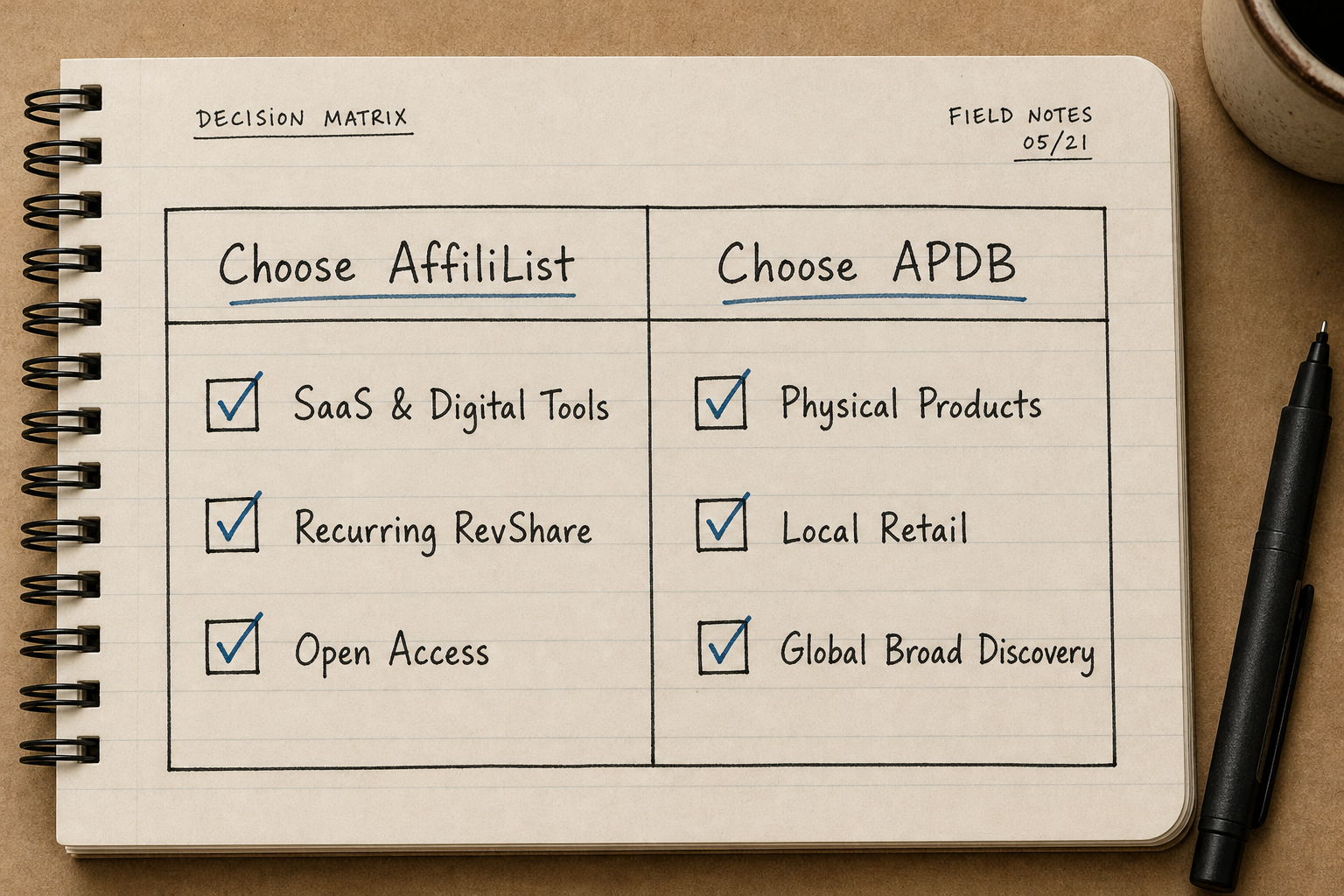
Choosing between AffiliList and an aggregator like APDB ultimately comes down to your niche, your monetization model, and how much time you are willing to spend cleaning data.
When to Use Affiliate Program Database (APDB)
- Physical Goods: You run niche sites focused on physical hobbies (e.g., woodworking, fitness equipment) and need non-Amazon retail options.
- Geo-Specific Offers: You are targeting localized traffic in specific countries and need local service affiliate programs.
- Broad Discovery: You have not yet chosen a niche and want to browse across hundreds of disparate consumer categories to see what exists.
When to Use AffiliList
- SaaS and Digital Focus: Your content serves businesses, entrepreneurs, or digital professionals, and you need high-ticket software programs.
- Recurring Revenue Models: You prioritize subscription-based software that pays lifetime recurring commissions.
- Speed of Execution: You refuse to sign up for multiple accounts just to do basic market research and want open access to commission data.
- Verified Data: You want to avoid the "ghost offers" and rely on a curated list of active programs.
Frequently Asked Questions
What is the difference between an affiliate program and an affiliate program finder database?
An affiliate program is the actual arrangement offered by a specific brand (e.g., the Shopify Affiliate Program), where they pay you a commission for referrals. An affiliate program finder database is a third-party research tool (like AffiliList or APDB) that aggregates thousands of these programs into one searchable interface so you can compare commission rates and terms across the entire internet.
How does the update frequency differ between specialized directories and massive aggregators?
Massive aggregators that scrape data for tens of thousands of consumer products often struggle with data decay, leading to outdated commission rates or dead links. Specialized directories like AffiliList maintain higher accuracy by focusing on a curated list of digital products and utilizing direct merchant submission portals to keep terms fresh.
Do I need to create an account to view commission rates?
It depends on the platform. Many legacy networks and databases require you to create an account and verify your email before revealing the specifics of a program. AffiliList provides an open-access model, allowing you to view commission percentages, cookie durations, and payout types directly from the search interface without logging in.
Can I find physical product programs on these databases?
APDB has extensive categories for physical retail goods and consumer products. AffiliList does feature various categories, but its core strength and primary curation focus lie in SaaS, digital tools, finance, and B2B services. If your strategy relies heavily on physical e-commerce goods, an aggregator might serve you better, whereas AffiliList is the superior tool for digital and software margins.