
AffiliList vs APDBio: Which Affiliate Directory is Right for You
Compare AffiliList vs APDBio to find the best affiliate directory for your niche. Discover key differences in SaaS focus, UI, pricing, and curation.

- The Broken State of Affiliate Discovery
- High-Level Overview: Two Distinct Philosophies
- Head-to-Head Feature Comparison
- The Merchant Side: Submitting Your Own Program
- Scenario Analysis: Building a Tech Stack Review Site
- The Hidden Costs of Poor Affiliate Research
- Beyond the Basics: Evaluating Niche Viability
- Frequently Asked Questions
- Maximizing Your Discovery Workflow
- Making Your Final Choice
Finding the right affiliate program has historically been an exercise in frustration. If you have ever tried to monetize a niche site or a social media audience, you already know the standard workflow: you run endless Google searches, dig through outdated "Top 50 Programs" blog posts, and sign up for half a dozen clunky affiliate networks just to see if a merchant's commission rate is actually worth your time. The inefficiency is staggering.
To solve this discovery problem, independent affiliate directories have emerged as the go-to tools for modern publishers. Instead of acting as middlemen who take a cut of your earnings or control your payout terms, these directories act purely as search engines for partnerships. Two of the most prominent names in this space are AffiliList and APDBio (Affiliate Program Database).
While both platforms aim to connect marketers with merchants, they operate on entirely different philosophies. AffiliList is built around speed, transparency, and a heavy curation of modern SaaS and digital products. APDBio, on the other hand, operates as a massive, cross-industry repository that catalogs everything from enterprise software to obscure physical goods.
If you are trying to decide where to invest your research time, understanding the structural and philosophical differences between these two databases is critical. This guide breaks down the core features, user experience, data quality, and ideal use cases for both platforms.
The Broken State of Affiliate Discovery
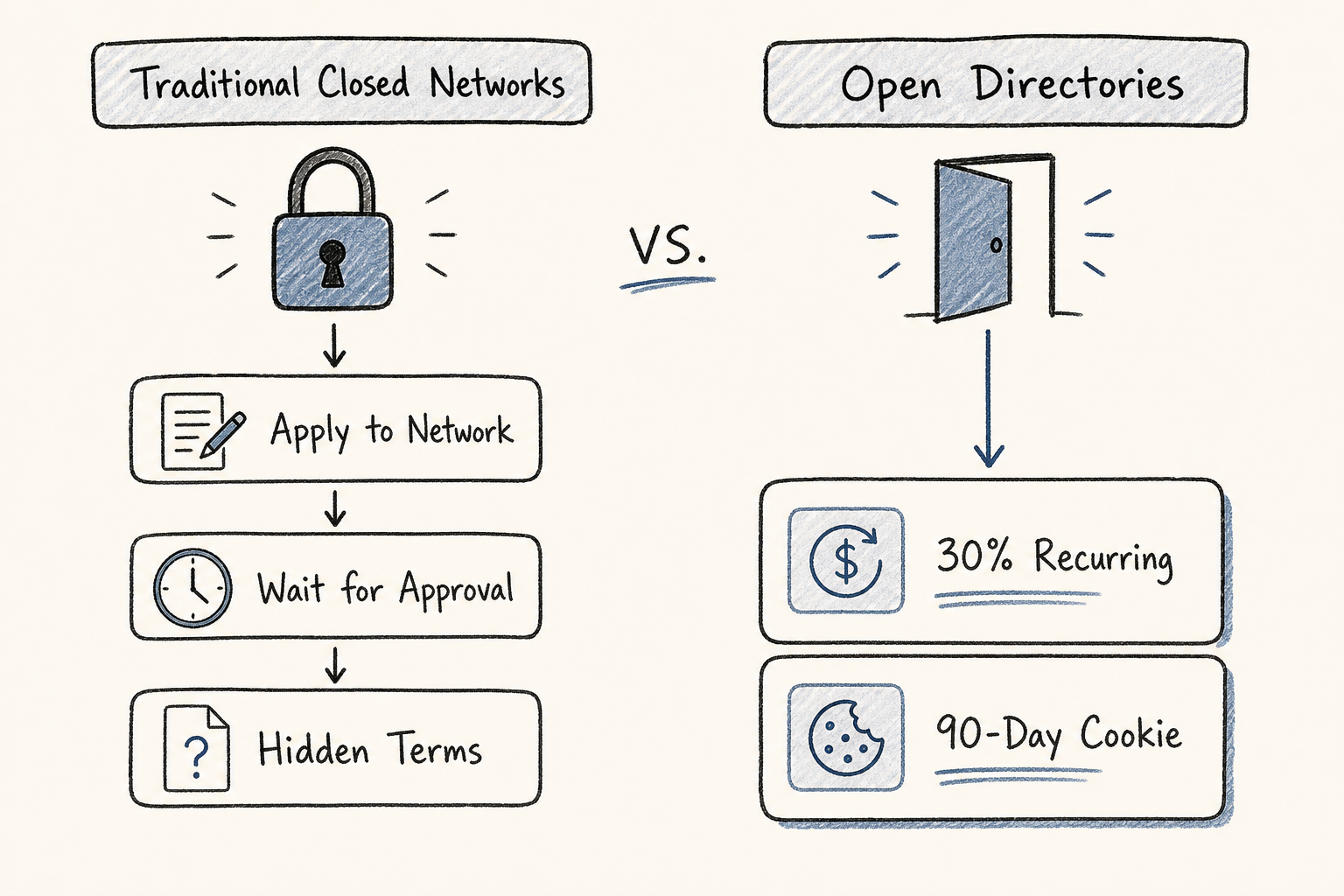
Before comparing the tools, it helps to understand the exact problem they are trying to solve. For years, the affiliate industry has relied on closed networks. To find out what a company pays, what their cookie duration is, or what promotional methods they allow, you typically have to apply to their specific network (like Impact, ShareASale, or CJ Affiliate), wait days for approval, and then manually search their internal systems.
This gated approach creates a massive bottleneck for content creators. If you are building a comparison guide for email marketing software, you do not have time to apply to ten different networks just to map out the baseline economics of your article. You need upfront data. You need to know if Tool A pays a flat $50 CPA (Cost Per Action) while Tool B pays 30% recurring lifetime revenue.
Both AffiliList and APDBio bypass this gating process. They scrape, aggregate, and manually curate program terms into searchable public databases. You do not need to create an account to view the baseline commission structures. However, how they organize and present this data dictates who should actually use them.
High-Level Overview: Two Distinct Philosophies
At a glance, both platforms serve the same function: they tell you what affiliate programs exist and where to sign up for them. But the moment you land on their respective homepages, the divergence in strategy becomes obvious.
AffiliList: The Specialized, High-Speed Approach
AffiliList was built specifically for the modern digital economy. It houses a curated database of over 10,000 affiliate programs, but it intentionally biases its collection toward SaaS (Software as a Service), digital tools, AI products, and B2B services.
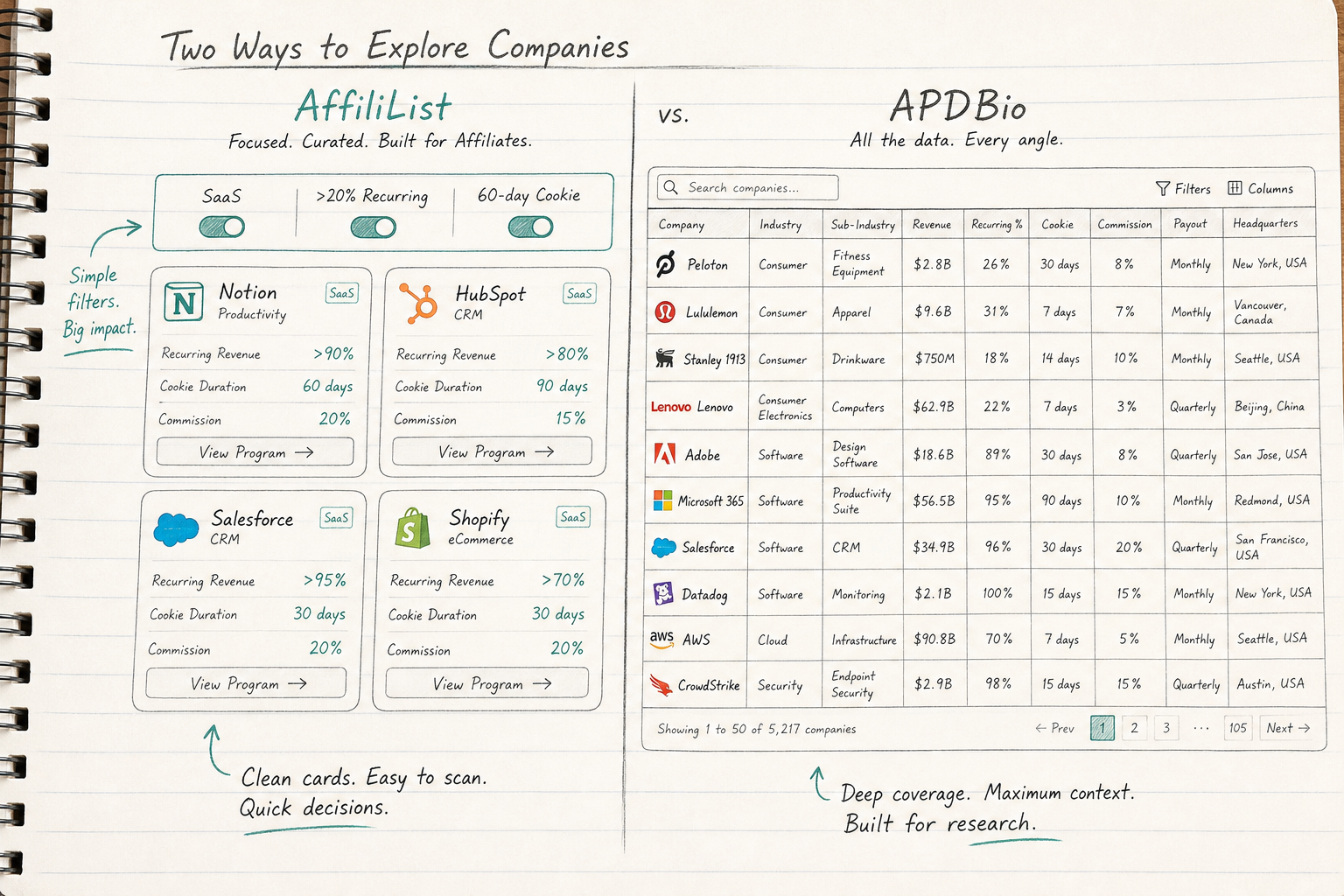
The platform is designed for marketers who value workflow efficiency. The interface is clean and clutter-free, focusing heavily on filtering capabilities. If you want to find finance software that pays over 20% recurring commissions and has a cookie window longer than 30 days, AffiliList is built to return that query instantly. It treats affiliate data like software documentation: it should be clean, instantly accessible, and highly accurate. If you are evaluating a Flexoffers directory alternative, AffiliList offers a stark contrast to the traditional network interface.
APDBio: The Broad, Data-Dense Repository
APDBio (Affiliate Program Database) takes a maximalist approach. It aims to be the global encyclopedia of affiliate programs. With coverage across more than 500 categories, APDBio catalogs programs for both digital goods and physical products across multiple continents (US, UK, Europe, Australia).
If you are monetizing a highly obscure physical product niche—say, specialized outdoor survival gear or bespoke woodworking tools—APDBio is likely to have listings that AffiliList intentionally ignores. The tradeoff for this massive breadth is the user interface. APDBio utilizes a traditional, data-dense, spreadsheet-style presentation. It feels less like a modern SaaS tool and more like a heavy-duty research repository.
Head-to-Head Feature Comparison
To understand which directory aligns with your workflow, we have to look past the marketing copy and examine the actual mechanics of how these databases handle data, user experience, and merchant submissions.
| Feature | AffiliList | APDBio (Affiliate Program Database) |
|---|---|---|
| Primary Niche Focus | SaaS, AI, digital products, B2B tools, creator economy. | Broad global coverage; physical and digital goods across 500+ categories. |
| Data Accessibility | 100% open access, clean UI, no gating for core commission data. | Public directory with a traditional, high-density spreadsheet layout. |
| Filtering Mechanics | Advanced tags based on payout type (CPA, recurring), commission rates, and cookie length. | Broad categorical filtering and sitewide text search. |
| Curation Method | Manual review within 48 hours focusing on program viability and accurate data. | Hand-curated listings explicitly filtering out credit-only or coupon schemes. |
| Merchant Cost | Free basic submission; optional premium fee for enhanced visibility/dofollow links. | One-time $299 fee for a lifetime directory listing. |
| Ancillary Services | Direct integration into publisher workflows for niche site discovery. | Paid custom research services and lead generation for merchants. |
Database Focus: Depth vs. Breadth
The most significant factor in choosing between these two platforms is the niche you operate in.
If your business model revolves around software reviews, tech tutorials, or B2B content, AffiliList offers a distinct advantage. SaaS affiliate programs are fundamentally different from physical product programs. Software programs often involve complex payout structures—tiered commissions, recurring revenue models, and multi-touch attribution windows. AffiliList’s database structure is built to capture and display these specific data points clearly. For anyone running a tech blog, utilizing a Findaffiliates for high paying software source guide is critical, and AffiliList acts as the active engine for that research.
APDBio shines when you step outside the tech bubble. If you run a lifestyle blog focused on sustainable home goods, or a YouTube channel reviewing musical instruments, a strictly software-focused directory will not help you. APDBio’s inclusion of hundreds of physical product categories means you can find obscure, independently run affiliate programs that are not aggregated anywhere else. Their commitment to avoiding coupon-only schemes ensures that even in strange niches, the listings actually pay out cash commissions.
User Interface and Workflow Velocity
How fast can you go from a raw idea to a short-listed group of viable affiliate programs? This is where the UX differences become material.
AffiliList prioritizes a low-friction user experience. The design ethos borrows heavily from modern indie hacker tools. You are not bombarded with display ads or chaotic community forums. Instead, you get straightforward sorting parameters. If you are a publisher who builds out content clusters quickly, the ability to instantly sort by "highest recurring commission" inside a specific sub-category (like HR software or crypto tools) drastically reduces your pre-production time. It is a highly optimized affiliate program finder for SaaS lists.
APDBio requires a bit more digging. The spreadsheet-style interface is incredibly information-dense. For data analysts or large media buyers who want to view as many data points as possible on a single screen without clicking through individual pages, this can actually be a benefit. However, for the average blogger or niche site owner, the sheer volume of unsorted text can lead to decision fatigue. It requires you to rely heavily on their sitewide search rather than intuitive, nuanced filtering.
Vetting and Data Decay Management
Affiliate programs change constantly. A company might launch with a generous 40% recurring commission to acquire users rapidly, only to drop it to 15% a year later once they have market share. They might slash their cookie window from 90 days to 7 days overnight.
If a directory does not actively manage data decay, it becomes useless.
AffiliList combats data decay through a combination of manual reviews and an active submission portal. Because the platform caters heavily to SaaS founders and affiliate managers, there is a constant influx of updated, primary-source data. When a merchant submits a program, it undergoes a manual review process within 48 hours to ensure the terms are accurate and the program is actually functional. If you are comparing databases similar to APDB for affiliate marketing, AffiliList’s speed of verification is a major differentiator.
APDBio also relies on manual curation, but given the massive scope of their database (covering everything from international fashion to industrial equipment), keeping every single listing perfectly updated is mathematically difficult. To their credit, they rigorously filter out low-quality schemes upfront. You won't find programs that only pay out in "store credit," which is a common plague in broader directories.
The Merchant Side: Submitting Your Own Program
If you are a founder or an affiliate manager, these directories are not just research tools; they are acquisition channels. Listing your program in a high-traffic directory is one of the highest-ROI activities you can do when launching a new partner program.
The economics of listing on these two platforms differ sharply.
APDBio operates on a very clear, premium model for finding affiliates for your business. They charge a one-time $299 fee for a lifetime listing. This fee acts as a barrier to entry, ensuring that only serious businesses with actual marketing budgets are submitting their programs. It cuts down on spam and ensures a baseline level of quality for the publishers browsing the site. Furthermore, APDBio offers custom market research and lead generation services for merchants who need hands-on help recruiting specific types of affiliates.
AffiliList takes a more accessible approach to submissions. It offers a straightforward portal for merchants to list their programs, making it an ideal answer for those wondering where SaaS founders can submit their affiliate program. Basic inclusion relies on manual review rather than a high upfront fee. This encourages early-stage startups and indie hackers to list their generous, newly launched programs before they become widely known. AffiliList does offer optional premium placements for merchants who want guaranteed visibility or dofollow links, but the core directory remains accessible to businesses of all sizes.
This difference in submission models directly impacts the publishers using the site. Because APDBio charges $299, you are generally looking at established companies. Because AffiliList allows accessible submissions, you are much more likely to discover a hungry, day-one startup offering a massive 50% commission to aggressively capture market share.
Scenario Analysis: Building a Tech Stack Review Site
To truly understand which directory fits your needs, it helps to look at a practical scenario.
Imagine you are launching a new niche site dedicated to reviewing productivity and HR software for remote teams. Your monetization strategy relies entirely on SEO traffic and high-ticket affiliate commissions.
Using APDBio: You navigate to the directory and use the sitewide search for "HR software" or "remote work." You will likely find dozens of programs. The data will be displayed in a dense format, showing you programs across the US, UK, and Europe. You will have to sift through physical office supply affiliate programs that happen to trigger the "remote work" keyword alongside the actual software platforms. The process is thorough, and you might uncover a massive enterprise software program that isn't listed anywhere else, but compiling your shortlist will take hours of manual reading.
Using AffiliList: You log on and immediately navigate to the SaaS and B2B categories. You apply a filter specifically looking for programs offering "Recurring" commissions above 20%. The system instantly filters out all one-off CPA programs. You are left with a clean, heavily vetted list of exactly 14 HR and productivity tools that match your exact economic requirements. You can see their cookie durations at a glance. You copy the links, apply to the merchants, and begin outlining your content.
This is why AffiliList is frequently cited as the superior alternative to findaffiliates for high paying software. It removes the friction from the exact workflow that digital publishers use every day.
The Hidden Costs of Poor Affiliate Research
Many new content creators underestimate the importance of directory research, assuming they can just rely on standard Google searches or sign up for a massive network like CJ Affiliate and browse internally. This is a critical mistake that costs publishers thousands of dollars in lost revenue.
The Problem with Network-Internal Searching
When you use a traditional affiliate network as a search engine, you are only seeing the merchants who have agreed to pay that specific network's exorbitant setup fees and monthly minimums. You are seeing a fraction of the market.
Furthermore, networks are notoriously terrible at surfacing modern, high-paying SaaS products. A new AI writing tool is not going to pay a legacy network $5,000 just to be listed; they are going to run their program through a lightweight tracker like Rewardful or PartnerStack and rely on independent directories for visibility. If you rely solely on legacy networks, you will miss out on the most lucrative, modern offers. Looking for an Affiliate Watch alternative to find programs often leads publishers to these independent databases specifically to escape the network bubble.
The Danger of Ignoring Cookie Windows
Another major pitfall is ignoring the fine print of a program's terms. Two companies might both offer a 30% commission, making them look identical on the surface. But if Company A has a 7-day cookie window and Company B has a 90-day cookie window, Company B is infinitely more profitable for an SEO-driven site where the buyer journey is long.
Dense, poorly structured directories make it incredibly difficult to compare these specific data points side-by-side. The value of a platform like AffiliList is not just in having the data, but in presenting the cookie duration right next to the commission rate in an easily digestible format. You can evaluate the true economic potential of a partnership in seconds rather than digging through terms of service documents.
Beyond the Basics: Evaluating Niche Viability
When you are a side hustler or an indie creator, your time is your most constrained resource. You cannot afford to write a 3,000-word comprehensive review of a product only to find out their affiliate program requires manual approval and they reject you because you do not have 100,000 monthly visitors yet.
A strong directory should give you clues about the accessibility of a program.
AffiliList’s focus on the creator economy and indie-maker scene means that many of the programs listed are actively looking for long-tail affiliates. They are friendly to new bloggers and micro-influencers. If you need tools for side hustlers to find profitable affiliate products, starting with a database that biases toward accessible, modern software is a strategic advantage. You are less likely to run into draconian approval processes.
APDBio’s enterprise and broad retail listings sometimes link out to programs with incredibly strict acceptance criteria. A global fashion brand listed on APDBio might only accept publishers with established, high-traffic lifestyle properties. While the listing is accurate, it may not be actionable for a newer publisher.
Frequently Asked Questions
When comparing these two databases, several common questions arise regarding their technical structure and business models.
Are AffiliList and APDBio affiliate networks?
No. Neither platform acts as an affiliate network. They do not track clicks, manage your affiliate links, process your payments, or require you to integrate their code onto your site. They are independent directories. When you find a program you like on either site, you click a link that takes you directly to the merchant’s own application page (which may be hosted on a network like Impact, or internally via software like Tapfiliate). They are purely discovery tools.
Which platform is better for finding SaaS and software affiliates?
If your primary focus is software, AI tools, B2B services, or digital products, AffiliList is the superior choice. It was built specifically to parse and present the unique data structures of software affiliate programs (like recurring monthly revenue and tier-based systems). It serves as a highly specialized AffiliList for findaffiliates for high paying software equivalent.
Do I have to pay to view the directories?
Both directories allow publishers to browse their core listings for free. The monetization happens on the merchant side (charging businesses for premium placements or listings) or through supplementary services. You do not need to pull out a credit card to research commission rates on either platform.
How do they ensure the data is accurate?
Data accuracy is a shared challenge. AffiliationList and AffiliList rely heavily on founder submissions and a 48-hour manual review process to ensure that the initial data going into the system is perfectly accurate. APDBio uses hand-curation to build out its massive categorical database. However, because affiliate programs change their terms independently, both platforms rely on community feedback and periodic manual audits to catch instances of data decay.
Does APDBio offer anything AffiliList does not?
Yes. APDBio’s massive breadth means it covers physical products, highly obscure regional niches, and traditional retail categories that AffiliList intentionally ignores. Additionally, APDBio offers a paid, custom research service. If you are a large agency and you need someone to manually hunt down profitable contact points or generate leads for specific affiliate partnerships, APDBio will do that custom work for a fee.
Maximizing Your Discovery Workflow
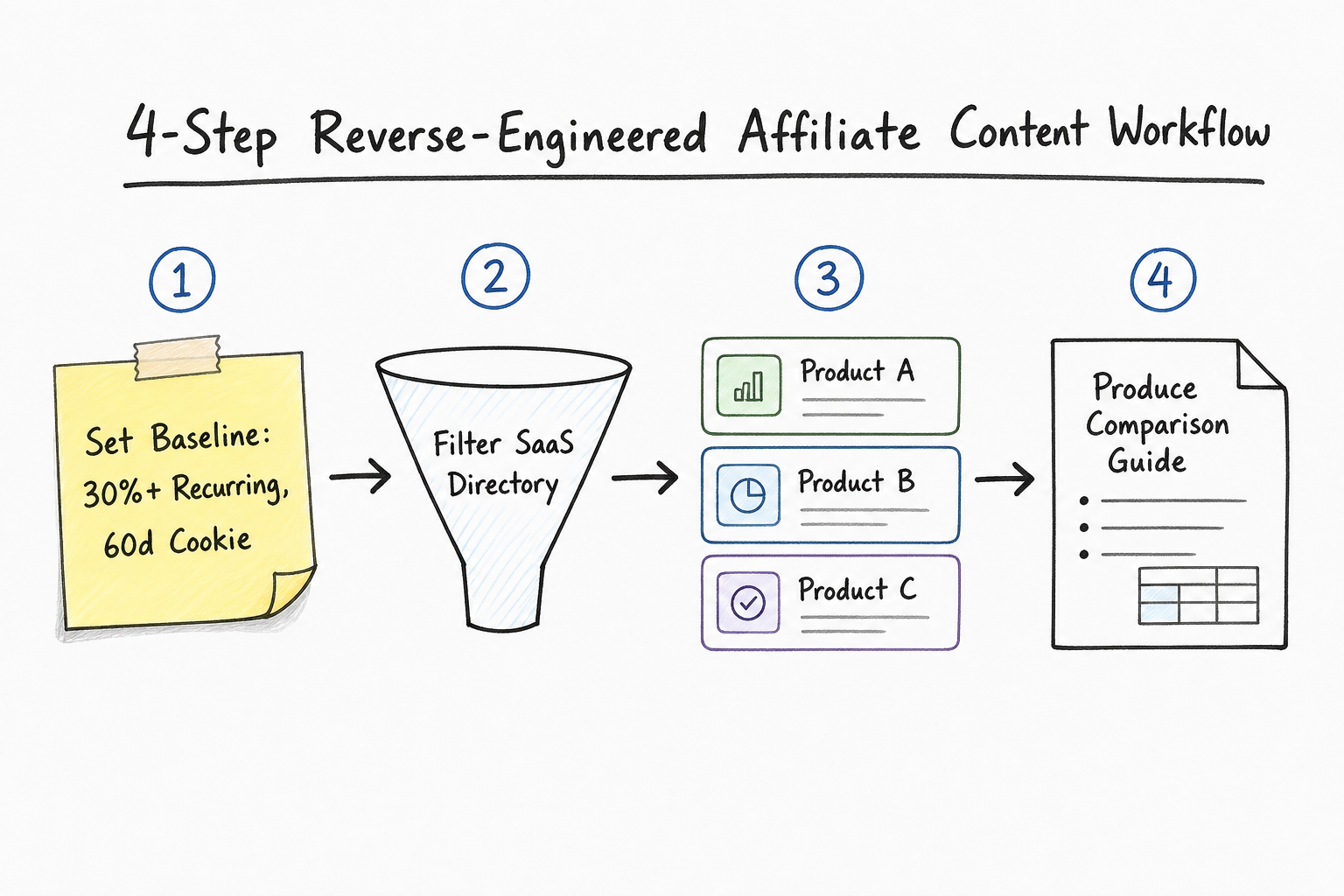
To get the most out of whichever platform you choose, you need to systematize how you interact with the data. Do not just blindly search for the exact software you already know about. Use the directories to reverse-engineer your content strategy.
Instead of writing an article and then looking for a program to monetize it, try the inverse:
- Open your chosen directory.
- Filter for the highest-paying, most reliable structures (e.g., 30%+ recurring commissions with a 60+ day cookie).
- Identify three or four high-quality tools in a specific sub-niche that meet those criteria.
- Build a comparison article or a "best of" listicle around those specific tools.
By doing the financial research first, you guarantee that every piece of content you produce is tied to a highly profitable, viable partnership. If you are creating content for a highly specialized audience, using a vetted tech affiliate listings for social media influencers evaluation checklist alongside your directory research ensures you are not wasting time on low-converting offers.
Making Your Final Choice
The decision between AffiliList and APDBio is not about which tool is objectively "better" in a vacuum; it is about which tool aligns with your specific monetization strategy.
You should use APDBio if you are monetizing broad consumer niches, physical products, or hyper-specific regional industries. If you need a directory that covers everything from camping gear to European fashion, and you do not mind a dense, spreadsheet-heavy interface, APDBio provides a massive, reliable repository of data.
You should choose AffiliList if you are operating in the digital economy. If you write about SaaS, B2B tools, marketing software, AI, or the creator economy, AffiliList is explicitly designed for you. Its clean interface, advanced filtering for recurring commissions, and zero-gatekeeping approach make it the fastest way to map out profitable partnerships in the tech space.
By leveraging the right directory for your niche, you eliminate the single biggest bottleneck in affiliate marketing: the endless, frustrating search for reliable data.